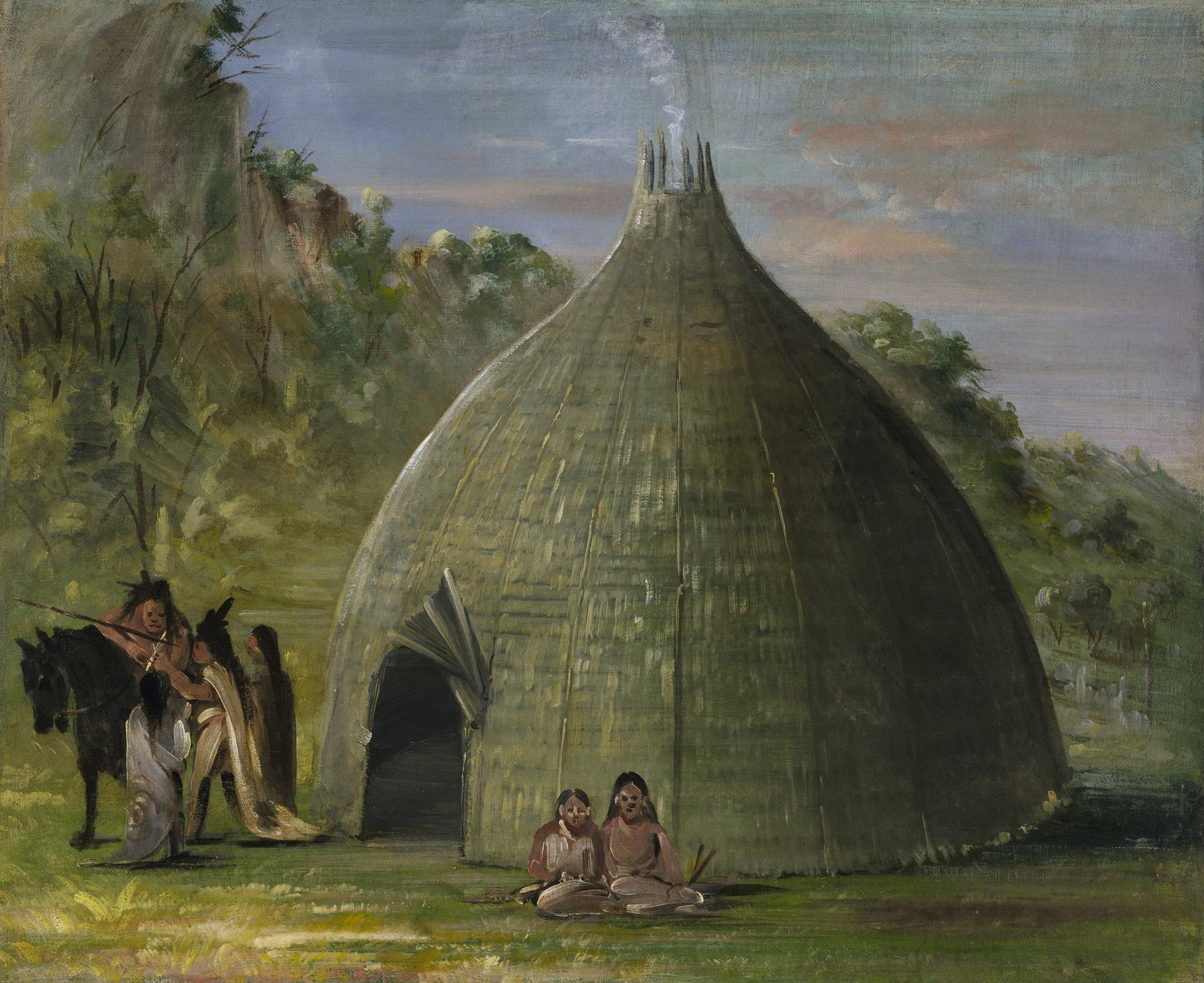
Wichita Lodge, Thatched with Prairie GrassGeorge Catlin, 1834–1835. Smithsonian American Art Museum, Gift of Mrs. Joseph Harrison, Jr., 1985.66.492 · Public domain
Wichita is a broader people-level reading route, while Wichita and Affiliated Tribes is the name of a present government centered at Anadarko, Oklahoma. Its institutional history includes Wichita Proper, Waco, Taovaya, Tawakoni and Kichai, whose names and histories should remain individually identified. This community-source foundation follows the Tribe’s account of Plains village life, displacement, continuing community and educational resources; it does not make the historical labels interchangeable or establish every present affiliation.
See each region’s evidence for historical or present-day scope.
Homeland / region
Great Plains / Oklahoma / Texas / Kansas
Research depth
Source guide
Source collection
14 annotated resources · 7 Indigenous-led
Inspected sources
9 substantive works · selected content reviewed
Initial adequacy
Still unfinished
Source review
October 27, 2026
Names & relationshipsDistinguish the broader Wichita historical/people-level route from the Wichita and Affiliated Tribes government and from the individually named Waco, Tawakoni, Taovaya and Kichai histories. The Tribe’s included-peoples account does not collapse those labels into synonyms or establish a separate present government for each. Related directory routes require their own identity checks; no ancestry or membership inference follows from a name alone.
A source guide for a deeper dive.This entry provides a brief orientation and an organized reading path. A comprehensive deep dive has not yet been completed. Follow the annotated sources and distinguish primary community accounts from outside reference material.
Still unfinished
One selected primary collection strengthens comparison of removal chronology, administrative language and a later delegates’ petition. Nine substantive works remain uneven; original manuscripts, route/register evidence, community-specific histories and wider coverage are unfinished. No source quantity establishes completion or community review.
Assessment recorded October 27, 2026. This is separate from research completion and community review.
The actual 1846 treaty transcription is now read; other treaty manuscripts, negotiations, implementation records, French/Spanish originals and reliable critical editions still need inspection.
A reprinted September 3, 1859 removal report is now inspected, while original manuscripts, fuller route/military records, individual registers and Elam’s cited 2008 book remain unread. The agent’s satisfaction and complete-property statements are not independently verified.
Waco, Tawakoni, Taovaya, Kichai, Wichita Proper and other historically related labels require separate sources and changing dates/scopes. Neither the treaty nor a government’s included-peoples list establishes all descendants or present governments.
The governing resolution remains unreadable in prior retrievals; no current consolidated law, jurisdiction, citizenship or membership conclusion is made.
The dictionary listing is inspected but audio, apps and linked children’s videos were not tested. The 2018 thesis does not establish current speaker numbers, proficiency or learning outcomes.
Hodges’s study uses a largely community-event convenience sample and includes different participant relationships; it is not representative of every citizen or a basis for present legal identity.
Education pages carry dated and varying financial details; no current amount, deadline, eligibility guarantee or measured outcome is asserted.
Municipal reference p431-s3 remains an unread original lead. Underlying archaeological datasets, interviews and archive recordings were not accessed; no community review, endorsement or research completion is claimed.
The 1882 petition is read as an attributed statement by its signatories, not an adjudication. Historic labels and described claims do not establish present identity, title or territorial boundaries; surrounding official arguments remain perspectives rather than settled findings.
Backdrop images & credits
These images have individual, documented connections to this entry. Their captions and source records define the people, place, object, and period shown; no one image represents every community within a broader label.
Wichita Lodge, Thatched with Prairie Grass George Catlin, 1834–1835. Smithsonian American Art Museum, Gift of Mrs. Joseph Harrison, Jr., 1985.66.492 · Public domain
A museum-identified historical depiction of a Wichita grass lodge. The museum places the expedition context in present-day Oklahoma. This is Catlin's outside artistic representation, not a documentary photograph, Wichita-made artwork, a surveyed homeland or an image of a present government. Its title does not establish the identity of every depicted figure or speak for every affiliated people. Read the primary item title, creator/date/medium/object number and gift credit, visible reuse designation, HTML rights metadata and museum interpretive paragraph. Visually inspected the complete available 2599×2121 source frame. The exact max=2600 URL was obtained from the item's HTML srcset; no image filename was guessed. Catlin's quoted village estimates and observations were not independently corroborated or added to research synthesis. The complete available frame was proportionally resized/compressed without generation, retouching or upscaling. CSS crops and overlays apply to directory/background displays; the opened-page banner preserves the complete frame.
Image, association, and reuse record reviewed 2026-10-26.
Full images are displayed proportionally above. A translucent background copy may be cropped by the viewport; it does not replace the complete image or its record.
The visual treatment does not change the research status, evidence, or remaining gaps recorded in this profile.
Start reading here
Wichita is a broader historical and people-level route linked to Wichita and Affiliated Tribes; Waco, Tawakoni, Taovaya and Kichai labels are not interchangeable. The four exhibit chapters count as one work. Newsletter history is retrospective, while the 2024 paper's selected methods and discussion do not include its detailed results, maps or underlying interviews.
The Tribe's connected Wichita Memories chapters provide an introductory historical narrative with the cooperative exhibit's authorship and scope visible.
Selected collaborative-research sections connect twentieth-century community gathering places with archaeological methods and attributed memories.
These are selected starting points. The full annotated collection, source perspectives, inspection limits and remaining research questions follow below. A starting guide is not an exhaustive history or community endorsement.
01
Named peoples and a present government
The Tribe’s history identifies Wichita Proper, Waco, Taovaya, Tawakoni and Kichai within its account. Its later chapter describes the organized Wichita and Affiliated Tribes community at Anadarko. Keep those two levels clear: related historical peoples are not simply alternate spellings, and this institutional account does not make every historical group one timeless government. Other historical and community sources should be read with their dates and named scope. The dated Elam and Harper accounts also distinguish narrower and broader uses of Wichita; their historical terminology must be read in context.
The People of the Grass House chapter describes a seasonal pattern combining gardens and buffalo hunting. It follows food preservation and storage alongside the work of maintaining grass houses. Read this as a historical account of particular Plains village practices, including cooperative household work, rather than a picture of how every Wichita person lives today. Cultural and ceremonial narratives in the original remain with their publisher.
Harper places Taovaya settlements on both sides of the Red River and discusses related villages sharing trade centers. Her interpretation supports historical Texas connections while retaining separate names; it does not establish a fixed territory. The underlying colonial records remain unread here.
The May 15, 1846 treaty names Wichita, Waco and other participating groups separately. Its text addresses trade, prisoners, violence, peace, and proposed blacksmith and teaching services. The printed signatory list also retains distinct period headings. Readers can examine a primary agreement here while keeping its limits clear: stated promises are not proof of implementation, and historical names or signatures alone do not settle present identity, jurisdiction or treaty rights.
The Tribe’s August 2012 history distinguishes Waco and Tawakoni removal from the Brazos Reserve from the Wichita and Keechi journey through the Fort Arbuckle area. Neighbors’s September 3, 1859 report, reprinted in 1883, dates his Texas-reserve party’s arrival to August 16 and the administrative handover to September 1. He also reports that people were unwilling to occupy new homes without protection. Those official dates do not establish safety, voluntary migration or one identical journey for every named people. Individual registers and fuller route records remain unreviewed. The Tribe’s account later describes wartime flight to Kansas and a return to Indian Territory.
A later petition and the limits of official records
The collection also prints an April 1882 petition by delegates identifying Wichita, Caddo and “Pannatakees,” using that period wording. They ask Congress to confirm land held in common. This preserves their stated claim, not a finding that the claim was accepted or proof of every community’s position. Keeping the petition separate from officials’ interpretations helps readers compare whose account each record presents.
A New Beginning emphasizes continuing community after the loss of grass-house village life. The account describes older and younger generations sharing memories while people pursue education, employment and family gatherings. Its language of endurance is the institution’s interpretation of its history; it is not a statistical survey or a claim that every member has the same experience or practice.
Bethke, Trabert and Gary McAdams’s collaborative research with Wichita and Affiliated Tribes brings community memories together with archives and low-impact archaeology. The authors describe how twentieth-century gathering places in Oklahoma helped sustain relationships through and after allotment. Their account connects older history with living Wichita people. It remains a specific community-based study: its published recollections and academic interpretation should be attributed, rather than treated as a survey of every community or a current legal boundary.
The Tribe’s online dictionary pairs English vocabulary and phrases with Wichita forms and links many entries for pronunciation. Readers can follow this community-published resource directly. The listing was inspected, but recordings and apps were not tested. Resource availability alone does not establish current speaker totals, proficiency or learning outcomes.
Language learning and community-controlled archives
Sapphire Hodges’s 2018 thesis examines archives and language-learning possibilities in a Wichita community setting. Her account describes Tribal direction of an archive project and argues for community control over learning priorities. The survey was largely voluntary at a local event, included people with different community relationships, and used self-assessed language ability. It is a dated case study, not a census or a test of present proficiency. The Tribe’s Department of Preservation separately describes its History Center, archives, library and language projects; listing a resource does not make all its materials public or establish learning outcomes.
The Education Services Department describes support ranging from adult and vocational learning to undergraduate and graduate study. Its program account also discusses lending equipment for coursework. These are the publisher’s stated activities and aims. Funding, eligibility and application requirements vary; this guide does not promise assistance or report measured outcomes. The original pages remain the route to current details.
Begin with the Tribe’s connected history exhibit, then compare its more specific newsletter account of removal with the 1846 treaty text and the later federal compilation of the 1859 report and 1882 petition. Use the public dictionary and education pages as direct community-published routes. Harper’s trade-history pages, the collaborative twentieth-century study and Hodges’s language/archive case study ask different questions and should retain their dates, methods and perspectives. Further primary records, separately scoped affiliated histories and governing-text review remain open. This is a developing cited source guide, not a completed or community-endorsed history.
The actual 1846 treaty transcription is now read; other treaty manuscripts, negotiations, implementation records, French/Spanish originals and reliable critical editions still need inspection.
A reprinted September 3, 1859 removal report is now inspected, while original manuscripts, fuller route/military records, individual registers and Elam’s cited 2008 book remain unread. The agent’s satisfaction and complete-property statements are not independently verified.
Waco, Tawakoni, Taovaya, Kichai, Wichita Proper and other historically related labels require separate sources and changing dates/scopes. Neither the treaty nor a government’s included-peoples list establishes all descendants or present governments.
The governing resolution remains unreadable in prior retrievals; no current consolidated law, jurisdiction, citizenship or membership conclusion is made.
The dictionary listing is inspected but audio, apps and linked children’s videos were not tested. The 2018 thesis does not establish current speaker numbers, proficiency or learning outcomes.
Hodges’s study uses a largely community-event convenience sample and includes different participant relationships; it is not representative of every citizen or a basis for present legal identity.
Education pages carry dated and varying financial details; no current amount, deadline, eligibility guarantee or measured outcome is asserted.
Municipal reference p431-s3 remains an unread original lead. Underlying archaeological datasets, interviews and archive recordings were not accessed; no community review, endorsement or research completion is claimed.
The 1882 petition is read as an attributed statement by its signatories, not an adjudication. Historic labels and described claims do not establish present identity, title or territorial boundaries; surrounding official arguments remain perspectives rather than settled findings.
Follow the reading path
Sources & further reading
Open any title to read the original source. Annotations explain what each link can help you explore.
No Indigenous-led source is identified in this entry yet. This is a gap in this collection, and does not imply an absence of community knowledge or organization.
Indigenous-led / collaborative public historyWichita and Affiliated Tribes; exhibit collaboration credited to the Stovall Museum of Science and History and Oklahoma Archaeological SurveySource 1
Four linked chapters explain the Tribe’s historical account from early encounters through village life, displacement and continuing community. The credits identify a cooperative exhibit. Treat the chapters as one work, keep named historical groups distinct, and attribute archaeological, treaty and continuity interpretations rather than turning the narrative into independently checked archival evidence.
Inspection: Content reviewed for the stated scope
Scope: Complete main narratives of In the Beginning:1540–1750 (lines27–38), People of the Grass House:1750–1820 (27–39), Days of Darkness:1820–1934 (27–37), and A New Beginning:1934–Present (27–38), plus References and Contributors (27–91). Public narrative passages read; no quoted origin stories, ceremonial details, images or underlying bibliography reproduced or separately researched.
Review recorded: October 26, 2026
Access note: Public readable English HTML, no account/paywall encountered. Individual publication/revision dates are unstated; date ranges in titles are historical coverage, not publication dates. Do not repeat historical population estimates as current figures, infer present identities from archaeological phases, or treat institutional treaty summaries as direct readings of the instruments.
Inspected material and access routes
In the Beginning:1540–1750 ↗ — Complete main narrative; original p431-s2 URL preserved separately as a duplicate reading route.
Days of Darkness:1820–1934 ↗ — Complete main narrative; population estimates and legal interpretations not adopted as independent facts.
A New Beginning:1934–Present ↗ — Complete main narrative; ongoing cultural/community account attributed to this publisher, not a current statistical survey.
References and Contributors ↗ — Collaboration, credits and reference list inspected; cited works remain unread unless checked separately by the other research agent.
Preserved original route to the first chapter of the history exhibit counted under Source 1. It identifies the peoples included in the publisher’s account. Archaeological relationships are the account’s interpretations; the page is not additional independent corroboration or another substantive-work count.
Inspection: Supporting or limited review; see scope
Scope: Complete main chapter narrative, lines27–38. No images, quoted origin narrative or archaeological records reused or separately reviewed.
Review recorded: October 26, 2026
Counting note: Same connected institutional history as p431-s1; retained as a useful chapter route without duplicate counting.
Preserved municipal-history reading lead, not the Wichita and Affiliated Tribes government. Its content was not inspected in this foundational review; it remains uncounted and does not establish present community identity.
Inspection: Unread municipal-history lead
Access recorded: October 19, 2026
Counting note: Unread original municipal reference, retained without a substantive content check.
An official alphabetic English-to-Wichita resource with vocabulary and short phrases, many linked for pronunciation playback. The public listing itself was read. It offers a language-learning route, not evidence of current speaker totals, learner proficiency or the independent verification of every transcription.
Inspection: Content reviewed for the stated scope
Scope: Complete visible dictionary introduction and A–Y listing, lines27–202. Audio links and app routes were noted but no recordings listened to, apps installed, full dictionary database exported or speaker identities inferred.
Review recorded: October 26, 2026
Access note: Public English/Wichita HTML, no login/paywall encountered. No vocabulary entries or recordings copied into the Atlas proposal; link-only. Pronunciation links were not playback-tested, and accessibility of audio controls/apps was not checked.
A detailed first-party description of adult education, vocational training, degree support and equipment borrowing, read with the Department’s stated mission. It shows the institution’s published educational aims and program structure. It does not establish participation outcomes, guaranteed awards or eligibility for every reader.
Inspection: Content reviewed for the stated scope
Scope: Higher Education Programs main program descriptions through deadlines, lines27–123; Department of Education vision/mission and program categories, lines42–74. Long external-resource directories, applications, financial records, service-area image and program outcomes were not inspected.
Review recorded: October 26, 2026
Access note: Public English HTML; no login/paywall encountered for descriptions. Actual applications were not submitted/opened and reader eligibility was not tested. Different pages display different funding figures and dated academic-year information; amounts, deadlines and benefit guarantees are deliberately omitted. Consult the publisher for current program details.
The Tribe’s government page identifies executive offices and links readers to a Governing Resolution and meeting materials. This short roster is supporting context. Current officeholder names are not carried into the historical synthesis, and the linked governing instrument was not read.
Inspection: Supporting or limited review; see scope
Scope: Government roster/navigation, lines27–122; no biographies, minutes or governing-document content inspected.
Review recorded: October 26, 2026
Access note: Public HTML. The linked 2016-named Governing Resolution appeared as a seven-page PDF to the web tool, but text/screenshot output was unreadable and normal direct download returned403. No legal provisions inferred or counted; no paywall claim or bypass attempted.
Counting note: Short roster/navigation; not a substantive governmental history or actual-content review of the linked law.
Academic / historical scholarshipOklahoma Historical Society, The Chronicles of Oklahoma; digitization at The Gateway to Oklahoma History / UNT LibrariesSource 7
Harper, Elizabeth Ann. 1953. “The Taovayas Indians in Frontier Trade and Diplomacy 1719–1768.” The Chronicles of Oklahoma 31(3): 268–289.
Publication: 1953
A dated historical study of Taovaya trade and village names. Interpretations and colonial terminology are attributed, rather than adopted as current community identity.
Inspection: Content reviewed for the stated scope
Scope: Actual repository OCR of printed pp. 269–271 and 273 read, including associated notes. The opening page was also encountered but has a conflicting OCR page header. Remaining article pages, illustrations and cited original documents were not inspected.
Review recorded: October 26, 2026
Access status: Public repository page images and OCR links; selected OCR readable without an account
Access note: Primary repository record confirms author, Autumn1953, journal31(3),22pages and268–289 range. Selected OCR routes returned actual article content. One page272 request failed and was not silently filled; another first-page OCR request failed before the corresponding image-view page supplied text. A primary image link was followed but no usable visual inspection result was returned. No local PDF download or visual image review is claimed. OCR contains obvious spelling errors, so no uncertain spelling or exact source-language transcription is adopted. The repository's description has an apparent wording error about Spain; the draft relies on article text, not that description. Rights holder is Oklahoma Historical Society; no reproduction license was established and the article remains link-only.
Bethke, Brandi, Sarah Trabert, and Gary McAdams. 2024. “Anchoring Sovereignty in Space: Documenting Places of Wichita Community Building in the Twentieth Century.” American Antiquity 89(3): 360–377. https://doi.org/10.1017/aaq.2024.23.
Publication: 2024-05-13
A collaborative study joining archaeology, archives and community memories. It offers twentieth-century Oklahoma history and a clear explanation of its methods. The authors distinguish community priorities and quoted memories from their own academic interpretation.
Inspection: Content reviewed for the stated scope
Scope: Actual full HTML: abstract; introduction before Theoretical Framework; opening Wichita Places of Gathering paragraphs; Collaborative Archaeological Methods and its three subsections; Discussion and Conclusions; acknowledgments and data-availability statement. Detailed results, photographs, maps, underlying interviews and restricted datasets were not independently reviewed.
Review recorded: October 26, 2026
Access status: Public full HTML, publisher-labelled Open Access
Access note: The complete article HTML was available without login. Primary metadata supplies authors, affiliations, DOI, issue/pages, publication date and CC BY4.0 license. Gary McAdams is explicitly affiliated with Wichita and Affiliated Tribes; no other author's ancestry is inferred. The methods state Tribal Executive Committee involvement and participant consent, and distinguish academic interpretation from community memories. Raw interviews, field notes and spatial datasets are held by named offices and may be accessible only at their discretion; none were requested or accessed. No ceremonial descriptions, stories, archaeological location codes, coordinates, photographs or maps are proposed for reproduction.
Useful for comparing narrow-band and broader uses of Wichita in Texas history. Retained as supporting context: unsupported racial and religious generalizations and dated present-government wording elsewhere in the article are not adopted.
Inspection: Supporting or limited review; see scope
Scope: Full visible article and bibliography read; only opening naming distinctions and regional-history paragraphs used. Stereotyped cultural claims, current legal-status inference, and cited works are excluded from this proposal.
Review recorded: October 26, 2026
Access status: Public readable article
Access note: Author, article body, bibliography and February1,1996 date were visible on the original publisher page. No login required for the inspected text; present government information should instead come from current Nation publications.
Counting note: Dated short supporting orientation with problematic generalized assertions; not promoted into the excellent substantive target.
Wichita and Affiliated Tribes. 2012. “Removal from Texas.” Wichita and Affiliated Tribes Newsletter, August, 2–3.
Publication: 2012-08
A substantial Tribal history article distinguishes Waco and Tawakoni removal from the Brazos Reserve from the Wichita and Keechi journey through the Fort Arbuckle area. It follows later displacement and village rebuilding. This is the publisher’s retrospective account, drawing on Earl H. Elam’s 2008 book; it is not a direct inspection of the removal reports.
Inspection: Content reviewed for the stated scope
Scope: Complete “Wichita History / Removal from Texas” article on printed pp. 2–3 (PDF pages 2–3; extracted lines 113–204), including all eleven endnotes. Issue cover inspected for August 2012 date and publisher. Adjacent employment notices, personal news, photographs and the rest of the issue were not reviewed for the proposal.
Review recorded: October 26, 2026
Access status: Public searchable English PDF, no account required in the inspected access
Access note: The upload directory says 2023 but the issue itself says August 2012. PDF text was inspected; no source photograph is cleared or proposed. Elam’s cited 2008 book and the historical reports behind it remain unread. Historical counts, detailed casualty assertions and broad claims of inevitable disappearance are not adopted. Individual authorship is not guessed from other newsletter contributors.
Primary historical document / university-hosted treaty transcriptionOklahoma State University Libraries, Tribal Treaties Database; Indian Affairs: Laws and TreatiesSource 11
“Treaty with the Comanche, Aionai, Anadarko, Caddo, etc., 1846.” Concluded May 15, 1846; proclaimed March 8, 1847. 9 Stat. 844. Charles J. Kappler, Indian Affairs: Laws and Treaties, vol. 2; Oklahoma State University Libraries transcription.
Publication: 1846-05-15
Read the treaty’s preamble and dated obligations concerning trade, peace, prisoners and proposed material/educational assistance. Distinct named groups and signatory headings can be compared without treating them as modern aliases. A treaty text records an agreement’s wording, not proof that its promises were fulfilled.
Inspection: Content reviewed for the stated scope
Scope: Complete actual HTML transcription: dating/preamble, Articles 1–14 (including struck Articles 3 and 5), closing statement and named signatory/witness/interpreter headings, lines 23–157. A separate six-page transcription on the Lipan Apache site was encountered as the same work, not another count.
Review recorded: October 26, 2026
Access status: Public searchable English HTML, no account required
Access note: The OSU index link initially returned a tool error; the actual canonical article was then located and read. The page links a scan and National Archives alternative, but manuscript marks, signatures, marginal changes and translations were not visually compared. Preserve period spellings only as attributed historical labels. No current jurisdiction, treaty-rights entitlement, citizenship or legal conclusion is drawn.
Academic / community-engaged language and archival researchUniversity of Oklahoma, MA thesis in Applied Linguistic Anthropology; SHAREOK institutional repositorySource 12
Hodges, Sapphire. 2018. Community-Based Archives, Museums and Language Revitalization: A Case Study from the Wichita and Affiliated Tribes in Anadarko, Oklahoma. MA thesis, University of Oklahoma. https://hdl.handle.net/11244/299837.
Publication: 2018
Selected chapters connect community-controlled archives with language-learning possibilities. Methods and participation limits are explicit: surveys were largely collected at a community event, and responses are not a population census or proficiency assessment. Read the author’s recommendations as a dated interpretation, not proof of present outcomes.
Inspection: Content reviewed for the stated scope
Scope: Actual PDF text: title/degree/copyright/contents/abstract; introduction pp. 1–3; Sections 3.3–3.4 pp. 84–90 plus opening self-assessment caveat in 3.5 p. 90; Section 4.1 pp. 130–134; Chapter 6 “Final Thoughts,” pp. 180–186. Printed page number = PDF zero-based page index minus 7. Surrounding returned excerpts were encountered, but detailed survey-result sections, grammar appendix, underlying archive materials and recordings were not systematically inspected or reproduced.
Review recorded: October 26, 2026
Access status: Public searchable English PDF and repository metadata, no account required
Access note: 247 PDF pages were available; only the specified sections are reviewed. The author reports mostly voluntary participation at the Annual Dance, mixed participant relationships/enrollment, and self-assessed language ability without a standardized proficiency instrument. Do not extrapolate this convenience sample to all citizens or treat an academic category as a citizenship determination. The study’s archive account partly rests on an interview with a project consultant; the underlying interview was not inspected. The 2018 dates and tentative recommendations must remain visible. No present fluent-speaker count, guaranteed revitalization outcome or community endorsement is claimed.
Inspected material and access routes
Full thesis PDF — selected sections inspected ↗ — Selected printed pages 1–3, 84–90, 130–134 and 180–186; remaining chapters/appendices unread except table of contents and incidental returned excerpts.
The Tribe describes its History Center, language and photographic archives, library, cultural/language projects and Historic Preservation Office. This first-party page provides current published institutional context; its short descriptions and linked resources do not verify outcomes or open access to every archival item.
Inspection: Supporting or limited review; see scope
Scope: Complete substantive department body, lines 27–139: component programs; History Center description; language-project list; public resource links; THPO functions. Links to elder interviews, children’s videos/apps, cultural organizations, restricted records and surveys were not opened.
Review recorded: October 26, 2026
Access status: Public readable English HTML
Access note: Publication date is unstated; the page was observed October 26, 2026. Program listings are attributed to the publisher; no benefit, event, performance, legal jurisdiction or underlying resource-access guarantee is inferred. No contact form was used.
Counting note: Supporting institutional/program overview. Embedded routes overlap already reviewed history/dictionary sources; neither navigation nor each listed project becomes another substantive work.
Wichita Tribal History Center·Language programs·Historic preservation·Contemporary institutions
Primary historical collection / reprinted administrative report and delegates’ petitionUnited States Senate / Government Printing Office; GovInfo digital copySource 14
United States Senate. Land in the Indian Territory. Senate Executive Document 13, 48th Congress, 1st session, ordered printed December 19, 1883. Selected report of Robert S. Neighbors, September 3, 1859, p. 26; petition of delegates, April 1, 1882, p. 28.
Publication: 1883
This federal collection preserves an official removal account beside an Indigenous delegates’ petition. Their different dates, authors and purposes matter: arrival and administrative handover are not proof of consent, and a petition records a stated claim rather than a legal determination.
Inspection: Content reviewed for the stated scope
Scope: Actual 84-page public PDF: cover/front matter p. 1; complete Robert S. Neighbors report dated September 3, 1859, printed/PDF p. 26; complete delegates’ petition dated April 1, 1882, p. 28, ending at its date/attestation before a separate Cheyenne–Arapaho text. Nearby estimates and later official arguments were encountered for context, not adopted as findings.
Review recorded: October 27, 2026
Access status: Public English scanned PDF with extractable OCR; normal direct download succeeded
Access note: Web tool rejected the 57,166,188-byte file as too large; normal HTTP 200 retrieval succeeded. No manuscript comparison or independent verification of the agent’s satisfaction/property claims. The letter does not independently identify every people in the Tribe’s later removal narrative. Petition boundaries, historic labels and claims are not converted into present territories, identities or legal rights.
Related entries may represent alternate names, constituent communities, wider groupings, or historical connections. Read the naming notes before treating entries as equivalent.
Robey’s Atlas of Indigenous North America · Compiled October 19, 2026 · Wichita