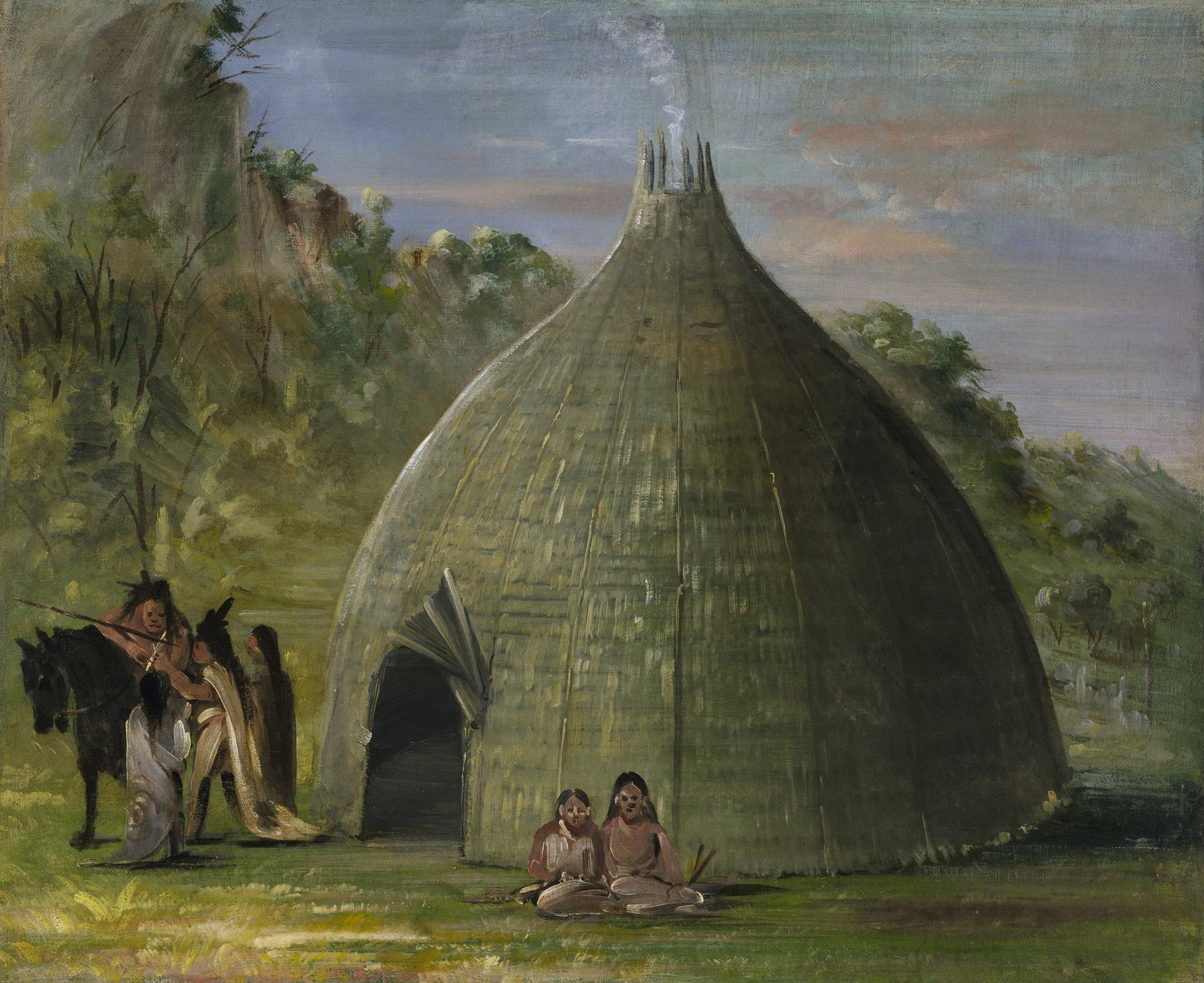
Wichita lodge,1834–1835 — historical artistic contextGeorge Catlin, 1834–1835. Smithsonian American Art Museum, Gift of Mrs. Joseph Harrison, Jr., 1985.66.492 · Public domain
Tribal government / contemporary community · Added to the original list
Wichita and Affiliated Tribes
Wichita and Affiliated Tribes is a named government and community centered at Anadarko, Oklahoma. Its own history, preservation work and education publications offer a compact introduction. Historical Texas connections remain part of that longer account; they do not make the present Oklahoma government a Texas-located government or erase the identities of its affiliated peoples.
See each region’s evidence for historical or present-day scope.
Homeland / region
Oklahoma
Research depth
Source guide
Source collection
4 annotated resources · 4 Indigenous-led
Inspected sources
2 substantive works · selected content reviewed
Initial adequacy
Still unfinished
Source review
October 27, 2026
Names & relationshipsThis government route is linked to the broader Wichita reading collection. Individually named historical peoples and government membership are not interchangeable categories; this name check does not determine descent, citizenship, jurisdiction or historical boundaries.
A source guide for a deeper dive.This entry provides a brief orientation and an organized reading path. A comprehensive deep dive has not yet been completed. Follow the annotated sources and distinguish primary community accounts from outside reference material.
A bounded community-specific starting guide with selected source perspectives, an annotated reading path and scoped imagery. Wider history, current implementation and community review remain open.
Assessment recorded October 27, 2026. This is separate from research completion and community review.
Read the governing instrument and newer institutional records before describing current rules.
Add more community-authored family and place histories with appropriate access limits.
Underlying archives, recordings, program outcomes and individual citizenship questions are not reviewed.
Backdrop images & credits
These images have individual, documented connections to this entry. Their captions and source records define the people, place, object, and period shown; no one image represents every community within a broader label.
Wichita lodge,1834–1835 — historical artistic context George Catlin, 1834–1835. Smithsonian American Art Museum, Gift of Mrs. Joseph Harrison, Jr., 1985.66.492 · Public domain
A museum-identified historical depiction of a Wichita grass lodge. The museum places the expedition context in present-day Oklahoma. This is Catlin's outside artistic representation, not a documentary photograph, Wichita-made artwork, a surveyed homeland or an image of a present government. Its title does not establish the identity of every depicted figure or speak for every affiliated people. Read the primary item title, creator/date/medium/object number and gift credit, visible reuse designation, HTML rights metadata and museum interpretive paragraph. Visually inspected the complete available 2599×2121 source frame. The exact max=2600 URL was obtained from the item's HTML srcset; no image filename was guessed. Catlin's quoted village estimates and observations were not independently corroborated or added to research synthesis. The complete available frame was proportionally resized/compressed without generation, retouching or upscaling. CSS crops and overlays apply to directory/background displays; the opened-page banner preserves the complete frame. The Tribe’s own later history connects grass-lodge memories and the organized community atAnadarko; the museum-identified1834–35Wichita painting is historical context, not a photograph/currentgovernment/identifiedmember or allaffiliatedpeoples. Existing full-frame web derivative visually reinspected2026-10-27. Any card/backdrop CSS cropping and overlays are display treatments; the page image preserves the complete web frame.
Image, association, and reuse record reviewed 2026-10-27.
Full images are displayed proportionally above. A translucent background copy may be cropped by the viewport; it does not replace the complete image or its record.
The visual treatment does not change the research status, evidence, or remaining gaps recorded in this profile.
Start reading here
Present Oklahoma government with a wider historical Texas reading connection. Affiliated historical peoples are not reduced to aliases; the photograph requirement is met through explicitly identified historical artistic context, not a current-government portrait.
Explore the government’s own education-program account without inferring outcomes or eligibility.
These are selected starting points. The full annotated collection, source perspectives, inspection limits and remaining research questions follow below. A starting guide is not an exhaustive history or community endorsement.
01
Named peoples and an organized community
The Tribe’s connected history names Wichita, Waco, Tawakoni, Taovaya and Kichai within its account of continuity and organized government at Anadarko. It emphasizes family memories and relationships across generations. Read the institutional narrative with its historical scope: individually named peoples, government organization and a person’s citizenship are different questions, rather than interchangeable labels.
The Department of Preservation describes a History Center opened in 2018, graphic panels, exhibits and an outdoor grass-house display. It also identifies a language archive, photograph archive and research library. These are published institutional descriptions. They do not mean every holding is available online or that the Atlas has reviewed the collections, elder interviews, recordings or restricted records.
Education Services describes adult learning, vocational and degree-related support and equipment borrowing. These first-party program descriptions show educational aims and structures; they do not guarantee awards, current eligibility or measured outcomes. The broader Wichita guide adds removal records and historical scholarship. The credited Catlin lodge painting provides outside historical illustration, not an image of the present government or its current buildings.
Read the governing instrument and newer institutional records before describing current rules.
Add more community-authored family and place histories with appropriate access limits.
Underlying archives, recordings, program outcomes and individual citizenship questions are not reviewed.
A community-specific starting guide reuses selected earlier actual-content reviews with their original dates/scopes. It does not add new global works merely because a URL appears on this route. Picture identification/rights are separate from historical adequacy or community endorsement.
Follow the reading path
Sources & further reading
Open any title to read the original source. Annotations explain what each link can help you explore.
No Indigenous-led source is identified in this entry yet. This is a gap in this collection, and does not imply an absence of community knowledge or organization.
Indigenous-led / supporting government navigationWichita and Affiliated TribesSource 1Supporting reference · outside substantive inspected count
The named government’s own publication supplies this separate identity and shared-reading route. Only government/name navigation is established here; its governing instrument and standalone institutional history remain queued.
Inspection: Identity check only
Scope: Previously read government roster/navigation at lines27–122, used here only for the government name and official publisher identity. No legal provisions, officeholder claims, membership rules or jurisdiction are inferred.
Review recorded: October 26, 2026
Access note: Public HTML. The linked 2016-named Governing Resolution appeared as a seven-page PDF to the web tool, but text/screenshot output was unreadable and normal direct download returned403. No legal provisions inferred or counted; no paywall claim or bypass attempted.
Counting note: Supporting identity check only; not an additional substantive history work.
Indigenous-led / collaborative public historyWichita and Affiliated Tribes; exhibit collaboration credited to the Stovall Museum of Science and History and Oklahoma Archaeological SurveySource 2
Four linked chapters explain the Tribe’s historical account from early encounters through village life, displacement and continuing community. The credits identify a cooperative exhibit. Treat the chapters as one work, keep named historical groups distinct, and attribute archaeological, treaty and continuity interpretations rather than turning the narrative into independently checked archival evidence.
Inspection: Content reviewed for the stated scope
Scope: Complete main narratives of In the Beginning:1540–1750 (lines27–38), People of the Grass House:1750–1820 (27–39), Days of Darkness:1820–1934 (27–37), and A New Beginning:1934–Present (27–38), plus References and Contributors (27–91). Public narrative passages read; no quoted origin stories, ceremonial details, images or underlying bibliography reproduced or separately researched.
Review recorded: October 26, 2026
Access note: Public readable English HTML, no account/paywall encountered. Individual publication/revision dates are unstated; date ranges in titles are historical coverage, not publication dates. Do not repeat historical population estimates as current figures, infer present identities from archaeological phases, or treat institutional treaty summaries as direct readings of the instruments.
Inspected material and access routes
In the Beginning:1540–1750 ↗ — Complete main narrative; original p431-s2 URL preserved separately as a duplicate reading route.
Days of Darkness:1820–1934 ↗ — Complete main narrative; population estimates and legal interpretations not adopted as independent facts.
A New Beginning:1934–Present ↗ — Complete main narrative; ongoing cultural/community account attributed to this publisher, not a current statistical survey.
References and Contributors ↗ — Collaboration, credits and reference list inspected; cited works remain unread unless checked separately by the other research agent.
The Tribe describes its History Center, language and photographic archives, library, cultural/language projects and Historic Preservation Office. This first-party page provides current published institutional context; its short descriptions and linked resources do not verify outcomes or open access to every archival item.
Inspection: Supporting or limited review; see scope
Scope: Complete substantive department body, lines 27–139: component programs; History Center description; language-project list; public resource links; THPO functions. Links to elder interviews, children’s videos/apps, cultural organizations, restricted records and surveys were not opened.
Review recorded: October 26, 2026
Access status: Public readable English HTML
Access note: Publication date is unstated; the page was observed October 26, 2026. Program listings are attributed to the publisher; no benefit, event, performance, legal jurisdiction or underlying resource-access guarantee is inferred. No contact form was used.
Counting note: Supporting institutional/program overview. Embedded routes overlap already reviewed history/dictionary sources; neither navigation nor each listed project becomes another substantive work.
A detailed first-party description of adult education, vocational training, degree support and equipment borrowing, read with the Department’s stated mission. It shows the institution’s published educational aims and program structure. It does not establish participation outcomes, guaranteed awards or eligibility for every reader.
Inspection: Content reviewed for the stated scope
Scope: Higher Education Programs main program descriptions through deadlines, lines27–123; Department of Education vision/mission and program categories, lines42–74. Long external-resource directories, applications, financial records, service-area image and program outcomes were not inspected.
Review recorded: October 26, 2026
Access note: Public English HTML; no login/paywall encountered for descriptions. Actual applications were not submitted/opened and reader eligibility was not tested. Different pages display different funding figures and dated academic-year information; amounts, deadlines and benefit guarantees are deliberately omitted. Consult the publisher for current program details.
Related entries may represent alternate names, constituent communities, wider groupings, or historical connections. Read the naming notes before treating entries as equivalent.
Robey’s Atlas of Indigenous North America · Compiled October 19, 2026 · Wichita and Affiliated Tribes