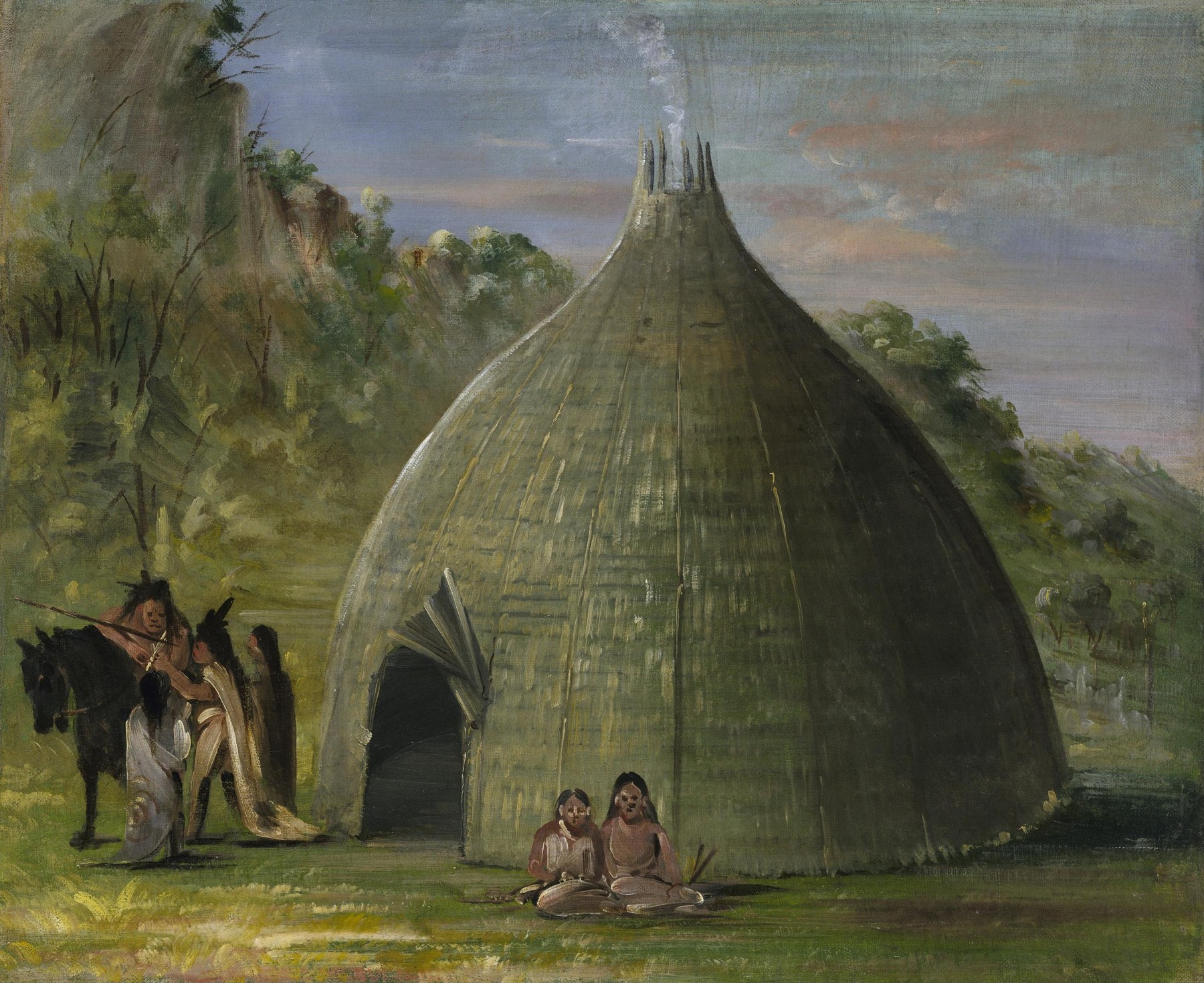
Wichita lodge, George Catlin, 1834–1835 — related historical context for Taovaya readingGeorge Catlin, 1834–1835. Smithsonian American Art Museum, Gift of Mrs. Joseph Harrison, Jr., 1985.66.492 · Public domain
Named people / Wichita-affiliated historical community · Added to the original list
Taovaya
Taovaya, also recorded under spellings such as Tawehash, names a particular historical Wichita-related people. Jelks’s focused entry and the Wichita and Affiliated Tribes’ connected history provide a bounded introduction to Red River communities, agriculture, exchange and diplomacy. Historical relationships do not make Taovaya an interchangeable label for every affiliated people or a separate current government here.
See each region’s evidence for historical or present-day scope.
Homeland / region
Southern Plains / historical Texas connections
Research depth
Source guide
Source collection
2 annotated resources · 1 Indigenous-led
Inspected sources
2 substantive works · selected content reviewed
Initial adequacy
Still unfinished
Source review
October 27, 2026
Names & relationshipsThe Wichita and Affiliated Tribes’ own historical account includes Taovaya among its named peoples. This separate reading route preserves the individual name within that broader context; it does not assert a separate present-day tribal government.
A source guide for a deeper dive.This entry provides a brief orientation and an organized reading path. A comprehensive deep dive has not yet been completed. Follow the annotated sources and distinguish primary community accounts from outside reference material.
Still unfinished
A bounded historical-community starting path with selected actual-content works, attributed perspectives and explicitly scoped imagery. No fixed source minimum, comprehensive completion, current subgroup government or individual descent is claimed.
Assessment recorded October 27, 2026. This is separate from research completion and community review.
Compare diplomatic, trade and treaty summaries with original records and community-specific scholarship.
Find a separately cleared Taovaya place/object image; the present painting is explicitly related Wichita context, not a subgroup depiction.
A Spanish Fort commemorative-site photo was inspected privately but not selected because separate rights in its monument relief were not established.
No current citizenship, separate present government, individual descent or surveyed homeland boundary is determined.
Backdrop images & credits
These images have individual, documented connections to this entry. Their captions and source records define the people, place, object, and period shown; no one image represents every community within a broader label.
Wichita lodge, George Catlin, 1834–1835 — related historical context for Taovaya reading George Catlin, 1834–1835. Smithsonian American Art Museum, Gift of Mrs. Joseph Harrison, Jr., 1985.66.492 · Public domain
Related Wichita historical context only. The Tribe’s inspected connected history explicitly names Taovaya among its affiliated historical peoples, supplying a source bridge for related reading. SAAM identifies the painted lodge as Wichita, not specifically Taovaya; neither the building nor any figure is assigned Taovaya identity. This is George Catlin’s outside artistic representation from 1834–1835, not a photograph, subgroup-made art, a present government portrait or proof of a particular family’s dwelling. The exact earlier museum identification/rights record is retained; it is not a new full museum-page review. The full existing 1800×1469 web derivative was copied unchanged into this folder and visually re-inspected on 2026-10-27. Do not remove the related-context qualification from the visible title/caption. Exact available full-frame JPEG copied unchanged; CSS crops and overlays affect card/backdrop display only.
Image, association, and reuse record reviewed 2026-10-27.
Full images are displayed proportionally above. A translucent background copy may be cropped by the viewport; it does not replace the complete image or its record.
The visual treatment does not change the research status, evidence, or remaining gaps recorded in this profile.
Start reading here
Historical people/community grouping; broader Caddo or Wichita access points are related reading. No automatic subgroup identity is assigned to an umbrella source, historical picture or current government.
Use the Tribe-published historical collection for the explicit affiliated relationship and wider historical context.
These are selected starting points. The full annotated collection, source perspectives, inspection limits and remaining research questions follow below. A starting guide is not an exhaustive history or community endorsement.
01
Red River communities and diplomacy
Jelks places Taovaya people in an eighteenth-century movement into southern Oklahoma and northern Texas and describes a settlement near present Spanish Fort by 1759. His account connects the community with the 1758 attack on San Sabá and the successful defense against a Spanish retaliatory expedition in 1759. These episodes are presented as the author’s synthesis, not as a new reading of the expedition papers. The modern place-name Spanish Fort should not turn the Taovaya settlement into a Spanish-built village.
Farming, exchange and related historical interpretation
The entry describes cultivated crops, seasonal bison hunting and regional exchange, drawing attention to a farming community rather than reducing its history to warfare. The Tribe’s own narrative explicitly includes Taovaya among named peoples. The accompanying Catlin painting is carefully labeled related Wichita grass-lodge context: the museum identifies its subject as Wichita, not Taovaya. It is an outside artist’s nineteenth-century representation and does not identify the pictured individuals or prove that this particular lodge belonged to a Taovaya family.
Compare diplomatic, trade and treaty summaries with original records and community-specific scholarship.
Find a separately cleared Taovaya place/object image; the present painting is explicitly related Wichita context, not a subgroup depiction.
A Spanish Fort commemorative-site photo was inspected privately but not selected because separate rights in its monument relief were not established.
No current citizenship, separate present government, individual descent or surveyed homeland boundary is determined.
This reviewed starting guide records selected actual-content sources, their perspectives and access limits. Reused earlier reviews retain their original dates/scopes; images and repeated URLs do not create new historical works. Comprehensive history and community review remain open.
Follow the reading path
Sources & further reading
Open any title to read the original source. Annotations explain what each link can help you explore.
No Indigenous-led source is identified in this entry yet. This is a gap in this collection, and does not imply an absence of community knowledge or organization.
Scholarly referenceTexas State Historical Association, Handbook of Texas OnlineSource 1
Publication: Originally 1952; revised April 27, 2019
Edward B. Jelks’s focused article identifies Taovaya name variants, a Red River settlement near present Spanish Fort, agriculture, regional exchange and Spanish relations. Historical interpretations remain attributed; its brief treaty/outcome conclusion is not adopted as verified implementation or present status.
Inspection: Content reviewed for the stated scope
Scope: Complete main body, web lines 7–11, author, bibliography and publication/revision metadata read. The Bolton and Hodge works, original treaty and underlying encounter records remain unread. Historical labels and the word descendants are not individual genealogy evidence.
Review recorded: October 27, 2026
Access note: Actual public HTML body readable without an account in this inspection. Linked bibliography, archival instruments and media remain separate works unless expressly listed.
Indigenous-led / collaborative public historyWichita and Affiliated Tribes; exhibit collaboration credited to the Stovall Museum of Science and History and Oklahoma Archaeological SurveySource 2
Four linked chapters explain the Tribe’s historical account from early encounters through village life, displacement and continuing community. The credits identify a cooperative exhibit. Treat the chapters as one work, keep named historical groups distinct, and attribute archaeological, treaty and continuity interpretations rather than turning the narrative into independently checked archival evidence.
Inspection: Content reviewed for the stated scope
Scope: Complete main narratives of In the Beginning:1540–1750 (lines27–38), People of the Grass House:1750–1820 (27–39), Days of Darkness:1820–1934 (27–37), and A New Beginning:1934–Present (27–38), plus References and Contributors (27–91). Public narrative passages read; no quoted origin stories, ceremonial details, images or underlying bibliography reproduced or separately researched.
Review recorded: October 26, 2026
Access note: Public readable English HTML, no account/paywall encountered. Individual publication/revision dates are unstated; date ranges in titles are historical coverage, not publication dates. Do not repeat historical population estimates as current figures, infer present identities from archaeological phases, or treat institutional treaty summaries as direct readings of the instruments.
Inspected material and access routes
In the Beginning:1540–1750 ↗ — Complete main narrative; original p431-s2 URL preserved separately as a duplicate reading route.
Days of Darkness:1820–1934 ↗ — Complete main narrative; population estimates and legal interpretations not adopted as independent facts.
A New Beginning:1934–Present ↗ — Complete main narrative; ongoing cultural/community account attributed to this publisher, not a current statistical survey.
References and Contributors ↗ — Collaboration, credits and reference list inspected; cited works remain unread unless checked separately by the other research agent.
Related entries may represent alternate names, constituent communities, wider groupings, or historical connections. Read the naming notes before treating entries as equivalent.
Robey’s Atlas of Indigenous North America · Compiled October 19, 2026 · Taovaya