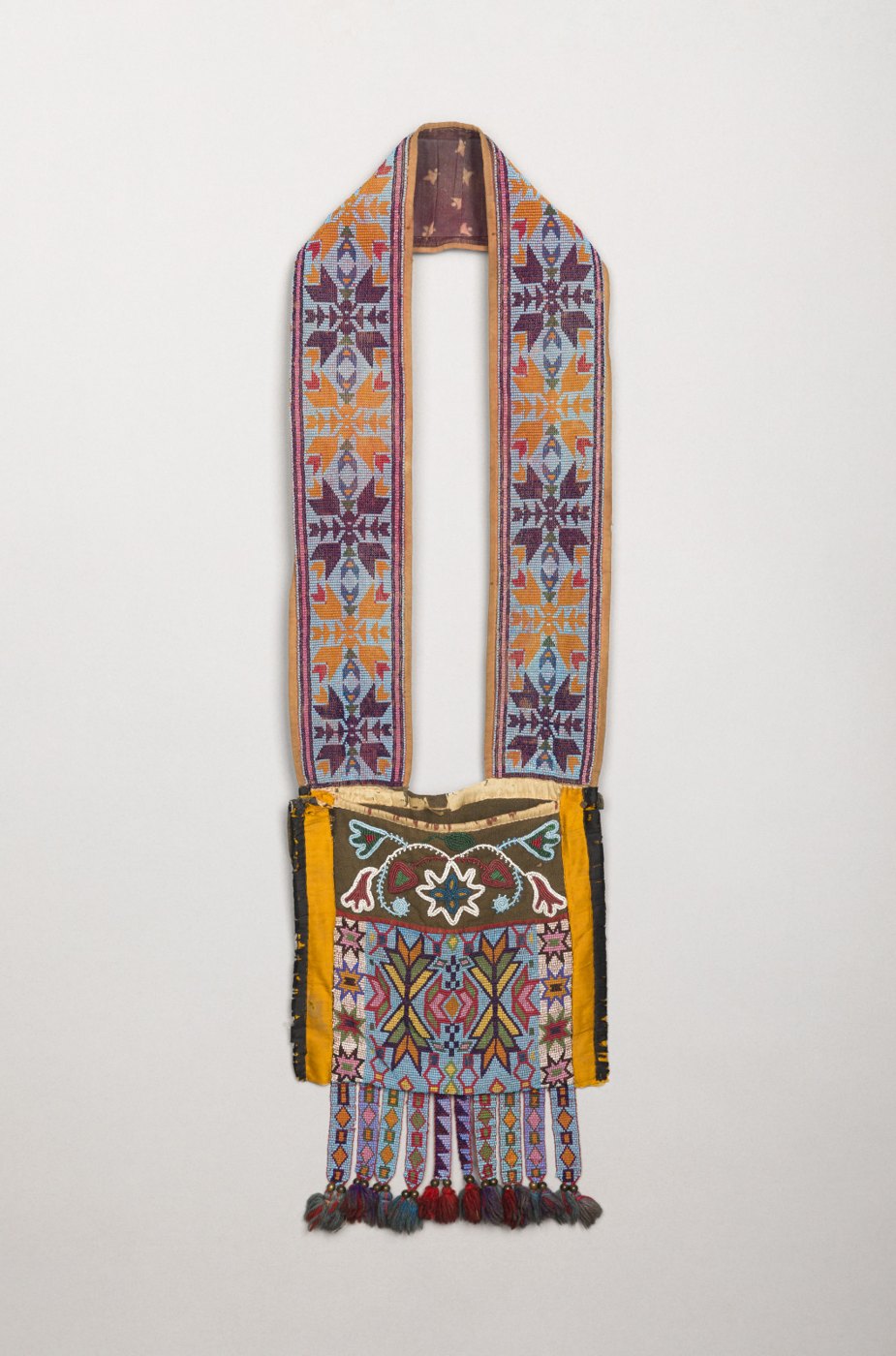
Bandolier Bag, Anishinaabe (Ojibwe) artistSaint Louis Art Museum, Gift of Elizabeth B. and Robert Wells Streett, 20:2022; Anishinaabe (Ojibwe) artist, name unrecorded
Anishinaabe is a shared identity used in different ways across related communities. These readings connect particular Ojibwe, Odawa and Potawatomi histories, language projects, education systems and ecological work while keeping their governments and local experiences distinct.
See each region’s evidence for historical or present-day scope.
Homeland / region
Great Lakes / Canada / United States
Research depth
Expanded profile
Source collection
14 annotated resources · 8 Indigenous-led
Inspected sources
13 substantive works · selected content reviewed
Initial adequacy
Adequate initial introduction
Source review
October 21, 2026
Names & relationshipsAnishinaabe is a wider and context-dependent identity, linked here to Ojibwe, Odawa, and Potawatomi. The Three Fires relationship, Ontario's Anishinabek Nation, GLIFWC, and individual sovereign communities have different scopes and are not interchangeable names.
An expanded introduction, with sources reviewed.This profile develops several themes through identified sources. Citations connect each section to its evidence; remaining gaps appear below. It has not been reviewed or endorsed by the community.
Adequate initial introduction
Thirteen substantive inspected works or conservative collections support an accessible introduction through specific community histories, governance, language scholarship, education, knowledge relationships, climate planning and food teaching. The short commission directory remains supporting context. Actual selected-page limits and differing institutional participation are explicit. This meets the twelve-source quantity target without implying a comprehensive history or community endorsement; coverage supports continuing alphabetically with the stated gaps.
Assessment recorded October 21, 2026. This is separate from research completion and community review.
The selected Great Lakes/Ontario examples are not an exhaustive account of every people or community using Anishinaabe identity.
Current institutional participation, constitutional amendments, outcomes and speaker totals require separate dated verification.
Backdrop photographs & credits
These photographs have individual, documented connections to this entry. Their captions and source records define the people, place, object, and period shown; no one photograph represents every community within a broader label.
Bandolier Bag, Anishinaabe (Ojibwe) artist Saint Louis Art Museum, Gift of Elizabeth B. and Robert Wells Streett, 20:2022; Anishinaabe (Ojibwe) artist, name unrecorded
One Anishinaabe (Ojibwe) artist's nineteenth-century bandolier bag, c. 1860. Suitable for the broad Anishinaabe profile only with the precise Ojibwe attribution retained. Do not imply one object represents all Anishinaabe nations or governments, copy its beadwork as generated filler, or infer symbolism beyond the inspected museum record. RISD 43.119 remains an image-retrieval gap. Used one bounded museum alternative: SLAM object 20:2022. Actual museum page read, Public Domain link and Terms of Use read, image URL extracted from the official page HTML, original 1057 x 1600 JPEG downloaded and visually inspected in full. Object attribution is explicitly Anishinaabe (Ojibwe), not merely geographic. No maker biography, separate community review, or detailed design meanings established. Web copies proportionally resized/recompressed without retouching; CSS crops and overlays are presentation only. Complete image displayed proportionally in the page banner. The same precisely identified Ojibwe artist’s bag may accompany the broad Ojibwe collection as well as Anishinaabe. The maker’s individual name and particular Ojibwe government/community are unrecorded in the inspected item. It must not be assigned specifically to one Minnesota Band, used as a universal Ojibwe design, or copied into invented traditional motifs.
Image, association, and reuse record reviewed 2026-10-26.
Full photographs are displayed proportionally above. A translucent background copy may be cropped by the viewport; it does not replace the complete image or its record.
The visual treatment does not change the research status, evidence, or remaining gaps recorded in this profile.
Start reading here
Curation of the existing developed collection. The original overview, substantive sections, full source collection, review dates, scopes and adequacy assessment are retained. The route remains unfinished; no new global work or history expansion is claimed.
Read the dictionary’s regional and contributor methodology rather than treating all identities as interchangeable.
These are selected starting points. The full annotated collection, source perspectives, inspection limits and remaining research questions follow below. A starting guide is not an exhaustive history or community endorsement.
01
Related peoples, different histories
The Pokagon Band's history places Potawatomi relationships with Ojibwe and Odawa within the Three Fires while acknowledging differing origin accounts. It then follows a particular community's efforts to remain in its Great Lakes homeland under removal pressure. The account treats Congress's 1994 reaffirmation of federal recognition as recognition of an already existing people. Pokagon continuity therefore adds a distinct perspective; it cannot stand for every Potawatomi community's experience or the governments of all Anishinaabe peoples.
The Little Traverse Bay Bands' 2005 history explains that Anishinaabe expresses a relationship shared with Ojibwe and Potawatomi, while a person's band or tribe remains more specific. Drawing on documents and elder interviews, the book follows Waganakising Odawa land use through settlement pressure, reduced seasonal movement, land loss and growing wage employment. Its account also describes continuing practices through change. This is a locally grounded history of particular Odawa bands, rather than one history for all Anishinaabe communities.
Citizen Potawatomi Nation's 2018 account of its Cultural Heritage Center presents oral tradition as a way of carrying history. Director Kelli Mosteller and artist Jennifer Randell explain how public interpretation connects ancestral experience with present responsibilities and future generations. Their account addresses colonial disruption while emphasizing continuity and renewal. This is a particular museum's interpretation, useful alongside other community voices; it should not become a universal prophetic timetable for every Anishinaabe nation.
Forest County Potawatomi's historical timeline follows a particular Wisconsin community through political reorganization and institution building. Its later entries record a Tribal Court in 1994, a tribal newspaper in 1995, and a museum with a People of the Three Fires exhibit in 2002. These dated entries show different settings in which community life and public history developed. They describe Forest County institutions, not a single government shared by all Potawatomi or Anishinaabe peoples, and do not verify current operations.
The Anishinabek Nation describes itself as an Ontario political advocate and identifies the Union of Ontario Indians, established in 1949, as its legal secretariat. Its history connects modern organizing with earlier Three Fires councils while also recording later institutional changes. The page explains a 2017 direction to retain the corporate name for legally binding agreements and use Anishinabek Nation otherwise. This organizational history does not turn all Anishinaabe people or independent First Nations into one government.
A constitution with a defined participating context
Proclaimed in 2012, this constitution defines Anishinabek Nation through First Nations that proclaimed and signed it. It provides a Grand Council advised by Elders’, Women’s and Youth councils and calls for citizen consultation. Collective and individual First Nation laws operate together, with individual First Nation laws taking precedence where they exist. Its inclusive definition of Anishinaabemowin concerns the languages of its peoples; it does not establish one uniform dialect or a constitution for every Anishinaabe nation.
Education roles and locally directed language work
In its 2024–25 report, the Kinoomaadziwin Education Body describes a system where local education authorities vary by First Nation, regional councils identify priorities, and the KEB provides central administrative support. Its language-strategy account connects surveys and community consultations with approval in November 2024, and describes locally directed work, including Lunaapeew support. The report documents an institution’s activities and planning; it does not establish uniform language conditions, independently measured outcomes, or participation by every Anishinaabe government.
Community examples and youth educational priorities
The report of the April 2022 Niigaan Gdizhaami Forum records different educational experiences. Its Atikameksheng Anishnawbek example describes language immersion with speakers, music and conversation. Youth groups called for belonging, recognition of their experiences, responses to racism, and space for culture in schools. The report connects those messages with proposed next steps. These are accounts from particular projects and participants, rather than evidence that all Anishinaabe students have identical priorities or that the recommendations were completed.
The Ojibwe People’s Dictionary centers Central Southwestern Ojibwe from Minnesota, Wisconsin and Canadian border-lakes communities. It uses a double-vowel writing system and identifies speakers and regional usage. Its word-building guide explains why an entry represents related inflected forms, rather than just one fixed spoken word. The project’s history describes collaboration with Elders and cultural collections. These features support learning while preserving differences; they do not establish a uniform standard for all Anishinaabe languages.
Writing from her Wiikwemkoong experience, Mary Ann Naokwegijig-Corbiere describes speaker workshops that checked and expanded vocabulary for an Odawa and Eastern Ojibwe dictionary. She explains that English glosses can hide grammatical information and social context, so entry forms, examples and usage variation need careful decisions. Her account makes documentation visible as ongoing judgment and collaboration. It is an educator’s situated analysis of her project, not evidence of uniform usage across every community.
GLIFWC identifies its commission as staff working with member tribes on Ojibwe treaty rights and stewardship. Its directory connects particular bands with Minnesota, Wisconsin and Michigan, while its explanation links the institution to specific nineteenth-century treaties and continuing relationships with homelands. This is a way to locate participating governments and their own websites. It does not identify every Anishinaabe government or determine an individual reader’s citizenship or harvesting eligibility.
GLIFWC specialist Michael Waasegiizhig Price describes Indigenous knowledge as localized, inherited through language, stories and lived relationships with a landscape. He argues that bringing it into research requires knowledge holders and elders to help shape the questions and design. His discussion also emphasizes their authority over knowledge, including refusal of its use. These are reasons to read ecological knowledge alongside community responsibilities, rather than treating it as information freely detached from its holders.
The 2019 Tribal Climate Adaptation Menu emerged from collaborators who found existing planning tools insufficient for a tribally focused wild-rice project. Its authors place relationships and community priorities alongside ecological observations, rather than offering a single prescribed approach. They invite communities to adapt the framework to their own language, values and circumstances. The work draws specifically on Ojibwe and Menominee perspectives; their collaboration does not make these peoples interchangeable or establish one plan for all Anishinaabe nations.
GLIFWC’s 2013–2014 Mino Wiisinidaa reporting describes food teaching through particular community gatherings. LaTisha Coffin recalls Red Cliff children choosing fruit for their wild-rice salads; Owen Maroney later describes Lac Vieux Desert youth learning about wild rice with Roger LaBine. These examples connect food knowledge with practical learning and relationships across generations. They document activities from that project period, rather than a universal Anishinaabe diet, proof of health outcomes or an assurance that the same program operates today.
Broaden direct community histories and Indigenous scholarship beyond the selected Great Lakes and Ontario examples; these institutions do not represent all Anishinaabe peoples.
Investigate additional Algonquin, Saulteaux and other community-specific uses of related identities through their own sources; shared names do not justify automatic affiliation or interchangeable language labels.
Review current constitutional ratifiers/amendments, education-system participants and project outcomes separately. Reported approvals and activities are not independent outcome evaluations.
The full Odawa/Eastern Ojibwe dictionary, GLIFWC treaty guide,2023 vulnerability assessment and finished food cookbook remain unread leads. No recordings were listened to and no map/media reuse licence is inferred.
Keep differing Three Fires interpretations attributed. No universal duty chart, precise migration timetable, current population/speaker count, individual harvesting eligibility or restricted cultural instructions is supplied. Community review remains open.
Fourteen source cards support thirteen substantive works/collections and one short supporting commission guide. Separate reports are distinct works; dictionary subpages and related food-program articles are grouped conservatively. Anishinabek Nation membership, constitutional signatories, education-system participation, GLIFWC member bands and broad peoplehood have different scopes. Menominee collaboration on the climate framework does not make Menominee a synonym of Anishinaabe. The seven-page constitution file omits the contents-listed signatory page and referenced territorial appendix. No roster, boundary or current implementation claim follows. LTBB history publication is November2005, not2021upload. Corbiere’s2021workshop,2025volume and2026online release are distinct. Her download ends on printed122 despite a suggested104–123citation. The observed GLIFWC store download terms were not accepted. The guide and inaccessible2023assessment add no count. Selected public newspaper articles and the distinct USDA-hosted2019Menu were read without using that store flow; no blanket reuse permission, images, source data or ceremonies are republished. Selected actual-content works support a bounded starting guide. Earlier source objects retain their original review dates and limits. Reused URLs, images and identity-only checks are not new global historical works. Full history and community review remain open.
Maps with context
Historical maps
Explore authentic historical documents connected to this entry. Their names and boundaries reflect their makers and periods.
Ralph M. Shane and Grand Portage Band of Chippewa Indians (catalogued authors)
The catalogue credits the Grand Portage Band as co-author. Community and NPS sources identify Grand Portage with Ojibwe / Anishinaabe history in Minnesota. This is one community example within the broader directory entry; the map image remains uninspected.
Historical scope: 1946 publication; Grand Portage community
Ralph M. Shane and Grand Portage Band of Chippewa Indians; W. A. Fisher Company, Virginia, Minnesota, 1946. David Rumsey Historical Map Collection, list 10847.000. Rights record ↗
These map connections are a growing selection. Historical depictions do not establish current boundaries, and a link does not imply community authorship or endorsement.
Follow the reading path
Sources & further reading
Open any title to read the original source. Annotations explain what each link can help you explore.
No Indigenous-led source is identified in this entry yet. This is a gap in this collection, and does not imply an absence of community knowledge or organization.
Community-authored cultural and historical accountPokagon Band of PotawatomiSource 1
Publication: Undated; footer year is not treated as publication date
Substantive public history from a particular Potawatomi government. Useful for differences within related peoples and continuity through removal pressures. Legal summaries, casualty estimates and court details are not independently established here. Other ritual and clan sections are outside the selected synthesis.
Inspection: Content reviewed for the stated scope
Scope: Actual History section, web lines 511–522, and introductory culture paragraphs 499–503. Linked videos, archives and other sections not claimed as reviewed works.
Publication: November 2005; cover says compiled and printed then, not the 2021 upload date
A tribal project combining documents and elder interviews, with youth participation. Its own introduction limits later history to Waganakising bands, including Beaver Islands, and distinguishes shared identity from specific belonging. Selected pages only; neither a full-book review nor current legal interpretation. Historical vocabulary and family records are not replicated.
A dated account of the Cultural Heritage Center's public exhibit, with named staff and artist perspectives. Read as Citizen Potawatomi interpretation. Prophetic details, sacred symbolism and precise migration chronology are not reproduced or made universal; its Three Fires role labels differ from other community accounts.
Inspection: Content reviewed for the stated scope
Scope: Actual complete article body, paragraphs on the reopening, Kelli Mosteller's and Jennifer Randell's interpretation, and concluding continuity statements; web lines 41–67.
A substantial community chronology, counted as one work. Selected institutional entries add a Wisconsin perspective rather than a universal Anishinaabe history. Origin dates, treaty totals, population figures and imprecise legal labels are excluded. The timeline's endpoint is not evidence of present operations.
Inspection: Content reviewed for the stated scope
Scope: Actual full timeline body read, web lines 59–171; synthesis uses 1937 and 1994–2002 institutional entries. A later same-day refetch timed out after successful initial inspection.
Substantive institutional history explains the legal secretariat, changing political organization and naming policy. This is the Ontario organization’s own account, not a definition of all Anishinaabe people. Undated membership and population totals are not adopted as current figures.
Inspection: Content reviewed for the stated scope
Scope: Actual About and History bodies read in full, web lines 145–163. Navigation, contacts, event notices and linked information-book flipbook excluded.
Publication: Proclaimed June 6, 2012; document’s edition/publication day not established
The constitutional text defines its participating First Nations, institutional language, citizen consultation and relationship between collective and First Nation laws. Its provisions are not proof of implementation or universal jurisdiction. The linked file omits the contents-listed signatory page and referenced territorial appendix.
Inspection: Content reviewed for the stated scope
Scope: Actual seven-page PDF: printed 4–7 (PDF 4–7), English definitions and Articles 1–11, plus title/contents/proclamation headers. No signatory roster, Appendix A or translated-preamble analysis claimed.
Publication: Publication day not established; filename dated September 8, 2025
Selected report pages explain local, regional and central education roles and describe language-strategy consultation and work. Activities and approval are the institution’s dated account, not independent outcome findings. Its reporting period, filename and upload directory have different meanings.
Inspection: Content reviewed for the stated scope
Scope: Actual 36-page PDF: cover, printed 5–7, 14–15, 17, 25–30 read as text; page 7 visually checked. No full-report, linked-strategy, resource-kit or outcome-audit review.
Event report preserves region-specific priorities, community project descriptions and youth group messages. Its summaries are useful primary institutional evidence of what was reported and proposed; they do not measure every student’s views or verify lasting project outcomes.
Inspection: Content reviewed for the stated scope
Scope: Actual 24-page PDF: title/copyright 2, introduction 7–10, selected project 16–17, curriculum/language 18, transitions 19, youth 20–21 and next steps 23 read as text. No videos, ceremonies or linked documents reviewed.
Community collaboration / language documentationOjibwe People’s Dictionary; University of Minnesota American Indian Studies and University Libraries, with Ojibwe contributorsSource 9
A regionally focused dictionary collection explains spelling, speaker attribution and word-building. Selected methodology and contributor accounts were read together as one work. Historical speaker figures and undated biographical roles are not treated as current; no audio was played.
Inspection: Content reviewed for the stated scope
Scope: Actual language introduction, project history, regional key and selected English contributor accounts; word-stem and audio-method text inspected. Scope is selected text, not the complete dictionary.
Indigenous-authored / language education scholarshipProceedings of the 27th Stabilizing Indigenous Languages Symposium: Language From the Four Directions; Queen’s University journal platformSource 10
Proceedings volume 27 (2025); paper adapted from the SILS 27 workshop in 2021. Publisher online date: May 13, 2026.
Publication: 2026-05-13
A Wiikwemkoong speaker and educator explains community checking, translation and learner-oriented dictionary decisions. Selected substantive pages were read beyond the abstract. Her project experience and proposals are attributed, not treated as universal usage rules or evidence of present speaker numbers.
Inspection: Content reviewed for the stated scope
Scope: Actual 19-page article PDF: printed 105–109 and 118–122, including personal/project context, speaker checking, translation examples and conclusion. Not a whole-paper or dictionary reading claim.
Publication: Undated web page; footer copyright year is not a publication date
A short commission explanation and member-band directory. Useful for identifying this particular intertribal institution and treaty context; retained as supporting orientation rather than a full substantive study.
Inspection: Supporting or limited review; see scope
Scope: Actual introductory text, member-band/state links, Ceded Territories paragraphs and Voigt note read. Linked governments, maps and legal materials were not thereby inspected.
Review recorded: October 21, 2026
Counting note: Short explanatory orientation interspersed with a directory; do not use it to fill the substantive target.
Publication: Overview undated; GLIFWC identifies the Price article as originally published Winter 2022–2023
The overview and its linked Price article are grouped once. The article explains localized knowledge and meaningful knowledge-holder participation. Comparative examples from other peoples and dated federal-policy descriptions are not adopted as Anishinaabe facts or current law.
Inspection: Content reviewed for the stated scope
Scope: Actual overview explanatory paragraphs and full linked Price article body read. No interviews, recordings, forms, store books or underlying vulnerability assessment were inspected through these pages.
Publication: 2019, as cited in the actual document
A collaborative planning framework drawing on Ojibwe and Menominee perspectives, which remain distinct peoples. Selected introductions and planning passages explain local adaptation and relationships. One work, including its Guiding Principles; no separate chapter counts.
Inspection: Content reviewed for the stated scope
Scope: Actual PDF 52 pages total: citation/abstract 2 and selected front-matter authorship/contents; guiding-principles pages 8–11,14–15; introductory note 16, overview 17, observation 23 and engagement 24. Selected text only, not a full-work read.
Publication: Fall 2013 and Spring/Summer 2014; upload-folder dates are not publication dates
Two related project reports are treated as one conservative collection. They describe particular teaching activities and plans, rather than a representative food survey, present program audit or clinical evaluation. No recipes or plant-use instructions are reproduced.
Inspection: Content reviewed for the stated scope
Scope: Actual Fall 2013 printed 11/PDF 11 article by Coffin; Spring/Summer 2014 printed 18/PDF 17 article by Maroney. Article bodies and bylines read; the complete issues and finished cookbook/DVD were not reviewed.
Related entries may represent alternate names, constituent communities, wider groupings, or historical connections. Read the naming notes before treating entries as equivalent.
Robey’s Atlas of Indigenous North America · Compiled October 19, 2026 · Anishinaabe