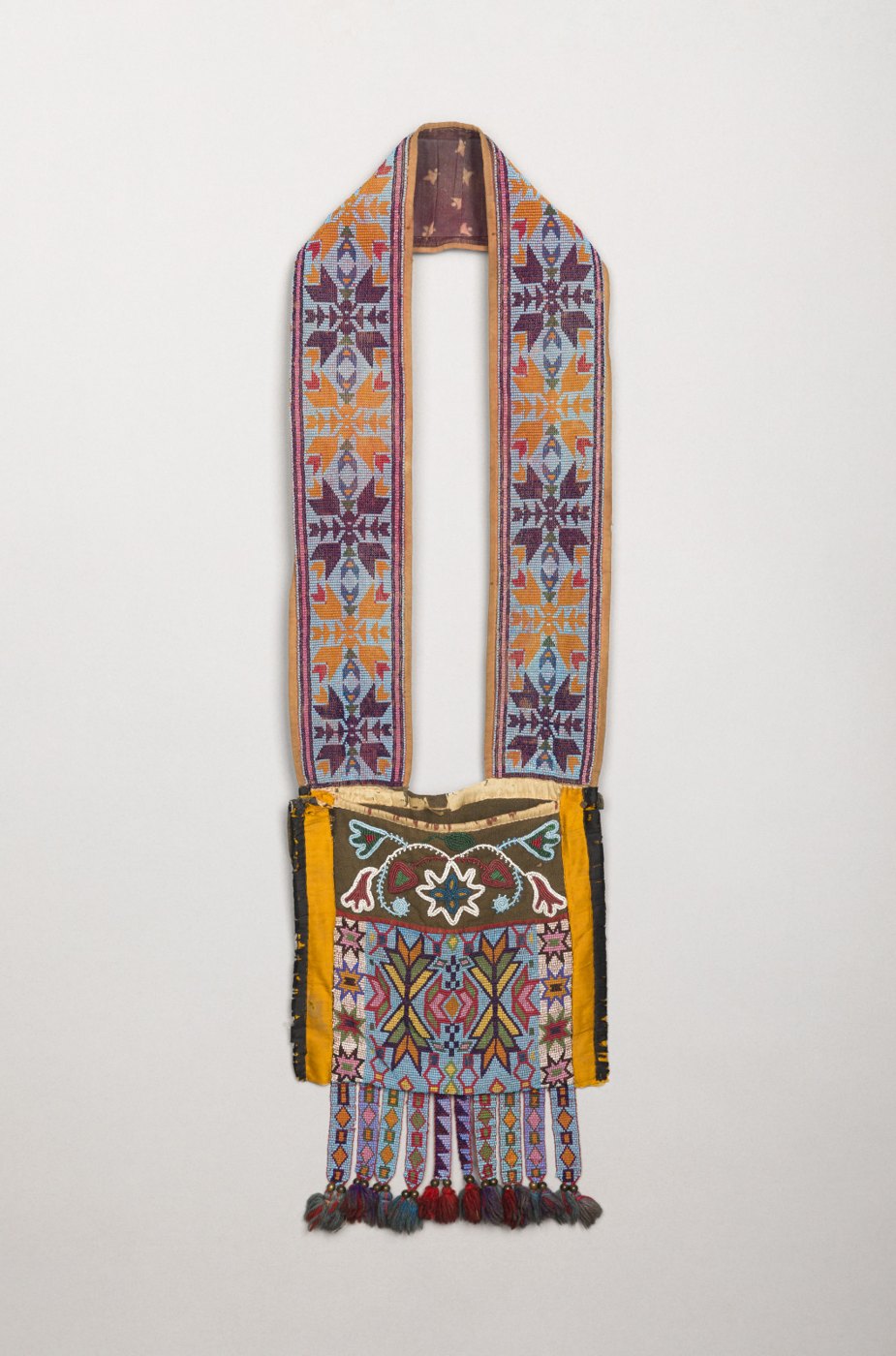
Bandolier Bag, Anishinaabe (Ojibwe) artistSaint Louis Art Museum, Gift of Elizabeth B. and Robert Wells Streett, 20:2022; Anishinaabe (Ojibwe) artist, name unrecorded
Ojibwe, Chippewa, and Anishinaabe are names used in different contexts for a wider people, while Minnesota includes distinct Ojibwe governments and communities. Six separately sovereign Bands form the Minnesota Chippewa Tribe and share its constitution; Red Lake Nation follows a separate governmental history. This Minnesota-focused guide brings together community accounts, Leech Lake Band treaty and co-management history, dated federal and state court opinions, a Smithsonian Leech Lake lesson, and place-specific historical research. The sources describe different nations and periods rather than one uniform community.
See each region’s evidence for historical or present-day scope.
Homeland / region
Great Lakes / Canada / United States
Research depth
Source guide
Source collection
27 annotated resources · 16 Indigenous-led
Inspected sources
19 substantive works · selected content reviewed
Initial adequacy
Still unfinished
Source review
October 24, 2026
A source guide for a deeper dive.This entry provides a brief orientation and an organized reading path. A comprehensive deep dive has not yet been completed. Follow the annotated sources and distinguish primary community accounts from outside reference material.
Still unfinished
Nineteen substantive works have now been inspected, including direct sources from several Minnesota Ojibwe governments, a Leech Lake Band resource-management and treaty-history booklet, two full reported court opinions about Leech Lake treaty rights and a 1973 settlement, a 2023 federal order addressing Fond du Lac tribal standing and communal treaty interest in a land-exchange challenge, a Band-authored Grand Portage land-return report, the Bois Forte community museum, a White Earth community planning document, and National Park Service place-based research. The guide distinguishes community accounts from specific legal holdings and names all seven Minnesota government routes in the reviewed inventory. Quantity exceeds the twelve-work target, but community-specific depth remains uneven; the Grand Portage release is a dated Band account, not an independently checked title history or comprehensive Ojibwe history; the Fond du Lac litigation source concerns a preliminary standing ruling, not the merits or a complete Band history; and the wider Ojibwe peoples across Canada and the United States are not comprehensively covered. No community review is recorded. The Fond du Lac food-sovereignty assessment adds dated community-program and survey-method evidence; it does not establish current outcomes.
Assessment recorded October 24, 2026. This is separate from research completion and community review.
The seven Minnesota governments have not all received equally deep, direct source review. Leech Lake now has a Band-published historical overview and two reported court opinions, but the underlying treaty texts, 1973 settlement document, current rules, and later legal history still need review; Fond du Lac now has a directly relevant 2023 federal standing order in addition to its language and official-source coverage, but still needs more direct community history, treaty material, and review of the case merits and later docket; separate institutional and community voices should be deepened for every Band and Red Lake Nation.
The Minnesota Chippewa Tribe website’s linked History of the Tribe page did not expose substantive text through the inspection tool, and the direct 2015 Leech Lake annual report exceeded the source tool’s document-size limit. The Leech Lake Band’s 20-page overview inside its 133-page co-management booklet and the full reported opinions in Leech Lake Band v. Herbst (1971) and State v. Forge (1977) were inspected; the booklet’s later MOU, appendices, and implementation materials, underlying treaties, settlement document, and later legal history were not reviewed. These are inspection constraints, not evidence that readers face a paywall; no limit was bypassed.
The full Bois Forte oral-history transcripts listed by its museum, the Smithsonian video transcript, and the Mille Lacs Band’s linked Social History book were not read. They are not represented as inspected sources.
Specialist Ojibwe language scholarship, treaty originals and legal decisions, more community-authored records from Grand Portage, White Earth and Red Lake, and relevant communities in Wisconsin and Canada remain to be reviewed.
The Minnesota Indian Affairs Council’s older Fond du Lac sketch includes broad, dated ethnographic descriptions; it is retained only as supporting context and those generalizations are not carried into the synthesis.
No Ojibwe community review or endorsement is recorded.
The 2026 Grand Portage land-return release documents a specific Band action and presents the Band historical interpretation; its underlying treaty, title, state-transfer and allotment records were not independently inspected. It cannot stand for other Ojibwe Bands or a single homeland boundary.
Backdrop photographs & credits
These photographs have individual, documented connections to this entry. Their captions and source records define the people, place, object, and period shown; no one photograph represents every community within a broader label.
Bandolier Bag, Anishinaabe (Ojibwe) artist Saint Louis Art Museum, Gift of Elizabeth B. and Robert Wells Streett, 20:2022; Anishinaabe (Ojibwe) artist, name unrecorded
One Anishinaabe (Ojibwe) artist's nineteenth-century bandolier bag, c. 1860. Suitable for the broad Anishinaabe profile only with the precise Ojibwe attribution retained. Do not imply one object represents all Anishinaabe nations or governments, copy its beadwork as generated filler, or infer symbolism beyond the inspected museum record. RISD 43.119 remains an image-retrieval gap. Used one bounded museum alternative: SLAM object 20:2022. Actual museum page read, Public Domain link and Terms of Use read, image URL extracted from the official page HTML, original 1057 x 1600 JPEG downloaded and visually inspected in full. Object attribution is explicitly Anishinaabe (Ojibwe), not merely geographic. No maker biography, separate community review, or detailed design meanings established. Web copies proportionally resized/recompressed without retouching; CSS crops and overlays are presentation only. Complete image displayed proportionally in the page banner. The same precisely identified Ojibwe artist’s bag may accompany the broad Ojibwe collection as well as Anishinaabe. The maker’s individual name and particular Ojibwe government/community are unrecorded in the inspected item. It must not be assigned specifically to one Minnesota Band, used as a universal Ojibwe design, or copied into invented traditional motifs.
Image, association, and reuse record reviewed 2026-10-26.
Full photographs are displayed proportionally above. A translucent background copy may be cropped by the viewport; it does not replace the complete image or its record.
The visual treatment does not change the research status, evidence, or remaining gaps recorded in this profile.
Start reading here
Curation of the existing developed collection. The original overview, substantive sections, full source collection, review dates, scopes and adequacy assessment are retained. The route remains unfinished; no new global work or history expansion is claimed.
Continue to the Leech Lake Band’s selected treaty and resource-management history.
These are selected starting points. The full annotated collection, source perspectives, inspection limits and remaining research questions follow below. A starting guide is not an exhaustive history or community endorsement.
01
Names, peoples, and distinct governments
Sources use Ojibwe, Chippewa, and Anishinaabe in overlapping but context-dependent ways. The White Earth Nation and Sault Tribe explain their naming and language choices from their own community perspectives. The Bureau of Indian Affairs lists six member Bands of the Minnesota Chippewa Tribe, and Mille Lacs states that those Bands are separately sovereign with distinct laws and systems. Red Lake Nation’s history says its leaders maintained a separate political path rather than joining that six-Band organization. These records describe present governments and source usage; they do not make every local identity interchangeable.
Bois Forte’s government and Heritage Center preserve a community migration account centered on an elder’s prophecy and a westward route around the Great Lakes. The Red Lake Nation’s timeline offers its own chronology of Ojibwe movement into northern Minnesota. Mille Lacs’ illustrated guide also presents a migration teaching and seasonal food history. These accounts are attributed to their publishers; older archaeological and colonial records cannot replace them, and one community’s route is not treated as a uniform timeline for all Ojibwe communities.
Mille Lacs’ treaty reading path connects the 1837 cession and reserved harvesting rights with later litigation, and identifies the 1855 treaty as establishing its reservation. Its historical guide describes the Sandy Lake tragedy, later pressure to remove the Band, and allotment policy. Bois Forte’s history outlines separate 1854 and 1866 treaty arrangements and an 1881 executive order. Grand Portage’s government identifies its 1854 Treaty of La Pointe relationship, while the National Park Service places the monument within Grand Portage Anishinaabe homeland. These are distinct community and place-specific histories, not statewide boundary definitions. The Leech Lake Band’s resource-management booklet supplies a direct Band account of the 1837, 1854, 1855, 1864, and 1867 treaty sequence, followed by the Nelson Act, allotment, and logging. It describes the 1864 consolidation and the later creation of White Earth while Leech Lake lands were retained, and explains the effects of these policies from the Band’s perspective. The booklet also records differing Pillager and military accounts of how the 1898 Sugar Point conflict began. Its legal conclusions and chronology are attributed to the Band; the treaty texts and underlying court and archival records require separate review. Two later reported opinions help distinguish the historical stages of the Leech Lake dispute. In 1971, the U.S. District Court held that treaty rights had not been ended by the Nelson Act and protected hunting, fishing, and wild-rice gathering on public lands and waters within the reservation, while declining to grant the Band the exclusive regulatory authority it sought. In 1977, the Minnesota Supreme Court upheld the 1973 settlement and fishing-stamp statute as a compromise that recognized retained treaty rights while also allowing state regulation of fishing by nonmembers under that arrangement. These are specific historical holdings; current rules, later law, and the underlying treaty texts remain separate research questions. A 2023 federal district-court order in Fond du Lac Band v. Cummins concerned the Band’s challenge to a Forest Service land exchange for a proposed NorthMet mine. At the motion-to-dismiss stage, the court accepted the complaint’s allegation that the exchange could remove access to 6,650 acres used for treaty rights and held that the Band could assert its own 1854 Treaty usufructuary interests; the rights were not exclusively individual-member rights. The court denied dismissal, but did not decide the land-exchange claim on its merits or the project’s ultimate outcome. A 2026 Grand Portage Band news release reports the return of three parcels to Band ownership and describes different routes by which they had left Band ownership: treaty cession, transfer into state school-trust lands, and allotment. This is the Band account of one present-day land return; the underlying treaty and title records were not independently examined, and this case does not define all Ojibwe homelands or imply that all Bands experienced the same history.
Fond du Lac records its 2010 decision to make Ojibwe its official language and describes a language program established in 2015. White Earth’s cultural division describes ongoing work in language, schools, gatherings, and cultural activities. The Smithsonian Leech Lake lesson explains manoomin as a food and teaching relationship and includes educator contributions; it is a broad school resource rather than a substitute for community-specific teaching. Each account has a distinct publisher and scope.
A National Park Service study of Voyageurs combines archaeology, photographs, historic maps, records, and oral histories to document Bois Forte occupation in and near the park, especially during the late nineteenth and early twentieth centuries. Its author marks the limit of the evidence and does not claim to trace the groups to their beginning. Grand Portage National Monument describes a separate portage corridor and identifies the Grand Portage Band as a present community connected to that place. Such local studies are useful precisely because their place and time limits are explicit.
White Earth’s 2025 Climate Action Plan was co-authored through a community planning process and links seasonal cycles, wild rice, food sovereignty, and climate resilience to White Earth’s current priorities. Its survey and modeled outcomes are dated to the plan and its respondents; they are not current population statistics or a universal Ojibwe position. Bois Forte’s current natural-resources page and public statement describe the Band’s own work and treaty concerns in its 1854 treaty area. These sources show living governments and current community priorities alongside historical accounts. A Leech Lake Band resource-management booklet describes the Reservation Business Committee’s assignment of natural-resource law and planning to the Band’s Division of Resource Management, and presents the 2019 co-management agreement with the Chippewa National Forest as a government-to-government framework. This is the Band’s own institutional explanation, based on a compilation that includes dated 2019–2020 materials; it is not a current status audit of every agreement or program.
Fond du Lac’s Food Sovereignty Assessment 2019–2022 describes Gitigaaning as a community farm and training site, with demonstration gardens and a kitchen/cannery. These are the Band’s dated descriptions, not verified current schedules or evidence of outcomes. Its December 2018–May 2019 survey received 342 responses; most analysis used 223 responses from Band members, descendants or elders, while some questions included broader groups. Voluntary online and paper participation and the report’s explicit limits on representativeness mean its results should not be generalized to every Band member or other Ojibwe governments.
This is a reviewed initial source guide, not a complete history of Ojibwe peoples. It gives distinct starting points for all seven Minnesota governments named in the regional inventory: the six Minnesota Chippewa Tribe member Bands and the separate Red Lake Nation. Direct, deeper histories remain uneven: Leech Lake now has a Band-published treaty, land, and co-management overview as well as a Smithsonian educational module; Fond du Lac still needs more direct public history and treaty material; the other communities have varying mixes of government and place-based evidence. Wisconsin and Canadian communities, specialist language scholarship, primary treaty scans, oral-history transcripts, and community review remain open work. Short listings and background references are labeled as support rather than counted as substantive works.
The seven Minnesota governments have not all received equally deep, direct source review. Leech Lake now has a Band-published historical overview and two reported court opinions, but the underlying treaty texts, 1973 settlement document, current rules, and later legal history still need review; Fond du Lac needs more direct public history and treaty material; separate institutional and community voices should be deepened for every Band and Red Lake Nation.
The Minnesota Chippewa Tribe website’s linked History of the Tribe page did not expose substantive text through the inspection tool, and the direct 2015 Leech Lake annual report exceeded the source tool’s document-size limit. The Leech Lake Band’s historical overview and the full reported opinions in Leech Lake Band v. Herbst (1971) and State v. Forge (1977) were inspected; the booklet’s later MOU, appendices, implementation materials, underlying treaties, and settlement document were not independently reviewed.
The full Bois Forte oral-history transcripts listed by its museum, the Smithsonian video transcript, and the Mille Lacs Band’s linked Social History book were not read. They are not represented as inspected sources.
Specialist Ojibwe language scholarship, treaty originals and legal decisions, more community-authored records from Grand Portage, White Earth and Red Lake, and relevant communities in Wisconsin and Canada remain to be reviewed.
The Minnesota Indian Affairs Council’s older Fond du Lac sketch includes broad, dated ethnographic descriptions; it is retained only as supporting context and those generalizations are not carried into the synthesis.
No Ojibwe community review or endorsement is recorded.
19 substantive inspected works are counted separately from supporting resources. Quantity remains distinct from adequacy, completion and community review. The six Minnesota Chippewa Tribe Bands and Red Lake Nation are treated as distinct governments. Minnesota’s state lines and the regional map are navigation aids, not Indigenous homeland boundaries. Community histories, government pages, educational modules, a state-hosted historical page and NPS research answer different questions. Claims stay attributed to source, community, time and place. The 2025 White Earth Climate Action Plan is a contemporary planning source; its survey and modeled future outcomes are not population measurements or evidence of an all-Ojibwe consensus. The existing Grand Portage map-profile association remains linked with its prior evidence; this source pass did not inspect a map object or create a new association. Leech Lake Band of Ojibwe’s 133-page co-management compilation was counted once, based on its complete 20-page historical/current overview (PDF pages 4–23). Its treaty and legal claims remain explicitly attributed; the later included MOU, appendices, and implementation materials are not separately counted as inspected works. Leech Lake Band v. Herbst (1971) and State v. Forge (1977) are counted as two distinct full judicial opinions. The synthesis records their historical holdings and sequence; neither is presented as current regulatory advice. The 1971 court declined the Band’s claim to exclusive regulatory authority, and the 1977 Minnesota Supreme Court discussed and upheld a 1973 legislative/settlement compromise. Underlying instruments and later law remain open. Fond du Lac Band of Lake Superior Chippewa v. Cummins (2023) is a full federal order on standing at the motion-to-dismiss stage. It holds that the Band may assert its 1854 Treaty usufructuary interest; it does not resolve the merits of the land exchange or later project status. The 6,650-acre access loss is a complaint allegation accepted at that procedural stage, not a final factual finding. Fond du Lac Food Sovereignty Assessment 2019–2022 counted once after selected-text inspection. Voluntary respondent selection and question-specific denominators limit interpretation. Maps, photographs and charts were not visually reviewed, and medical claims are not used. Selected actual-content works support a bounded starting guide. Earlier source objects retain their original review dates and limits. Reused URLs, images and identity-only checks are not new global historical works. Full history and community review remain open.
Maps with context
Historical maps
Explore authentic historical documents connected to this entry. Their names and boundaries reflect their makers and periods.
Ralph M. Shane and Grand Portage Band of Chippewa Indians (catalogued authors)
The catalogue credits the Grand Portage Band as co-author. Community and NPS sources identify Grand Portage with Ojibwe / Anishinaabe history in Minnesota. This is one community example within the broader directory entry; the map image remains uninspected.
Historical scope: 1946 publication; Grand Portage community
Ralph M. Shane and Grand Portage Band of Chippewa Indians; W. A. Fisher Company, Virginia, Minnesota, 1946. David Rumsey Historical Map Collection, list 10847.000. Rights record ↗
These map connections are a growing selection. Historical depictions do not establish current boundaries, and a link does not imply community authorship or endorsement.
Follow the reading path
Sources & further reading
Open any title to read the original source. Annotations explain what each link can help you explore.
No Indigenous-led source is identified in this entry yet. This is a gap in this collection, and does not imply an absence of community knowledge or organization.
A Sault Tribe account connects Anishinaabeg language with cultural continuity, describes intergenerational language suppression and lists revitalization work. This voice is specific to one Michigan-based tribal government and is used as a wider regional perspective, not as a Minnesota Band account.
Inspection: Content reviewed for the stated scope
Scope: Read the full Ojibwe Language page, including the dated language-program description and linked culture guidance (lines 98–107). The linked programs were not independently reviewed.
The Smithsonian module is specifically labeled Leech Lake Ojibwe and offers an accessible school-level introduction, terminology, map captions, wild-rice teaching and attributed educator material. Its introductory generalizations are kept distinct from local evidence and do not define every Ojibwe community.
Inspection: Content reviewed for the stated scope
Scope: Read the module’s complete Meet the People section, visible key terms, maps/legends and story captions (lines 37–174). The video transcript link and other modules were not reviewed.
A substantial Indigenous-educator resource with a Michigan and Three Fires Confederacy focus. It provides comparative context but does not establish the histories or identities of Minnesota communities; retained as supporting material only.
Inspection: Supporting or limited review; see scope
Scope: Inspected the manual’s sovereignty statement, Three Fires framing, artist statement and contents (PDF pages 1–3).
Publication: Undated web page; page includes current institutional material
The Band’s own account traces its relationship to the Mille Lacs region, the 1837 and 1855 treaties, dispossession and later reconstruction of tribal government. This is a situated community history; broad legal summaries and undated population claims are not used as independently verified facts.
Inspection: Content reviewed for the stated scope
Scope: Read the complete History and Recognition of Self Government sections (page lines 87–113). The linked Social History of the Mille Lacs Band (1640–1993) was not opened or counted.
This Band-authored reading explains its understanding of the 1837 ceded territory and retained hunting, fishing and gathering rights, and describes the 1994–1999 litigation and later conservation code. The Band’s legal interpretation is identified as its own account; the page is not a substitute for the treaty text or court opinions.
Inspection: Content reviewed for the stated scope
Scope: Read the complete Treaty of 1837, Treaty of 1855 and Today sections (lines 51–76), including the Band’s account of the federal-court and Supreme Court proceedings.
Publication: Undated PDF; no publication date established from the inspected pages
The guide connects an Ojibwe migration account, seasonal food practices, treaties, the Sandy Lake tragedy, removal pressure, boarding schools and Band persistence. Claims and remembered history are presented as the Band’s account; this guide is related to the Band’s website history but is a separate illustrated publication.
Inspection: Content reviewed for the stated scope
Scope: Inspected PDF pages 2–5 (PDF lines 28–141): values, migration and subsistence narrative, treaty summary, Sandy Lake account, 1863–64 non-removal history, allotment and boarding-school discussion. Other pages were not reviewed. Treaty details were not independently checked against full primary records in this pass.
Publication: Undated timeline; current website footer not treated as publication date
Red Lake Nation’s own timeline describes Ojibwe community history in northern Minnesota, the Old Crossing treaty, allotment policy and Red Lake’s decision to retain a separate political path rather than join the six-band Minnesota Chippewa Tribe. Its chronology and historical characterizations are attributed to the Nation; individual claims need comparison with treaties and archival scholarship.
Inspection: Content reviewed for the stated scope
Scope: Read the page’s full visible 17th- through 20th-century timeline (lines 33–73). The embedded Red Lake Historical Photos video was not played; it is not counted as inspected.
The Cultural Division describes its work in language, school and community programs, and explains naming conventions as used in its White Earth history. It states that Ojibwe, Chippewa and Anishinaabe usage varies by context; the wording is the Nation’s institutional account and is not used to flatten differences among communities.
Inspection: Content reviewed for the stated scope
Scope: Read the full visible Culture introduction and reservation-history paragraphs (lines 53–63), including the Division mission and the account of White Earth Reservation’s 1867 establishment.
This is a contemporary, community-planning source rather than a general history. Its introduction ties land, climate and seasonal cycles to White Earth culture and food sovereignty, and describes planning-team and community-survey methods. Survey results are the plan’s dated respondents, not population estimates or universal consensus.
Inspection: Content reviewed for the stated scope
Scope: Inspected PDF pages 2–3 and 12–14 (PDF lines 91–188 and 534–600): reservation and cultural context, 1867 history, government structure, plan purpose, co-authoring process and survey scope. The remaining sector chapters were not reviewed for this profile.
Publication: Undated public history page; 2026 site footer not treated as publication date
The Band distinguishes its three reservation sectors and gives its own migration account, treaty chronology and present-day resource and community context. Its account is not treated as a boundary map or as a template for other Ojibwe communities.
Inspection: Content reviewed for the stated scope
Scope: Read the complete visible Brief Summary of Bois Forte History (lines 134–145): community locations, migration account, 1854 and 1866 treaties, 1881 executive order, self-government and cultural/resource continuity. Contemporary business totals are not repeated.
Publication: Undated pages; Center opening date stated as 2002
The community museum identifies its founding through elder and Tribal Council member Phyllis Boshey, describes its migration mural and exhibits, and lists public oral-history interviews. The migration narrative is attributed to the Center’s account; interviews are listed but were not individually read. Sacred materials are not reproduced.
Inspection: Content reviewed for the stated scope
Scope: Read the About page’s museum-founding and migration paragraphs (lines 9–18) and the complete visible Exhibits & Displays descriptions (lines 10–44). The oral-history transcripts themselves were not opened or counted.
Review recorded: October 22, 2026
Inspected material and access routes
Exhibits & Displays ↗ — Exhibit descriptions, museum perspective, and list of publicly linked oral-history transcripts; transcripts not read.
This NPS synthesis identifies Bois Forte as the primary local Chippewa group and traces evidence of multiple bands living in or near the present park during the late nineteenth and early twentieth centuries. It describes evidence limits and dates; the park study’s findings concern a particular area and do not establish the beginning or full extent of Bois Forte history.
Inspection: Content reviewed for the stated scope
Scope: Read the full article (lines 19–39): research question, methods, 1880–1920 occupation evidence, photo/map comparisons, limited 1996 archaeology and the author’s explicit statement that evidence does not yet trace groups further back. The linked images were not separately inspected.
The park identifies Grand Portage National Monument as within the homeland of the Grand Portage Anishinaabe and identifies the Band as the center of tribal government. It describes the portage corridor and Minong (Isle Royale) as important to Grand Portage. This park interpretation is geographically specific and does not define all Ojibwe homelands.
Inspection: Content reviewed for the stated scope
Scope: Read the complete History & Culture page, especially lines 22–52 on Gichi Onigaming, trade, Grand Portage homeland, land donation and Minong. Linked articles and image files were not opened.
Publication: Undated page; language resolution dated 2010 and program history dated 2015
Fond du Lac describes Ojibwemowin’s role in its community, cites the Band’s 2010 resolution naming Ojibwe its official language and its 2015 language-program creation. First-person language about cultural continuity and historical schooling remains attributed to the Band; this is not a current language-speaker count.
Inspection: Content reviewed for the stated scope
Scope: Read the complete visible language-history statement (lines 17–30), including the 2010 resolution, 2015 program and learning goals. Linked teaching materials and videos were not opened.
Publication: Current federal directory page; publication date not displayed
Useful for distinguishing the Minnesota Chippewa Tribe’s six member Bands from Red Lake Nation. It is a federal service/jurisdiction listing, not a complete account of Ojibwe identity, history or community affiliation.
Inspection: Supporting or limited review; see scope
Scope: Read the complete Minnesota Agency description (lines 1–4). Counts as supporting context only.
The Band explains that it and five other separately sovereign Bands share the Minnesota Chippewa Tribe constitution while retaining their own governing laws and systems. This short institutional page is retained to clarify current governance, not as a standalone history.
Inspection: Supporting or limited review; see scope
Scope: Read the complete main Our Government text (lines 50–59). Counts as supporting context only.
Publication: Current election information for 2026; historical statement undated
The Band states its inherent sovereignty, its 1854 treaty relationship and membership in the six-band Minnesota Chippewa Tribe. This concise government page is useful for direct identity and present-governance context; detailed historical claims are supported by the NPS history page and treaties.
Inspection: Supporting or limited review; see scope
Scope: Read the page’s complete main government statement (lines 12–31). Counts as supporting context only.
Grand Portage Band·1854 Treaty of La Pointe·Minnesota Chippewa Tribe
Government / Indigenous educationMichigan Department of Lifelong Education, Advancement, and PotentialSource 18Supporting reference · outside substantive inspected count
The manual has Indigenous educator and artist contributions and is a substantial Michigan-focused teaching resource. It addresses Ojibwe within the Three Fires Confederacy but does not supply Minnesota-specific community history for this collection, so it remains a comparative supporting resource.
Inspection: Supporting or limited review; see scope
Scope: Read the sovereignty and Three Fires framing and artist statement on PDF pages 1–3 (lines 6–50) and table of contents. The grade-band curriculum sections were not reviewed. Counts as supporting context only.
This older state-hosted account gives Fond du Lac location and a historical sketch. It includes sweeping, dated descriptions and terminology which are not adopted as neutral current facts. It is retained only as a reference to compare with direct Band accounts, especially on migration, seasonal life, and the relationship between archaeological inference and oral tradition.
Inspection: Supporting or limited review; see scope
Scope: Read the complete historical body (lines 16–35). Its population ranking, broad ethnographic generalizations and unsourced periodization are not repeated as current or universal claims. Counts as supporting context only.
Publication: Current page includes 2026 program highlights
The Band describes stewardship on its reservation sectors and within the 1854 Treaty Area, including its cooperation with the 1854 Treaty Authority and current programs. It is a present-day institutional account; land-return and harvest-right assertions are attributed and not independently adjudicated here.
Inspection: Supporting or limited review; see scope
Scope: Read the mission and 2026 highlights (lines 136–158), including the climate plan partnership and current ecological/resource projects. Linked plans and video were not opened.
A dated Band statement explains the Band’s view of treaty-protected harvesting, ancestral homelands and environmental risk related to proposed mining. Its estimates of access and policy impacts remain attributed to the Band; the source is a community position statement, not an independent environmental or legal assessment.
Inspection: Supporting or limited review; see scope
Scope: Read the full statement (lines 18–30). It distinguishes Congressional action from later permitting; underlying legislation and environmental analyses were not reviewed in this profile pass. Counts as supporting context only.
Publication: Undated compilation; contains a 2019 Memorandum of Understanding and a 2020 briefing presentation
A first-party Leech Lake Band educational and resource-management account, created to explain historical events, treaties, the Band’s government, and its agency relationships to Band staff and citizens. The historical overview narrates the 1837, 1854, 1855, 1864, and 1867 treaty sequence, later allotment and logging, the 1898 Sugar Point conflict, and the Band’s resource-governance work. Treaty-right and legal conclusions are presented as the Band’s institutional interpretation; the underlying treaty instruments, court opinions, and cited historical records were not independently checked in this source review. The booklet also includes later co-management materials that should be read as dated documents, not assumed to describe every current policy.
Inspection: Content reviewed for the stated scope
Scope: Read the complete first 20-page “Right to Self-Governance: Historical and Current Overview” (PDF pages 4–23), including its preface, treaty chronology, Nelson Act/allotment and timber discussion, Sugar Point account, present governance and federal/state-agency relationships. The complete PDF has 133 pages; later slide decks, the 2019 MOU, appendices, management letters, implementation guide, and species list were not inspected as separate works. No map or sensitive site information was reused.
The complete reported opinion addresses whether Leech Lake Band members could fish, hunt, and gather wild rice on public lands and waters within the Leech Lake Reservation free from Minnesota game and fish laws. The court held that treaty rights had not been abrogated by the Nelson Act and declared those activities protected on the specified public lands and waters. The opinion did not accept the Band’s claim to exclusive regulatory authority over all fishing, hunting, and ricing. This is a dated judicial holding in a particular case, not a statement of current regulations or a substitute for later law.
Inspection: Content reviewed for the stated scope
Scope: Read the full opinion and notes (reported text at pages 1001–1010; Justia lines 38–143). The opinion recounts the litigants’ positions, testimony, treaty/legal analysis, and the court’s narrow declaratory judgment. The 1855/1864/1867 treaty originals, trial exhibits, and later proceedings were not independently inspected in this entry.
The full opinion recounts the Leech Lake Band’s 1969 federal lawsuit, the 1971 Herbst decision, the 1973 settlement and consent judgment, and challenges to Minnesota’s reservation fishing stamp. The Minnesota Supreme Court held that Minnesota Chippewa Tribe members retained treaty rights and upheld the 1973 statutory compromise and the convictions of nonmembers who fished without the stamp. This later ruling supplies important historical context for the 1971 opinion; it does not establish every present-day regulation or decide all treaty-right questions.
Inspection: Content reviewed for the stated scope
Scope: Read the full reported opinion and notes (262 N.W.2d 341–349; Justia lines 38–163), including its description of the 1971 federal case, the 1973 settlement and consent judgment, statutory terms, holding, and express limits on what issues the appeal decided. The settlement document, current statute and later court cases were not separately reviewed.
In a challenge to a Forest Service land exchange for the proposed NorthMet mine, the District Court denied PolyMet’s motion to dismiss. At this pleading-stage ruling, it accepted the complaint’s allegation that the exchange could remove access to 6,650 acres used for the Band’s treaty rights and held that the Band had standing to assert its own 1854 Treaty usufructuary interests; those rights were not exclusively individual member rights. This is not a decision on the merits of the land exchange or the ultimate project outcome. The alleged access loss is described as a complaint allegation, not a factual finding.
Inspection: Content reviewed for the stated scope
Scope: Read the full 18-page opinion as reproduced on Justia, including the docket/date and disposition (lines 38–50), the complaint’s background and stated alleged injury (lines 51–63), the treaty and tribal-right analysis (lines 64–98), and the order denying dismissal (lines 103–110). The complaint and docket exhibits, Forest Service Record of Decision, environmental review, and later case history were not independently inspected.
A Grand Portage Band news release reports that a February 2026 acquisition restored three parcels totaling about 87 acres to Band ownership through a partnership with the Lloyd K. Johnson Foundation and Minnesota Land Trust. The Band describes three distinct routes by which those parcels left Band ownership: 1854 treaty cession, state school-trust transfer, and allotment. This is a direct community source for the Bands current action and its historical interpretation; the underlying treaty, land-title chain, tax records, and allotment documents were not independently checked. The Bands broad discussion of allotment policy remains attributed to the release and is not generalized to every Ojibwe Band. A linked map/images package is not included.
Inspection: Content reviewed for the stated scope
Scope: Read the full 83-line public Band news release on October 23, 2026. It reports the February 16, 2026 acquisition of three parcels through a Band/Foundation partnership, describes the Band account of different land-loss mechanisms, and quotes the Band chair and partner representatives. Its linked map/images were not opened or used. The Band statements about federal policy and the parcels past ownership are attributed community interpretation; underlying treaty, land-title and allotment records were not independently inspected.
A dated community assessment linking food access and gardening education. Its voluntary survey is a bounded community snapshot, not a representative measurement of every Band member or all Ojibwe peoples. Read the program descriptions alongside the methodology; present operations and outcomes were not verified.
Inspection: Content reviewed for the stated scope
Scope: Searchable text of printed pp.5–8,16–20,22–31 reviewed on October 23, 2026. Page images, maps and charts were not visually inspected. Medical claims, eligibility advice and numerical chart labels are excluded from synthesis; no image is reproduced.
These collections preserve links from supplied studies and further research leads. The collection notes explain their provenance and review status. Links already used above point to their source cards. Supporting references and unread leads are excluded from the substantive inspected-source count.
Tittabawassee Ojibwe communities: history, culture and timeline · 19 links
Owner-supplied study concerning Tittabawassee River communities and Saginaw Chippewa/Ojibwe context; identity and historical claims await original-source review.
Related entries may represent alternate names, constituent communities, wider groupings, or historical connections. Read the naming notes before treating entries as equivalent.
Robey’s Atlas of Indigenous North America · Compiled October 19, 2026 · Ojibwe