Potawatomi people continue through distinct nations and communities. Begin with Pokagon’s own historical account, Forest County’s selected institutional chronology and Citizen Potawatomi Nation’s explanation of the 1861 treaty. These community perspectives describe different paths through homeland continuity, removal pressures and political change.
See each region’s evidence for historical or present-day scope.
Homeland / region
Great Lakes / United States / Canada
Research depth
Source guide
Source collection
7 annotated resources · 4 Indigenous-led
Inspected sources
3 substantive works · selected content reviewed
Initial adequacy
Still unfinished
Source review
October 27, 2026
A source guide for a deeper dive.This entry provides a brief orientation and an organized reading path. A comprehensive deep dive has not yet been completed. Follow the annotated sources and distinguish primary community accounts from outside reference material.
Still unfinished
A bounded reading route with inspected content and a specifically explained visual. It does not establish a complete history, separate nation count or community endorsement.
Assessment recorded October 27, 2026. This is separate from research completion and community review.
Broaden direct community histories in Kansas, Oklahoma, Wisconsin, Michigan, Indiana and Canada beyond these selected examples.
Inspect original treaty instruments, implementation records and Indigenous scholarship before expanding legal or removal chronology; dated estimates and current rules are not established here.
The 2005 endpoint of the Forest County timeline and the 2021 Citizen article do not verify present operations, population or economic outcomes.
Language-specific naming, diverse migration accounts and additional community voices remain open. No community review or endorsement is recorded.
Backdrop images & credits
These images have individual, documented connections to this entry. Their captions and source records define the people, place, object, and period shown; no one image represents every community within a broader label.
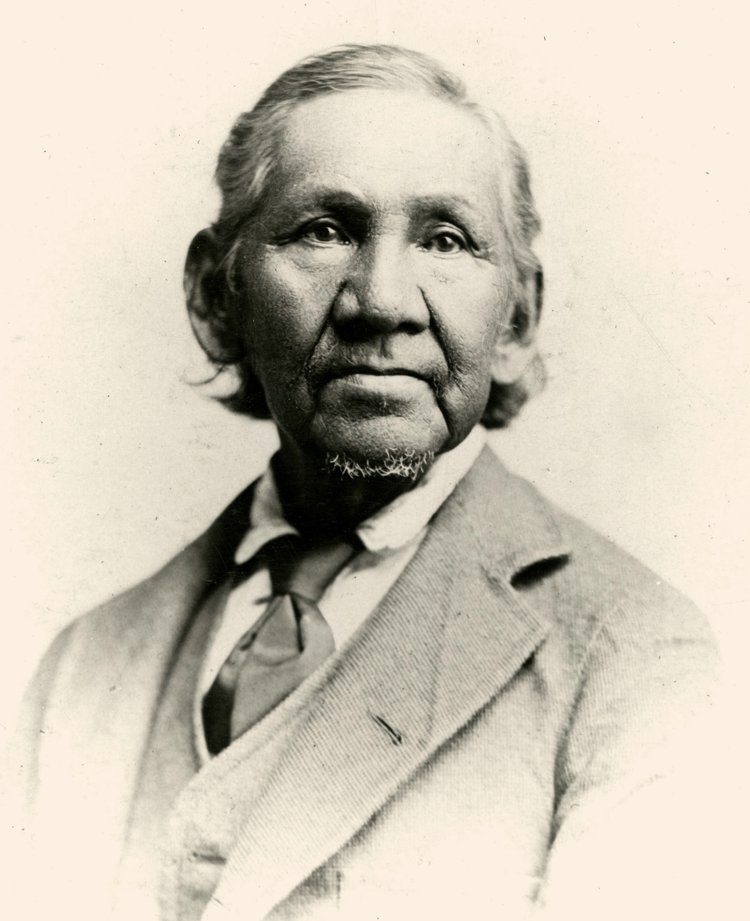
Historical portrait of Simon Pokagon Photographer unidentified · Chicago History Museum · Public domain
The museum identifies the portrait as Simon Pokagon, a historical Potawatomi writer and leader, and explicitly labels that portrait public domain. Reuse as a named-person illustration within this broad people route, not a universal Potawatomi portrait or a picture of a present government. Existing exact asset and rights record retained. A museum-identified portrait of the named historical Potawatomi writer, not a portrait of the current Pokagon government or every Band citizen. The caption identifies its publication context as The City Beyond the White City: Simon Pokagon and The Red Man’s Rebuke/the Red Man’s Greeting, but does not name photographer or photograph date. Explicit Public domain statement applies to this portrait only, not other article images. Exact available full-frame JPEG copied unchanged; CSS crops and overlays affect card/backdrop display only.
Image, association, and reuse record reviewed 2026-10-27.
Full images are displayed proportionally above. A translucent background copy may be cropped by the viewport; it does not replace the complete image or its record.
The visual treatment does not change the research status, evidence, or remaining gaps recorded in this profile.
Start reading here
A wider Potawatomi reading route with specific community examples, not a single government, interchangeable Band histories or a complete account.
Read Citizen Potawatomi Nation’s dated explanation of 1861 and its distinct political path.
These are selected starting points. The full annotated collection, source perspectives, inspection limits and remaining research questions follow below. A starting guide is not an exhaustive history or community endorsement.
01
Identity and context
Potawatomi people continue through multiple distinct nations and communities.
Focus the next stage of research on: Bodéwadmi naming, language, Great Lakes homelands, removal and individual governments. The sources below are selected reading paths; their authorship, dates and community scope should guide how they are used.
The Pokagon account presents its homeland continuity through removal pressure. Forest County’s selected timeline entries add a Wisconsin institutional perspective. These are related Potawatomi histories with different places and periods.
Citizen Potawatomi Nation’s 2021 article describes different Citizen and Prairie Band choices and attributes an explanation of allotment and citizenship pressures to Kelli Mosteller. The treaty text and actual implementation remain separate reading tasks.
The historical portrait shows Simon Pokagon, identified by the holding museum as a Potawatomi leader and writer. It accompanies this broader reading route as one named person, without representing all communities.
Broaden direct community histories in Kansas, Oklahoma, Wisconsin, Michigan, Indiana and Canada beyond these selected examples.
Inspect original treaty instruments, implementation records and Indigenous scholarship before expanding legal or removal chronology; dated estimates and current rules are not established here.
The 2005 endpoint of the Forest County timeline and the 2021 Citizen article do not verify present operations, population or economic outcomes.
Language-specific naming, diverse migration accounts and additional community voices remain open. No community review or endorsement is recorded.
Selected actual-content works support a bounded starting guide. Earlier source objects retain their original review dates and limits. Reused URLs, images and identity-only checks are not new global historical works. Full history and community review remain open.
Follow the reading path
Sources & further reading
Open any title to read the original source. Annotations explain what each link can help you explore.
No Indigenous-led source is identified in this entry yet. This is a gap in this collection, and does not imply an absence of community knowledge or organization.
Community or Indigenous-organization perspective linked for this entry. Use “160th anniversary of becoming the Citizen Potawatomi - Potawatomi.org” to begin with the publisher’s own account; check whether its scope is one community or a wider people.
Community or Indigenous-organization perspective linked for this entry. Use “CPN celebrates 25th anniversary of name change - Potawatomi.org” to begin with the publisher’s own account; check whether its scope is one community or a wider people.
Community or Indigenous-organization perspective linked for this entry. Use “Timeline of Potawatomi History” to begin with the publisher’s own account; check whether its scope is one community or a wider people.
The Nation’s 2021 account attributes interpretation to Cultural Heritage Center director Kelli Mosteller and discusses the 1861 treaty, differing Citizen and Prairie Band choices, allotment and citizenship pressures. These are particular historical paths, not all Potawatomi experience.
Inspection: Content reviewed for the stated scope
Scope: Actual full article body, web lines 39–81 read. The underlying treaty and its implementation records were not inspected. Dated population and economic totals are not repeated.
Publication: Undated; footer year is not treated as publication date
Substantive public history from a particular Potawatomi government. Useful for differences within related peoples and continuity through removal pressures. Legal summaries, casualty estimates and court details are not independently established here. Other ritual and clan sections are outside the selected synthesis.
Inspection: Content reviewed for the stated scope
Scope: Actual History section, web lines 511–522, and introductory culture paragraphs 499–503. Linked videos, archives and other sections not claimed as reviewed works.
A substantial community chronology, counted as one work. Selected institutional entries add a Wisconsin perspective rather than a universal Anishinaabe history. Origin dates, treaty totals, population figures and imprecise legal labels are excluded. The timeline's endpoint is not evidence of present operations.
Inspection: Content reviewed for the stated scope
Scope: Actual full timeline body read, web lines 59–171; synthesis uses 1937 and 1994–2002 institutional entries. A later same-day refetch timed out after successful initial inspection.
Supporting portrait identity and item-specific public-domain designation. The broader article is not added as another substantive history work.
Inspection: Supporting or limited review; see scope
Scope: Actual museum paragraphs75–85 and portrait caption81 inspected for named Potawatomi author and portrait-specific Public domain. Other article images have different credits and were not reused.
Review recorded: October 27, 2026
Counting note: Visual identity and rights support only; excluded from starting-guide substantive works.
Related entries may represent alternate names, constituent communities, wider groupings, or historical connections. Read the naming notes before treating entries as equivalent.
Robey’s Atlas of Indigenous North America · Compiled October 19, 2026 · Potawatomi