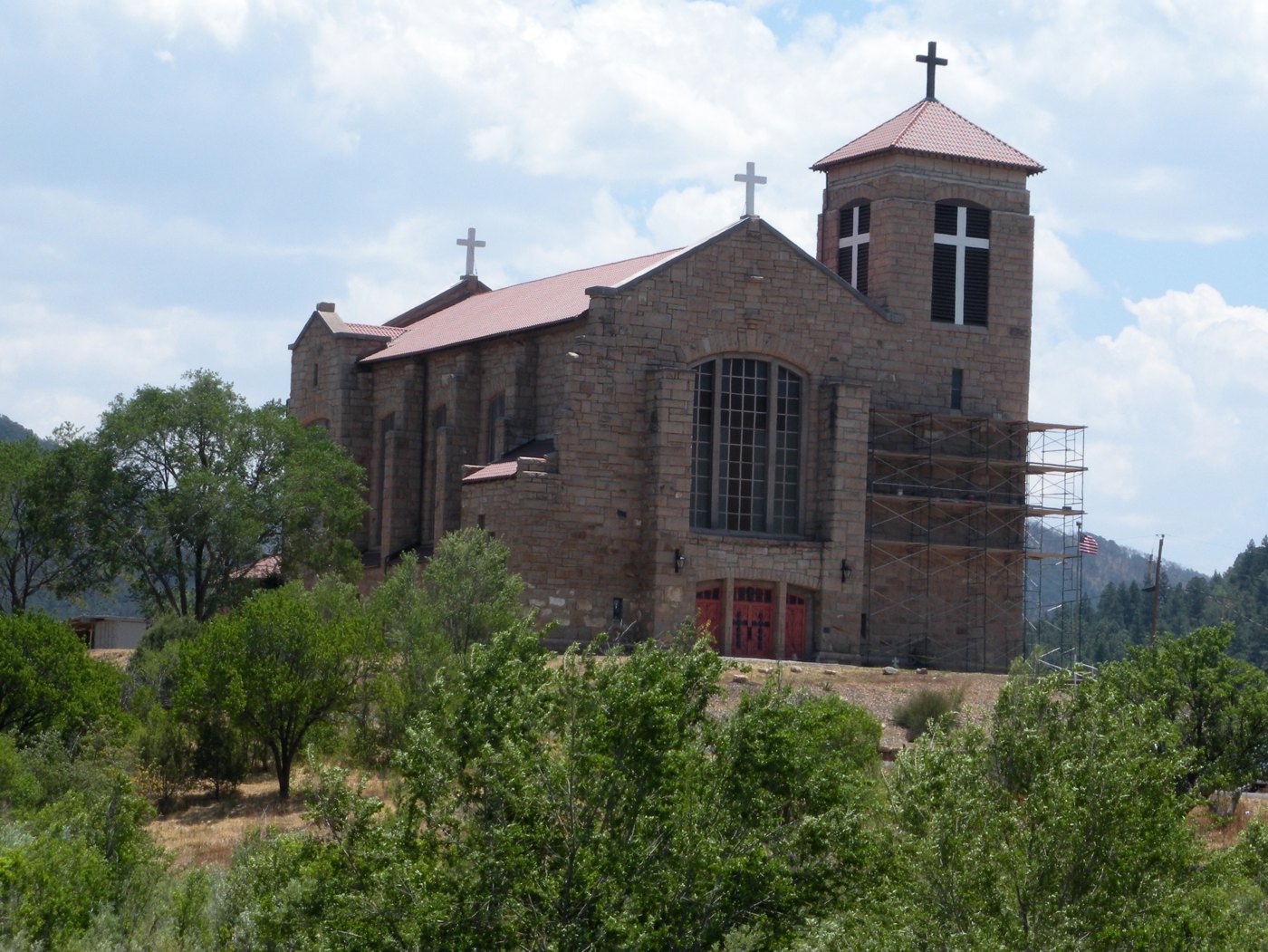
St. Joseph Apache Mission, Mescalero, during restoration in 2011ADSCN3656 (St. Joseph Apache Mission, Mescalero, New Mexico), photo by mr_t_77, June 3, 2011. CC BY-SA 2.0, via Wikimedia Commons.
The Mescalero Apache Tribe’s public sources describe a contemporary community that includes Mescalero, Lipan, and Chiricahua people. This reading path brings together the Tribe’s public history, language-program goals and a dated 2024 education update, its posted constitution, Texas-focused historical research, and a peer-reviewed account of a Tribe-requested family-program pilot. It is an initial introduction, not a complete history or a substitute for distinct community accounts from Mescalero, Lipan, and Chiricahua people.
See each region’s evidence for historical or present-day scope.
Homeland / region
Southern New Mexico / Texas / northern Mexico
Research depth
Cited overview
Source collection
8 annotated resources · 2 Indigenous-led
Inspected sources
8 substantive works · selected content reviewed
Initial adequacy
Adequate initial introduction
Source review
October 23, 2026
A cited introduction, with more to explore.This overview draws together the linked sources below. It is an introduction, and does not replace community-authored histories or a full scholarly study.
Adequate initial introduction
Eight substantive works provide an initial path across the Tribe’s public identity and reservation history, a dated posted constitution, the Tribe’s language-program goals and a September 2024 program snapshot, a Texas-focused government synthesis whose source pool and draft received Historic Preservation Officer input, an NPS regional interpretation, and a peer-reviewed Mescalero Apache–University of New Mexico participatory-research article coauthored with Mescalero program staff. The 2024 update reports hiring and plans at that time but does not confirm subsequent delivery or outcomes. The research article concerns a specific 2013–2014 pilot rather than current service delivery. This remains an initial introduction—not a complete history, community endorsement, or claim that the broader research target has been met.
Assessment recorded October 23, 2026. This is separate from research completion and community review.
The Tribe’s Our Culture page is undated and contains broad older language; only identity, broad geography, reservation history, and non-sensitive public foodways context were used.
The 2023 tribal commemoration says Lipan members joined the reservation community in 1905; the Tribe’s undated Our Culture page says about 1903. This difference remains unresolved.
The posted constitution is amended through October 18, 1988; newer ordinances and current legal updates were not reviewed.
TxDOT’s 2020 report was inspected selectively, not cover to cover. It is a government synthesis, though its introduction documents source approval and draft comments from the Tribe’s Historic Preservation Officer. Most cited underlying records were not independently inspected.
The NPS page gives a short historical interpretation without showing its underlying sources; its language about disappearance from the Trans-Pecos is not used to imply the disappearance of Mescalero people.
Further community-authored publications and distinct perspectives from Mescalero, Lipan, and Chiricahua members and institutions are needed. No community review or endorsement of this Atlas profile is recorded.
TxDOT report maps and figures were not visually inspected or connected to a profile; the report’s page 50 culturally sensitive planning section was deliberately not opened.
No current population, enrollment, acreage, language-program status, or other changeable figures are claimed.
The 2017 participatory-research article concerns a small 2013–2014 pilot with incomplete follow-up; it does not establish current services, community-wide outcomes, or long-term effects. Its broader homeland description is not a boundary survey.
The undated Ndé Bizaa’ page states language-program goals and planned approaches but gives no current schedule, baseline, fluency counts, or measured outcomes; possible future strategies are not treated as implemented policies.
The September 2024 language-program update is a dated snapshot: planned class start dates and recruitment are not verified as later implementation, and no follow-up outcomes were reviewed.
Backdrop photographs & credits
These photographs have individual, documented connections to this entry. Their captions and source records define the people, place, object, and period shown; no one photograph represents every community within a broader label.
St. Joseph Apache Mission, Mescalero, during restoration in 2011 ADSCN3656 (St. Joseph Apache Mission, Mescalero, New Mexico), photo by mr_t_77, June 3, 2011. CC BY-SA 2.0, via Wikimedia Commons.
A public exterior photograph of a documented Mescalero Apache community institution. The mission's own restoration site says it was built to serve the Mescalero Apache Reservation and has served the community's spiritual and communal needs. This is a community-landmark image; it does not show a traditional Mescalero basket or clothing, and should not be captioned as representing the beliefs of all Mescalero Apache people. Actual primary Flickr HTML, image-specific license link and Commons file record were inspected; the complete downloaded source frame was visually reviewed. Restoration scaffolding is visible. This dated public exterior is community-landmark context, not traditional basketry, interior art or a statement that all Mescalero Apache people share a faith. Mission context is its own institutional account, not a tribal endorsement or independent historical audit. No people, ceremonies or restricted activities are shown. Proportional web resizing/compression only; background/card CSS may crop or overlay. All image adaptations retain CC BY-SA 2.0. No generated or retouched image content. Complete source frame is shown proportionally in the page banner; no endorsement is implied.
Image, association, and reuse record reviewed 2026-10-25.
Full photographs are displayed proportionally above. A translucent background copy may be cropped by the viewport; it does not replace the complete image or its record.
The visual treatment does not change the research status, evidence, or remaining gaps recorded in this profile.
Start reading here
The Mescalero Apache Tribe includes Mescalero, Lipan and Chiricahua people, while those peoples and other communities retain distinct histories. Read only the identified public passages; ceremonial and animal protocols, culturally sensitive report material and participant data are outside the synthesis.
This community-partnered study gives a concrete 2013–2014 family-program example with explicit research and outcome limits.
These are selected starting points. The full annotated collection, source perspectives, inspection limits and remaining research questions follow below. A starting guide is not an exhaustive history or community endorsement.
01
A present-day Tribe and its own public history
The Mescalero Apache Tribe’s official pages describe a contemporary community that includes Mescalero, Lipan, and Chiricahua people. Its 2023 anniversary account presents these as three bands working together to preserve ancestral homelands, traditions, and culture. The Tribe’s public constitution, in its posted version amended through 1988, defines membership irrespective of Apache band and sets out a formal government framework. This dated constitutional text is useful for institutional history; it is not a substitute for current codes or a community-reviewed explanation of each band’s distinct history. A 2017 peer-reviewed article by University of New Mexico and Mescalero Apache program staff describes a Tribe-requested research partnership, a Tribal Council resolution to co-write and co-submit the project, and a Mescalero Apache Tribal Research Team that adapted and piloted a family program. The article says the publication was approved by the Tribal Council and Southwest Tribal IRB. This documents a dated community-based research process, not current program delivery or a universal description of Mescalero family life.
The Tribe’s Ndé Bizaa’ Language Program says its mission is to support Apache language and culture and describes language as important to identity and community well-being. Its stated goals include increasing the number of fluent speakers, Apache use across age groups and settings, literacy, knowledge of history, and participation in cultural activities. The undated page lists documentation, curriculum updates at the Language Program, immersion school and K–12 schools, language materials, and development of future language teachers; later items are possible approaches, not confirmed policy. A September 2024 program update reports that two immersion teachers had been hired for early-childhood settings, with classes planned to begin at specified sites, and describes efforts to recruit mentor–apprentices and learn from other language programs. Those are dated reports and plans, not confirmation that classes began as scheduled or remain active. Neither page supplies present fluency figures or measured outcomes. Ceremony-specific material is not repeated.
The Tribe’s undated Our Culture page describes historical Mescalero movement through Texas and neighboring parts of the Southwest and northern Mexico. TxDOT’s 2020 report focuses specifically on the locations and periods of Mescalero Apache presence in Texas. Its introduction says its source set was recommended and approved by the Tribe’s Historic Preservation Officer and that her draft comments were addressed. The report remains a government synthesis, and it sometimes uses Apache as an inclusive label for several historical bands. Its regional account does not define the present Tribe’s boundaries or imply that every Apache group in Texas was Mescalero. The collaborative study also describes Mescalero homelands across the current reservation and broader Southwest regions of Texas, Arizona and Mexico. This is the article’s broad historical framing, not a boundary survey; its underlying historical sources were not independently checked here.
Historical names and changing political conditions
Spanish and later writers applied changing names to Apache communities, sometimes based on outsiders’ descriptions rather than names used within the communities. The TxDOT report lays out this problem while tracing a broad chronology from Spanish Texas through the nineteenth century; the Fort Davis National Park Service page adds a shorter Trans-Pecos chronology. Read their group labels and accounts of conflict as period-specific descriptions, not as a single timeless Apache identity. NPS’s wording about a historical end to free-roaming Mescalero presence in the Trans-Pecos does not mean the people disappeared. The study provides a dated background on the three bands brought together at the reservation and on family connections to ancestral bands, while noting that the present institutional community formed through reorganization. These statements are attributed to the authors and are read alongside the Tribe’s own public account and dated constitution.
Reservation history and the Tribe’s commemorative perspective
The Tribe’s 2023 article commemorates the May 1873 designation of the present reservation and quotes then-President Edward Martinez describing the event as a return to homeland and a point of resilience. Those statements convey the Tribe’s public interpretation and are attributed to its speaker. The same article dates Lipan arrival at the reservation to 1905, while the undated Our Culture page says “about 1903.” The available pages do not resolve that difference, so this guide preserves both formulations rather than selecting one.
Begin with the Tribe’s own public history and its 2023 reservation-anniversary account, then compare the posted constitution’s dated framework with the 2020 TxDOT report and the Fort Davis NPS page. Keep community statements, government research, and park interpretation distinct. The TxDOT report contains maps that were not inspected as images, and it separately marks culturally sensitive planning resources; that section was not opened. More work is needed on community-authored accounts from Mescalero, Lipan, and Chiricahua people, the primary records behind the historical chronology, current legal materials, and differences among historical labels. Read the 2017 Mescalero Apache–University of New Mexico study as a specific example of Tribal-directed, co-produced research and a family curriculum pilot, not as a current program directory. The pilot ran in 2013–2014 with a small participant group and short follow-up; the article itself says its long-term impact required further evaluation. Its broader homeland statements should be checked against the Tribe’s own sources and the underlying historical evidence.
The Tribe’s Our Culture page is undated and contains broad older language; only identity, broad geography, reservation history, and non-sensitive public foodways context were used.
The 2023 tribal commemoration says Lipan members joined the reservation community in 1905; the Tribe’s undated Our Culture page says about 1903. This difference remains unresolved.
The posted constitution is amended through October 18, 1988; newer ordinances and current legal updates were not reviewed.
TxDOT’s 2020 report was inspected selectively, not cover to cover. It is a government synthesis, though its introduction documents source approval and draft comments from the Tribe’s Historic Preservation Officer. Most cited underlying records were not independently inspected.
The NPS page gives a short historical interpretation without showing its underlying sources; its language about disappearance from the Trans-Pecos is not used to imply the disappearance of Mescalero people.
Further community-authored publications and distinct perspectives from Mescalero, Lipan, and Chiricahua members and institutions are needed. No community review or endorsement of this Atlas profile is recorded.
TxDOT report maps and figures were not visually inspected or connected to a profile; the report’s page 50 culturally sensitive planning section was deliberately not opened.
No current population, enrollment, acreage, language-program status, or other changeable figures are claimed.
The 2017 participatory-research article documents a Tribe-requested pilot and includes a broad historical homeland summary, but its cited historical sources were not independently reviewed and it does not establish current family-program availability or outcomes.
The Ndé Bizaa’ language-program page is undated and does not provide current implementation, fluency data, curriculum materials, or outcome measures.
The September 2024 language-program update is a dated snapshot: planned class start dates and recruitment are not verified as later implementation, and no follow-up outcomes were reviewed.
Follow the reading path
Sources & further reading
Open any title to read the original source. Annotations explain what each link can help you explore.
No Indigenous-led source is identified in this entry yet. This is a gap in this collection, and does not imply an absence of community knowledge or organization.
The National Park Service’s Fort Davis page offers a brief regional historical interpretation of Mescalero Apache geography and nineteenth-century events in the Trans-Pecos. Its author and supporting record citations are not shown on the page, and its broad use of Apache labels and statement that Mescaleros had “disappeared” from the Trans-Pecos must not be read as the disappearance of a people or as a description of present identity. Use the site’s dated chronology alongside the Tribe’s own accounts and the consulted TxDOT report.
Inspection: Content reviewed for the stated scope
Scope: Read the complete visible page body (lines 21–30), including the range description, selected named events, the 1871/1875 timeline and the site’s 1881–1882 narrative. The page says it was last updated October 30, 2021. No underlying archival records or associated image were inspected.
The Tribe’s public Our Culture page is a first-party institutional account. This review uses only its statements about the present Tribe’s three named constituent bands, its account of broad historical travel through Texas and neighboring regions, and its reservation chronology. The page is undated and also contains broad older descriptions; detailed ceremonial material and animal protocols are deliberately not reproduced or treated as unrestricted cultural instruction.
Inspection: Content reviewed for the stated scope
Scope: Read the visible body at lines 14–26 and 43–56 for the Tribe’s identity, reservation chronology, homeland and foodways account. The dedicated puberty-rite description and animal protocol sections (lines 59–89) were intentionally excluded from this synthesis. Linked photographs were not inspected or reused.
The Tribe’s own 2023 commemoration describes its communitywide anniversary event for the present reservation boundaries and quotes then-President Edward Martinez explaining the Tribe’s interpretation of the 1873 designation. The article describes the contemporary Tribe as comprising Mescalero, Lipan, and Chiricahua bands and gives a Lipan arrival date of 1905, while the Tribe’s undated Our Culture page says “about 1903”; that discrepancy is left open. Statements about time immemorial and ancestry are attributed to the Tribe or its president, not independently established by this article.
Inspection: Content reviewed for the stated scope
Scope: Read the full visible article body, especially the Tribe’s account of the 1873 anniversary, the quoted statement from President Edward Martinez, its description of three constituent bands, and the 1905 Lipan / 1913 Chiricahua chronology (lines 13–34). The linked resolution and parade video were not opened; ceremonial activity is not described beyond the article’s public event summary.
Present-day community·Reservation history·Texas connections·Lipan and Chiricahua histories
Primary community-government documentMescalero Apache Tribe; constitution text identifies the U.S. Department of the Interior / Office of Indian AffairsSource 4
Publication: Approved March 25, 1936; revised January 12, 1965; amendments shown through October 18, 1988
The constitution is a primary source for the Tribe’s formally stated governmental framework in the version posted: Article I defines membership irrespective of Apache band, Articles II–III address jurisdiction and reservation property, and Articles VII–VIII describe the branches and Tribal Council. The page states that the text is amended through 1988. It is not used as a complete statement of current ordinances or present policy; current legal amendments were not checked, and period-specific membership wording is not repeated in this profile.
Inspection: Content reviewed for the stated scope
Scope: Read the title, revision history, preamble, Articles I–III and VII–VIII, including the Council composition/election provisions (visible lines 13–215). Selected Tribal Council powers in Article XI were read (lines 357–435). Remaining articles and current ordinances were not reviewed.
Government historical research report developed in consultation with the Tribe’s Historic Preservation OfficeTexas Department of Transportation, TxDOT Tribal Histories ProjectSource 5
This 54-page government report specifically studies locations and periods of Mescalero Apache presence in Texas. Its introduction says the sources were recommended and approved by Mescalero Apache Tribe Historic Preservation Officer Holly Houghton, who also commented on the draft; the report itself remains a TxDOT synthesis, not a Tribe-authored work. It combines historical, archaeological, linguistic, oral-history, and contemporary sources and says its broad contextual narrative is inclusive of Apache bands. Older names such as Querecho, Natage, and Lipan should therefore remain attributed and should not be collapsed into present-day government identities. Findings and colonial descriptions are attributed to the report and its cited authors.
Inspection: Content reviewed for the stated scope
Scope: Read PDF pages 3–4 (method, consultation and scope), 7–8 and 10–12 (selected early records and historical-name table), 35–40 (Texas-era chronology and reservation context), and selected lines on pages 41 and 48–49. The 54-page report was not read cover to cover. Page 50’s section explicitly labeled culturally sensitive for future planning was not opened. Maps and figures were not visually inspected or used as map evidence; most cited underlying records were not independently checked.
Texas historical geography·Apache group names·Colonial and nineteenth-century records·Reservation history
Peer-reviewed community-based participatory researchPublic Health Reviews 38 (2017), article 30; University of New Mexico and Mescalero Apache community partnership; PubMed Central open-access copySource 6
A peer-reviewed article coauthored by University of New Mexico researchers and staff affiliated with the Mescalero Apache Prevention Program and System of Care. It reports that the Tribe requested the partnership, that a Tribal Council resolution supported co-writing and co-submission, and that a Mescalero Apache Tribal Research Team adapted and piloted a family program. The authors state the manuscript received Tribal Council and Southwest Tribal IRB approval. The study concerns a specific 2013–2014 pilot, not current program availability, all Mescalero families, or long-term outcomes. Its brief historical statements—including a broad homeland context spanning parts of Texas, Arizona and Mexico—remain attributed to the article; the underlying historical records were not checked here. The Atlas does not reproduce curriculum materials, participant data, images, or private content.
Inspection: Content reviewed for the stated scope
Scope: Read the open-access article body: publication metadata, abstract, research-partnership and historical-background sections, team formation and curriculum adaptation, pilot design and sample, selected results, discussion/conclusion, acknowledgments, approval statement and data-availability note (visible sections around lines 33–160, 176–215, 224–300 and 373). The pilot is discussed only as a dated collaborative research project; small sample, incomplete follow-up, short duration, and the authors’ statement that no difference in substance use was observed are kept in view. No participant-level data, session materials, images or follow-up study results were accessed. Cited historical works were not independently reviewed.
The Tribe’s first-party language-program page states a mission to support Apache language and culture and sets goals for increasing fluent speakers, language use across ages and settings, literacy, knowledge of history, and participation in cultural activities. It outlines documentation, curriculum development at Tribal schools/programs, language materials, and teacher development. Later items on the page are framed as possible strategies, not current commitments. The page is undated and does not report current schedules, fluency counts, or outcomes. Sacred and animal-specific guidance on the same page is not reproduced or elaborated.
Inspection: Content reviewed for the stated scope
Scope: Complete visible Ndé Bizaa’ page read. The mission, stated goals, current strategy headings, teaching settings, teacher-development goals, and proposed future approaches were reviewed. Sacred/culturally sensitive details were excluded from the synthesis; linked images and curriculum materials were not reviewed.
Review recorded: October 23, 2026
Access note: Public page on the official Mescalero Apache Tribe website; undated. The atlas links to the page and does not reproduce text or images.
A two-page program update linked from the Tribe’s September 9, 2024 news post. It reports that two immersion teachers had been hired for early-childhood settings, describes intended start dates for classes, and reports recruitment and peer-learning activity for a mentor–apprentice program. These are statements in a dated program snapshot; its plans are not confirmation that classes began as scheduled or remain active, and the report provides no later outcome data. Ceremony-specific material is not summarized.
Inspection: Content reviewed for the stated scope
Scope: Visually inspected both pages of the complete two-page scanned PDF after rendering; the PDF has no searchable text. Read the program update, including reported immersion-teacher hiring, planned early-childhood classes, mentor–apprentice recruitment and program visits. Used only language-education details. Ceremony-specific content was deliberately excluded. No linked curricula, lesson materials, current program schedule, or subsequent outcome reports were reviewed.
Review recorded: October 23, 2026
Access note: Public PDF linked from the Mescalero Apache Tribe website. The page was an image scan and required visual rendering to inspect; the atlas links to the original PDF and does not reproduce it.
Related entries may represent alternate names, constituent communities, wider groupings, or historical connections. Read the naming notes before treating entries as equivalent.
Robey’s Atlas of Indigenous North America · Compiled October 19, 2026 · Mescalero Apache