Lipan Apache is a living people whose community histories cross Texas, northern Mexico, and neighboring regions. Lipan Apache accounts and historical scholarship describe multiple bands, settlements, and routes; present-day communities should not be collapsed into one historical movement or equated with every Apache community.
See each region’s evidence for historical or present-day scope.
Homeland / region
Texas / northern Mexico / New Mexico
Research depth
Cited overview
Source collection
21 annotated resources · 11 Indigenous-led
Inspected sources
14 substantive works · selected content reviewed
Initial adequacy
Still unfinished
Source review
October 23, 2026
A cited introduction, with more to explore.This overview draws together the linked sources below. It is an introduction, and does not replace community-authored histories or a full scholarly study.
Still unfinished
This Texas-focused collection now contains fourteen substantive inspected works, including Tribe-hosted history and treaty records, a full scholarly place-name study, the text of a ratified multination treaty, federal correspondence about a small Lipan group at Fort Griffin, and local reporting on a contemporary Presidio historical-stewardship project. The numerical target is exceeded, but the collection remains unfinished: direct community-source depth and coverage of related Lipan communities remain uneven; treaty implementation and party-specific responses are unverified; two earlier treaty scans and two full theses/dissertations remain unread; and legal and chronology questions remain open. The 1876 federal report describes one group and government proposals, while the 2024 news report documents one local project through attributed interviews; neither should be generalized to all Lipan people. No community review is recorded.
Assessment recorded October 23, 2026. This is separate from research completion and community review.
The 1838 and 1844 treaty scans linked by the Tribe were not readable in the available reader; do not treat the landing pages as inspected treaty text. The 1846 multination treaty was read, but it does not establish implementation or a uniform Lipan response.
The 2026 UTEP dissertation and 2016 UTRGV thesis were inspected only through repository abstracts; full texts returned automated HTTP 403 responses and remain unread and uncounted.
The TSHA article is an outside historical synthesis; its bibliography points to community historians, archival records and scholarship that require separate review.
The 1903/1904 difference for Lipan arrivals at the Mescalero community and the 1934/1936 reorganization dates need source-level resolution.
The Texas State Library and Archives map 01413 remains metadata-only; the image was not inspected and no map-to-profile association has been made.
The Webster place-name article is based primarily on one narrator’s 1938 account, includes some unidentified locations, and should not be used to draw a fixed homeland boundary or generalize beyond its own small sample.
Current legal status, enrollment, population, language use and relationships among Lipan communities in Texas, New Mexico, Oklahoma and northern Mexico require further, carefully scoped research.
No community review or endorsement has been recorded.
The 1876 Fort Griffin report is a federal administrative compilation. Its statements concern one Lipan group and federal policy; underlying records, a Lipan-authored interpretation, and whether recommendations were implemented remain unverified.
The 2024 Marfa Public Radio report is a useful dated local case study, not a comprehensive history written by the Tribe; the audio was not played, and its accounts should remain attributed to the interviewees.
Backdrop images & credits
These images have individual, documented connections to this entry. Their captions and source records define the people, place, object, and period shown; no one image represents every community within a broader label.
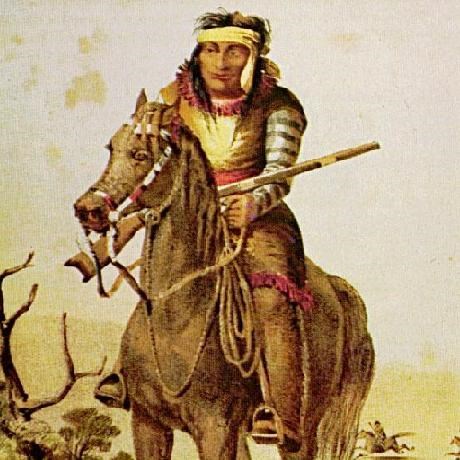
Lipan rider — NPS detail after Arthur Schott After Arthur Schott · National Park Service reproduction · Historical print detail
NPS explicitly identifies this as a drawing of a Lipan man on horseback and credits NPS. The design was compared with the complete primary museum/UNT image of the print catalogued as published in 1857; the title and Schott / Sarony, Major & Knapp imprint were visible in that comparison. Reuse of the old design is based on its documented nineteenth-century publication, not on an inference that Schott was an NPS employee or that NPS owns every hosted image. National Library of Medicine historical-copyright guidance was inspected for the pre-1923 public-domain rule. Exact NPS source impression, scan lineage and digital preparer remain unidentified, and no individual permission grant, CC0 or Creative Commons license is claimed. This is an outside historical illustration, not a photograph, a named current community member, Lipan-made artwork, a universal depiction of clothing or a surveyed territorial boundary. The exact downloaded 460×460 agency detail was visually inspected and copied byte-for-byte with no resizing, retouching, generation or additional pixel crop. It is already cropped and low resolution; the NPS source impression’s missing margins and scanner original were not inspected. CSS crops/overlays apply to the directory card and backdrop; the opened-page image retains the complete delivered square detail. The UNT comparison was private identification research only and is not reproduced; its undetermined digital-object rights and NMAH/NMAI restrictions are not treated as permissions. Existing NMAI saddlebag rights deferral remains unchanged.
Image, association, and reuse record reviewed 2026-10-27.
Full images are displayed proportionally above. A translucent background copy may be cropped by the viewport; it does not replace the complete image or its record.
The visual treatment does not change the research status, evidence, or remaining gaps recorded in this profile.
Start reading here
Lipan Apache people and distinct contemporary communities span Texas, northern Mexico and neighboring regions; their histories are not one route or synonymous with every Apache community. The timeline and historical synthesis remain authored interpretations, and one narrator’s place names are not a surveyed boundary.
Named descendants and collaborators describe a concrete community-led public-history and protection project in this 2024 report.
These are selected starting points. The full annotated collection, source perspectives, inspection limits and remaining research questions follow below. A starting guide is not an exhaustive history or community endorsement.
01
A living people and a present-day community
The Lipan Apache Tribe of Texas describes a united Lipan Apache community today while preserving the names and histories of distinct historical bands. Its account places families in Texas and across the border in northern Mexico and also describes later Lipan participation in the Mescalero Apache community. These records do not make every Lipan family’s history identical or make the Tribe interchangeable with other Apache governments.
The Tribe-hosted homeland essay and its community-contributed timeline describe relationships with the upper Brazos, Colorado, Concho, San Antonio, Rio Grande and northern Mexican communities across different periods. Brandon Seale’s Handbook of Texas account offers a broader scholarly narrative. Anthony K. Webster’s linguistic study examines place names in Augustina Zuazua’s 1938 narrative to Harry Hoijer; the article gives different totals in its main text and notes, leaves some locations unidentified, and cautions against broad conclusions from this small sample. These accounts offer historically situated evidence, not a surveyed boundary or proof that all places were occupied at the same time.
Diplomacy across Spanish, Mexican, and Texas governments
Community-authored histories discuss Lipan diplomacy with Mexican and Republic of Texas authorities, including the Bustamante agreement and the 1838 Treaty of Live Oak Point. The Tribe-reproduced 1846 Council Springs treaty is a multination U.S. instrument that names Lipan alongside other Native parties; its articles address U.S.-directed trade regulation, prisoners, legal arrangements, and other terms. The Indigenous Digital Archive/National Archives catalogue gives a March 8, 1847 ratification date, though its normalized named-nations field omits Lipan. This record does not establish implementation or a single Lipan response. The 1838 and 1844 treaty scans remain unread, so their terms are not independently summarized here.
Displacement, borderlands, and community continuity
The Tribe-hosted account of nineteenth-century campaigns describes Lipan communities in Coahuila and cross-border military attacks; its language and interpretation are attributed to the author. The TSHA entry supplies a related scholarly synthesis and describes later Lipan communities in Texas and northern Mexico. Neither sparse government records nor movement into Mexico or another Apache community establish that Lipan people disappeared.
The Tribe-hosted reservation-era essay describes different Lipan groups moving to Mescalero, Tonkawa, Mexican, and Texas communities. The Mescalero Apache Tribe’s own history says Lipan survivors joined its community in about 1903; the Lipan Tribe-hosted essay dates one group’s joining to 1904. These accounts concern related but not necessarily identical events, and the one-year difference remains unresolved. A 2021 Fort Davis National Historic Site page says Lipan had no longer a “discernible presence” in their homeland after some families joined Mescalero. Later community and scholarly accounts document continuing Lipan communities and institutions, so the NPS phrase is not used here as evidence that Lipan people disappeared. Its stated 1936 Mescalero incorporation date also differs from the Mescalero Tribe’s 1934 date. A 1876 federal compilation adds a separate Fort Griffin strand: officials reported that a small Lipan group moved there from Fort Sill in 1874, and the 1875 Interior Department commissioner described intermarriage with Tonkawa people and considered several possible relocation arrangements. This is administrative correspondence, not a Lipan account; it does not show that the proposed consolidation or removal occurred and cannot stand for all Lipan groups.
Present-day institutions and public historical work
The Lipan Apache Tribe of Texas describes its Tribal Council and unified community, and it documents a 2021 transfer of a Presidio cemetery to the Tribe and a later collaboration around site protection and interpretation. A 2026 congressional bill proposing federal recognition was introduced and referred to committee; that proposed legislation is not an enacted law. This page makes no current population claim and does not substitute for the Tribe’s own legal or membership information. A 2024 local report follows the completion of a Presidio cemetery protection project, documenting participation by descendants and Lipan Apache Tribe of Texas leadership. It describes a historical-marker text drafted by an enrolled member in collaboration with the Texas Historical Commission and public historical interpretation developed for the site. These interviews document one dated local project and its participants, not all Lipan communities or a comprehensive account of Lipan history.
Lipan people at Fort Griffin in federal records, 1874–1876
An eight-page 1876 congressional document reproduces federal and military correspondence about Lipan people at Fort Griffin alongside Tonkawa people. Officials report authorizing a small Lipan group to move from Fort Sill in 1874, ending regular ration issues in 1875, and seeking help for both communities. An Interior Department letter describes the Lipans as related to Tonkawa people by intermarriage and considers possible destinations, including Mescalero or Hot Springs agencies. This is a colonial administrative record: its labels, descriptions, and policy proposals reflect federal officials. It does not establish a general Lipan-Tonkawa political merger, prove any proposed move occurred, or represent every Lipan community.
The 1838 and 1844 treaty scans linked by the Tribe were not readable in the available reader; do not treat the landing pages as inspected treaty text. The 1846 multination treaty was read, but its implementation and Lipan-specific response remain unverified.
The 2026 UTEP dissertation and 2016 UTRGV thesis were inspected only through repository abstracts; full texts returned automated HTTP 403 responses and remain unread and uncounted.
The TSHA article is an outside historical synthesis; its bibliography points to community historians, archival records and scholarship that require separate review.
The 1903/1904 difference for Lipan arrivals at the Mescalero community and the 1934/1936 reorganization dates need source-level resolution.
The Texas State Library and Archives map 01413 remains metadata-only; the image was not inspected and no map-to-profile association has been made.
The Webster place-name article is based primarily on one narrator’s 1938 account and includes unidentified locations; it cannot support a fixed homeland boundary or broad conclusions about all Lipan place-naming practices.
Current legal status, enrollment, population, language use and relationships among Lipan communities in Texas, New Mexico, Oklahoma and northern Mexico require further, carefully scoped research.
No community review or endorsement has been recorded.
October 22, 2026 follow-up: the collection now has twelve substantive inspected works (ten previously counted, plus Webster’s 2007 article and the 1846 Council Springs treaty text), seven supporting records excluded from the count, and six cited sections. Reaching the numerical target does not complete the research or establish adequacy/community endorsement. Webster’s full article analyzes place names centered on Augustina Zuazua’s 1938 narrative. The article cautions that broad claims cannot be made from its small sample; the abstract/main discussion mention 22 names while a note mentions a twenty-third, and some places are unidentified. The Atlas uses it as attributed linguistic/ethnohistorical interpretation, not as a boundary source. The full six-page 1846 Council Springs treaty text was read. It is a multination instrument naming Lipan among other Native parties and was ratified in 1847 according to the Indigenous Digital Archive/National Archives catalogue. The catalogue’s normalized “Named Native nations” field omits Lipan despite its title and the treaty preamble; this indexing discrepancy is preserved. Treaty text is not evidence by itself of implementation, a uniform Lipan response, or a modern homeland boundary. The 2026 H.R. 10435 text and UTEP dissertation abstract were rechecked as supporting records only. Proposed legislative findings and a dissertation abstract are attributed positions, not independently corroborated findings; the full dissertation and the UTRGV thesis remain unread after automated HTTP 403 responses. The earlier Lipan source review remains valid for its original eight-source addition and other inspection limits. The current initial adequacy is Still unfinished because substantive gaps remain despite reaching twelve inspected works. No historical map was added or assigned.
Follow the reading path
Sources & further reading
Open any title to read the original source. Annotations explain what each link can help you explore.
No Indigenous-led source is identified in this entry yet. This is a gap in this collection, and does not imply an absence of community knowledge or organization.
Community-produced reading on identity, history, cultural continuity, and present-day priorities.
Inspection: Content reviewed for the stated scope
Scope: The complete visible “Who We Are” page was read, including its discussion of historical bands, present-day community and government, 2009 and 2019 Texas resolutions, and the 2021 cemetery transfer. Its undated registered-population figure was not repeated as current fact.
Institutional reading to place the entry in historical or linguistic context; read alongside community voices.
Inspection: Content reviewed for the stated scope
Scope: The complete Fort Davis National Historic Site page, last updated October 30, 2021, was read. It includes historical estimates and the phrase that Lipan no longer had a “discernible presence” in their homeland; this is attributed to the dated NPS page and is not carried forward as evidence that Lipan people disappeared. The page’s 1936 incorporation date also differs from the Mescalero Tribe’s own account of 1934 reorganization.
A community-published timeline credited to N. McGown Minor, H. R. Walking Woman, and D. Pompa. It offers dated entries from early colonial history through the Tribe’s 2021 cemetery transfer. Read as the contributors’ synthesis, with individual claims and date conflicts checked against other sources where possible.
Inspection: Content reviewed for the stated scope
Scope: The complete visible timeline was read, from its opening early-history entries through the 2021 cemetery transfer. The cited underlying records and the timeline’s many specific dates were not individually checked in this pass; no sensitive ceremonial details are reproduced.
A Tribe-hosted historical account describing movement and place relationships across Texas and adjacent northern Mexico. It is attributed to Nancy McGown Minor and is presented as that authored account rather than a surveyed boundary or exhaustive territorial map.
Inspection: Content reviewed for the stated scope
Scope: The complete article body was read. Its narrative is used with attribution; referenced archival records and its geographic claims were not independently reconstructed into modern boundary lines.
A Tribe-hosted essay covering Lipan relations with Mexican independence-era actors and a treaty attributed to 1822. Its narrative is cited as community-published historical interpretation; the underlying treaty manuscript was not separately examined here.
Inspection: Content reviewed for the stated scope
Scope: The complete visible article text was read. The treaty page it references and the original archival document were not independently inspected.
A Tribe-hosted historical essay about Lipan relationships with the Republic of Texas, including the Treaty of Live Oak Point and the later Tehuacana Creek negotiations. The article’s claims are attributed; the linked treaty scans were not read in this pass.
Inspection: Content reviewed for the stated scope
Scope: The full visible article body, including its discussion of 1838–1844 relations, was read. Underlying treaty texts and cited correspondence were not independently inspected.
A Tribe-hosted account of nineteenth-century cross-border military campaigns and Lipan communities in northern Mexico. Its strong characterization of military policy is the author’s interpretation and is not restated as a neutral government finding.
Inspection: Content reviewed for the stated scope
Scope: The complete visible article body was read, including the 1873 El Remolino attack and later incursions. Cited military records and Mexican archival sources were not independently inspected.
A Tribe-hosted essay on several Lipan groups’ different routes during reservation-era displacement, including families joining Mescalero, Tonkawa, and Mexican communities. The narrative does not establish that all Lipan families followed one path.
Inspection: Content reviewed for the stated scope
Scope: The complete visible article body was read. Its account says a group led by Magoosh joined the Mescalero community in 1904; the Mescalero Apache Tribe’s own public history gives 1903 for Lipan survivors arriving. The one-year difference is recorded as unresolved rather than reconciled here.
A 2023 Tribe-published project account documents collaboration with Big Bend Conservation Alliance, family descendants, and named Lipan Apache researchers on cemetery protection, interpretation, and a regional land-reclamation study. It reports project plans at publication, not present-day completion status.
Inspection: Content reviewed for the stated scope
Scope: The complete article body and named project roles were read. Grant terms, construction completion, the land-reclamation study’s findings, and any culturally restricted cemetery details were not reviewed or reproduced.
A long-form state historical reference with sections on early colonial relations, diplomacy, displacement, diaspora, enclave communities, legal history, and present-day organizations. The article is valuable for its bibliography and chronology, but its claims about continuity, boundaries, peyote history, and present institutions remain the author’s synthesis and should be compared with community records and primary sources.
Inspection: Content reviewed for the stated scope
Scope: The complete main article body, sections and bibliography were read. The bibliography identifies additional work by Lipan Apache scholars and historians, but those cited books and archival records were not inspected in this pass. No population estimate or sensitive religious content is carried into the profile.
The Mescalero Apache Tribe’s own account identifies Mescalero, Lipan, and Chiricahua as constituent subtribes and describes Lipan arrivals in the early twentieth century. This is relevant to one historical community connection, not a complete Lipan history or a claim that all Lipan people are Mescalero.
Inspection: Supporting or limited review; see scope
Scope: The page’s relevant history and reservation-history paragraphs were read. It dates Lipan arrivals to about 1903, differing by one year from the Lipan Tribe-hosted reservation essay; this discrepancy remains open.
A Tribe-hosted document route to the 1838 Treaty of Live Oak Point. Retained for further primary-source reading; it does not count as an inspected treaty text in this profile.
Inspection: Supporting or limited review; see scope
Scope: Only the document landing page and title were inspected. The linked scan was not readable through the source-review tool in this pass, so its terms, signatures, manuscript lineage, and later implementation are not summarized.
A Tribe-hosted document route to the 1844 Tehuacana Creek treaty. The treaty is important for following territory, negotiations and political relationships, but the surviving text and later record have not yet been reviewed.
Inspection: Supporting or limited review; see scope
Scope: Only the document landing page and title were inspected. The linked seven-page scan was not readable through the source-review tool in this pass; it is retained as a lead and excluded from the substantive count.
A 2026 doctoral dissertation whose repository abstract outlines an argument about non-reservation Lipan continuity and describes archival, oral-history, family-interview and community-memory methods. The abstract represents the author’s thesis, not independently verified chapter-level evidence; the full 230-page work remains a high-priority reading lead.
Inspection: Supporting or limited review; see scope
Scope: Repository metadata and abstract were read. The linked full-text request returned HTTP 403 to the available reader; that response does not establish a reader paywall. No access control was bypassed, the dissertation remains unread, and this lead is excluded from the substantive-source count.
A 2016 master’s thesis whose abstract describes semi-structured interviews with 20 registered members of the Lipan Apache Tribe of Texas. It is an important direct-research lead, but the full text was not available to inspect in this pass.
Inspection: Supporting or limited review; see scope
Scope: Repository metadata and abstract only. The full PDF request returned HTTP 403 to the available reader; this is not evidence of a reader paywall and no access control was bypassed. Excluded from the substantive source count.
The introduced September 16, 2026 bill proposes federal recognition and contains legislative findings about the Tribe. Its introduction and committee referral do not make it law; statements in bill findings are attributed to Congress as proposed text and are not treated here as independently established historical findings. Retained as a dated supporting legislative reference, not a substantive historical work.
Inspection: Supporting or limited review; see scope
Scope: The complete introduced bill text and front matter were read, including its proposed recognition and services provisions. It was introduced and referred to the House Committee on Natural Resources on September 16, 2026. This record does not establish later action or enacted status and remains excluded from the substantive research count.
A linguistic and ethnohistorical analysis centered on Augustina Zuazua’s 1938 narrative to Harry Hoijer. Webster examines how place names work in that account and cautions that a small sample from one narrator cannot support broad claims about all Lipan Apache naming practices. The article’s abstract and main text refer to 22 names, while a note identifies a twenty-third; several locations remain unidentified. These names are not a surveyed boundary or a statement of present-day territorial extent.
Inspection: Content reviewed for the stated scope
Scope: The full 20-page article was read, including its discussion of the 1938 narrative, place-name forms and discourse, comparative analysis, conclusion and notes. The author explicitly limits generalization because the corpus is small and centered on one narrator. Some locations are unidentified; no new boundary geometry is inferred.
Publication: Concluded May 15, 1846; ratified March 8, 1847 (archival catalogue date)
A multination treaty text that names Lipan among its parties. Its articles describe U.S.-directed trade regulation, prisoner return, law-enforcement arrangements and other terms. Read as a government-recorded instrument and not as proof of implementation, uniform Lipan consent or response, or a boundary. The parallel Indigenous Digital Archive/National Archives record identifies ratification on March 8, 1847; its normalized “Named Native nations” tags omit Lipan despite Lipan appearing in the catalog title and treaty preamble.
Inspection: Content reviewed for the stated scope
Scope: The full six-page treaty text was read, including its preamble, articles, amendments/stricken clauses and signatures page. The Indigenous Digital Archive/National Archives Treaty 246 catalogue record was also inspected for title, date, ratification metadata and named-nation indexing. No claim is made about implementation or the Lipan parties’ interpretation.
Archive / government catalogueIndigenous Digital Archive Treaties Explorer / National Archives partnershipSource 19Supporting reference · outside substantive inspected count
Supporting catalogue record for the multination 1846 treaty, including related National Archives file units and the March 8, 1847 ratification date. Its “Named Native nations” indexing does not list Lipan even though the catalogue title and treaty text do; this is recorded as a catalogue scope/indexing issue, not an inference about the treaty parties. Excluded from the substantive-work count because the treaty itself is counted once.
Inspection: Supporting or limited review; see scope
Scope: The full visible catalogue record and its named-nation/present-day-nation fields were inspected. Related copies are not counted as separate works.
Primary government correspondence / Congressional Serial Set documentU.S. Government Publishing Office, Congressional Serial Set; digitized by the Law Library of CongressSource 20
Publication: February 1, 1876; compiles correspondence from 1872–1876
The congressional document records federal officials’ accounts of a small Lipan group moving from Fort Sill to Fort Griffin in 1874, subsequent ration decisions affecting Tonkawa and Lipan people there, and proposed removal options. The 1875 Interior Department letter reports kinship through intermarriage and discusses a possible consolidation; it is an official’s account and recommendation, not a Lipan-authored history or evidence that the proposal was implemented. It must not be generalized to all Lipan people or treated as proof of incorporation into Mescalero Apache.
Inspection: Content reviewed for the stated scope
Scope: Read the full searchable text of the eight-page public PDF, including its letters and reports dated 1872–1876. The OCR text was inspected; the page images, handwriting, signatures, and original correspondence files were not independently inspected. The authors write from federal and military administrative positions, not as Tonkawa or Lipan narrators. No reader access restriction was encountered.
Annie Rosenthal reports on the completion of a community-led protection and interpretation project at a Presidio cemetery. Interviewed descendants, an anthropologist, the Lipan Apache Tribe of Texas vice-chairman, local conservation partners, and the project architect describe their different roles. The story reports that a descendant drafted historical-marker text in collaboration with the Texas Historical Commission and that the completed site includes public historical and cultural interpretation. Use it as a dated local case study of contemporary community stewardship, not as a complete account of the Tribe or of Lipan communities generally. The profile summarizes the public-history work and omits sensitive burial details.
Inspection: Content reviewed for the stated scope
Scope: Read the complete visible article text (approximately six-minute audio story) and captions on October 23, 2026, paragraphs covering the 2024 completion of the Presidio cemetery protection project, local descendant participation, Lipan Apache Tribe of Texas leadership, and the collaboratively drafted historical-marker interpretation. The audio itself was not played and the article photographs were not used. This is local reporting based on attributed interviews, not a comprehensive Tribe-authored history; no access restriction interrupted reading.
Related entries may represent alternate names, constituent communities, wider groupings, or historical connections. Read the naming notes before treating entries as equivalent.
Robey’s Atlas of Indigenous North America · Compiled October 19, 2026 · Lipan Apache