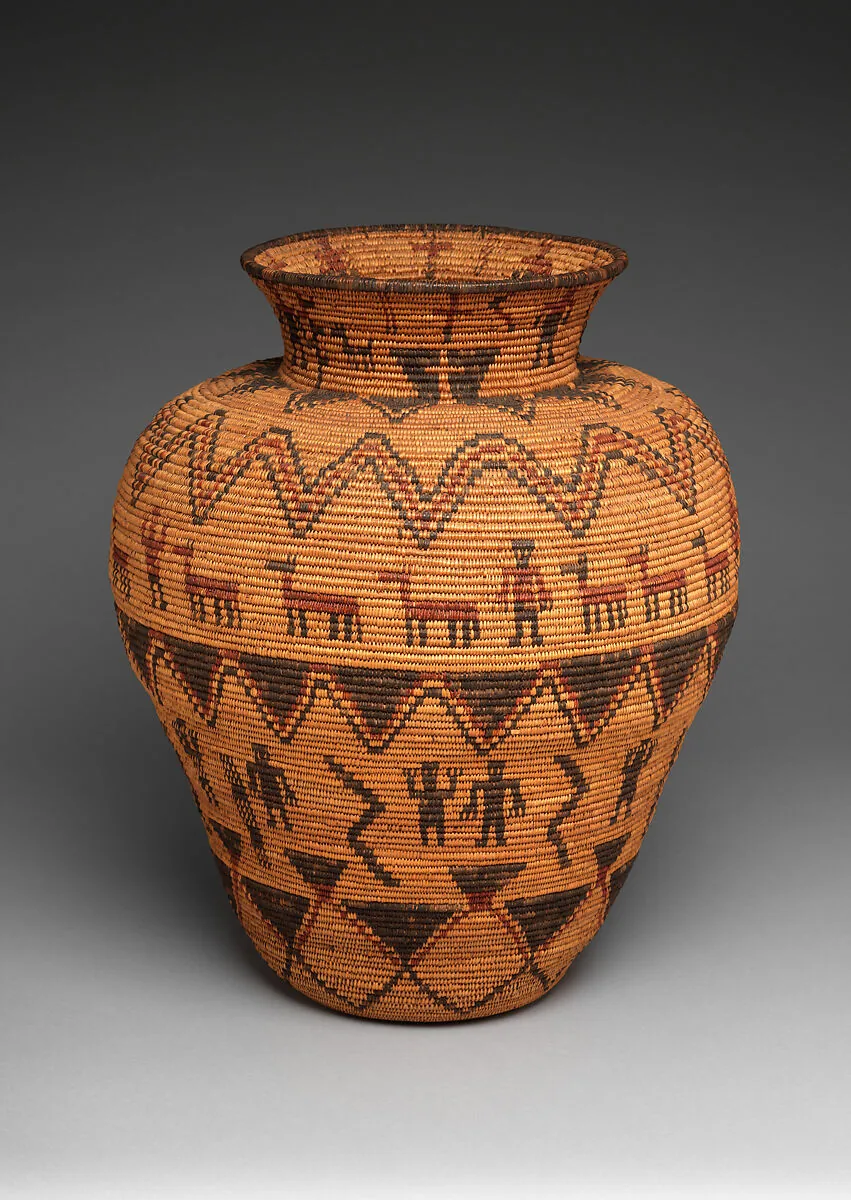
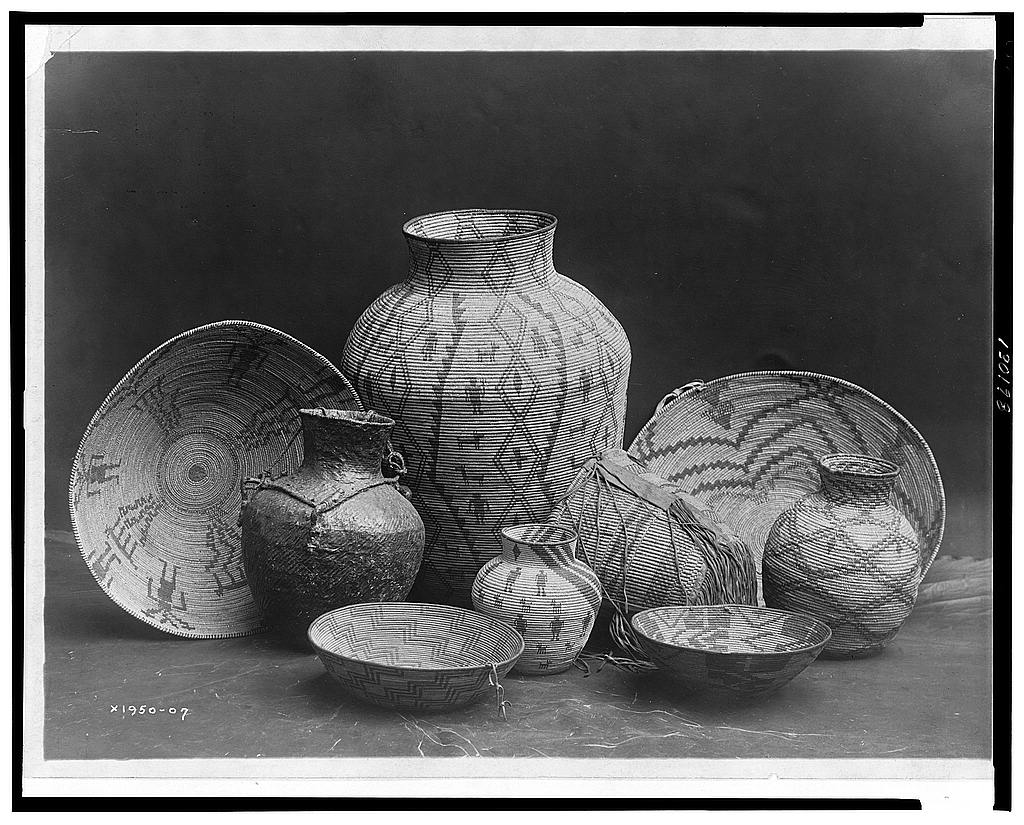
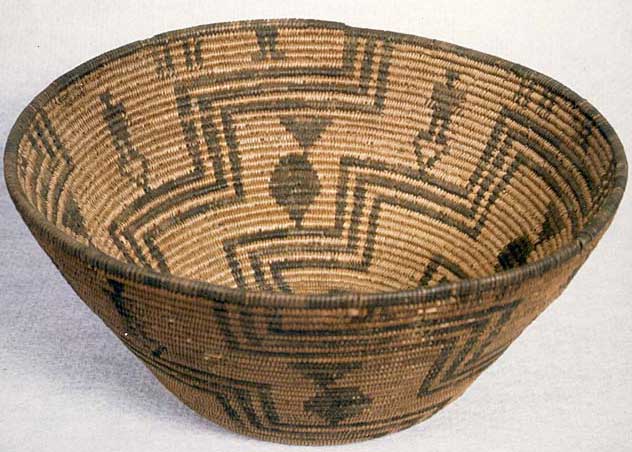
Apache storage basket · The MetEdward S. Curtis · c. 1907 · Library of CongressAttributed to Apache · USGS Museum StaffPhotographs & credits ↓
Wider grouping / peoples
Apache
Apache is a broad label spanning distinct peoples and governments. This reading path follows particular community histories, displacement, institutions and educational work, with a dated Jicarilla constitutional example and clear limits on older sources.
See each region’s evidence for historical or present-day scope.
Homeland / region
Southwest / Mexico
Research depth
Expanded profile
Source collection
15 annotated resources · 8 Indigenous-led
Inspected sources
12 substantive works · selected content reviewed
Initial adequacy
Adequate initial introduction
Source review
October 21, 2026
Names & relationshipsApache is a wider grouping. Plains/Kiowa Apache, Mescalero, Lipan, Chiricahua and Western Apache histories overlap without being interchangeable. The Fort Sill Apache Tribe and Apache Tribe of Oklahoma are separate governments; Yavapai is a distinct people within the Yavapai-Apache Nation.
An expanded introduction, with sources reviewed.This profile develops several themes through identified sources. Citations connect each section to its evidence; remaining gaps appear below. It has not been reviewed or endorsed by the community.
Adequate initial introduction
Twelve substantive works support a useful umbrella introduction across distinct community histories, displacement, constitutional organization, schooling and language-related education. Two short community introductions remain supporting references, and an unresolved language access point adds no substantive count. Actual selected-page scopes, contradictory older details and local perspectives are explicit. The quantity target is reached; coverage supports continuing alphabetically with the stated regional and topic gaps, without implying complete research or community endorsement.
Assessment recorded October 21, 2026. This is separate from research completion and community review.
A broad Apache page cannot replace a separate in-depth profile for each people or government. Jicarilla is represented here by a historical document, with modern community voices still needed.
Present program conditions, language vitality, individual eligibility and current legal rules need separate dated evidence.
Backdrop photographs & credits
Publicly available object photographs connected to the broad Apache entry. Individual objects are not representative of every Apache nation.
Apache storage basket, ca. 1890 — Apache artist, name unrecorded; specific Apache nation not identified. The Metropolitan Museum of Art, Diker Collection, gift of Charles and Valerie Diker, 2019. Source & image record · CC0 / Public Domain. Museum record and image inspected; photograph shown proportionally. Photographer not individually recorded.
Apache still life [A], c. 1907 — Edward S. Curtis. Library of Congress, Prints and Photographs Division, LC-USZ62-130198. A staged grouping of nine containers; individual makers and specific community are not identified in the record. Source & image record · No known restrictions on publication. Full catalogue body and full digital image inspected. Digital image is a copy-negative reproduction, not the original print.
Basket, attributed to Apache — Photograph: USGS Museum Staff. J. W. Powell Collection, USGS-575123. USGS says probably made by Apache and probably acquired by Powell in the 1880s. Its catalogue title gives ca. 1800; this is not a securely established making date. Source & image record · Public Domain. Source record and full digital photograph inspected; uncertain attribution retained.
Image records and photographs reviewed October 24, 2026. Layout uses neutral earth-toned gradients; no generated cultural imagery.
01
Plains Apache identity and historical scholarship
Dianna Everett's 2010 history describes the Apache Tribe of Oklahoma as a distinct linguistic and cultural community despite long relationships with other Plains peoples. Her account connects bison hunting with later reservation confinement and allotment, while acknowledging disagreements among historical and ethnographic interpretations. This Plains Apache history is a specific regional trajectory. It should be read alongside community perspectives, with the tribe kept distinct from Fort Sill's Chiricahua descendants.
Two distinct peoples within the Yavapai-Apache Nation
The Yavapai-Apache Nation’s own introduction identifies Yavapai and Apache as two distinct peoples and gives separate self-names and language affiliations. It locates the nation through five communities in Arizona’s Verde Valley. A shared government therefore should not flatten those identities into one interchangeable ethnic label. This concise primary page supplies orientation; its population figures are explicitly dated 2019, and its undated services list is not a verified current inventory.
The San Carlos Apache Tribe’s history describes seasonal movement between river valleys and higher country, linking planting, gathering and hunting with a varied landscape. It then recounts settler encroachment, confinement and assimilation policies that disrupted those relationships. Its schooling account describes separation from families and suppression of language and cultural practices. This community narrative provides a particular historical perspective; it does not establish one identical experience for every Apache people.
Fort Sill Apache history describes Chiricahua people arriving in Oklahoma in 1894 after imprisonment in Florida and Alabama. Its account follows pressure to leave the military reservation and different responses: some relocated to Mescalero in 1913, while others continued seeking promised lands near Fort Sill. It dates the latter group's release and resettlement on Oklahoma allotments to 1914. These forced movements explain distinct community histories rather than a single relocation shared by all Apache peoples.
The Mescalero Apache Tribe identifies Mescalero, Lipan and Chiricahua within its community. Its historical account dates the reservation's establishment to May 29, 1873, and describes Lipan arrivals from northern Chihuahua around 1903 and Chiricahua arrivals in 1913. These accounts connect the reservation with distinct histories of displacement and community formation. Membership in this government should not be equated with every Lipan or Chiricahua person's political belonging, or its cultural account applied to all Apache peoples.
The Lipan Apache Tribe's public history follows movement between Texas and Mexico under pressure and describes surviving communities around San Antonio, the Rio Grande Valley and Big Bend. Its narrative emphasizes continuity through displacement rather than disappearance. The page's description of a united community concerns this publishing tribe's own organization. It provides one Lipan governmental perspective, which should remain distinct from Mescalero membership and other Lipan voices.
The Jicarilla 1937 constitution provides for a representative council chosen through districts and an executive committee accountable to it. Its certification records tribal ratification on July 3 and federal approval on August 4. The text recognizes earlier tribal powers while describing a particular institutional arrangement. It supplies a historical Jicarilla example, rather than evidence that the people began in 1937 or that its membership, election and federal-review provisions are current rules.
Chiricahua imprisonment and the limits of the archive
The 2010 Chiricahua assessment follows removal and imprisonment through Florida, Alabama and Oklahoma, including the separation of children for schooling. Its introduction warns that historical timelines inherit the priorities of predominantly non-Apache records. Reading the narrative with that warning helps distinguish administrative decisions from Apache experiences. The work concerns particular Chiricahua histories; its account cannot serve as a single chronology for every Apache people or erase later community relationships.
An 1887 Senate document collects official correspondence about schooling for Apache prisoners at Fort Marion. It reports transfers to Carlisle and records a contract for teaching younger children in St. Augustine. Letters also discuss efforts to obtain parents’ agreement. These administrative voices reveal arrangements made within a system of captivity; they do not independently establish freely given consent, children’s own experiences or the officials’ claims about adequate care.
Welch’s 2011 nomination connects Fort Apache’s military history with its conversion to the Theodore Roosevelt School. It describes a federal assimilation project, initially enrolling Navajo and Hopi children, while local Apache families sought education closer to home. The resulting disputes concerned whose children the institution served and who directed its purposes. This local history shows why a school on Apache land cannot simply be assumed to have enrolled only Apache children.
San Carlos Apache College’s 2025–26 catalog traces its charter to 2014 and opening to August 2017. Its stated goals connect higher education with language and cultural renewal. Introductory language courses emphasize speaking, reading and listening, followed by grammar and increasingly complex communication. These are a particular college’s institutional history and planned curriculum, rather than proof of current enrolment, fluency outcomes or one language program for every Apache people.
A 2025 Extension report describes Gowa as a San Carlos partnership involving tribal officials, schools, a library and early-childhood services. San Carlos Apache educator Melody Grace Thomas explains selecting books with Indigenous authors, people and settings while working with Apache Language Preservation. The account shows local participation in educational materials. It does not independently establish the program’s effects or imply identical family practices across Apache communities.
The 2024 White Mountain regional report brings together census-based home-language categories, school language records and a Head Start questionnaire. Those sources ask different questions of different groups, so their results are not interchangeable measures of Apache fluency. Its language-program discussion draws on an earlier 2022 report. This makes the publication useful for understanding evidence and local context, while leaving present language use and individual learning outcomes to further research.
Tonto Apache Community School’s account dates its establishment to 2023 and describes community control over curriculum and cultural learning. It also presents an early-learning program alongside primary and elementary education. These are the institution’s own formation history and stated aims. They provide a local educational example, rather than proof of present enrolment, learning outcomes, unchanged staffing or a single school system shared by all Apache nations.
The original San Carlos language-program link remains available for further reading. Recent requests did not recover its body, so it contributes no renewed substantive count. The separately inspected college catalog and university report have their own authorship, dates and limits; they do not substitute for reviewing this page.
Broaden direct modern Jicarilla, White Mountain, Plains Apache and other community-authored language and cultural histories. The historical Jicarilla constitution is not a current government guide.
Develop foodways, arts and family perspectives without reproducing restricted ceremonies, sites, source designs or sensitive records. This pass emphasizes institutions, history and education.
The San Carlos Language Preservation page could not be freshly recovered after bounded timeouts and certificate-validation failure. Preserve its original link and honest unresolved status; university reporting is a separate work.
Verify current conditions and program outcomes independently before adding population/speaker totals, course delivery, enrolment, accreditation or eligibility claims. Older constitutional rules and institutional aims are dated evidence.
A stale Jicarilla directory domain displayed unrelated commercial content and was excluded as current authority. Verify a present authorized community publishing route; the Jicarilla access-point candidate remains queued.
Continue source-critical reading of colonial records alongside Apache voices. Officials’ reports of consent/care under captivity do not establish freely given consent or lived experience. Community review remains open.
Fifteen cards represent twelve substantive works, two short supporting orientations and one unresolved access point. Related report chapters, letters, alternate hosts and source bibliographies do not add separate works. Apache Tribe of Oklahoma/Plains Apache, Fort Sill Chiricahua, Mescalero, the publishing Lipan government, San Carlos, Yavapai-Apache and Payson Tonto institutions have different scopes. Yavapai and Apache remain distinct peoples in one nation. The OHS introductory Fort Sill chronology/identity aside conflicts with the tribal account and is not adopted. Fort Sill1894transfer,1913Mescalero relocation and1914remaining allotments are kept distinct. The2010NPS assessment contains an apparent1885/1886chronology inconsistency not adopted here. The Fort Apache nomination was prepared/edited2011, distinct from its2012host path and final designation. Initial Navajo/Hopi pupils are not relabeled Apache because the school stood on Apache land. The1937Jicarilla edition is a historical public primary document, distinct from modern amended text. No current constitution, membership rule, vote eligibility or precise district boundary is asserted. No source maps, personal family material, ceremonial directions, source photographs, tribal seals or clinical findings are republished. Actual limited-page readings and access failures remain explicit.
Follow the reading path
Sources & further reading
Open any title to read the original source. Annotations explain what each link can help you explore.
No Indigenous-led source is identified in this entry yet. This is a gap in this collection, and does not imply an absence of community knowledge or organization.
Museum / archiveOklahoma Historical Society, The Encyclopedia of Oklahoma History and CultureSource 1
Everett's dated reference supports the Plains Apache discussion while acknowledging contradictory scholarship. Its Fort Sill introductory aside is inconsistent with that tribe's account and is excluded. Old demographics, program descriptions and current legal status are not adopted.
Inspection: Content reviewed for the stated scope
Scope: Actual complete article body, lines 98–105, author 107 and publication/copyright metadata 133–148. Bibliographic references were identified but not read or counted.
Publication: Undated; population figures explicitly marked April 2019
Brief but important primary orientation distinguishing two peoples within one nation. Retained as supporting identity evidence rather than a substantive-study count. Its dated population figures and undated service list are not current measurements.
Inspection: Supporting or limited review; see scope
Scope: Actual complete substantive body, lines 15–31, read: identity/self-names, named communities,1995 enterprise paragraph and service descriptions. No linked laws or independent outcomes audited.
Review recorded: October 21, 2026
Counting note: Short identity/orientation page followed mainly by a service list; useful community authority without padding the substantive target.
Publication: Undated article; footer 2026 is not a demonstrated publication date
A substantial tribe-published historical narrative, useful for a situated San Carlos/Western Apache perspective. Its account of disrupted livelihoods and assimilation is attributed. Detailed casualty numbers, graphic quotations, ceremonial material and broad territorial comparisons are excluded.
Inspection: Content reviewed for the stated scope
Scope: Actual historical body, lines 277–297, read: seasonal livelihood, settler encroachment, confinement, schooling and ration dependence. Later archaeology/ceremonial paragraphs and linked sources are outside the proposed synthesis.
Publication: Undated; latest historical episode discussed is 2014, not a demonstrated publication year
The tribe's own history connects Chiricahua imprisonment with relocation, contested settlement and later political organization. Its account is distinct from Plains Apache history. Legal summaries are historical claims from the publisher, not an independent current-law assessment; numerical and casualty claims are excluded.
Inspection: Content reviewed for the stated scope
Scope: Complete actual historical body, lines 52–63; synthesis selects 1894 transfer, 1913 Mescalero/Oklahoma alternatives and 1914 release. Later litigation descriptions were read but are not developed as legal guidance.
Publication: Undated; footer/site year is not treated as publication date
The tribe's selected historical sections explain its Mescalero, Lipan and Chiricahua composition and reservation/arrival history. These are particular governmental and community histories, not an exhaustive Apache classification. Ceremonial instructions, warrior biographies, demographics and present office arrangements are outside the synthesis.
Inspection: Content reviewed for the stated scope
Scope: Actual Tribal History and Reservation History, lines 17–26. Later cultural/ceremonial sections surfaced during review but supplied no proposed instructions, site details or additional source counts.
Publication: Undated; references events through 2021, without establishing first publication or latest update
A substantial account from this particular Lipan government, with Texas/Mexico histories and its own institutional perspective. It does not speak for every Lipan person. Precise migration dates, blanket treaty claims, recognition/feather-law summaries and undated population are excluded.
Inspection: Content reviewed for the stated scope
Scope: Actual complete authored historical body, lines 25–45, and site identity/seal notice 46–49. Synthesis selects cross-border histories 31–34; linked cases, treaties, cemetery material and other pages were not inspected.
Publication: 1937 Government Printing Office imprint; federal approval August4,1937
An actual 1937 primary text supplies a particular Jicarilla constitutional perspective. It is a historical edition, not verified current law or the beginning of Jicarilla peoplehood. Current membership and governmental arrangements are not inferred.
Inspection: Content reviewed for the stated scope
Scope: Actual eight-page scanned PDF: title/imprint; printed 1–3 and 5–6 (PDF 3–5,7–8), including preamble, organization, powers, amendment and certification. No later amended constitution or implementation review.
Publication: July 2010, as stated in the actual title/imprint; 2018 URL directory is not publication year
A substantial commissioned assessment with individually credited chapters. Historical narrative and methodological cautions are used together; underlying colonial records are not treated as neutral voices. One collected work, not separate counts for chapters, timeline or bibliography.
Inspection: Content reviewed for the stated scope
Scope: Actual selected PDF text: title/imprint, introduction printed 3–4 and 6–7; historical narrative 245–249 (PDF 254–258). The 551-page report was not read in full; ethnobotany, sites and film were not reviewed.
Review recorded: October 21, 2026
Access note: Web reader supplied actual PDF text. Ordinary validated HTTPS download failed certificate verification; no bypass or successful local download claimed.
Publication: 1887-02-03, ordered printed; included correspondence spans 1886–1887
An original administrative compilation concerning imprisoned Apache families, including Chiricahua people. It records officials’ arrangements and rhetoric, not an unmediated account from children or parents. One work; the contracts and letters do not supply separate quota counts.
Inspection: Content reviewed for the stated scope
Scope: Actual selected printed/PDF pages 1–5 of 20 read as text; 1 and 5 visually checked. Transmittal, school contract and correspondence inspected; later pages and underlying files not read.
Review recorded: October 21, 2026
Inspected material and access routes
Actual Senate document PDF ↗ — Selected original pages 1–5; web reader size limit overcome through ordinary public download, not an abstract-only review.
Publication: Form prepared March 17, 2011; NPS program date May 13, 2011. The 2012 upload is distinct.
A substantial historical nomination connects military and educational institutions with community responses. Its cited records and author interpretations need their historical context. The nomination is not itself a signed designation certificate, current legal ruling or independent educational-outcome evaluation.
Inspection: Content reviewed for the stated scope
Scope: Actual selected text: printed/PDF 4–5, 36–40, 46–47 and preparation page 66; page 38 visually checked. The 84-page file, appendices and underlying sources were not read in full.
Publication: 2025–2026catalog year, version1.0; exact release day not established
An actual college catalog explains institutional history and language-course goals. Count selected pages as one work. Catalog requirements and aspirations are dated institutional evidence, rather than current course availability, accreditation verification or demonstrated learner outcomes.
Inspection: Content reviewed for the stated scope
Scope: Actual 151-page PDF downloaded normally after web timeout. Cover/contents and printed 18–19,113 read; selected history, mission and APA 101/102 descriptions. Not a whole-catalog, classroom or textbook review.
Original institutional reporting includes a San Carlos Apache educator’s account of choosing books and working with Language Preservation. Its program narrative and reported benefits remain attributed; this is not an independent efficacy study or evidence of uniform Apache practice.
Inspection: Content reviewed for the stated scope
Scope: Full actual article body and July 31,2025 byline read. Synthesis selects partnerships, caregiver learning and Melody Grace Thomas’s contribution. Linked 2023 evaluation, recordings and books not inspected.
Publication: 2024cover/copyright;2025upload path is not report year
A commissioned regional report combines dated data sources and local educational context. Selected language pages help readers distinguish measures and periods. No present speaker total, fluency inference or blanket account of all Apache communities is adopted.
Inspection: Content reviewed for the stated scope
Scope: Actual 169-page PDF: cover, title/copyright, introduction and selected printed 35–40 (PDF 36–41) language discussion, notes and source labels. Other chapters, underlying surveys and 2022 report not independently reviewed.
Publication: Undated page; school establishment described as 2023
A short institution-published history and educational statement, discovered in the owner-contributed Tonto study and now actually inspected. It identifies local aspirations and formation; legal assertions, current staffing and educational outcomes were not independently verified.
Inspection: Supporting or limited review; see scope
Scope: Actual Our Story and The School paragraphs, lines 14–27, plus publisher/footer identity read. No images, external law, enrolment materials, linked program pages or outcomes reviewed.
Review recorded: October 21, 2026
Counting note: Short school orientation, retained for a direct community educational voice rather than as an extensive source.
Original language-program reading route retained. Recent attempts did not recover the article body; no fresh substantive inspection or current program claim is made.
Inspection: Content review not recorded
Scope: Availability attempts only: web timeouts and normal HTTPS certificate-validation failure. No bypass; older source text was not recovered for this renewal.
These collections preserve links from supplied studies and further research leads. The collection notes explain their provenance and review status. Links already used above point to their source cards. Supporting references and unread leads are excluded from the substantive inspected-source count.
Tonto Apache culture, history and timeline · 3 links
Owner-supplied Tonto Apache study: Payson tribal sources, historical Tonto/Western Apache context and related Yavapai-Apache Nation resources have distinct scopes. Bibliographic labels are provisional; original-source content review is pending. This page includes only selected material relevant to its broader or related-community scope.
Broader Western Apache research lead. Check actual study sites, periods, community involvement and conclusions before applying findings to a particular Tonto community. Automated request returned 403; original-source review remains pending.
Historical Cibecue ethnography, not a description of every present Tonto community. Check edition, context and cultural restrictions; do not reproduce ceremonial instructions. Automated request returned 403; original-source review remains pending.
Related entries may represent alternate names, constituent communities, wider groupings, or historical connections. Read the naming notes before treating entries as equivalent.
Robey’s Atlas of Indigenous North America · Compiled October 19, 2026 · Apache