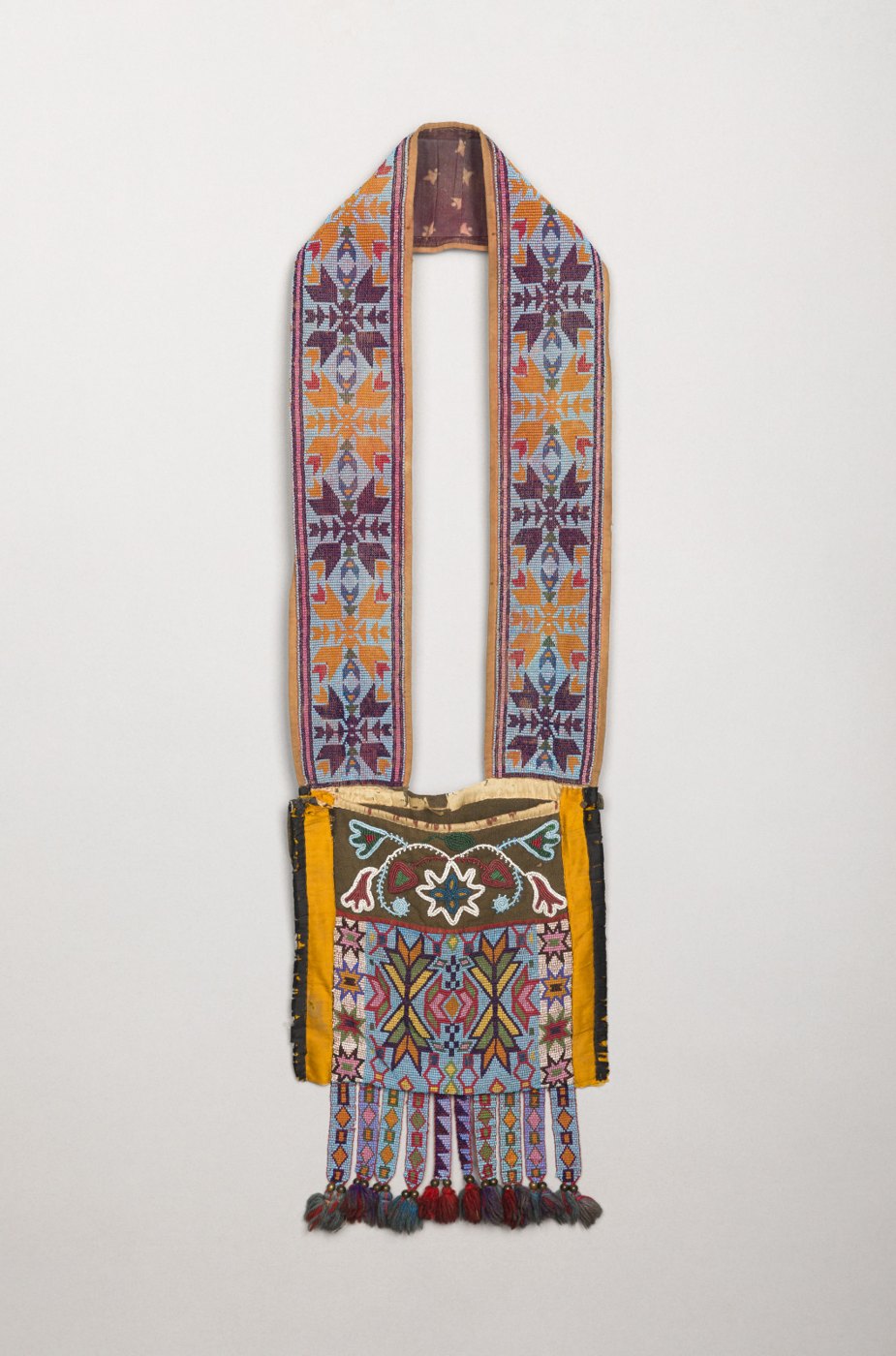
Bandolier Bag, Anishinaabe (Ojibwe) artistSaint Louis Art Museum, Gift of Elizabeth B. and Robert Wells Streett, 20:2022; Anishinaabe (Ojibwe) artist, name unrecorded
Alternate-name reading route · Added to the original list
Chippewa
Chippewa is an overlapping name used in Ojibwe language references and in the names of distinct communities and governments. This is an alternate doorway to Ojibwe reading routes, beginning with a regional dictionary, the Sault Tribe’s language account and Bois Forte’s own history.
See each region’s evidence for historical or present-day scope.
Homeland / region
Great Lakes / shared reviewed Ojibwe regional routes
Research depth
Source guide
Source collection
5 annotated resources · 3 Indigenous-led
Inspected sources
3 substantive works · selected content reviewed
Initial adequacy
Still unfinished
Source review
October 27, 2026
Names & relationshipsShared reading collection: Ojibwe. This card is an alternate-name access point.
A source guide for a deeper dive.This entry provides a brief orientation and an organized reading path. A comprehensive deep dive has not yet been completed. Follow the annotated sources and distinguish primary community accounts from outside reference material.
A bounded reading route with inspected content and a specifically explained visual. It does not establish a complete history, separate nation count or community endorsement.
Assessment recorded October 27, 2026. This is separate from research completion and community review.
Broaden community-specific readings beyond these Michigan and Minnesota examples and keep named governments distinct.
The dictionary’s older speaker figures and the Sault page’s dated program descriptions are not current censuses or a program audit.
This alternate-name route does not create another nation alongside Ojibwe or make Anishinaabe identity universal. The pictured artist’s individual name and community are unrecorded; no design meanings or endorsement are inferred.
Backdrop photographs & credits
These photographs have individual, documented connections to this entry. Their captions and source records define the people, place, object, and period shown; no one photograph represents every community within a broader label.
Bandolier Bag, Anishinaabe (Ojibwe) artist Saint Louis Art Museum, Gift of Elizabeth B. and Robert Wells Streett, 20:2022; Anishinaabe (Ojibwe) artist, name unrecorded
The inspected dictionary lists Chippewa among Ojibwe language names. The existing museum record explicitly attributes this c.1860 bag to an Anishinaabe (Ojibwe) artist, individually unrecorded. Reuse as an overlapping-name Ojibwe reading illustration; do not assign it to a particular Chippewa government or make it universal to every Anishinaabe people. One Anishinaabe (Ojibwe) artist's nineteenth-century bandolier bag, c. 1860. Suitable for the broad Anishinaabe profile only with the precise Ojibwe attribution retained. Do not imply one object represents all Anishinaabe nations or governments, copy its beadwork as generated filler, or infer symbolism beyond the inspected museum record. RISD 43.119 remains an image-retrieval gap. Used one bounded museum alternative: SLAM object 20:2022. Actual museum page read, Public Domain link and Terms of Use read, image URL extracted from the official page HTML, original 1057 x 1600 JPEG downloaded and visually inspected in full. Object attribution is explicitly Anishinaabe (Ojibwe), not merely geographic. No maker biography, separate community review, or detailed design meanings established. Web copies proportionally resized/recompressed without retouching; CSS crops and overlays are presentation only. Complete image displayed proportionally in the page banner. The same precisely identified Ojibwe artist’s bag may accompany the broad Ojibwe collection as well as Anishinaabe. The maker’s individual name and particular Ojibwe government/community are unrecorded in the inspected item. It must not be assigned specifically to one Minnesota Band, used as a universal Ojibwe design, or copied into invented traditional motifs.
Image, association, and reuse record reviewed 2026-10-27.
Full photographs are displayed proportionally above. A translucent background copy may be cropped by the viewport; it does not replace the complete image or its record.
The visual treatment does not change the research status, evidence, or remaining gaps recorded in this profile.
Start reading here
Alternate-name route sharing the broader Ojibwe collection. Chippewa, Ojibwe and Anishinaabe have overlapping but context-dependent usage, while Anishinaabe also has wider uses.
Continue with Bois Forte’s local historical account, keeping its community scope.
These are selected starting points. The full annotated collection, source perspectives, inspection limits and remaining research questions follow below. A starting guide is not an exhaustive history or community endorsement.
01
An overlapping name, with local scope
The dictionary includes Chippewa among names used for Ojibwe and identifies its own Central Southwestern regional focus. Its speakers, spellings and examples should be read with those limits.
The Sault Tribe’s language account and Bois Forte’s history come from distinct governments. They offer specific perspectives on language continuity and local historical experience rather than a single history for every community called Chippewa.
Broaden community-specific readings beyond these Michigan and Minnesota examples and keep named governments distinct.
The dictionary’s older speaker figures and the Sault page’s dated program descriptions are not current censuses or a program audit.
This alternate-name route does not create another nation alongside Ojibwe or make Anishinaabe identity universal. The pictured artist’s individual name and community are unrecorded; no design meanings or endorsement are inferred.
Published as an owner-authorized queued card after a narrow identification check. Zero substantive works counted; no history-completion or separate-government claim is made for band-name routes. Selected actual-content works support a bounded starting guide. Earlier source objects retain their original review dates and limits. Reused URLs, images and identity-only checks are not new global historical works. Full history and community review remain open.
Follow the reading path
Sources & further reading
Open any title to read the original source. Annotations explain what each link can help you explore.
No Indigenous-led source is identified in this entry yet. This is a gap in this collection, and does not imply an absence of community knowledge or organization.
Community collaboration / language documentationOjibwe People’s Dictionary; University of Minnesota American Indian Studies and University Libraries, with Ojibwe contributorsSource 3
A regionally focused dictionary collection explains spelling, speaker attribution and word-building. Selected methodology and contributor accounts were read together as one work. Historical speaker figures and undated biographical roles are not treated as current; no audio was played.
Inspection: Content reviewed for the stated scope
Scope: Actual language introduction, project history, regional key and selected English contributor accounts; word-stem and audio-method text inspected. Scope is selected text, not the complete dictionary.
A Sault Tribe account connects Anishinaabeg language with cultural continuity, describes intergenerational language suppression and lists revitalization work. This voice is specific to one Michigan-based tribal government and is used as a wider regional perspective, not as a Minnesota Band account.
Inspection: Content reviewed for the stated scope
Scope: Read the full Ojibwe Language page, including the dated language-program description and linked culture guidance (lines 98–107). The linked programs were not independently reviewed.
Publication: Undated public history page; 2026 site footer not treated as publication date
The Band distinguishes its three reservation sectors and gives its own migration account, treaty chronology and present-day resource and community context. Its account is not treated as a boundary map or as a template for other Ojibwe communities.
Inspection: Content reviewed for the stated scope
Scope: Read the complete visible Brief Summary of Bois Forte History (lines 134–145): community locations, migration account, 1854 and 1866 treaties, 1881 executive order, self-government and cultural/resource continuity. Contemporary business totals are not repeated.
Related entries may represent alternate names, constituent communities, wider groupings, or historical connections. Read the naming notes before treating entries as equivalent.
Robey’s Atlas of Indigenous North America · Compiled October 19, 2026 · Chippewa