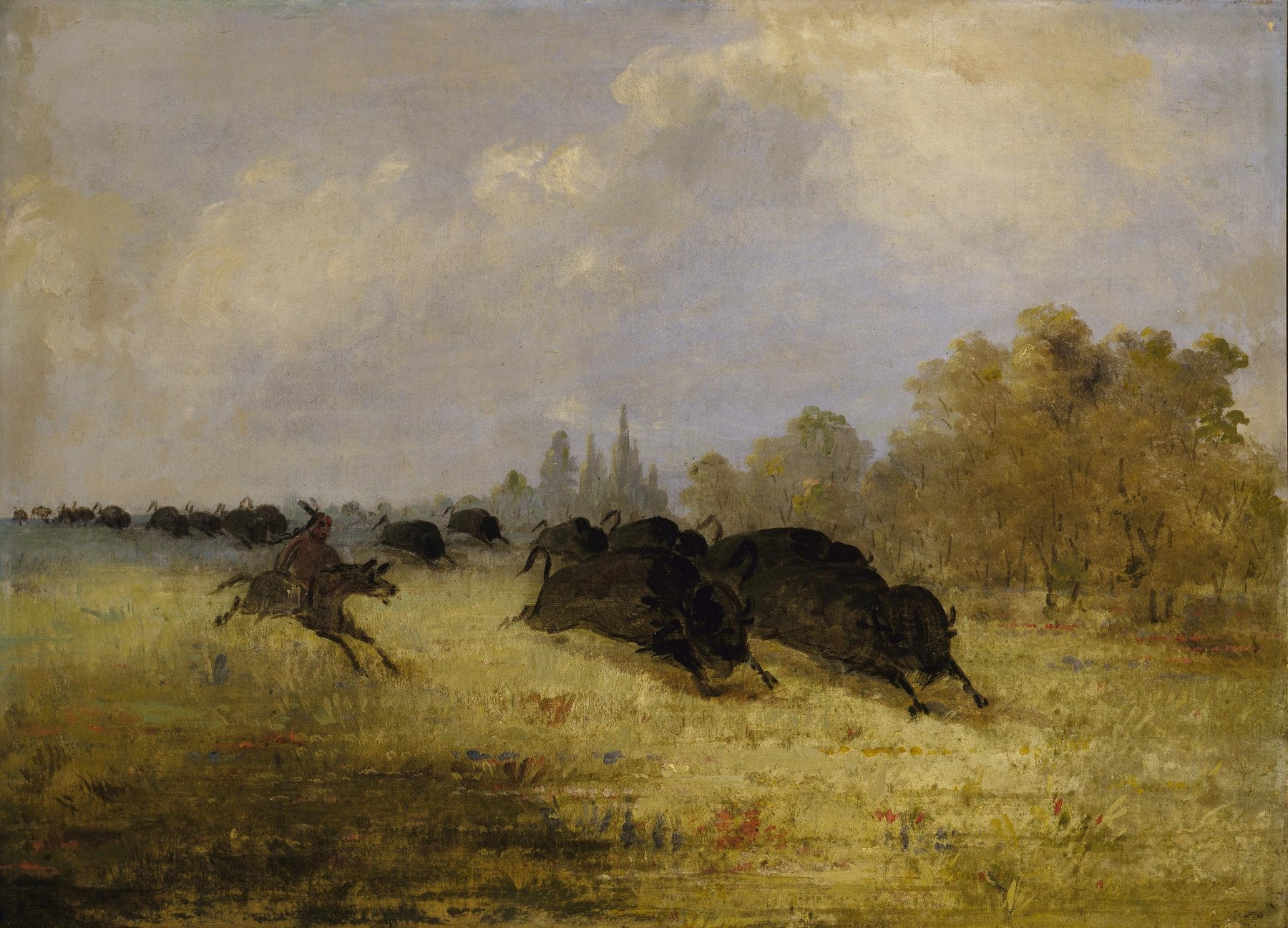
Caddo Indians Chasing Buffalo, Cross Timbers, TexasGeorge Catlin, Caddo Indians Chasing Buffalo, Cross Timbers, Texas, 1846–1848, oil on canvas. Smithsonian American Art Museum, Gift of Mrs. Joseph Harrison, Jr., 1985.66.589.
Caddo is a living Indigenous people with historical communities across the Red, Ouachita, Sabine, and Neches river regions. The Caddo Nation of Oklahoma is a contemporary tribal government formed from historically related communities; Caddoan language relationships do not make neighboring nations the same people. This Texas-focused guide distinguishes archaeological interpretation, written colonial records, Caddo oral histories, and current community work.
See each region’s evidence for historical or present-day scope.
Homeland / region
Southern Plains / Caddo Homeland
Research depth
Cited overview
Source collection
20 annotated resources · 5 Indigenous-led
Inspected sources
18 substantive works · selected content reviewed
Initial adequacy
Still unfinished
Source review
October 27, 2026
A cited introduction, with more to explore.This overview draws together the linked sources below. It is an introduction, and does not replace community-authored histories or a full scholarly study.
Still unfinished
The selected community-published constitutional-project account adds a contemporary institutional perspective to the earlier seventeen-work foundation. It improves the explanation of ongoing community participation without establishing current governing provisions or adoption of proposals. Post-removal history, separately named communities and further community-directed work remain uneven; the guide remains Still unfinished. Source quantity does not establish completion, community review or endorsement.
Assessment recorded October 27, 2026. This is separate from research completion and community review.
The Nation’s constitutional-project account now adds a contemporary participation perspective. Community-directed post-removal histories, underlying survey/report evidence and a separately verified governing-text/amendment review remain needed.
The post-removal history, including the Civil War, allotment, federal policy, and the 1860–1902 period, needs deeper work with Caddo-centered and archival sources.
The three historical confederacies and named local communities are not fully surveyed here; terms vary across oral history, colonial records, and later scholarship.
The 1835 treaty is read as a printed statutory text only; signed manuscript, ratification files, later agreements, and implementation records were not separately inspected.
The Caddo Archeology Journal PDF was inaccessible to the text-review tool and remains an unread lead; this does not establish a paywall.
Archaeological interpretations of ancestral continuity and the northern Arkansas Basin remain debated; no fixed homeland boundary is asserted.
No present population figure, current fluent-speaker count, exhaustive community list, or claim of community endorsement is made.
The project describes a planned 2026–2027 drafting phase. Linked project documents, surveys, the Commission final report and any later ballot/adoption result were not inspected; a project description is not evidence of enacted constitutional change.
Backdrop images & credits
These images have individual, documented connections to this entry. Their captions and source records define the people, place, object, and period shown; no one image represents every community within a broader label.
Caddo Indians Chasing Buffalo, Cross Timbers, Texas George Catlin, Caddo Indians Chasing Buffalo, Cross Timbers, Texas, 1846–1848, oil on canvas. Smithsonian American Art Museum, Gift of Mrs. Joseph Harrison, Jr., 1985.66.589.
George Catlin’s historical painting, dated 1846–1848 by the Smithsonian American Art Museum, depicts a mounted hunter and buffalo in the Cross Timbers of Texas. The item record names Caddo people, credits the painter and the Harrison gift, and explicitly marks the image Free to use. This is an outside artistic depiction, not a Caddo-made work, a photograph, or a survey of territory. The museum’s historical Catlin quotation is not adopted as factual synthesis. The complete available 2600×1873 digital frame and primary item/rights record were inspected; the web image is proportionally resized/recompressed, with no generated content or retouching. Cards and backdrops use CSS crops/overlays; the opened profile also shows the complete frame. This visual review adds no substantive source checks.
Image, association, and reuse record reviewed 2026-10-25.
Full images are displayed proportionally above. A translucent background copy may be cropped by the viewport; it does not replace the complete image or its record.
The visual treatment does not change the research status, evidence, or remaining gaps recorded in this profile.
Start reading here
Caddo people, the Caddo Nation of Oklahoma, historical confederacies and the narrower Cadohadacho label have different scopes; related Caddoan languages do not merge neighboring nations. Exhibit testimony is situated, and its original recordings and archives were not separately inspected.
Caddo historian Cecile Elkins Carter’s homeland synthesis introduces naming, oral history and archival interpretation from an attributed Caddo perspective.
The Nation’s language program explains continuing work and why related Caddoan-speaking nations remain separate peoples.
These are selected starting points. The full annotated collection, source perspectives, inspection limits and remaining research questions follow below. A starting guide is not an exhaustive history or community endorsement.
01
Names, related communities, and the Caddo Nation today
Historical sources use Caddo both for a particular northern community often called Kadohadacho and, more broadly, for several related Caddo-speaking communities. Caddo Nation language materials describe the historical Kadohadacho, Natchitoches, and Hasinai confederacies and emphasize that Pawnee, Wichita, Arikara, and Kitsai are linguistically related but remain culturally and historically separate Nations. The present Caddo Nation of Oklahoma is a contemporary government formed through 1930s reorganization; its 1938 constitution records one dated stage in that history, not today’s governing rules. The narrower Kadohadacho entry by Howard Meredith should be read for that community rather than generalized to every Caddo group.
Caddo historical communities are associated with river valleys across what are now northeast Texas, northwest Louisiana, southwest Arkansas, and southeast Oklahoma. The Caddo Homeland exhibit describes a large central homeland and a northern Arkansas Basin whose relationship to Caddo identity remains debated. It also explains that territories changed over time and that archaeological sites do not create fixed political borders. A separate Caddo oral-history synthesis describes three broad historical groupings and named villages using both community memory and colonial records. These regional descriptions document historical relationships; they do not define a present-day boundary or suggest that all Caddo people live in one place.
Ancestors, archaeology, and what the evidence can show
Archaeological sequences trace distinctive Caddo pottery, villages, mound centers, agriculture, and long-distance exchange over many centuries. Researchers infer parts of that history from durable remains, but the timeline exhibit cautions that most ordinary lives and events leave little archaeological trace. The Texas Historical Commission’s Caddo Mounds account describes one important ceremonial and settlement center, not the whole Caddo world. A useful starting method is to compare archaeology with Caddo oral histories, language, written records, and later scholarship, while keeping uncertainty visible where those sources do not align.
Contact, diplomacy, and records written by outsiders
Spanish, French, Mexican, and United States records describe encounters with Caddo communities, but they reflect the observers’ aims and assumptions. The Texas Beyond History research guide explains how missionary, travel, and government records can be useful while remaining selective and biased. Its Caddo Voices material, researched and written by enrolled Caddo historian Cecile Elkins Carter, combines oral histories with archival evidence and gives specific speakers and dates. Those accounts offer situated perspectives rather than one interchangeable story for every Caddo family or community.
The 1835 treaty printed in the United States Statutes at Large records the cession agreement and related terms negotiated with named Caddo leaders. The instrument is evidence of the legal document and its signatories; it cannot by itself describe the different experiences of all Caddo communities or prove how every provision was carried out. Caddo Voices recounts movement from Louisiana into Texas, violence and loss of homes, and later movement to the Brazos area and west. Fallis Elkins’s 1973 family account and Sadie Bedoka Weller’s 1968 recollection are explicitly attributed testimony, not anonymous folklore. State and federal site histories add an institutional chronology of the 1855 reservation and 1859 removal, which should be read alongside those Caddo accounts.
Language, cultural continuity, and renewed practice
The Caddo Nation’s language program describes Caddo language as Hasinai in some contexts and situates language work within community history, gatherings, and cultural life. The program states that other Caddoan-language Nations are separate peoples. It also documents contemporary language-archive and learning work; language change or the loss of fluent speakers does not mean that Caddo people or culture have disappeared. The Texas Beyond History pottery exhibit connects ancient material evidence with Jeri Redcorn’s first-person account of learning and renewing Caddo pottery. A Texas Historical Commission exhibit developed with Caddo citizens and featuring artist Chase Kahwinhut Earles presents selected community knowledge about Caddo Mounds. These works are specific examples and do not stand for every citizen’s practice.
Community participation in a constitutional project
The Caddo Nation’s project account describes research followed by citizen surveys and meetings, then a planned 2026–2027 period of analysis, education and drafting. It presents consultation as part of deciding what constitutional changes to consider. Read this as the Nation’s dated account of an ongoing process. A plan to prepare proposals for a later vote does not show that changes were adopted or that all citizens agreed. This source does not replace the governing text and amendments.
The Nation’s constitutional-project account now adds a contemporary participation perspective. Community-directed post-removal histories, underlying survey/report evidence and a separately verified governing-text/amendment review remain needed.
The post-removal history, including the Civil War, allotment, federal policy, and the 1860–1902 period, needs deeper work with Caddo-centered and archival sources.
The three historical confederacies and named local communities are not fully surveyed here; terms vary across oral history, colonial records, and later scholarship.
The 1835 treaty is read as a printed statutory text only; signed manuscript, ratification files, later agreements, and implementation records were not separately inspected.
The Caddo Archeology Journal PDF was inaccessible to the text-review tool and remains an unread lead; this does not establish a paywall.
Archaeological interpretations of ancestral continuity and the northern Arkansas Basin remain debated; no fixed homeland boundary is asserted.
No present population figure, current fluent-speaker count, exhaustive community list, or claim of community endorsement is made.
The project describes a planned 2026–2027 drafting phase. Linked project documents, surveys, the Commission final report and any later ballot/adoption result were not inspected; a project description is not evidence of enacted constitutional change.
Reviewed October 22, 2026 (America/Denver): 17 substantive works have actual-content inspection records; two supporting or out-of-scope references are excluded from the count. Links from a source bibliography and external embedded media are not treated as reviewed. The source set combines Caddo Nation program material, Caddo historian Cecile Elkins Carter’s attributed oral-history/archival synthesis, identified first-person testimony, government interpretation, archaeology education, a primary treaty printing, and a dated constitution. Their scopes and perspectives are labeled at the source cards. The language family is not a peoplehood shortcut: Caddo Nation materials state that Pawnee, Wichita, Arikara, and Kitsai are linguistically related yet distinct Nations. The Adai Caddo Indian Nation source is retained only as an explicit distinction and contributes no Caddo evidence or source count. The 1835 treaty and 1938 constitution are primary records for their own text and dates. They are not treated as complete accounts of community experience or current law/governance. The 2010-era OSDE figures are excluded from current claims. No new historical-map association was added. The NPS early-history page and Texas Beyond History exhibits contain map imagery, but map inspection, rights review, and a profile-specific association were outside this research batch.
Follow the reading path
Sources & further reading
Open any title to read the original source. Annotations explain what each link can help you explore.
No Indigenous-led source is identified in this entry yet. This is a gap in this collection, and does not imply an absence of community knowledge or organization.
A concise NPS exhibit locates historic Caddo communities in the Piney Woods and distinguishes Hasinai, Kadohadacho, and Natchitoches areas. Its chronology and population statements are institutional summaries, not current community counts; consult the cited oral-history and archaeological works for nuance.
Inspection: Content reviewed for the stated scope
Scope: The complete visible article, including its 1687 map caption, related-page links, and 2020 update date, was read. The linked map itself was not added to the historical-map room or assessed for reuse in this batch.
The Caddo Nation language program describes Hasinai/Caddo language work, the historical confederacies, community archiving, and the distinction between linguistic relationship and separate Nations. This is the Nation program’s own account of its work and language history.
Inspection: Content reviewed for the stated scope
Scope: The full visible page was inspected, including the program lead, goals, language-history section, linked dated news items, and statement of continuing community work. No current speaker count was inferred from older media links.
A site history summarizes the settlement and ceremonial center at Caddo Mounds and later Hasinai and Caddo movement. Its account is useful for this particular site and institutional chronology, not a complete history of the Caddo people.
Inspection: Content reviewed for the stated scope
Scope: The full visible history article and its listed chronology were read. Interpretations of why the center was vacated remain attributed to the site’s archaeological account.
This public exhibit says it was designed with Caddo citizens and features Caddo artist Chase Kahwinhut Earles. It connects selected knowledge about Caddo Mounds, the High Temple Mound, gardens, the grass house, and present gatherings; it is one collaborative interpretation, not a statement by every Caddo citizen.
Inspection: Content reviewed for the stated scope
Scope: The visible exhibit text and chapters for High Temple Mound, prairie/garden, grass house, Low Platform Mound, and burial mound were inspected. Embedded external material and any cultural knowledge outside the public exhibit were not accessed.
A detailed exhibit places Caddo communities within river systems and landscapes while explaining that territorial reach changed through time. Its map and text also distinguish a broad northern Arkansas Basin area where identity and archaeological classification are debated.
Inspection: Content reviewed for the stated scope
Scope: The complete visible homeland page, its map caption, geographic description, and discussion of changing extent and disputed northern affiliation were read. The map is a scholarly exhibit, not a legal or present-day territorial boundary.
This exhibit overview explains its archaeological and historical questions, the long chronology it covers, and the uncertainty in reconstructing pre-written history. Its linked chapters offer a deeper reading path; only the overview was inspected for this review.
Inspection: Content reviewed for the stated scope
Scope: The full visible overview and chapter descriptions were inspected; individual linked chapter pages were not read and are not claimed as inspected.
A chronological overview explains that archaeological timelines are useful scholarly tools but cannot capture most individual experiences or all events. It identifies the need to compare archaeology with oral, written, linguistic, and community evidence.
Inspection: Content reviewed for the stated scope
Scope: The complete visible timeline page and its methodological caveats, chronology, captions, and cited source leads were read. Cited books and records were not independently inspected unless separately listed.
Cecile Elkins Carter, an enrolled Caddo historian, presents a Caddo-centered synthesis using oral history, archival records, and historical group names. The page distinguishes broad Caddo use from the narrower historical Cadohadacho label; these are attributed historical interpretations rather than a universal current naming rule.
Inspection: Content reviewed for the stated scope
Scope: The full visible page and the separate credits page were read. Its account is Carter’s researched and written synthesis; underlying cited archives and all referenced books were not independently reviewed.
This page follows displacement and movement among Louisiana, Texas, the Brazos area, and Indian Territory using archival records and named Caddo testimony. Testimony from Fallis Elkins (1973) and Sadie Bedoka Weller (1968) is identified by speaker and date; it is situated family memory, not a generic or interchangeable Caddo story.
Inspection: Content reviewed for the stated scope
Scope: The full visible page, narrative, map caption, archival references, and attributed oral-history excerpts were read. The complete recordings and all referenced primary records were not inspected.
This exhibit explains the archaeological importance of Caddo pottery and directs readers to a separate account of contemporary Caddo potter Jeri Redcorn’s practice. The archaeological framing and present-day artistic work are connected but should not be collapsed into a claim that cultural practices are unchanged.
Inspection: Content reviewed for the stated scope
Scope: The full visible exhibit introduction and its described pottery galleries and linked sections were read. Gallery images and the separate pages are not counted as independently inspected here.
Caddo potter Jeri Redcorn describes her own process of learning and reviving pottery practice and reflects on removals and boarding schools. This is a named person’s first-person account, not a claim that one maker speaks for all Caddo people.
Inspection: Content reviewed for the stated scope
Scope: The complete visible interview page and credited contextual material were read. The profile attributes its reflections to Redcorn and does not reproduce restricted or unpublished material.
This methods essay describes the strengths and limitations of oral history, archaeology, linguistics, ethnography, and European accounts. It directly cautions that missionary and explorer records can reflect the authors’ motives and prejudices, a useful guide for interpreting older documentary sources.
Inspection: Content reviewed for the stated scope
Scope: The complete visible essay, named source traditions, image captions, and bibliography leads were inspected. The books and archival documents it describes remain separate leads unless listed as inspected.
The printed federal treaty text records the 1835 agreement, parties, cession, and supplementary articles. It is evidence of the document and federal legal framing; it cannot establish the views or experiences of every Caddo community, or by itself verify implementation.
Inspection: Content reviewed for the stated scope
Scope: Both pages of the treaty text and supplementary articles were inspected. This is the published statutory transcription, not an examination of the signed manuscript or separate ratification and implementation files.
Howard Meredith’s entry concerns Kadohadacho in particular and describes its Red River villages and later participation in the 1938 Caddo government. Its narrower subject is valuable for distinguishing a historical community from the broader Caddo people, but it must not be generalized to all Caddo communities.
Inspection: Content reviewed for the stated scope
Scope: The complete visible encyclopedia article, author attribution, publication date, and bibliography were read. Its references are not independently inspected here.
A 15-page education guide compiles Caddo history, removal, government, language, and cultural information. Its leadership and enrollment details are dated and must not be used as current facts; it serves here as a broad educational reference with historical scope.
Inspection: Content reviewed for the stated scope
Scope: The complete 15-page PDF was reviewed. Page 11 identifies membership and leadership material dated to October 2010 and older estimates; those figures are excluded from the current synthesis. The guide does not identify a Caddo Nation author in the inspected pages.
This primary document records the 1938 constitutional organization and its ratification. It is useful for a dated account of political reorganization, not a description of the Nation’s current constitution or government structure.
Inspection: Content reviewed for the stated scope
Scope: The full seven-page document was read, including its preamble, membership/governance provisions, election rules, approval, and ratification certification.
The state’s current visitor page documents the 2024 reopening and says the site is held in trust and actively managed by the Texas Historical Commission and Caddo Nation. This is a site-management and visitor account, not a general statement about Caddo government or land title elsewhere.
Inspection: Content reviewed for the stated scope
Scope: The page sections on reopening, site management, public interpretation, and visits were read. Admission and schedule details are not reproduced because they can change.
This source belongs to the Adai Caddo Indian Nation access point, not the Caddo Nation of Oklahoma profile. It is retained only to help readers distinguish the separate Adai identity; its claims are not transferred to Caddo.
Inspection: Supporting or limited review; see scope
Scope: The visible community history page was read previously in the Adai/Coahuiltecan research context; it is out of scope as evidence for the Caddo Nation and is excluded from the count.
Potentially useful specialist reading, retained as a lead. The PDF could not be inspected in this review, so no contents are summarized and it does not count toward the substantive target.
Inspection: Supporting or limited review; see scope
Scope: Automated open returned an internal error. This is not evidence of a reader paywall and no access control was bypassed; the work remains unread.
Caddo Nation. Constitution Project. Undated project webpage describing 2024–2027 stages. Main body reviewed October 27, 2026.
The Nation explains its consultation and drafting process. This is a first-party account of institutional work and plans, rather than a consolidated constitution, an independently evaluated participation study or proof that proposed changes were adopted.
Inspection: Content reviewed for the stated scope
Scope: Complete main project body: Background, Phase I research/project initiation, Phase II citizen outreach and Phase III analysis/education/research/drafting, web lines 6–53; public contributor lists and linked-document titles encountered. Main-body text inspected, not merely a navigation index. Linked constitutions, amendments, slides, FAQ, surveys and Commission final report were not read or counted.
Review recorded: October 27, 2026
Access status: Public readable English HTML; linked project documents not inspected
Access note: Actual HTML body read through the publisher page. The linked slides and FAQ returned reader cache errors; ordinary direct downloads could not verify the certificate chain and were stopped without overriding security checks. This is not evidence of a reader paywall. Underlying citizen responses, meeting records and final report remain unread. No current membership total, officeholder eligibility, consolidated governing provisions, amendment adoption, election result or jurisdiction finding is asserted.
Related entries may represent alternate names, constituent communities, wider groupings, or historical connections. Read the naming notes before treating entries as equivalent.
Robey’s Atlas of Indigenous North America · Compiled October 19, 2026 · Caddo