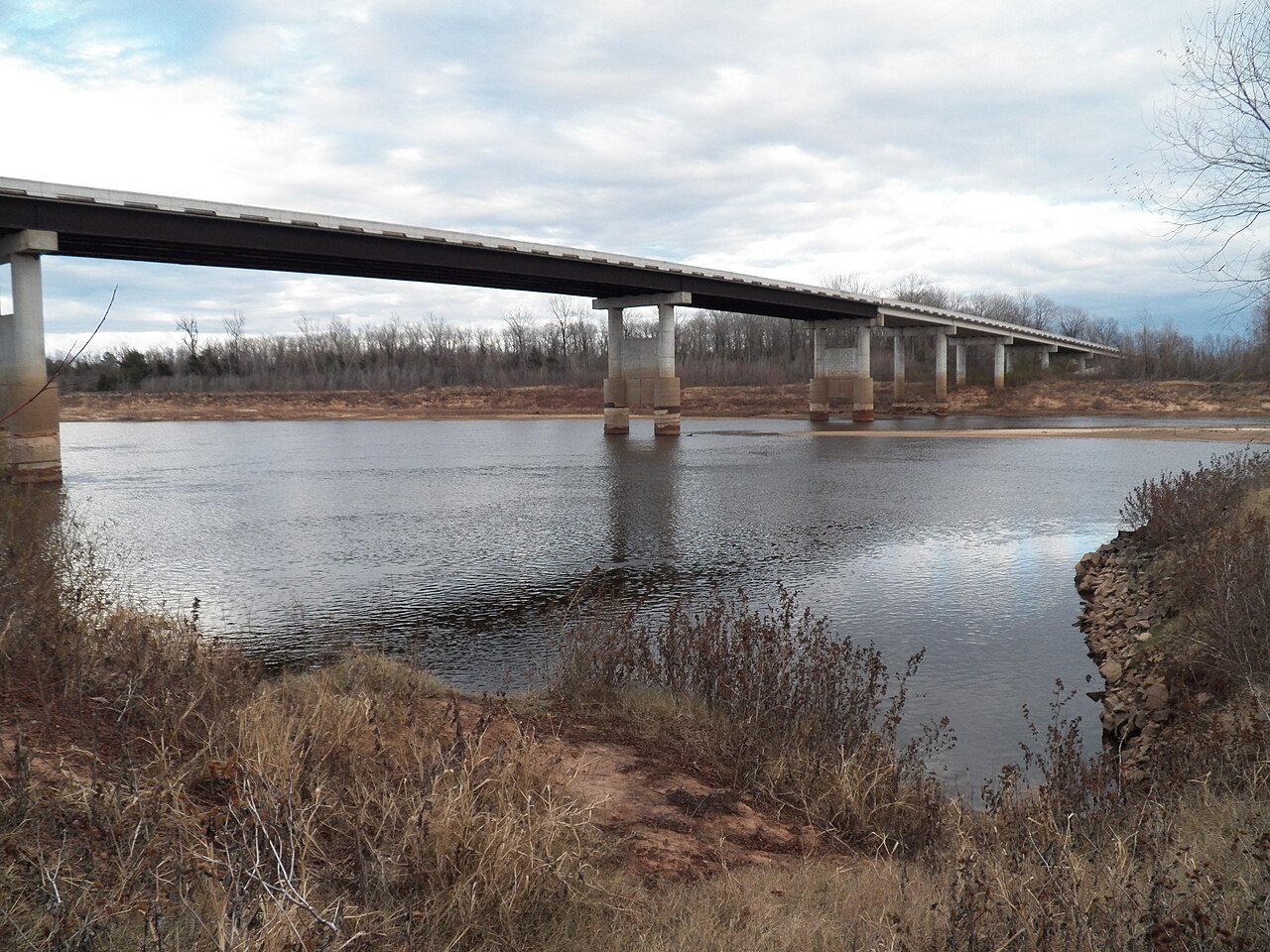
Red River near Lewisville, Arkansas, 2012 — Cadohadacho regional contextRobert Nunnally, 2012-12-16 (item dating; camera timestamp not independently verified); Wikimedia Commons. CC BY 2.0.
Historical Caddo community grouping · Added to the original list
Cadohadacho
Cadohadacho, often written Kadohadacho in the selected scholarship, is a historical Caddo community grouping associated with the great bend of Red River. Carter’s Caddo-centered history and Meredith’s focused encyclopedia article help distinguish this narrower historical name from broader uses of Caddo. This reading route does not establish a separate current government or an individual lineage.
Names & relationshipsCadohadacho is individually named in the Caddo Voices account as a historical Caddo branch along the great bend of Red River. This separate name-only reading route does not identify a separate present-day tribal government, fix a boundary or establish individual descent. The broader Caddo guide remains related reading.
A source guide for a deeper dive.This entry provides a brief orientation and an organized reading path. A comprehensive deep dive has not yet been completed. Follow the annotated sources and distinguish primary community accounts from outside reference material.
Still unfinished
A bounded historical-community starting path with selected actual-content works, attributed perspectives and explicitly scoped imagery. No fixed source minimum, comprehensive completion, current subgroup government or individual descent is claimed.
Assessment recorded October 27, 2026. This is separate from research completion and community review.
Compare the historical village, diplomatic and movement accounts with underlying records and further community-specific work.
Add public Cadohadacho/Kadohadacho family and language histories with speaker/author and publication context.
The image is modern regional river context, not an identified ancestral settlement, proof of present ownership or a precise homeland boundary.
Backdrop photographs & credits
These photographs have individual, documented connections to this entry. Their captions and source records define the people, place, object, and period shown; no one photograph represents every community within a broader label.
Red River near Lewisville, Arkansas, 2012 — Cadohadacho regional context Robert Nunnally, 2012-12-16 (item dating; camera timestamp not independently verified); Wikimedia Commons. CC BY 2.0.
Modern regional Red River context in southwestern Arkansas, not an identified Cadohadacho village. Carter’s and Meredith’s accounts place the historical grouping around the great bend of Red River across this wider region. The specific photographed riverbank’s historical occupancy and present ownership are not established. No highway bridge, visible plant or modern earthwork is assigned an Indigenous maker or traditional meaning. Full frame retained, including the modern bridge, to avoid a falsely timeless landscape. Private candidate is a byte-for-byte copy of the inspected full-frame display JPEG. Root may make proportional card/page resizes with dimensions/hash and change note. Preserve photographer/source/license credits and any ShareAlike obligation for photographic derivatives; disclose display-only CSS crops or overlays. No source-count increment or endorsement. Exact available full-frame JPEG copied unchanged; CSS crops and overlays affect card/backdrop display only.
Image, association, and reuse record reviewed 2026-10-27.
Full photographs are displayed proportionally above. A translucent background copy may be cropped by the viewport; it does not replace the complete image or its record.
The visual treatment does not change the research status, evidence, or remaining gaps recorded in this profile.
Start reading here
Historical people/community grouping; broader Caddo or Wichita access points are related reading. No automatic subgroup identity is assigned to an umbrella source, historical picture or current government.
Continue with Meredith’s specifically Kadohadacho article; its narrower subject should remain visible.
These are selected starting points. The full annotated collection, source perspectives, inspection limits and remaining research questions follow below. A starting guide is not an exhaustive history or community endorsement.
01
A particular historical name within Caddo history
Carter distinguishes Cadohadacho along Red River from Hasinai in East Texas and from other Caddo branches. Meredith’s article uses Kadohadacho and describes a cluster of villages across the area now divided among southwestern Arkansas, northeastern Texas and southeastern Oklahoma. The spelling variation is a source-naming bridge, not a new people count. These accounts should be compared in their historical setting rather than turning the broad Caddo name into a uniform political identity for every period.
Meredith describes food surpluses and manufactured goods supporting domestic life and trade, including crops, bows and pottery. This offers a practical introduction to Red River towns alongside the diplomatic history in Carter’s account. The modern photograph near Lewisville, Arkansas, supplies regional Red River landscape context. It identifies neither a historical village nor the makers of any artifact, and its highway bridge is modern infrastructure. The complete frame is retained without transforming today’s riverbank into a claimed community boundary or current landholding.
Compare the historical village, diplomatic and movement accounts with underlying records and further community-specific work.
Add public Cadohadacho/Kadohadacho family and language histories with speaker/author and publication context.
The image is modern regional river context, not an identified ancestral settlement, proof of present ownership or a precise homeland boundary.
This reviewed starting guide records selected actual-content sources, their perspectives and access limits. Reused earlier reviews retain their original dates/scopes; images and repeated URLs do not create new historical works. Comprehensive history and community review remain open.
Follow the reading path
Sources & further reading
Open any title to read the original source. Annotations explain what each link can help you explore.
No Indigenous-led source is identified in this entry yet. This is a gap in this collection, and does not imply an absence of community knowledge or organization.
Indigenous-ledTexas Beyond History; researched and written by Cecile Elkins CarterSource 1
Cecile Elkins Carter, an enrolled Caddo historian, presents a Caddo-centered synthesis using oral history, archival records, and historical group names. The page distinguishes broad Caddo use from the narrower historical Cadohadacho label; these are attributed historical interpretations rather than a universal current naming rule.
Inspection: Content reviewed for the stated scope
Scope: The full visible page and the separate credits page were read. Its account is Carter’s researched and written synthesis; underlying cited archives and all referenced books were not independently reviewed.
Howard Meredith’s entry concerns Kadohadacho in particular and describes its Red River villages and later participation in the 1938 Caddo government. Its narrower subject is valuable for distinguishing a historical community from the broader Caddo people, but it must not be generalized to all Caddo communities.
Inspection: Content reviewed for the stated scope
Scope: The complete visible encyclopedia article, author attribution, publication date, and bibliography were read. Its references are not independently inspected here.
Related entries may represent alternate names, constituent communities, wider groupings, or historical connections. Read the naming notes before treating entries as equivalent.
Robey’s Atlas of Indigenous North America · Compiled October 19, 2026 · Cadohadacho