Historical Caddo community grouping · Added to the original list
Hasinai
Hasinai is a historical Caddo community grouping associated with East Texas, rather than a separate present-day government in this directory. Caddo historian Cecile Elkins Carter’s account distinguishes Hasinai from other named Caddo branches. Selected Hasinai-specific scholarship and a public historic-site history supply additional regional context while leaving the underlying records open.
See each region’s evidence for historical or present-day scope.
Homeland / region
East Texas (historical)
Research depth
Source guide
Source collection
3 annotated resources · 1 Indigenous-led
Inspected sources
3 substantive works · selected content reviewed
Initial adequacy
Still unfinished
Source review
October 27, 2026
Names & relationshipsHasinai is individually named in the Caddo Voices account as a historical Caddo branch in east Texas. This separate name-only reading route does not identify a separate present-day tribal government, fix a boundary or establish individual descent. The broader Caddo guide remains related reading.
A source guide for a deeper dive.This entry provides a brief orientation and an organized reading path. A comprehensive deep dive has not yet been completed. Follow the annotated sources and distinguish primary community accounts from outside reference material.
Still unfinished
A bounded historical-community starting path with selected actual-content works, attributed perspectives and explicitly scoped imagery. No fixed source minimum, comprehensive completion, current subgroup government or individual descent is claimed.
Assessment recorded October 27, 2026. This is separate from research completion and community review.
Compare settlement and movement accounts with original documents and further Hasinai-focused scholarship.
Do not equate ancient archaeological classifications with a specific later community without separate evidence.
Add public community voices and language history; no individual descent or present governmental status is inferred.
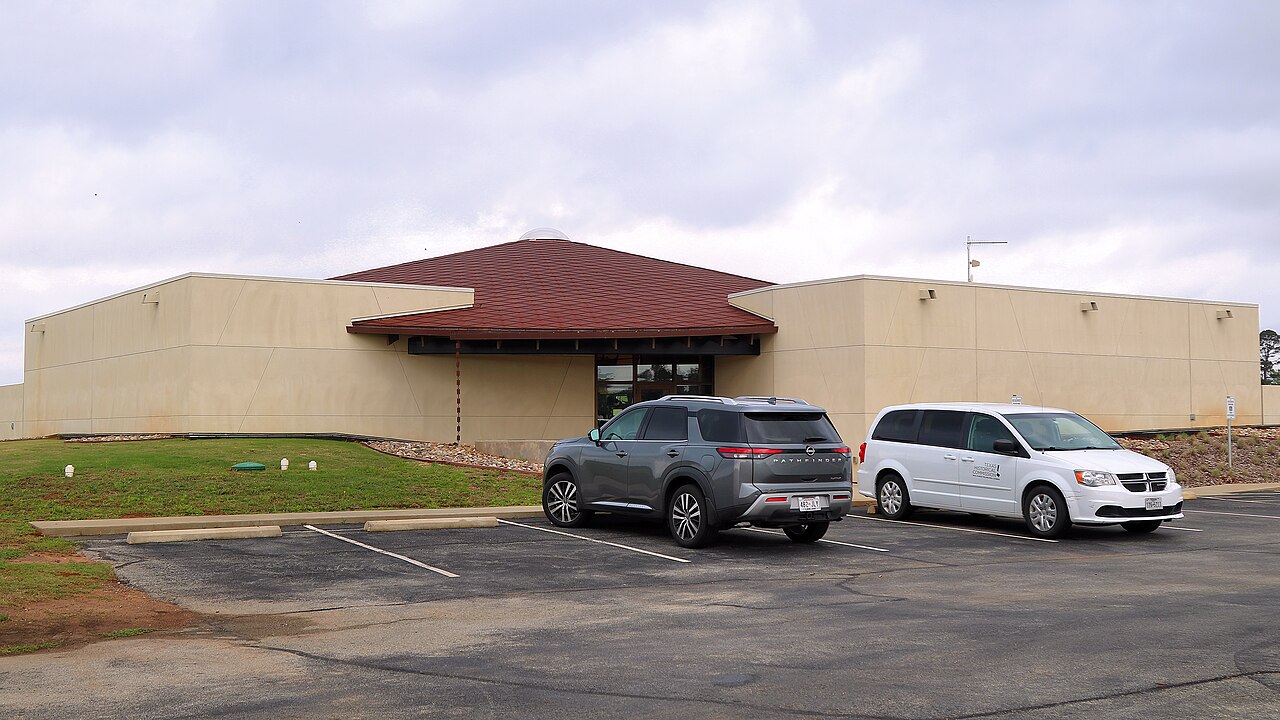
The museum picture supplies regional public-history context, not a specifically Hasinai-made or Hasinai-depicting artifact.
Backdrop photographs & credits
These photographs have individual, documented connections to this entry. Their captions and source records define the people, place, object, and period shown; no one photograph represents every community within a broader label.
Caddo Mounds museum exterior, 2026 — Hasinai regional interpretation context Larry D. Moore, 2026-04-03; Wikimedia Commons. CC BY 4.0.
A public historic-site institution in the related East Texas region. The site’s own historical article explicitly discusses later Hasinai communities in the Neches/Angelina valleys; that is the bridge to this named historical grouping. The photograph is not a Hasinai house, proof that ancient mound builders had the same subgroup identity, an ancient reconstruction, a cultural design template or a depiction of all Caddo communities. No interior artifacts, ceremonial knowledge or burials appear. Private candidate is a byte-for-byte copy of the inspected full-frame display JPEG. Root may make proportional card/page resizes with dimensions/hash and change note. Preserve photographer/source/license credits and any ShareAlike obligation for photographic derivatives; disclose display-only CSS crops or overlays. No source-count increment or endorsement. Exact available full-frame JPEG copied unchanged; CSS crops and overlays affect card/backdrop display only.
Image, association, and reuse record reviewed 2026-10-27.
Full photographs are displayed proportionally above. A translucent background copy may be cropped by the viewport; it does not replace the complete image or its record.
The visual treatment does not change the research status, evidence, or remaining gaps recorded in this profile.
Start reading here
Historical people/community grouping; broader Caddo or Wichita access points are related reading. No automatic subgroup identity is assigned to an umbrella source, historical picture or current government.
Use the Caddo Mounds history for this particular site’s interpretation and the explicitly named Hasinai regional connection.
These are selected starting points. The full annotated collection, source perspectives, inspection limits and remaining research questions follow below. A starting guide is not an exhaustive history or community endorsement.
01
Names, river valleys and communities
Carter places Hasinai communities in East Texas within a wider Caddo history, while Magnaghi’s reference entry locates them in the middle Neches and upper Angelina valleys. The latter describes agricultural hamlets encountered in the seventeenth century. Read these accounts with their different perspectives and periods visible. A historical grouping, a linguistic family and a modern government are different kinds of relationship; the sources do not establish that every Caddo person or archaeological site is specifically Hasinai.
The Caddo Mounds site history discusses Hasinai communities continuing in East Texas through the 1830s and later Caddo displacement toward the Brazos. This supplies the bridge to the modern museum exterior used here. The photograph is a public interpretation institution in the related region, not a historical Hasinai house or a proof of direct subgroup identity for ancient mound builders. Sensitive burial and ceremonial descriptions, cultural rankings and unreviewed archaeological conclusions are excluded from this introduction.
Compare settlement and movement accounts with original documents and further Hasinai-focused scholarship.
Do not equate ancient archaeological classifications with a specific later community without separate evidence.
Add public community voices and language history; no individual descent or present governmental status is inferred.
The museum picture supplies regional public-history context, not a specifically Hasinai-made or Hasinai-depicting artifact.
This reviewed starting guide records selected actual-content sources, their perspectives and access limits. Reused earlier reviews retain their original dates/scopes; images and repeated URLs do not create new historical works. Comprehensive history and community review remain open.
Follow the reading path
Sources & further reading
Open any title to read the original source. Annotations explain what each link can help you explore.
No Indigenous-led source is identified in this entry yet. This is a gap in this collection, and does not imply an absence of community knowledge or organization.
Indigenous-ledTexas Beyond History; researched and written by Cecile Elkins CarterSource 1
Cecile Elkins Carter, an enrolled Caddo historian, presents a Caddo-centered synthesis using oral history, archival records, and historical group names. The page distinguishes broad Caddo use from the narrower historical Cadohadacho label; these are attributed historical interpretations rather than a universal current naming rule.
Inspection: Content reviewed for the stated scope
Scope: The full visible page and the separate credits page were read. Its account is Carter’s researched and written synthesis; underlying cited archives and all referenced books were not independently reviewed.
Russell M. Magnaghi’s entry provides specifically Hasinai naming, river-valley and settlement context. Selected historical paragraphs are read with Carter’s Caddo-centered account. The article’s dated cultural rankings, ceremonial/burial descriptions and confident archaeological reconstructions are not adopted.
Inspection: Content reviewed for the stated scope
Scope: Selected actual main-body paragraphs, web lines 7–10, 14–15 and 18–19, plus author and bibliography read. Synthesis uses East Texas Neches/Angelina context, agricultural hamlets and later movement only. Ceremonial details, burial material, evaluative cultural rankings, ancient identity equivalence, exact community counts and current descendant assertions excluded. Underlying bibliography not read.
Review recorded: October 27, 2026
Access note: Actual public HTML body readable without an account in this inspection. Linked bibliography, archival instruments and media remain separate works unless expressly listed.
A site history summarizes the settlement and ceremonial center at Caddo Mounds and later Hasinai and Caddo movement. Its account is useful for this particular site and institutional chronology, not a complete history of the Caddo people.
Inspection: Content reviewed for the stated scope
Scope: The full visible history article and its listed chronology were read. Interpretations of why the center was vacated remain attributed to the site’s archaeological account.
Related entries may represent alternate names, constituent communities, wider groupings, or historical connections. Read the naming notes before treating entries as equivalent.
Robey’s Atlas of Indigenous North America · Compiled October 19, 2026 · Hasinai