Tribal government / contemporary community · Added to the original list
White Earth Nation
White Earth Nation is a distinct Minnesota tribal government and community. Its Cultural Division introduces language, naming and reservation history, while its 2025 climate plan connects contemporary priorities with land, water, seasonal cycles and food sovereignty. These community publications offer a focused introduction rather than a history of every Ojibwe or Anishinaabe community.
See each region’s evidence for historical or present-day scope.
Homeland / region
Minnesota
Research depth
Source guide
Source collection
2 annotated resources · 2 Indigenous-led
Inspected sources
2 substantive works · selected content reviewed
Initial adequacy
Still unfinished
Source review
October 27, 2026
Names & relationshipsMnDOT explicitly places this individual Minnesota government under its Ojibwe Tribal Nation grouping. It remains a separate government; the broader Ojibwe directory route is related reading, not a substitute identity.
A source guide for a deeper dive.This entry provides a brief orientation and an organized reading path. A comprehensive deep dive has not yet been completed. Follow the annotated sources and distinguish primary community accounts from outside reference material.
Still unfinished
A compact source-led introduction to this named community; historical breadth, local voices and outcomes remain limited. No comprehensive completion or community endorsement is claimed.
Assessment recorded October 27, 2026. This is separate from research completion and community review.
Compare reservation history with original instruments and wider community voices.
Inspect the remaining plan chapters and later implementation before claiming outcomes.
Current language fluency, program access and community review remain unverified.
Backdrop photographs & credits
These photographs have individual, documented connections to this entry. Their captions and source records define the people, place, object, and period shown; no one photograph represents every community within a broader label.
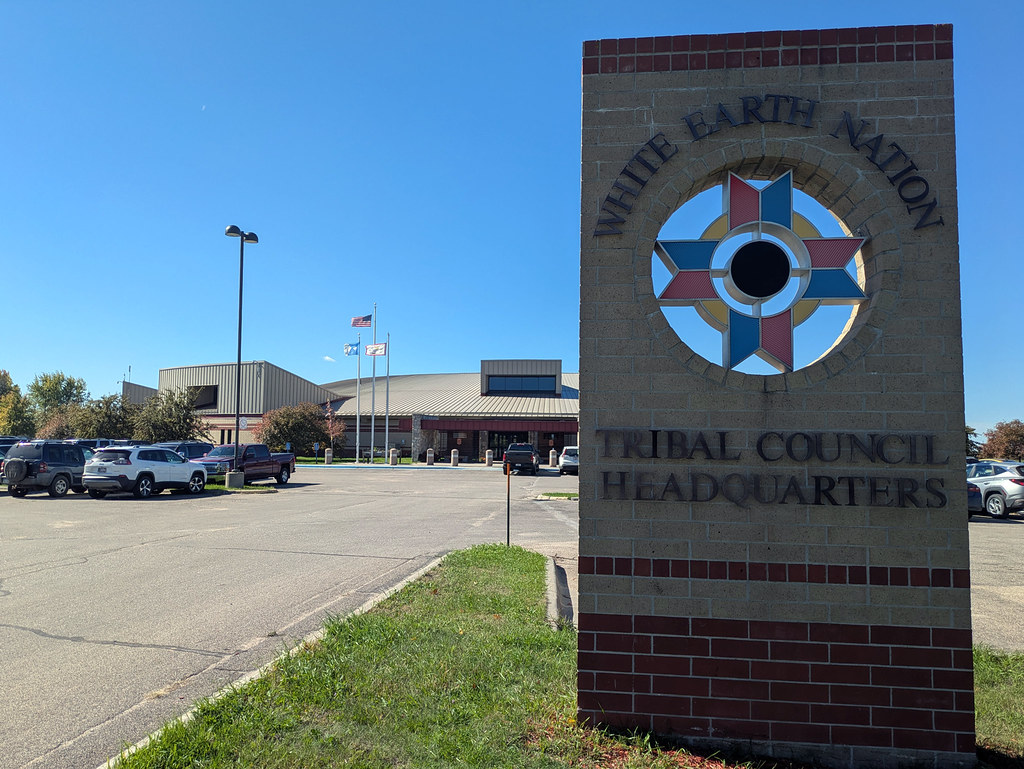
White Earth Nation Tribal Headquarters, 2026 Todd Mahon / Minnesota Historical Society Heritage Preservation Department, 2026; Flickr / Wikimedia Commons. CC BY 4.0.
Exterior of the specifically identified White Earth Nation Tribal Headquarters, with its identifying sign and building visible. The item description explicitly credits Todd Mahon and the Minnesota Historical Society Heritage Preservation Department. This is a particular government site, not an image of all White Earth people or a traditional cultural design. The official-looking sign is incidental to the photographed exterior; no logo is extracted or offered as an independent design asset. The complete Flickr display frame was downloaded using its actual og:image URL; this is a 1024-pixel display copy, not the 4494-pixel original listed on Commons. Its complete composition was visually inspected. No crop, retouching, generated pixels or alteration was applied. Keep creator, source and license link visible; disclose display crops/overlays. Keep modified photographic versions under the stated ShareAlike license where applicable. No visual-source count contributes to substantive reading-source counts.
Image, association, and reuse record reviewed 2026-10-27.
Full photographs are displayed proportionally above. A translucent background copy may be cropped by the viewport; it does not replace the complete image or its record.
The visual treatment does not change the research status, evidence, or remaining gaps recorded in this profile.
Start reading here
Named government/community route; wider Dakota or Ojibwe reading profiles remain related context rather than interchangeable identities.
See a dated community planning process connecting land, food and climate.
These are selected starting points. The full annotated collection, source perspectives, inspection limits and remaining research questions follow below. A starting guide is not an exhaustive history or community endorsement.
01
Culture, language and a particular community
The Cultural Division describes work with schools and community programs and explains Ojibwe, Chippewa and Anishinaabe naming as used in its own account. Context matters: related terms are not a reason to collapse separate communities into one government. The introduction places the White Earth Reservation's establishment in 1867. It is an institutional historical orientation, rather than an independently reconstructed treaty history or a measure of present language fluency. Start with the Nation's wording and carry its specific community context into wider reading.
The 2025 Climate Action Plan links cultural life and food sovereignty with land, climate and seasonal cycles. Its introduction describes a planning team of community members and government staff, meetings held in 2024 and a community survey. These methods help readers understand whose input shaped the document. The selected pages establish the plan's purpose and process; unreviewed sector chapters are not summarized. Survey respondents are a dated group, not a census or proof that everyone shares one view, and proposed actions are not completed outcomes.
Compare reservation history with original instruments and wider community voices.
Inspect the remaining plan chapters and later implementation before claiming outcomes.
Current language fluency, program access and community review remain unverified.
A community-specific starting guide reuses selected earlier actual-content reviews with their original dates/scopes. It does not add new global works merely because a URL appears on this route. Picture identification/rights are separate from historical adequacy or community endorsement.
Follow the reading path
Sources & further reading
Open any title to read the original source. Annotations explain what each link can help you explore.
No Indigenous-led source is identified in this entry yet. This is a gap in this collection, and does not imply an absence of community knowledge or organization.
The Cultural Division describes its work in language, school and community programs, and explains naming conventions as used in its White Earth history. It states that Ojibwe, Chippewa and Anishinaabe usage varies by context; the wording is the Nation’s institutional account and is not used to flatten differences among communities.
Inspection: Content reviewed for the stated scope
Scope: Read the full visible Culture introduction and reservation-history paragraphs (lines 53–63), including the Division mission and the account of White Earth Reservation’s 1867 establishment.
This is a contemporary, community-planning source rather than a general history. Its introduction ties land, climate and seasonal cycles to White Earth culture and food sovereignty, and describes planning-team and community-survey methods. Survey results are the plan’s dated respondents, not population estimates or universal consensus.
Inspection: Content reviewed for the stated scope
Scope: Inspected PDF pages 2–3 and 12–14 (PDF lines 91–188 and 534–600): reservation and cultural context, 1867 history, government structure, plan purpose, co-authoring process and survey scope. The remaining sector chapters were not reviewed for this profile.
Related entries may represent alternate names, constituent communities, wider groupings, or historical connections. Read the naming notes before treating entries as equivalent.
Robey’s Atlas of Indigenous North America · Compiled October 19, 2026 · White Earth Nation