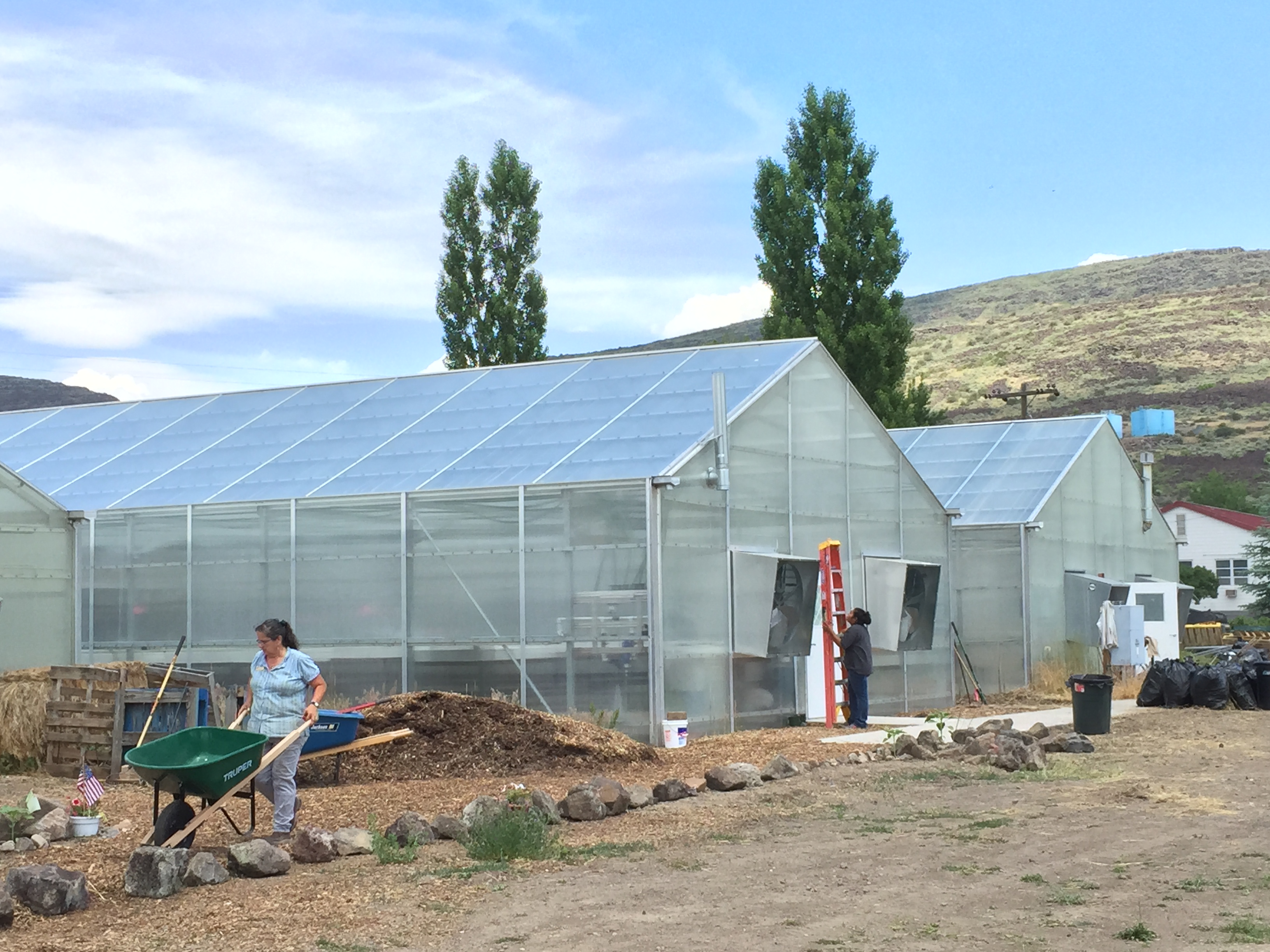
Sho-Pai Greenhouses at Duck Valley,2015A. Hedrick, Bureau of Land Management Idaho,2015; BLM and Sho-Pai Greenhouses / Flickr / Wikimedia Commons. CC BY2.0; U.S. federal-government work also marked public domain.
Tribal government / contemporary community · Added to the original list
Shoshone-Paiute Tribes
The Shoshone-Paiute Tribes are the joint government of the Duck Valley Indian Reservation, which spans Idaho and Nevada. The Tribes' history identifies Western Shoshone and Northern Paiute descendants in this community. Its public account, a historical constitution and a federal water-settlement statement offer a focused introduction to Duck Valley rather than all Shoshone or Paiute peoples.
See each region’s evidence for historical or present-day scope.
Homeland / region
Idaho
Research depth
Source guide
Source collection
3 annotated resources · 1 Indigenous-led
Inspected sources
3 substantive works · selected content reviewed
Initial adequacy
Still unfinished
Source review
October 27, 2026
Names & relationshipsThis is an individually named government and community route. Its own publications and the selected institutional sources provide the scoped context below. Broader people-level reading routes are related context, not interchangeable governments, an individual citizenship determination or a boundary claim.
A source guide for a deeper dive.This entry provides a brief orientation and an organized reading path. A comprehensive deep dive has not yet been completed. Follow the annotated sources and distinguish primary community accounts from outside reference material.
Still unfinished
A compact source-led introduction to this named government. Selected public sources provide useful orientation, with limited voices, historical coverage and outcome evaluation; no comprehensive completion or community endorsement is claimed.
Assessment recorded October 27, 2026. This is separate from research completion and community review.
Compare the public history with original executive orders and broader community voices.
Review original constitutional scans, later amendments and current tribal law before making legal claims.
Check the later legislative and implementation record before describing present settlement outcomes.
Backdrop photographs & credits
These photographs have individual, documented connections to this entry. Their captions and source records define the people, place, object, and period shown; no one photograph represents every community within a broader label.
Sho-Pai Greenhouses at Duck Valley,2015 A. Hedrick, Bureau of Land Management Idaho,2015; BLM and Sho-Pai Greenhouses / Flickr / Wikimedia Commons. CC BY2.0; U.S. federal-government work also marked public domain.
Publicly published BLM photograph of the specifically identified Duck Valley Sho-Pai Greenhouses. The record describes Owyhee High School FFA participation in growing sagebrush seedlings for mine reclamation and wildfire restoration. The inspected image shows the exterior greenhouses and two people working; their names, citizenship and governmental roles are not inferred. The photo documents this particular community-linked project and date, not all Shoshone or Paiute peoples, present program outcomes or a complete reservation landscape. Actual Commons file description, credit, source, Flickr license review and licensing read; the record explicitly displays the original Flickr URL downloaded here. Full3264x2448 JPEG downloaded, decoded and visually inspected after completion. No crop, retouching or generated pixels. Cards/backgrounds may use disclosed CSS cropping. Provide visible A.Hedrick/BLM credit and CC BY2.0 license link. Image evidence adds no substantive reading-source count.
Image, association, and reuse record reviewed 2026-10-27.
Full photographs are displayed proportionally above. A translucent background copy may be cropped by the viewport; it does not replace the complete image or its record.
The visual treatment does not change the research status, evidence, or remaining gaps recorded in this profile.
Start reading here
Named government route; nearby people-level profiles remain related reading rather than interchangeable identities. Review dates and selected-content limits are preserved.
Separate a particular federal settlement account from a later legislative proposal.
These are selected starting points. The full annotated collection, source perspectives, inspection limits and remaining research questions follow below. A starting guide is not an exhaustive history or community endorsement.
01
Duck Valley’s community history
The Tribes' Cultural Department distinguishes the reservation's establishment in 1877 from expansions in 1886 and 1910. It recounts movement, schooling and resistance to a proposed relocation to Fort Hall. Its narrative keeps the shared Western Shoshone and Northern Paiute community visible. Undated membership and acreage totals are omitted here, and its account is attributed to the Tribes rather than presented as an independently reconstructed history.
A public transcription of the 1936 constitution and bylaws names the joint Tribes and sets out a business council, territorial jurisdiction, land provisions and an amendment process. Its certification distinguishes a March 21 ratification vote from April 20 approval. The transcription has apparent errors; neither it nor its original date establishes present citizenship rules or all later amendments.
The Interior Department's H.R. 1869 statement describes the 2009 Duck Valley water-rights settlement and a proposed correction about trust-fund interest. It places the reservation on both sides of the Idaho–Nevada border. This is a dated federal legislative position about one settlement issue, not the Tribes' full water history. The inspected statement does not establish subsequent enactment, implementation or present outcomes.
Compare the public history with original executive orders and broader community voices.
Review original constitutional scans, later amendments and current tribal law before making legal claims.
Check the later legislative and implementation record before describing present settlement outcomes.
A community-specific starting guide reuses selected earlier actual-content reviews with their original dates/scopes. It does not add new global works merely because a URL appears on this route. Picture identification/rights are separate from historical adequacy or community endorsement.
Follow the reading path
Sources & further reading
Open any title to read the original source. Annotations explain what each link can help you explore.
No Indigenous-led source is identified in this entry yet. This is a gap in this collection, and does not imply an absence of community knowledge or organization.
Indigenous-led / community government historyShoshone-Paiute Tribes of the Duck Valley Indian ReservationSource 1
The joint government identifies Western Shoshone and Northern Paiute descendants at Duck Valley and recounts reservation creation/expansion, resistance to relocation, schooling and constitutional organization. This is its institutional history, not a uniform history of all Northern Paiute communities. Undated membership and present-program figures are not used.
Inspection: Content reviewed for the stated scope
Scope: Complete visible history body, lines43–61, read October23. Linked history videos were not played and photographs not reused.
Government / historical primary legal document1936 Government Printing Office text transcribed by University of Oklahoma Native American Constitution and Law Digitization ProjectSource 2
Historical governing instrument identifying the joint Tribes, territorial jurisdiction, council powers, land provisions and amendment process. Its adoption certification dates the vote to March21,1936 and approval to April20. The transcription contains apparent errors; do not silently correct its text or present 1936 provisions as verified current law.
Inspection: Content reviewed for the stated scope
Scope: Complete HTML transcription including constitution articlesI–X, bylawsI–VI and adoption/approval certification, lines53–266. Original scan and amendments not inspected.
Federal account of the joint Tribes’ Idaho/Nevada water-rights settlement and a proposed trust-fund interest correction. Useful for separating the 2009 settlement from a later legislative proposal. The Department’s support is a policy position, not proof of enactment or successful implementation.
Inspection: Content reviewed for the stated scope
Scope: Complete statement for the record, lines34–65. Bill enactment, later implementation and underlying settlement instruments not independently reviewed.
Related entries may represent alternate names, constituent communities, wider groupings, or historical connections. Read the naming notes before treating entries as equivalent.
Robey’s Atlas of Indigenous North America · Compiled October 19, 2026 · Shoshone-Paiute Tribes