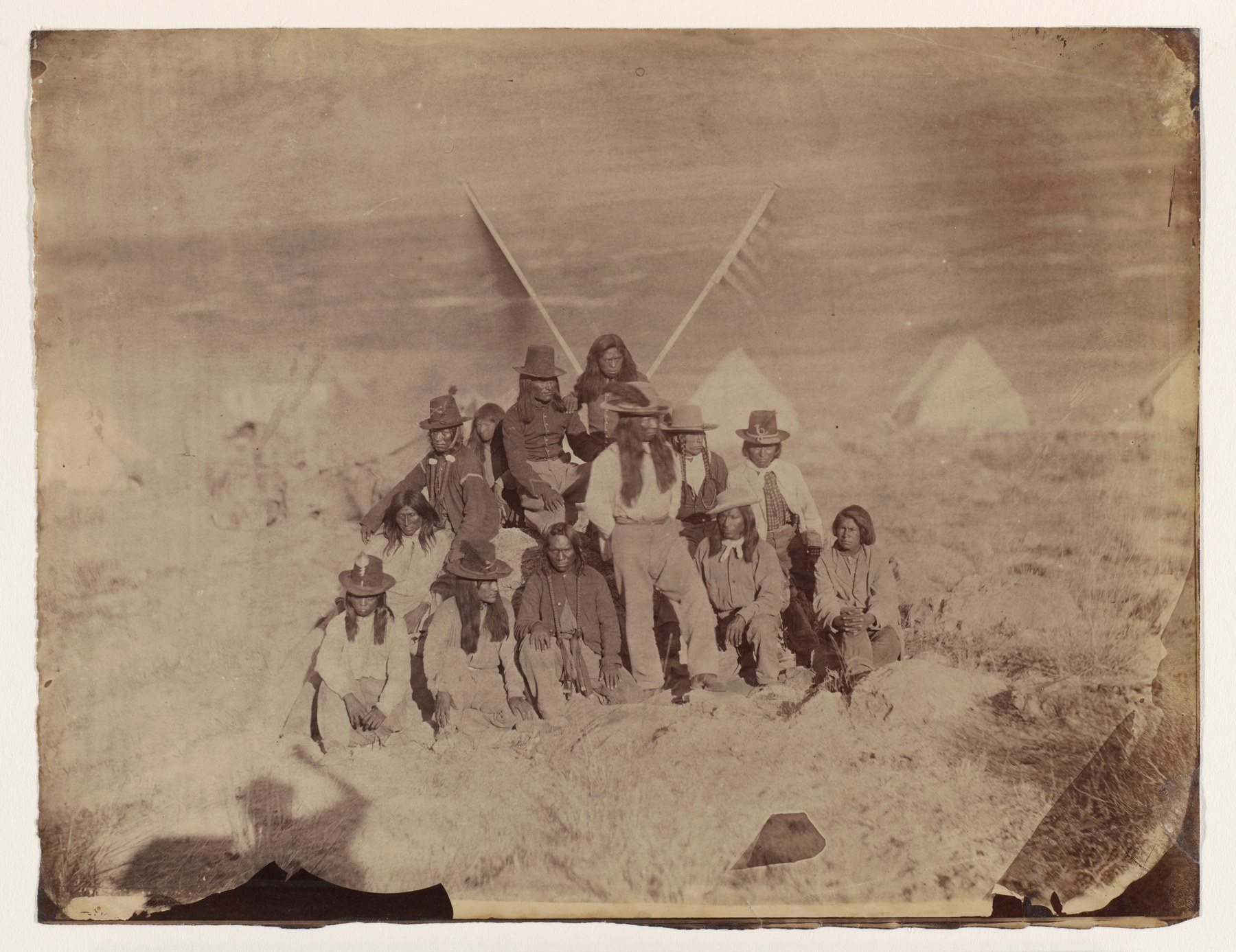
Shoshone, photograph by Timothy H. O’Sullivan, 1867–72Timothy H. O’Sullivan. The Metropolitan Museum of Art, Gilman Collection, Purchase, Marlene Nathan Meyerson Family Foundation Gift, 2005; 2005.100.104.
Shoshone is a broad name for distinct regional peoples and communities, not one single government or uniform history. This reviewed introduction centers publicly documented histories connected to Idaho, including the Shoshone-Bannock Tribes at Fort Hall and the Shoshone-Paiute Tribes of Duck Valley, while also placing Eastern and Northwestern Shoshone sources in view. It is a selected reading guide, not an exhaustive account of all Shoshone communities.
See each region’s evidence for historical or present-day scope.
Homeland / region
Great Basin / Great Plains
Research depth
Source guide
Source collection
14 annotated resources · 5 Indigenous-led
Inspected sources
12 substantive works · selected content reviewed
Initial adequacy
Still unfinished
Source review
October 23, 2026
A source guide for a deeper dive.This entry provides a brief orientation and an organized reading path. A comprehensive deep dive has not yet been completed. Follow the annotated sources and distinguish primary community accounts from outside reference material.
Still unfinished
Twelve distinct substantive works have actual-content inspection records: community publications from Fort Hall, Duck Valley, Eastern Shoshone and the Northwestern Band; a community–NPS exhibit; two place-based NPS histories; a Northwestern Shoshone historian’s selected chapter pages; a cited Wyoming history article; primary treaty and constitutional texts; and a federal Duck Valley water-settlement statement. These support a carefully scoped introduction across several regional communities, but the entry is a broad umbrella and evidence depth remains uneven. Reaching the source target does not make the collection complete or community-reviewed.
Assessment recorded October 23, 2026. This is separate from research completion and community review.
The entry’s broad “Shoshone” access point cannot stand in for separate studies of the many Shoshone governments, communities, bands, and family histories. The current sample is uneven across Fort Hall, Duck Valley, Wind River, the Northwestern Band, and other Shoshone communities.
More community-authored histories, language materials, and contemporary accounts from Shoshone governments in Nevada, Utah, Idaho, and Wyoming remain to be inspected; no single source represents all communities.
The Fort Bridger Treaty text, the Shoshone-Bannock Treaty Day account, and WyoHistory describe the separate Bannock reservation and later move using different chronology. The relationship between reservation promises, relocation, and later Fort Hall governance needs further original-record review.
Mae Parry’s 2000 chapter was reviewed at selected pages only. Its family and oral-history evidence is attributed, while its historical interpretations are not treated as universal community consensus.
The Shoshone-Paiute cultural page and Eastern Shoshone About page contain undated or broad totals and historical claims that require independent checking; no current population, acreage, or deep-time claim is reused.
The Shoshone-Bannock and Shoshone-Paiute language evidence here is introductory. Comparative specialist work on Shoshone varieties, Bannock, and Northern Paiute, with each community’s terminology and stewardship preferences, remains needed.
No community review or endorsement is recorded. No historical map was independently inspected for this batch and none has been newly assigned.
Backdrop images & credits
These images have individual, documented connections to this entry. Their captions and source records define the people, place, object, and period shown; no one image represents every community within a broader label.
Shoshone, photograph by Timothy H. O’Sullivan, 1867–72 Timothy H. O’Sullivan. The Metropolitan Museum of Art, Gilman Collection, Purchase, Marlene Nathan Meyerson Family Foundation Gift, 2005; 2005.100.104.
An archival group portrait catalogued by The Met as Shoshone. The inspected record does not establish individual names, a precise location, or a particular band or present-day government. Do not assign it specifically to Idaho, Eastern Shoshone, Washakie, Fort Hall, Duck Valley, or the Northwestern Band, or imply that it represents all Shoshone people. Museum narrative interpretations and historical evaluative language are not adopted. Actual item page, object API and media policy were inspected; media clearance is explicit and does not rest on metadata CC0. The exact API primaryImage was downloaded unchanged and the complete frame visually inspected, including its margins and existing print damage. No retouching or generated restoration. Proportional web resizing/recompression is permitted. Show the complete image proportionally on the opened page; use contain for the card where practical to retain the group. Disclose any CSS crop or overlay as presentation treatment. No community endorsement is recorded. Delivered page and card files are proportional resizes/JPEG recompressions of the complete4000×3083API original. Card and background CSS may crop or overlay; the opened-page banner preserves the complete composition.
Image, association, and reuse record reviewed 2026-10-27.
Full images are displayed proportionally above. A translucent background copy may be cropped by the viewport; it does not replace the complete image or its record.
The visual treatment does not change the research status, evidence, or remaining gaps recorded in this profile.
Start reading here
Shoshone is a wider grouping of peoples and distinct governments, not one nation-state or a synonym for the Fort Hall government. This Idaho-centered path samples Fort Hall, Duck Valley, Northwestern and Eastern Shoshone perspectives; it is not an exhaustive community list. Parry was read only on pp. 25–26, 34–42, 59–61 and 69–72 in the public book viewer.
The Eastern Shoshone government's About account shows why Wind River's history must be read separately from Idaho and Northwestern communities.
These are selected starting points. The full annotated collection, source perspectives, inspection limits and remaining research questions follow below. A starting guide is not an exhaustive history or community endorsement.
01
Names, communities, and scope
“Shoshone” is used for related peoples whose histories span a large area of the inland West; the name does not identify one government or one community. The Shoshone-Bannock Tribes describe their Fort Hall government as comprising Northern Shoshone and Bannock bands, while their account distinguishes the peoples’ languages. The Shoshone-Paiute Tribes’ Duck Valley history describes a separate community formed from Western Shoshone and Northern Paiute bands whose reservation crosses today’s Idaho–Nevada border. The Eastern Shoshone Tribe and Northwestern Band of the Shoshone Nation are distinct governments with their own public historical accounts. The NPS wayside exhibit’s term “Newenee” and its “Shoshonean” language grouping belong to a specific Shoshone-Bannock collaboration and should not be treated as universal names for every Shoshone community.
For the Fort Hall community, the Shoshone-Bannock Tribes describe ancestral lands extending beyond present reservation and state borders, and document seasonal use of southern Idaho’s river, camas, salmon, and high-country areas. The National Park Service’s Craters of the Moon account outlines a seasonal round through Fort Hall, Camas Prairie, the Boise and Snake Rivers, and hunting areas farther north and east. That is a place-based NPS interpretation, not a complete account of all Shoshone families or a present-day territorial boundary. Northwestern Shoshone historian Mae Parry’s chapter separately describes seasonal gathering and travel in northern Utah, southern Idaho, and adjoining regions; her account helps show why present state lines and reservation maps cannot stand in for community history.
The Shoshone-Bannock Language and Cultural Preservation Department describes teaching both Shoshone and Bannock, maintaining archives and family-history materials, recording oral histories, and protecting information it considers confidential or sensitive. The NPS Newenee exhibit was prepared with Shoshone-Bannock representatives and includes artwork by Shoshone-Bannock artist Derek No-Sun Brown; its welcome and language examples should be read as a specific community contribution to a public park exhibit. These sources document programs and public interpretation, not language-use totals or outcomes. This guide does not reproduce restricted material.
Treaties, reservation formation, and distinct governments
The 1868 Fort Bridger treaty names the Eastern Shoshone and Bannock parties separately. Its text set aside the Wind River reservation for named Shoshone signatories and promised a later reservation for the Bannacks in the Portneuf and “Kansas Prairie” countries. The Shoshone-Bannock Tribes’ Treaty Day account says the separate Bannock reservation was never established and that Bannock people were relocated to Fort Hall in 1869. WyoHistory’s timeline describes later Bannock moves in 1873 and the arrival of Pocatello’s band in 1876. These accounts differ in how they date the move and do not make the treaty’s promise identical to its later implementation. The Fort Hall Constitution and Bylaws, approved in 1936 and amended through 2013 in the published copy, describe that government’s own jurisdiction and council structure; they should not be generalized to other Shoshone governments.
The Shoshone-Paiute Tribes’ cultural department locates Duck Valley across Idaho and Nevada and describes the community as including Western Shoshone and Northern Paiute bands. Its historical account covers executive orders, movement on and off the reservation, resistance to a proposed relocation to Fort Hall, the 1936 constitution, and schooling. The page’s acreage and membership figures are undated and are not repeated here. A 2021 Department of the Interior statement for the record explains the Duck Valley water-rights settlement and the federal trust funds for irrigation infrastructure; it is a narrow legal and administrative source, not a full account of the Tribes’ history or water knowledge.
Mae Parry’s chapter, written by a Northwestern Shoshone historian for a Utah history volume proposed by Utah Indian leaders, combines family oral history, written records, and tribal history. The selected pages discuss the Bear River Massacre of 1863, survivors’ accounts, the settlement of Washakie, testimony about homes burned in 1960, and the Northwestern Band’s later legal history. Utah Humanities’ 2024 account, produced for the Northwestern Band, describes Mae Parry’s archival and oral-history work and continuing community efforts. These sources provide Northwestern-specific context; their accounts do not represent every Shoshone community. The Eastern Shoshone government’s About page is also retained as its own public account, while its deep-time and treaty-area figures are left unattributed in the synthesis because they need closer comparison with community and archaeological sources.
This source set supports an introductory comparison of several living Shoshone communities and particular treaty, language, place, and government records. Its coverage remains uneven: Fort Hall, Duck Valley, Wind River, and the Northwestern Band have different kinds and depths of documentation here, while many other Shoshone communities, family histories, languages, and contemporary priorities are not represented. Some historical sources use old collective labels or compress distinct bands into one timeline. The collection has twelve substantive works with actual content inspected, but that count is separate from adequacy, completeness, or community review. No community endorsement is recorded, no population total is offered, and no map is assigned by geographic inference.
Open any title to read the original source. Annotations explain what each link can help you explore.
No Indigenous-led source is identified in this entry yet. This is a gap in this collection, and does not imply an absence of community knowledge or organization.
Read the actual Culture and History body (especially paragraphs on bands, homelands, language distinctions, seasonal foodways and reservation geography). This is the Fort Hall Tribes’ own public summary; its expansive ancestral-land description is not a boundary survey, and its dated account is not universal to all Shoshone peoples.
Retained as a relevant National Park Service reading lead. Its page body was not inspected in this review, so it is not cited as evidence and does not count as a substantive content check.
Read the department’s sections on language teaching, archival stewardship, Original Territories research, family histories, oral-history recording and museum work. The page itself identifies confidential or sensitive information; no such material is reproduced. Current class schedules and changing program details are not repeated.
Read the complete public exhibit article, including the Shoshone-Bannock welcome, the exhibit panel, and its attributed elder quotation. The page states NPS collaborated with Shoshone-Bannock representatives and identifies artist Derek No-Sun Brown as a Shoshone-Bannock artist. “Newenee” and “Shoshonean” are used in this exhibit’s context, not asserted as universal labels.
Read the complete Shoshone-Bannock and Goodale’s Cutoff sections. Useful as an NPS place-based account of seasonal routes and the later use of those routes by emigrants. Its “limited resources” framing and settler-centered account of the 1862 wagon-train incident are attributed to the NPS page rather than adopted as a comprehensive tribal interpretation; the two public oral narratives on the page are not retold here.
Read the full Our History section. It describes Duck Valley as a shared Western Shoshone and Northern Paiute community, the reservation’s executive orders, movement and resistance, schools, and the Tribe’s 1936 constitution. The page’s undated acreage, membership and current-governance figures are not reused; its account is identified as the Tribe’s own historical narrative.
Read the complete Secretary’s statement for the record, especially the Duck Valley settlement background and trust-fund explanation. This is a 2021 federal legislative position on one technical correction, not the Tribe’s own full water history or a neutral summary of all parties’ views.
Read the treaty heading and Articles 1–2 in the Tribe’s hosted reproduction of the 1904 Kappler compilation. The text distinguishes Eastern Shoshone and Bannock parties and promises a later Bannock reservation; it is primary treaty text, not evidence by itself of how each provision was later implemented.
Read the preamble and the territory, membership and council provisions in the published copy. It documents the Fort Hall government’s constitutional structure in this dated edition; later amendments or current practice should be checked against current tribal law before making present-day claims.
Read the complete public About page and its sections on the Wind River reservation, Washakie and Sacajawea. This is the Eastern Shoshone government’s own public account; some archaeological, treaty-area and historical totals are not independently assessed here and are not repeated as established fact.
Read the full article’s 1863 treaty, migration and 1868 treaty sections, plus its notes and bibliography. A cited secondary narrative useful for treaty chronology and comparisons; it distinguishes Eastern Shoshone and Bannock groups but is not a substitute for treaty text or the involved governments’ accounts. Its dates for later Bannock moves differ from the Shoshone-Bannock Tribes’ public account.
Indigenous-authored historical interpretation / selected book excerptMae Parry; edited by Forrest S. Cuch; Utah State Division of Indian Affairs and Utah State Division of History, 2000Source 12
Read selected pages of Mae Parry’s 48-page chapter in the digitized book viewer: pp. 25–26 on regional seasonal life; pp. 34–42 on the Bear River Massacre and survivor accounts; pp. 59–61 on Washakie testimony; and pp. 69–72 on the Box Elder treaty and Northwestern Band legal history. The book introduction identifies this as a Utah Indian leaders’ project; Parry’s family and oral-history sources are attributed as such. This selected-page review is not a reading of every page in the chapter.
Community collaboration / public historyNate Housley, Megan van Frank, and Megan Weiss for the Northwestern Band of the Shoshone Nation; The Beehive Archive / Utah Humanities, 2024-12-30Source 13
Read the full article and metadata/source notes. The authors describe the Band’s public history and archive work and Mae Parry’s oral-history role; it is a dated public-history synthesis produced for the Northwestern Band, not an exhaustive tribal account. The article uses a different death toll estimate than some other public histories, so no single figure is asserted here.
Read the page’s timeline and historical sections. Retained as a current Band-published perspective, but its compressed treaty and relocation chronology conflicts with the 1868 treaty text and other histories; those unverified details are not used as settled facts. It is excluded from the substantive count pending closer comparison.
Inspection: Supporting or limited review; see scope
Related entries may represent alternate names, constituent communities, wider groupings, or historical connections. Read the naming notes before treating entries as equivalent.
Robey’s Atlas of Indigenous North America · Compiled October 19, 2026 · Shoshone