Bannock histories connect the Snake River Plain with Northern Paiute communities and wider Great Basin and Rocky Mountain travel networks. At Fort Hall, Bannock and Shoshone people share the Shoshone-Bannock Tribes government while maintaining distinct languages. Community publications connect treaty history, language teaching, food sovereignty, and environmental stewardship.
See each region’s evidence for historical or present-day scope.
Homeland / region
Great Basin / Idaho
Research depth
Expanded profile
Source collection
13 annotated resources · 10 Indigenous-led
Inspected sources
13 substantive works · selected content reviewed
Initial adequacy
Not assessed
Source review
October 19, 2026
Names & relationshipsBannock is closely connected to Northern Paiute and shares government with Shoshone people at Fort Hall. Bannock and Shoshoni are linguistically distinct. Sources about the Shoshone-Bannock Tribes describe shared institutions and should not be presented as evidence of a separate contemporary Bannock-only government.
An expanded introduction, with sources reviewed.This profile develops several themes through identified sources. Citations connect each section to its evidence; remaining gaps appear below. It has not been reviewed or endorsed by the community.
Backdrop photographs & credits
These photographs have individual, documented connections to this entry. Their captions and source records define the people, place, object, and period shown; no one photograph represents every community within a broader label.
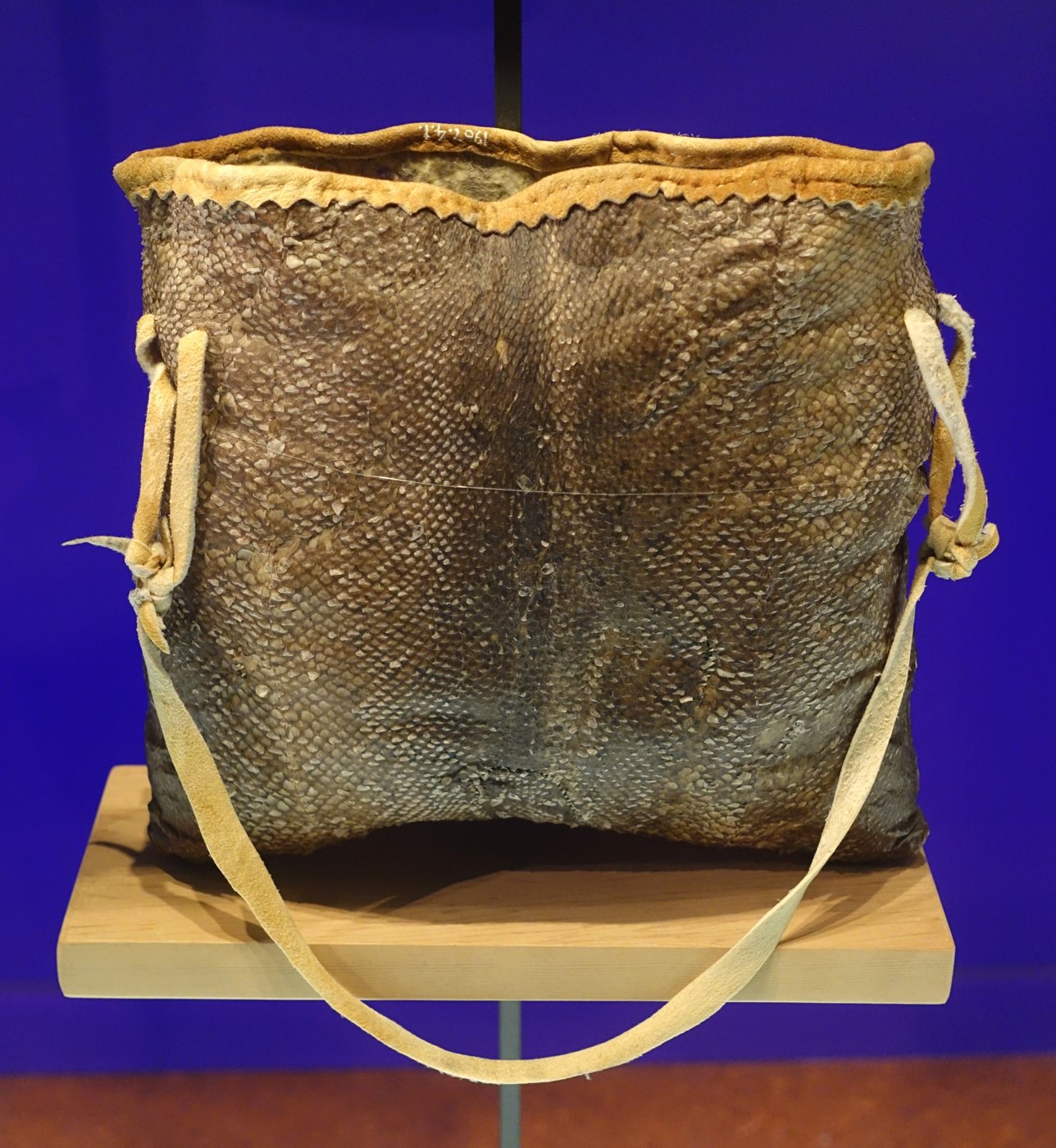
Salmon-skin bag, catalogued as Bannock-Shoshone Daderot / Wikimedia Commons; Museum of Ethnography, Stockholm, object 1987.04.0001
Museum object labelled Bannock-Shoshone, not assigned exclusively to Bannock or a specific modern government. Use this exact shared attribution in visible caption. Commons description, licensing and full original photograph visually inspected. Museum identifier present; original object catalogue not independently read. No meaning of patterns inferred. Web copies proportionally resized/recompressed; display backgrounds may be cropped by CSS. Full image remains proportional in the page banner.
Image, association, and reuse record reviewed 2026-10-24.
Full photographs are displayed proportionally above. A translucent background copy may be cropped by the viewport; it does not replace the complete image or its record.
The visual treatment does not change the research status, evidence, or remaining gaps recorded in this profile.
Start reading here
Bannock people and their Northern Paiute language variety remain distinct from Shoshoni; Fort Hall has a shared Shoshone-Bannock government. The 2020 journal article was previously read in its introduction, Edmo narrative and recording notes; current journal access has not been rechecked. Edmo's 1959 recorded account is one person's mediated history, and treaty metadata discrepancies remain unresolved.
The Tribes' Culture and History account introduces Bannock relationships and Fort Hall's shared community without assigning all joint territory exclusively to Bannock people.
Lizzie Edmo's attributed autobiographical material and recording notes provide a named Fort Hall speaker's perspective within a specialist language study.
The Tribes' Treaty Day article explains their interpretation of the promised Bannock reservation and later shared Fort Hall history.
These are selected starting points. The full annotated collection, source perspectives, inspection limits and remaining research questions follow below. A starting guide is not an exhaustive history or community endorsement.
01
People, language relationships, and homelands
Bannock is both a people’s name and the name of a Northern Paiute language variety. Linguist Tim Thornes locates historical Bannock territory around the Snake River Plain of southwestern Idaho and the Boise River Valley, and describes sustained contact with Shoshoni. The Tribes’ own overview places Bannock bands within a shared history with Northern Shoshone bands, across ancestral lands extending well beyond present reservation boundaries. Their related Numic languages belong to the Uto-Aztecan family. A shared government and close cultural relationships coexist with linguistic distinctions; neither Bannock nor Northern Paiute should be treated as simply another name for Shoshone.
The Language and Cultural Preservation Department’s 2024 essay describes Tennambo’i, the lava-flow country now within Craters of the Moon, through ancestral memory and living place names. It connects routes across the Snake River Plain with salmon fishing, buffalo hunting, and camas and wild-carrot gathering farther afield. These paths linked important food areas and relationships across a large region. The department also explains its work with the National Park Service to bring tribal interpretations into public signage. Its account connects historical travel with present responsibilities, including collaborative efforts against invasive grass threatening camas habitat at Centennial Marsh.
The treaty, an unfulfilled reservation promise, and Fort Hall
The treaty signed at Fort Bridger on July 3, 1868, contains different provisions for Eastern Shoshone and Bannock people. Article 2 promises a future Bannock reservation; the published text names Portneuf and “Kansas Prairie,” while the Tribes’ public interpretation identifies Camas Prairie. Article 4 addresses reservation residence and hunting on specified unoccupied lands. In its Treaty Day account, the Shoshone-Bannock Tribes explains that the separate Bannock reservation was never created and that Bannock people were instead relocated to Fort Hall in 1869. The Tribes’ historical overview describes subsequent losses through surveying, legislation, and allotment. Reading the treaty beside tribal interpretation helps distinguish the agreement’s text from what the United States actually implemented.
A 2023 study coauthored by tribal citizens and university researchers connects the Bannock War of 1878 with restricted access to food, damage to camas grounds, and unmet federal obligations. Its historical discussion places hunger and displacement at the center of the conflict rather than describing war as an isolated outbreak. The study also documents a contemporary project to make camas more accessible at Fort Hall through cultivation experiments and community activities. Seeds and transplanted bulbs offered possible ways to strengthen access, although the authors identify questions about genetic differences and longer-term effects. This work connects experimental science, tribal oversight, and relationships maintained through food.
The Tribes’ Language and Cultural Preservation Department describes instruction in both Bannock and Shoshone, taught by tribal members and connected to history, identity, and treaty knowledge. Its archival and digital preservation programs retain documents, recordings, interviews, and family histories. Thornes’s 2020 publication provides a different kind of evidence: Bannock-language narratives with transcription, grammatical analysis, and translation. The autobiographical narrative of Lizzie Edmo was recorded by Sven Liljeblad at Fort Hall in 1959. Her recollections describe travel, gathering, fishing, and exchanges among families. The article preserves an individual speaker’s experience and linguistic knowledge; it should not be generalized into a single life story for every Bannock family.
The published constitution and bylaws identify the Fort Hall Business Council as the governing body of the Shoshone-Bannock Tribes and provide for seven elected members. The document records a constitution approved in 1936 and later amendments. This is a primary source for the shared government’s formal structure, rather than a description of every earlier Bannock political arrangement. Cultural work is also institutional: the preservation department maintains archives, supports historical research, and addresses misleading representations and exploitation of tribal intellectual property. Its museum presents community history, art, and the Benedicte Wrensted photographic collection. Publicly shared information sits alongside material the department explicitly treats as confidential or sensitive.
The Tribes describe Indian relay racing as a continuing horse tradition passed to younger generations by tribal families. Its public explanation outlines a team of four people and three horses, with the rider changing horses between laps while teammates manage the exchanges. This gives readers a concrete view of coordination and skill. The page’s broader claims about the sport’s origin represent the Tribes’ own account; this profile does not turn its undated historical claims into a precise chronology.
The shared government’s Fish and Wildlife Department links habitat restoration and fisheries work to the exercise of treaty rights. The Tribes’ salmon advocacy also calls for removal of the four lower Snake River dams, framing recovery as a cultural responsibility as well as an ecological issue. Its Water Resources Department describes protection of water quality, administration of reservation water use, and implementation of the 1990 Fort Hall water agreement. A separate 2022 Community Action Plan brings air monitoring, community survey findings, renewable energy, and efficiency measures into environmental planning. Together these sources show distinct forms of contemporary tribal action. They document governmental priorities and proposals, rather than proving that every proposed project or policy has been completed.
Add more Bannock-authored or community-approved family histories and public oral histories, including experiences beyond Fort Hall; one narrator cannot represent every band or family.
Deepen the 1878 war account with community interpretation and critically assessed archival records, including differing experiences among Bannock, Northern Paiute, and Shoshone families.
Compare the published treaty text with manuscript and official publication records, and document the chronology of Fort Hall boundary changes without collapsing promises, executive orders, and later legislation into one event.
Add a dated community account of Bannock language learning and teaching outcomes; no current speaker total is asserted here.
Expand evidence on schooling, livelihoods, art, and family life, and verify permissions and cultural suitability before reproducing archival images or knowledge.
Follow the reading path
Sources & further reading
Open any title to read the original source. Annotations explain what each link can help you explore.
No Indigenous-led source is identified in this entry yet. This is a gap in this collection, and does not imply an absence of community knowledge or organization.
Tribal historical overview, especially “Culture and History” and the reservation discussion. Explains the shared community’s composition, food resources, travel, and land reduction. Undated; its broad regional account is not a map of exclusively Bannock territory.
Tim Thornes, 2020, volume 86 supplement 1, pp. S13–S33. Read the introduction, Lizzie Edmo’s autobiographical narrative, and recording notes. Specialist linguistic analysis accompanies older speaker recordings; the article’s speaker estimate is dated, not a current census.
Tribal department’s guest essay, updated September 25, 2024. Explains place names, ancestral travel, interpretive collaboration, and camas habitat restoration. This is an explicitly tribal-authored perspective hosted by the park, not an anonymous federal summary.
Primary treaty text dated July 3, 1868; inspect Articles 2 and 4 for the promised Bannock reservation and hunting provision. Published in Kappler’s 1904 compilation and reproduced by the Tribes. Historical wording requires context and does not by itself settle present legal disputes.
Public tribal interpretation of the treaty, its continuing importance, the unfulfilled separate Bannock reservation, and relocation to Fort Hall. Complements the primary text by explaining the government’s own historical and political understanding. No publication date is displayed in the inspected article.
Sidney Fellows, Georgia Hart-Fredeluces, Nolan Brown, and Morey Burnham, 2023. Tribal–university collaboration; read “Postcolonial Suppression,” partnership methods, and conclusions. Connects restricted food access and 1878 conflict to cultivation research, while identifying biological uncertainties. Historical discussion is a synthesis, not a complete war history.
Substantive departmental account of instruction, archives, historical research, oral-history recording, museum work, and protection of sensitive knowledge. Undated; class times, personnel, and visitor details require a fresh check before use. Programs serve the shared Shoshone-Bannock community.
Constitution approved April 30, 1936, presented with amendments through August 15, 2013. Read the preamble and governing-body provisions for the seven-member Business Council. The web transcription repeats an article heading incorrectly; consult the linked official document for precise legal citation.
Community account of family horse traditions, relay-team roles, and changing horses during a race. Useful for the Tribes’ own public presentation of the sport. Undated origin and age claims are attributed accounts, not an independently established chronology.
Departmental explanation of treaty-based responsibilities, restoration priorities, and salmon and steelhead projects. Read “Management Authority,” “Areas of Focus,” and “Snake River Policy.” Broad program descriptions are undated; announcements and project implementation dates need separate verification.
Tribal advocacy page explains cultural stakes of salmon recovery, the Snake River policy, and support for lower Snake River dam removal. Includes named community perspectives and discussion of a 2021 congressional proposal. Read as a policy position, not proof of a completed dam-removal decision.
Tribal account of the 1990 Fort Hall water agreement, department formation, water-use administration, and quality monitoring. Read “History and Direction” and “Water Quality Program.” Explains governmental responsibilities; it is not a substitute for the agreement’s full legal text.
Dated November 15, 2022. Read printed pp. 1–4 for purpose, pp. 10–14 for community survey, pp. 15–21 for monitoring, and pp. 29–31 for implementation. A planning document with community input; recommended actions and dated measurements are not current outcome evaluations.
Related entries may represent alternate names, constituent communities, wider groupings, or historical connections. Read the naming notes before treating entries as equivalent.
Robey’s Atlas of Indigenous North America · Compiled October 19, 2026 · Bannock