Tribal government / contemporary community · Added to the original list
Shakopee Mdewakanton Sioux Community
The Shakopee Mdewakanton Sioux Community is a distinct Dakota tribal government in Minnesota. Its public historical timeline and Dakota language account connect community continuity, land purchases and political organization with language recovery and public education. This guide centers those community publications while preserving distinctions between the SMSC, related peoples and neighboring governments.
See each region’s evidence for historical or present-day scope.
Homeland / region
Minnesota
Research depth
Source guide
Source collection
2 annotated resources · 2 Indigenous-led
Inspected sources
2 substantive works · selected content reviewed
Initial adequacy
Still unfinished
Source review
October 27, 2026
Names & relationshipsMnDOT explicitly places this individual Minnesota government under its Dakota Tribal Nation grouping. It remains a separate government; no automatic equivalence to Santee Dakota or another band is inferred.
A source guide for a deeper dive.This entry provides a brief orientation and an organized reading path. A comprehensive deep dive has not yet been completed. Follow the annotated sources and distinguish primary community accounts from outside reference material.
Still unfinished
A compact source-led introduction to this named community; historical breadth, local voices and outcomes remain limited. No comprehensive completion or community endorsement is claimed.
Assessment recorded October 27, 2026. This is separate from research completion and community review.
Compare selected chronology with original land and government records.
Broaden community, family and artistic voices beyond institutional publications.
Check current learning-resource availability and outcomes; no community review is recorded.
Backdrop photographs & credits
These photographs have individual, documented connections to this entry. Their captions and source records define the people, place, object, and period shown; no one photograph represents every community within a broader label.
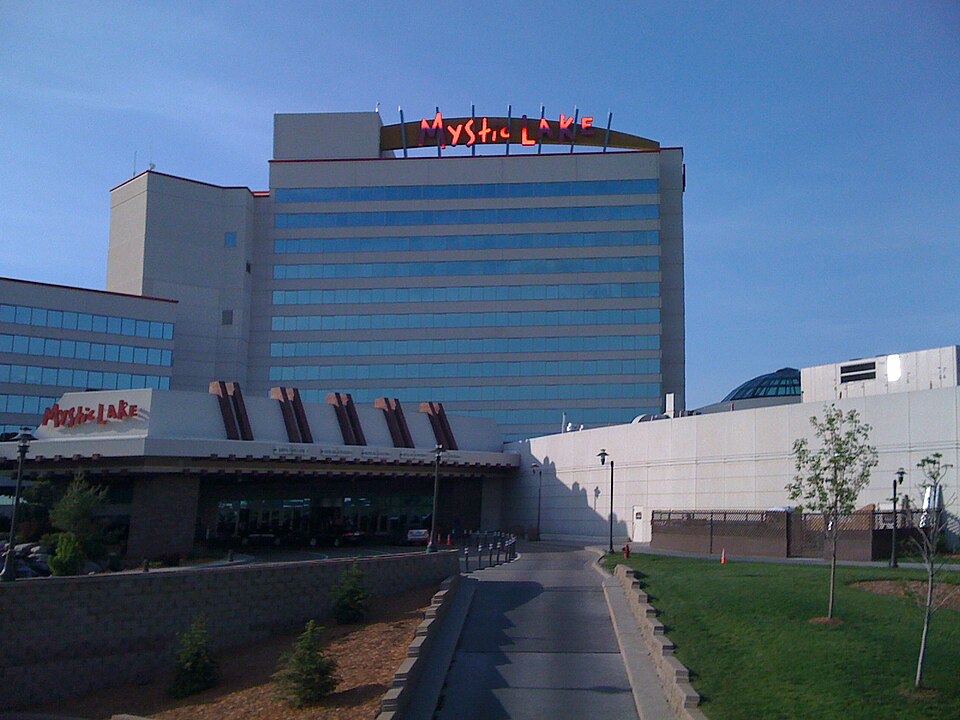
Mystic Lake Casino exterior,2010 Jayesh Naithani, 2010; Wikimedia Commons. CC BY-SA3.0. Complete960px preview; original-resolution image not inspected.
A2010 exterior of the specifically identified Mystic Lake Casino. The Community’s own enterprise FAQ explicitly identifies Mystic Lake Casino Hotel as part of its Gaming Enterprise. This is a community-institution connection, not a traditional-artwork, tribal-member, sovereignty-boundary or current-building-condition claim. Building signage is incidental within the complete exterior photograph; no logo is extracted or offered separately. Complete browser-rendered preview frame preserved unchanged, without crop, retouching or generated pixels. The opened-page image is proportional; directory/backdrop copies may use disclosed CSS crops and overlays. Preserve this photograph and derivatives under CC BY-SA3.0 with creator/source/license credit. This image review adds no substantive historical reading count. Unchanged complete browser preview; CSS cropping/overlays only, with disclosure. CC BY-SA3.0 applies to photograph and derivatives; no endorsement asserted.
Image, association, and reuse record reviewed 2026-10-27.
Full photographs are displayed proportionally above. A translucent background copy may be cropped by the viewport; it does not replace the complete image or its record.
The visual treatment does not change the research status, evidence, or remaining gaps recorded in this profile.
Start reading here
Named government/community route; wider Dakota or Ojibwe reading profiles remain related context rather than interchangeable identities.
Read how the SMSC describes its language-learning work and tools.
These are selected starting points. The full annotated collection, source perspectives, inspection limits and remaining research questions follow below. A starting guide is not an exhaustive history or community endorsement.
01
Continuity and political organization
The Community's selected timeline follows removal in 1863, later land purchases and organization in 1969, then subsequent institutional developments. Its companion cultural introduction describes related peoples without making governmental membership identical. A 2019 cultural-center entry shows one way the SMSC presents history publicly. These are the Community's own historical and institutional accounts. Exact ancient chronology, broad legal summaries and every recent project claim are not adopted as independently verified facts; a historical timeline is an opening reading rather than a full documentary history.
The SMSC's Dakota Language page connects learning with identity and recovery. It describes a language team, classes, family activities, youth culture camps, a Language Bowl and a community keyboard. These details show the range of work described by this particular Community. The page is undated, so program descriptions are not guarantees of current schedules or access. Its account of language loss remains attributed to the SMSC, not generalized to all Dakota communities. The selected reading supplies no present speaker census or independently evaluated learning outcomes.
Compare selected chronology with original land and government records.
Broaden community, family and artistic voices beyond institutional publications.
Check current learning-resource availability and outcomes; no community review is recorded.
A community-specific starting guide reuses selected earlier actual-content reviews with their original dates/scopes. It does not add new global works merely because a URL appears on this route. Picture identification/rights are separate from historical adequacy or community endorsement.
Follow the reading path
Sources & further reading
Open any title to read the original source. Annotations explain what each link can help you explore.
No Indigenous-led source is identified in this entry yet. This is a gap in this collection, and does not imply an absence of community knowledge or organization.
Publication: Undated publication; timeline includes 2025 events, which do not establish its initial publication date
A particular Dakota government's account extends from removal and land purchases to its institutions. Related peoples and governmental membership remain distinct. Its historical legal summaries, precise ancient chronology, current project claims and cultural imagery are not adopted wholesale.
Inspection: Content reviewed for the stated scope
Scope: Actual timeline selected 1837–1969 and 1989–2025 entries, lines 76–407; public-exhibit description 419–421. Companion introduction 27–57 read. Claim selects 1863, later land purchases, 1969 organization, related-peoples wording and 2019 cultural center.
Review recorded: October 21, 2026
Inspected material and access routes
Culture & History ↗ — Actual related-peoples introduction, cultural-center history and language-history paragraphs; grouped with timeline.
Publication: Undated; site footer 2026 does not establish the page’s initial publication date
The Community describes Dakota language learning as part of its own identity and recovery, and outlines its language team, weekly classes, family programming, youth culture camps, the Dakota Language Bowl and a community keyboard. Its historical and language-loss framing remains attributed to the Community; it is not generalized to all Dakota communities, and no current speaker count is inferred.
Inspection: Content reviewed for the stated scope
Scope: Read the complete visible page body, lines 27–65, including the Community’s account of program origins, current program descriptions and the SMSC’s sovereign-government identification. Links to the cultural center and external learning materials were not opened.
Related entries may represent alternate names, constituent communities, wider groupings, or historical connections. Read the naming notes before treating entries as equivalent.
Robey’s Atlas of Indigenous North America · Compiled October 19, 2026 · Shakopee Mdewakanton Sioux Community