Dakota peoples include distinct communities and governments across a wide region. This Minnesota-focused reading path centers community accounts, Dakota public testimony and education, historical displacement, and a dated treaty record. It distinguishes Minnesota governments and specific historical evidence from broader Dakota identities and histories elsewhere.
See each region’s evidence for historical or present-day scope.
Homeland / region
Great Plains / Minnesota / Canada
Research depth
Source guide
Source collection
21 annotated resources · 9 Indigenous-led
Inspected sources
13 substantive works · selected content reviewed
Initial adequacy
Still unfinished
Source review
October 23, 2026
A source guide for a deeper dive.This entry provides a brief orientation and an organized reading path. A comprehensive deep dive has not yet been completed. Follow the annotated sources and distinguish primary community accounts from outside reference material.
Still unfinished
Thirteen substantive inspected works now support a Minnesota-focused introduction, including separate accounts from three Minnesota Dakota governments, the 2025 Upper Sioux Community account carried in a state guide, a Lower Sioux Community-produced history booklet, Dakota-created education, named Dakota public testimony, a specific 1851 treaty text and focused state records. New community pages add distinct Prairie Island preservation and language-program material and Shakopee language education. Seven supporting references remain excluded. This is still weighted toward Minnesota and institutional materials, not a deep history of every Dakota community, specialist language study, current demographic account or community-reviewed collection.
Assessment recorded October 23, 2026. This is separate from research completion and community review.
The Upper Sioux Community government website returned HTTP 403 to this research request. The accessible state-hosted histories and 2025 government guide provide useful community-attributed material, but the current Community constitution, official land-conveyance instrument, and a direct government publication about the 2024 return remain unreviewed; the access failure is not treated as a paywall and was not bypassed.
Dakota communities outside Minnesota, including particular governments in the Dakotas, Nebraska, and Canada, need their own community voices and scoped sources. This collection is not an exhaustive homeland or present-community map.
Specialist Dakota language scholarship is needed for precise language variation and classification; undated public speaker totals should not be used as current demographic findings.
Original treaty scans, oral understandings, 1863 statutes, community constitutions, and additional Dakota-authored historical scholarship would deepen the collection. Treaty text, state summaries, and public exhibition testimony answer different questions.
The complete Mni Sóta Maḳoce lesson materials require teacher training; the public page gives the curriculum overview but not the lessons themselves. Outcome research was described by the publisher as forthcoming, so no effectiveness claim is made.
Dated education reports and community evaluations would be needed before describing current operations, participation, or outcomes. No clinical, legal, membership, or service-eligibility conclusion is proposed.
No Dakota community review or endorsement is recorded.
The MNHS Dean Blue oral-history source is a short excerpt; its full interview was not verified through the archive link and the individual's view does not establish a Dakota-wide position.
Backdrop photographs & credits
These photographs have individual, documented connections to this entry. Their captions and source records define the people, place, object, and period shown; no one photograph represents every community within a broader label.
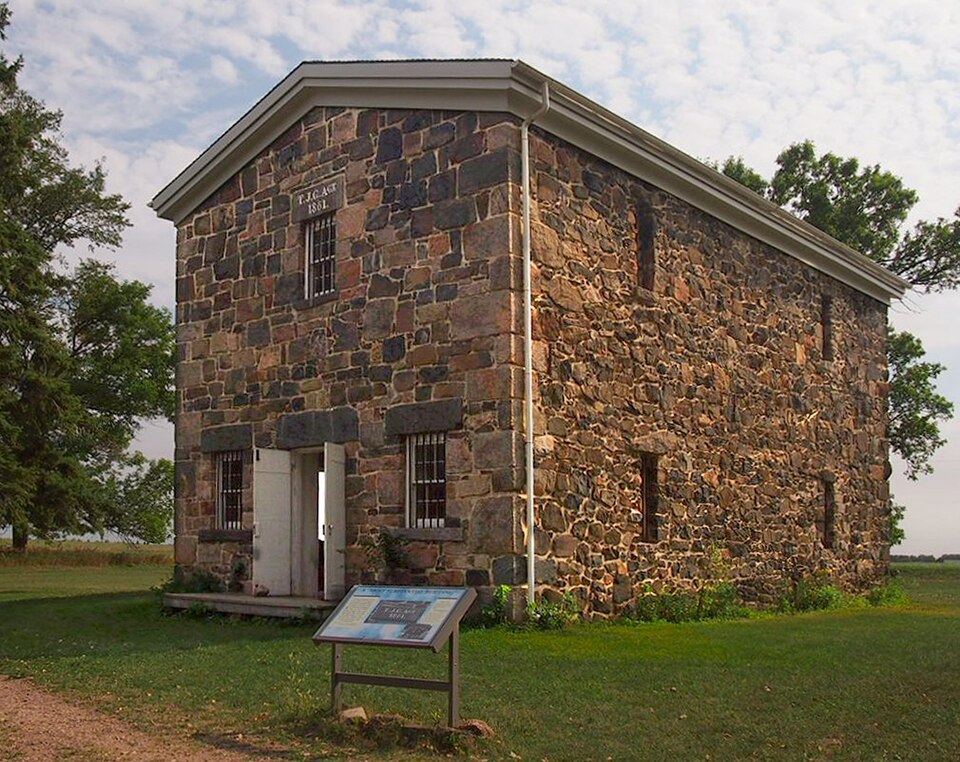
Lower Sioux Agency warehouse,2012 McGhiever, 2012; Wikimedia Commons. CC BY-SA3.0. Complete960px preview; original-resolution image not inspected.
Copy the existing cleared Lower Sioux Agency warehouse photograph with Dakota and Santee Dakota as the two new slugs, leaving the original Community mapping unchanged. The retained Dakota sources already identify Caŋṡayapi/Lower Sioux as Mdewakanton; the exact public historic-site body was reopened October 27, 2026 for the agency's Bdewakantunwan/Wahpekute connection and Community management. Caption it as this particular 2012 agency-era building under community public interpretation, not a traditional dwelling or a portrayal of all Dakota peoples. Preserve the original 960px browser-preview access limitation, McGhiever credit, CC BY-SA 3.0 and display-crop disclosure. Lower Sioux Agency warehouse exterior; the Community’s own Historic Site page describes its management of this specific public historic site through a cooperative agreement beginning in2007. This is a2012 photograph of an agency-era building, not a traditional Dakota dwelling, a current family home or a depiction of all community life. No war narrative, date of construction or property-title conclusion is inferred from its appearance. Complete browser-rendered preview frame preserved unchanged, without crop, retouching or generated pixels. The opened-page image is proportional; directory/backdrop copies may use disclosed CSS crops and overlays. Preserve this photograph and derivatives under CC BY-SA3.0 with creator/source/license credit. This image review adds no substantive historical reading count. Unchanged complete browser preview; CSS cropping/overlays only, with disclosure. CC BY-SA3.0 applies to photograph and derivatives; no endorsement asserted. Use the same new copy-only registry record as Dakota, with both slugs; preserve the old Lower Sioux mapping. The Community's historic-site body lines 83–97 read October 27, 2026 explicitly ties this agency to Bdewakantunwan and Wahpekute bands; NICC's actual history body identifies both within Santee. The photograph is specifically a Lower Sioux Agency warehouse in 2012, at a site managed by the Mdewakanton Community, not a generic Sioux substitute or a Nebraska government building. Preserve McGhiever, CC BY-SA 3.0 and the original 960px-preview access limitation.
Image, association, and reuse record reviewed 2026-10-27.
Full photographs are displayed proportionally above. A translucent background copy may be cropped by the viewport; it does not replace the complete image or its record.
The visual treatment does not change the research status, evidence, or remaining gaps recorded in this profile.
Start with the Caŋṡayapi Community-produced booklet for a situated history of land, continuity and interpretation; only the recorded selected pages were reviewed.
Finish with the Dakota-created curriculum's public overview; full training-only lessons and effectiveness were not reviewed.
These are selected starting points. The full annotated collection, source perspectives, inspection limits and remaining research questions follow below. A starting guide is not an exhaustive history or community endorsement.
01
Cansa'yapi: community continuity and public history
The Lower Sioux Indian Community identifies its members as Mdewakanton Dakota and calls its Minnesota River homeland Caŋṡayapi. Its account describes families returning despite exile. A companion historic-site page dates tribal management of the Lower Sioux Agency site to 2007. The Community’s public history booklet adds its own account of Caŋṡayapi, stewardship, sovereignty, the 1851–1858 treaty period, community continuity after 1862, Wacipi and Dakota-language renewal. These are community-specific historical and educational statements, not independent verification of broader Dakota history or a homeland boundary. Together the sources connect continuity with the Community’s authority to interpret a place shaped by federal reservation policy.
A particular Mdewakanton government's institutions
The SMSC identifies itself as a Dakota government within the Oceti Ṡakowiŋ, alongside related Dakota, Lakota and Nakota peoples. Its public timeline follows forced removal, later land purchases and its own 1969 governmental organization. The community dates Hoċokata Ṫi's opening to 2019. These are a particular Mdewakanton government's institutions, not a model shared by every Dakota community.
Prairie Island identifies its members as Bdewakantunwan, or Mdewakanton, Eastern Dakota. Its history follows families who remained or returned, purchased land and maintained a community despite displacement. The Tribe also describes pressures from dam construction, a nuclear generating plant and rail transport. These concerns are its situated account of Prairie Island, rather than a general description of every Dakota homeland.
Dakota Wicohan traces its origins to a 2001 language team involving Upper Sioux, Lower Sioux and Twin Cities Dakota, followed by nonprofit incorporation in 2002. Its account connects intergenerational language learning, teacher preparation and outreach with community relationships. This educational organization works across political boundaries; it is not another tribal government. Its undated speaker and program totals are not current measurements. A separate Dakota Wicohan curriculum was developed by Dakota scholars and educators led by Iyekiyapiwiƞ Darlene St. Clair. Its ten-lesson outline treats Minnesota as Dakota homeland and covers place, language, sovereignty, treaties, colonization, cultural continuity and living together. The public overview says teachers need training to access the lessons and that outcome research was still forthcoming; the materials have not been presented here as an evaluated program.
MNHS describes noncombatant Dakota imprisonment at Fort Snelling during 1862–1863 and forced transport to Crow Creek in May 1863. It distinguishes congressional actions of February 16 and March 3, 1863, concerning treaty annulment and removal. Its account also discusses a separate Ho-Chunk expulsion. These histories should not be conflated or taken to mean every Dakota person participated in the war.
The Mendota treaty text names Mdewakanton and Wahpekute parties, rather than every Dakota community. Its published version records a land cession, differentiated payments and funding for education and farms. It also marks Article 3 as deleted and prints supplemental terms. This specific written federal record does not establish fully informed consent, oral understandings, promise fulfillment or present individual entitlements.
Four Minnesota governments within wider Dakota peoples
MnDOT's public inventory names Lower Sioux, Prairie Island, Shakopee Mdewakanton and Upper Sioux as Minnesota Dakota communities. Each government needs its own institutional reading. This four-government inventory is a Minnesota access point, not an exhaustive list of Dakota peoples or their communities elsewhere in the United States and Canada.
The retained South Dakota teaching-kit versions offer a broad comparative educational starting point; only their contents and goals were inspected here. The retained Black Hills page identifies a hosted student legal position paper. These resources do not supply Minnesota Dakota community authority, a universal cultural description or verified current law, and remain outside this collection's substantive count.
In the Minnesota Historical Society’s Our Home exhibition transcript, five named Dakota speakers describe Minnesota as Dakota homeland, discuss the Seven Council Fires, and speak about relationships to land and relatives. The speakers use different formulations: Dallas Ross distinguishes Dakota as a way of life from a nation of people, while Grace Goldtooth-Campos refers to Dakota Oyate as a nation and describes its council-fire groups. Keeping each statement attributed makes the variation visible without treating one exhibition transcript as a universal definition for all Dakota people or governments. In a separate MNHS oral-history excerpt, Upper Sioux narrator Dean Blue reflects on Fort Snelling from his own experience as a veteran-service officer and expresses a personal view about the building. The interviewer notes that Dakota people held differing views; the excerpt should be read as one individual's public memory, not as consensus.
Upper Sioux Community: Pezihutazizi Oyate and returned agency lands
The 2025 Minnesota Tribal Government guide presents Upper Sioux Community’s account of Pejuhutazizi Kapi as Dakota homeland, the community’s formation in 1938 on 746 returned acres, and its 1995 constitution. The guide reports that the state returned the former Upper Sioux Agency State Park in 2024 and gives a resulting total land base of 3,725 acres; its membership count is a dated 2025 report figure, not a current 2026 measure. The Minnesota DNR describes the Community’s long-standing request and explains the 1862 history of starvation and death at the agency, while Minnesota law records the state’s direction to transfer park land. The DNR page and statute are state records, not substitutes for the Community’s own historical account. A separate undated state-hosted version repeats the community history with older acreage and population figures; neither version defines all Dakota homelands or a present boundary.
Language renewal within Prairie Island and Shakopee communities
Prairie Island describes its community language department, classes, culture camps, language-bowl activities and outreach at Red Wing High School. Shakopee Mdewakanton Sioux Community describes its own language team, weekly classes, family learning events, youth camps and Dakota-language education. These are two governments’ accounts of particular programs, not a single uniform Dakota-language system. Prairie Island’s page still refers to an app expected in spring 2023; its present availability was not verified.
Prairie Island’s cultural and historic preservation work
Prairie Island describes its Tribal Historic Preservation Office, artifact repatriation work, restoration of the public He Mni Can site, and partnership to protect the Grand Meadow Chert Quarry. These examples show the Community’s own preservation priorities and public interpretation. Its broader archaeological statements remain attributed to the Community; no burial locations or restricted details are repeated.
The Upper Sioux Community government website returned HTTP 403 to this research request. The accessible state-hosted histories and 2025 government guide provide useful community-attributed material, but the current Community constitution, official land-conveyance instrument, and a direct government publication about the 2024 return remain unreviewed; the access failure is not treated as a paywall and was not bypassed.
Dakota communities outside Minnesota, including particular governments in the Dakotas, Nebraska, and Canada, need their own community voices and scoped sources. This collection is not an exhaustive homeland or present-community map.
Specialist Dakota language scholarship is needed for precise language variation and classification; undated public speaker totals should not be used as current demographic findings.
Original treaty scans, oral understandings, 1863 statutes, community constitutions, and additional Dakota-authored historical scholarship would deepen the collection. Treaty text, state summaries, and public exhibition testimony answer different questions.
The complete Mni Sóta Maḳoce lesson materials require teacher training; the public page gives the curriculum overview but not the lessons themselves. Outcome research was described by the publisher as forthcoming, so no effectiveness claim is made.
Dated education reports and community evaluations would be needed before describing current operations, participation, or outcomes. No clinical, legal, membership, or service-eligibility conclusion is proposed.
No Dakota community review or endorsement is recorded.
Substantive works and supporting access routes are counted separately. Actual selected inspection scope and dates appear on the cards; unread references and source media are not counted. This is a Minnesota-focused initial source guide, not a complete history of Dakota peoples or a community endorsement. Governance, historical, educational, and language claims retain their particular community, speaker, source, and period. Three additional community-government pages reviewed on 2026-10-23 describe Prairie Island language education and cultural preservation and Shakopee Dakota-language programs. Their program descriptions are community-specific; an older anticipated app launch is not treated as current status, and linked lessons or dictionaries were not counted as inspected. The Minnesota Indian Affairs Council’s undated Upper Sioux page reports 453 people and more than 900 acres, while the 2025 Minnesota Tribal Government guide reports a 2024 return and a 3,725-acre total land base and prints a 577 membership figure. The records are dated differently; no number is treated as a current 2026 figure, and none defines a homeland boundary. No historical map association was added. The Minnesota regional route is a navigation aid and does not describe the extent of Dakota homelands. 2026-10-23 follow-up: read the full visible MNHS story page for a short Dean Blue oral-history excerpt on Fort Snelling and the interview metadata. The full interview link returned HTTP 404 during inspection; a search-discovered copy with unverified hosting provenance was not relied on. Added as supporting testimony only (countsTowardMinimum:false); the interviewer's prompt records differing Dakota views. 2026-10-23 follow-up: read selected substantive sections of the Lower Sioux Indian Community’s 19-page Caŋṡayapi history booklet hosted by Minnesota Department of Education. Added as a community-produced work for its scoped Lower Sioux history, homeland/treaty account, governance, site stewardship and language-education coverage. General historical claims are attributed; maps in the booklet were not separately catalogued. Dakota now has thirteen substantive inspected works; initial adequacy remains Still unfinished. Selected actual-content works support a bounded starting guide. Earlier source objects retain their original review dates and limits. Reused URLs, images and identity-only checks are not new global historical works. Full history and community review remain open.
Follow the reading path
Sources & further reading
Open any title to read the original source. Annotations explain what each link can help you explore.
No Indigenous-led source is identified in this entry yet. This is a gap in this collection, and does not imply an absence of community knowledge or organization.
Indigenous-ledLower Sioux Indian CommunitySource 1
Publication: Undated bodies; 2026 footer and opening hours do not date the historical accounts
The government's own account connects local identity, exile, return and public historical interpretation. Selected companion site history is grouped once. Population figures, casualty estimates, current service availability and blanket treaty/legal conclusions are excluded.
Inspection: Content reviewed for the stated scope
Scope: Actual About Us historical body, lines 59–82; companion Historic Site historical paragraphs 83–86 and public interpretation description 97 read. No video, embedded flipbook or underlying treaty opened from these pages.
Review recorded: October 21, 2026
Inspected material and access routes
Historic Site ↗ — Actual history and tribal-management account; hours, admissions and contacts excluded.
Publication: Undated publication; timeline includes 2025 events, which do not establish its initial publication date
A particular Dakota government's account extends from removal and land purchases to its institutions. Related peoples and governmental membership remain distinct. Its historical legal summaries, precise ancient chronology, current project claims and cultural imagery are not adopted wholesale.
Inspection: Content reviewed for the stated scope
Scope: Actual timeline selected 1837–1969 and 1989–2025 entries, lines 76–407; public-exhibit description 419–421. Companion introduction 27–57 read. Claim selects 1863, later land purchases, 1969 organization, related-peoples wording and 2019 cultural center.
Review recorded: October 21, 2026
Inspected material and access routes
Culture & History ↗ — Actual related-peoples introduction, cultural-center history and language-history paragraphs; grouped with timeline.
Publication: Undated; footer 2026 is not treated as the article date
Prairie Island speaks from its own Bdewakantunwan community history. Development pressures are attributed to the Tribe's account, without independently assessing legal liability, radiation exposure or current safety. No burial details, precise sensitive places or media are reproduced.
Inspection: Content reviewed for the stated scope
Scope: Actual complete historical body, lines 49–123: identity, Dakota history, reservation formation, development pressures, governmental economy and future generations. Synthesis selects identity, return/land history and attributed development concerns.
Publication: Undated body with historical episodes through 2013; footer copyright 2020 is not a verified article date
A Native educational organization's own substantial account of language activism across community boundaries. Its mission, history and described approaches are distinguished from present outcomes. Undated speaker/program totals and simplified D/L/N classification are excluded.
Inspection: Content reviewed for the stated scope
Scope: Actual mission, accomplishments and organizational origins, lines 48–76, read. Claim selects 2001 Language Team, 2002 incorporation and intergenerational educational purpose; no documentary, original Elder interview, radio recording or course content accessed.
Publication: Webpage undated; cited 2017 book and other bibliography dates are not automatically the webpage date
The selected historical account distinguishes noncombatants, military imprisonment and forced removal. Its treaty-annulment summary concerns historical congressional action, not present legal advice. Ho-Chunk expulsion is a separate history; casualty numbers and linked personal narratives are excluded.
Inspection: Content reviewed for the stated scope
Scope: Actual substantive body lines 278–303 and source/editor note 304–326 read. Claim selects noncombatant imprisonment, February/March 1863 actions, May transport and distinct Ho-Chunk removal; cited books, original statutes and trial records remain unread.
Publication: Concluded August 5, 1851; displayed proclamation February 24, 1853. Database publication/update date not established
A primary written record for specific named parties. The transcription distinguishes deleted reservation text and supplemental terms. It does not establish informed consent, oral understandings, fulfillment, current legal effect or individual entitlements. Linked original scan and archival record were not inspected.
Inspection: Content reviewed for the stated scope
Scope: Actual treaty heading, Articles 1–7 and supplemental article, lines 24–75 and 120–132, read. Signatory table was visible but not used for genealogical or name-identification claims; no original manuscript/image review claimed.
Publication: Undated body; reviewed October 21, 2026
An official inventory distinguishes named governments and broad Dakota/Ojibwe groupings. It supports navigation rather than a full community history, citizenship classification or exhaustive map of Indigenous presence. Outside the substantive count.
Inspection: Supporting or limited review; see scope
Scope: Actual government statements, headings and eleven names/links, lines 22–74, read. Individual fact sheets and maps were not inspected; separate structured inventory preserves the listed URLs and candidate reading links.
Publication: Undated selected pages; version date not established
Original link retained with limited review. The kit's broad South Dakota framing and object-based activities do not establish Minnesota Dakota identity or practice. Selected contents/goals only, outside the substantive count; no audio, designs or cultural instructions reused.
Inspection: Supporting or limited review; see scope
Scope: Actual 72-page PDF's contents and goals/materials, PDF/printed 1–2, read. Later teacher-resource body could not be recovered on bounded reopening; photograph-list text surfaced but no photographs were inspected or reused.
Publication: Undated selected pages; edition chronology not established
Alternate original ID/URL retained. Different pagination is not evidence of a distinct authored work; grouped with p 95-s 1 outside the substantive count.
Inspection: Supporting or limited review; see scope
Scope: Actual alternate PDF contents/goals, printed 1–2, read. Selected photograph-list text surfaced; teacher-resource pages were not recovered on reopening. No full-kit, associated book, recording or worksheet review claimed.
Publication: Undated paper includes 2001 interview references; surrounding links mention 2012/2013. None establishes paper publication or present legal position
Original route retained as contextual advocacy, outside the substantive Dakota count. The page identifies a student paper and focuses on Lakota/Black Hills arguments. The site's self-description does not establish authority for Minnesota Dakota governments or current legal conclusions.
Inspection: Supporting or limited review; see scope
Scope: Actual introduction, legal argument/conclusion and authorship note, lines 15–36 and 149–239, 277–298, read. Embedded poetry, original court/treaty records, linked letters and media supply no proposed quotation or further count.
This two-page community profile describes the Minnesota River homeland, the community’s establishment in 1938, its 1995 constitution, tribal enterprises and services, and the 2024 return of former Upper Sioux Agency State Park lands. The state publication carries the community’s narrative; it is not an independent verification of every historical statement. Its 577 membership figure and 3,725-acre land-base statement are dated to the report and are not current 2026 measurements or an Indigenous homeland boundary.
Inspection: Content reviewed for the stated scope
Scope: Read the complete Upper Sioux Community profile, pp. 9–10 (PDF lines 347–381), including the paragraphs on homeland, 1938 community formation, governance, economic development and services, and the 2024 transfer. The remaining tribal profiles and state agency listings were not counted as Dakota-community evidence.
Publication: 2016-12-19 page; curriculum piloted in 2016–17, 2017–18, and 2018–19
Dakota Wicohan’s public overview describes a ten-lesson sixth-grade curriculum created by Dakota educators. The outline treats Minnesota as Dakota homeland and includes land relationships, Dakota place names, sovereignty, treaty language, colonization, cultural and language revitalization, and living together. Teachers must attend training to access the complete lessons. The publisher says student-outcome research was forthcoming; this record does not claim measured educational effectiveness.
Inspection: Content reviewed for the stated scope
Scope: Read the public instructor overview, stated goals, authorship and training/access notes, and the complete visible list of ten lesson titles and selected subtopics (page lines 55–189). The full lesson PDFs, media, worksheets, and training-only materials were not accessed or counted as read.
Publication: Undated transcript for the Our Home: Native Minnesota exhibition
Five named Dakota speakers give public statements on Dakota homeland, the Oceti Ṡakowiƞ, relationships to land and relatives, and Dakota identity. The transcript includes differing formulations: one speaker distinguishes Dakota as a way of life from a nation of people, while another refers to Dakota Oyate as a nation. Their attributed statements are valuable perspectives but do not stand for every Dakota community or settle questions of political identity. The Minnesota Historical Society selected and hosts the transcript.
Inspection: Content reviewed for the stated scope
Scope: Read the complete public transcript (page lines 232–247) and checked its link to the associated exhibition page. The embedded Vimeo video was not played; only the text transcript is counted.
Publication: Current DNR information page; no publication date displayed
The DNR explains that the Upper Sioux Community had long requested return of the park because of its significance and describes Dakota starvation and deaths at the agency in 1862 in connection with treaty food that the United States failed to provide. It records the park’s 2024 closure and the 2023 law directing a state-land transfer. This is the state agency’s explanation and is retained as focused corroboration, not a community-authored history.
Inspection: Supporting or limited review; see scope
Scope: Read the page’s land-return rationale, cited 2023 legislation, closure date, and transfer-related public information (lines 5–15 and 31–35). Linked recreational listings were not reviewed.
Section 97 directs the commissioner of natural resources to convey state-owned land within Upper Sioux Agency State Park to the Upper Sioux Community without consideration; it separately authorizes a possible Minnesota Historical Society conveyance subject to Executive Council approval and legal barriers. The statute records the state’s authorization and requirements, not an independent account of Dakota history or proof of every step of conveyance.
Inspection: Supporting or limited review; see scope
Scope: Read section 97 and its effective-date clause (lines 4363–4372), plus the associated appropriation’s stated transfer purpose. The remainder of the omnibus act was not reviewed for this profile.
Upper Sioux Community·land transfer·Minnesota statute·Upper Sioux Agency State Park
Government / contextual referenceMinnesota Indian Affairs Council; page uses first-person community language and links to the Upper Sioux CommunitySource 16Supporting reference · outside substantive inspected count
The page preserves a first-person historical account of homeland, forced removal, return, government formation, enterprises and services. Its undated population and acreage statements (453 people and over 900 acres) differ from the 2025 state guide’s account of a 2024 land return and 3,725-acre total land base. These figures should be read as dated versions of a community narrative rather than treated as current or as evidence of a boundary. The linked Upper Sioux government site returned HTTP 403 to the research request; no access control was bypassed.
Inspection: Supporting or limited review; see scope
Scope: Read the full historical body and its links to elected leaders and the Upper Sioux Community website (page lines 16–36). The linked community site itself was not accessible from this request; its 403 response is not classified as a reader paywall.
Publication: Undated; footer 2026 does not date the page body
The Community describes language learning and outreach in its own institutional voice. The page still says an app was expected in spring 2023; its current availability was not verified, so no current app claim is made. Linked dictionaries and lessons were not opened and are not counted.
Inspection: Content reviewed for the stated scope
Scope: Read the complete visible body, especially lines 50–76 on language renewal and community programs and lines 115–120 on the Red Wing High School program and public exhibits. Outbound lesson, dictionary and app links were not independently inspected.
Publication: Undated; site footer 2026 does not establish the page’s initial publication date
The Community describes Dakota language learning as part of its own identity and recovery, and outlines its language team, weekly classes, family programming, youth culture camps, the Dakota Language Bowl and a community keyboard. Its historical and language-loss framing remains attributed to the Community; it is not generalized to all Dakota communities, and no current speaker count is inferred.
Inspection: Content reviewed for the stated scope
Scope: Read the complete visible page body, lines 27–65, including the Community’s account of program origins, current program descriptions and the SMSC’s sovereign-government identification. Links to the cultural center and external learning materials were not opened.
Publication: Undated; footer 2026 does not date the historical examples
The Community describes its preservation office, selected repatriation work and public historical-site partnerships. Its archaeological statements are attributed and not independently evaluated in this source review. Details about burials and sensitive cultural places were excluded from synthesis.
Inspection: Content reviewed for the stated scope
Scope: Read the complete visible substantive body at lines 51–65, covering preservation priorities, repatriation examples, He Mni Can restoration, the public Grand Meadow Chert Quarry partnership and THPO mission. Burial-specific details, media and linked external materials were not reproduced or counted.
Publication: Interview recorded April 27, 2011; web page dated July 24, 2026
This MNHS page publishes a short excerpt from an interview recorded in Granite Falls in 2011. Blue reflects on visits to Fort Snelling through his veteran-service work and gives his own view of whether the fort should remain. The interviewer's framing explicitly notes differing Dakota views, so this is one person's perspective, not community consensus or a general Dakota position. It is evidence about a named narrator's public memory, not independent verification of historical events.
Inspection: Supporting or limited review; see scope
Scope: Read the complete visible story page, including the transcript excerpt (lines 80–100), its citation and interview metadata. The MNHS-linked full oral-history record returned HTTP 404 during inspection; this does not establish a reader access restriction. A search-discovered copy with unverified hosting provenance was not relied on. This excerpt is retained as supporting testimony and does not count toward the substantive-work target.
Publication: Undated; no publication date displayed in the inspected PDF
This 19-page community-produced booklet introduces Caŋṡayapi (Lower Sioux) through community history, relationships to the Minnesota River Valley, stewardship, sovereignty, the Lower Sioux Agency site, Wacipi and Dakota language. It says the Community traces its lineage primarily to Mdewakanton Dakota, and describes Wahpekute relationships and wider Oceti Ṡakowiŋ connections. Community historical and homeland statements are attributed to this publication; they are not independently verified by this review or a boundary determination. Historic acreage and membership figures elsewhere in the booklet are not treated as current measurements.
Inspection: Content reviewed for the stated scope
Scope: Read selected substantive sections in the publicly accessible 19-page PDF: community introduction and relationship to the land (PDF pp. 2–4); land, stewardship and homeland/treaty history (pp. 6–12); Wacipi and language (pp. 14–16); and the historic-site and resource/back-cover context (pp. 17–19). Reviewed the visible resource list and map captions, but did not extract the map as a separate historical-map record. Other material and linked resources were not claimed as read.
Related entries may represent alternate names, constituent communities, wider groupings, or historical connections. Read the naming notes before treating entries as equivalent.
Robey’s Atlas of Indigenous North America · Compiled October 19, 2026 · Dakota