This Santee Dakota route concerns the wider Eastern Dakota grouping and its distinct communities, rather than all Dakota peoples or one Nebraska or Minnesota government. The tribal college's four-division orientation is paired with particular Flandreau and Lower Sioux community accounts.
See each region’s evidence for historical or present-day scope.
Homeland / region
Great Plains / Nebraska / Minnesota
Research depth
Source guide
Source collection
6 annotated resources · 5 Indigenous-led
Inspected sources
3 substantive works · selected content reviewed
Initial adequacy
Still unfinished
Source review
October 27, 2026
A source guide for a deeper dive.This entry provides a brief orientation and an organized reading path. A comprehensive deep dive has not yet been completed. Follow the annotated sources and distinguish primary community accounts from outside reference material.
Still unfinished
Two fresh selected historical-body reviews and one exact, previously reviewed Lower Sioux source support a short Eastern Dakota route with explicit local-government distinctions. Coverage of all four divisions, language and histories beyond these examples remains incomplete.
Assessment recorded October 27, 2026. This is separate from research completion and community review.
This is a wider Santee/Eastern Dakota route. Additional Wahpeton, Sisseton, Wahpekute and Mdewakanton communities, including Canadian perspectives, remain underrepresented.
The college's historical synthesis and the Flandreau/Lower Sioux institutional accounts answer different questions. They are not evidence that every Santee person followed the same displacement route or belonged to one government.
Original treaty/agency records, community-authored scholarship, distinct Dakota language work and public testimony beyond these selected accounts remain unread.
The reused Lower Sioux source retains its October 21 actual-review date and exact source object. Its photo-context page was reopened October 27 for site identification only; this does not count as a new substantive work.
No present acreage, membership, legal entitlement or current program outcome is asserted. No Santee Dakota community review or endorsement is recorded.
Backdrop photographs & credits
These photographs have individual, documented connections to this entry. Their captions and source records define the people, place, object, and period shown; no one photograph represents every community within a broader label.
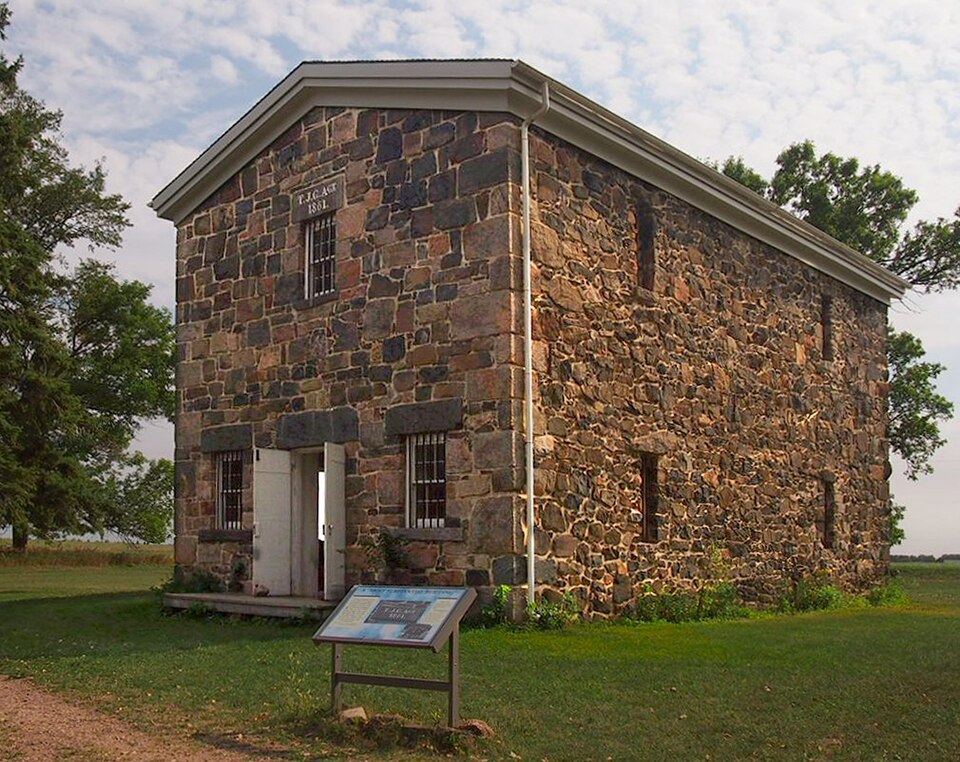
Lower Sioux Agency warehouse,2012 McGhiever, 2012; Wikimedia Commons. CC BY-SA3.0. Complete960px preview; original-resolution image not inspected.
Copy the existing cleared Lower Sioux Agency warehouse photograph with Dakota and Santee Dakota as the two new slugs, leaving the original Community mapping unchanged. The retained Dakota sources already identify Caŋṡayapi/Lower Sioux as Mdewakanton; the exact public historic-site body was reopened October 27, 2026 for the agency's Bdewakantunwan/Wahpekute connection and Community management. Caption it as this particular 2012 agency-era building under community public interpretation, not a traditional dwelling or a portrayal of all Dakota peoples. Preserve the original 960px browser-preview access limitation, McGhiever credit, CC BY-SA 3.0 and display-crop disclosure. Lower Sioux Agency warehouse exterior; the Community’s own Historic Site page describes its management of this specific public historic site through a cooperative agreement beginning in2007. This is a2012 photograph of an agency-era building, not a traditional Dakota dwelling, a current family home or a depiction of all community life. No war narrative, date of construction or property-title conclusion is inferred from its appearance. Complete browser-rendered preview frame preserved unchanged, without crop, retouching or generated pixels. The opened-page image is proportional; directory/backdrop copies may use disclosed CSS crops and overlays. Preserve this photograph and derivatives under CC BY-SA3.0 with creator/source/license credit. This image review adds no substantive historical reading count. Unchanged complete browser preview; CSS cropping/overlays only, with disclosure. CC BY-SA3.0 applies to photograph and derivatives; no endorsement asserted. Use the same new copy-only registry record as Dakota, with both slugs; preserve the old Lower Sioux mapping. The Community's historic-site body lines 83–97 read October 27, 2026 explicitly ties this agency to Bdewakantunwan and Wahpekute bands; NICC's actual history body identifies both within Santee. The photograph is specifically a Lower Sioux Agency warehouse in 2012, at a site managed by the Mdewakanton Community, not a generic Sioux substitute or a Nebraska government building. Preserve McGhiever, CC BY-SA 3.0 and the original 960px-preview access limitation.
Image, association, and reuse record reviewed 2026-10-27.
Full photographs are displayed proportionally above. A translucent background copy may be cropped by the viewport; it does not replace the complete image or its record.
The visual treatment does not change the research status, evidence, or remaining gaps recorded in this profile.
Compare a separate Mdewakanton community and its authority to interpret the Lower Sioux Agency site; original review date is retained.
These are selected starting points. The full annotated collection, source perspectives, inspection limits and remaining research questions follow below. A starting guide is not an exhaustive history or community endorsement.
01
Identity and context
Santee Dakota is a regional identity connected with Dakota people and specific contemporary communities.
Focus the next stage of research on: Distinct governments, Dakota language and histories of displacement. The sources below are selected reading paths; their authorship, dates and community scope should guide how they are used.
Nebraska Indian Community College names Mdewakantonwan, Wahpeton, Sisseton and Wahpekute within the Santee division. Flandreau's own history identifies its community primarily with Mdewakantonwan descendants and the Isanti division. Lower Sioux's account describes another Mdewakanton community at Caŋṡayapi. These are related Eastern Dakota contexts, not interchangeable names for a single government.
Displacement, rebuilding and authority to interpret history
The college's Nebraska-focused history follows forced movement through Crow Creek to northeastern Nebraska. Flandreau's account describes families moving from Santee Agency to homesteads along the Big Sioux River in 1869. Lower Sioux's companion historic-site account records tribal management beginning in 2007. Read these as distinct local histories of displacement, rebuilding and public interpretation; no one route describes every Santee Dakota family.
This is a wider Santee/Eastern Dakota route. Additional Wahpeton, Sisseton, Wahpekute and Mdewakanton communities, including Canadian perspectives, remain underrepresented.
The college's historical synthesis and the Flandreau/Lower Sioux institutional accounts answer different questions. They are not evidence that every Santee person followed the same displacement route or belonged to one government.
Original treaty/agency records, community-authored scholarship, distinct Dakota language work and public testimony beyond these selected accounts remain unread.
The reused Lower Sioux source retains its October 21 actual-review date and exact source object. Its photo-context page was reopened October 27 for site identification only; this does not count as a new substantive work.
No present acreage, membership, legal entitlement or current program outcome is asserted. No Santee Dakota community review or endorsement is recorded.
Selected actual-content works support a bounded starting guide. Earlier source objects retain their original review dates and limits. Reused URLs, images and identity-only checks are not new global historical works. Full history and community review remain open.
Follow the reading path
Sources & further reading
Open any title to read the original source. Annotations explain what each link can help you explore.
No Indigenous-led source is identified in this entry yet. This is a gap in this collection, and does not imply an absence of community knowledge or organization.
Community or Indigenous-organization perspective linked for this entry. Use “Flandreau Santee Sioux Tribe | About Us” to begin with the publisher’s own account; check whether its scope is one community or a wider people.
Historical context for this entry. Read “Santee Sioux Nation” with attention to the author, period covered, and communities named; compare with community-published accounts where available.
Community or Indigenous-organization perspective linked for this entry. Use “Government” to begin with the publisher’s own account; check whether its scope is one community or a wider people.
The tribal college's educational account names Mdewakantonwan, Wahpeton, Sisseton and Wahpekute as Santee divisions, then follows removal through Crow Creek to Nebraska and educational institutions. Its account is a Nebraska-focused historical synthesis; it is not one government speaking for every Eastern Dakota community. Terminology and treaty summaries need comparison with community authors and original records. Undated acreage figures are excluded.
Inspection: Content reviewed for the stated scope
Scope: Actual main history body lines 129–146 read completely, including division names at 131, 1862 narrative, nonparticipation distinction, removal paragraphs 142–143 and education at 145–146. Proposed synthesis uses division names, broad removal sequence and Nebraska focus; treaty dates/acreage, casualty and execution totals, place coordinates and evaluative period terminology are not adopted. Linked treaties and images not read/reused. Baseline p335-s2 remains unchanged; this fresh review receives a new ID.
The Tribe identifies primarily Mdewakantonwan ancestry within the Isanti division and gives its own history of displacement, the 1866 Santee Agency reunion, 1869 homesteading and later tribal organization. Its retrospective terms about citizenship and rights are not present membership advice. Undated land totals and linked media are omitted. This is one particular government's account, not a uniform account for all Santee Dakota communities.
Inspection: Content reviewed for the stated scope
Scope: Actual complete historical body lines 20–35 read. Synthesis selects Mdewakantonwan/Isanti identity, 1866 Santee Agency reunion and 1869 homesteading; no casualty total, present acreage, church antiquity, current membership rule or legal status is inferred. Images and program links not inspected/reused. Baseline p335-s1 remains unchanged; this fresh actual review receives a new ID.
Publication: Undated bodies; 2026 footer and opening hours do not date the historical accounts
The government's own account connects local identity, exile, return and public historical interpretation. Selected companion site history is grouped once. Population figures, casualty estimates, current service availability and blanket treaty/legal conclusions are excluded.
Inspection: Content reviewed for the stated scope
Scope: Actual About Us historical body, lines 59–82; companion Historic Site historical paragraphs 83–86 and public interpretation description 97 read. No video, embedded flipbook or underlying treaty opened from these pages.
Review recorded: October 21, 2026
Inspected material and access routes
Historic Site ↗ — Actual history and tribal-management account; hours, admissions and contacts excluded.
Related entries may represent alternate names, constituent communities, wider groupings, or historical connections. Read the naming notes before treating entries as equivalent.
Robey’s Atlas of Indigenous North America · Compiled October 19, 2026 · Santee Dakota