Tribal government / contemporary community · Added to the original list
Prairie Island Indian Community
Prairie Island Indian Community speaks from its own Bdewakantunwan Dakota history. Three public community accounts connect continuity and land with language learning and cultural preservation. They provide an opening to this particular government and its priorities while leaving wider Dakota histories, environmental assessment and current program outcomes for further reading.
See each region’s evidence for historical or present-day scope.
Homeland / region
Minnesota
Research depth
Source guide
Source collection
3 annotated resources · 3 Indigenous-led
Inspected sources
3 substantive works · selected content reviewed
Initial adequacy
Still unfinished
Source review
October 27, 2026
Names & relationshipsMnDOT explicitly places this individual Minnesota government under its Dakota Tribal Nation grouping. It remains a separate government; no automatic equivalence to Santee Dakota or another band is inferred.
A source guide for a deeper dive.This entry provides a brief orientation and an organized reading path. A comprehensive deep dive has not yet been completed. Follow the annotated sources and distinguish primary community accounts from outside reference material.
Still unfinished
A compact source-led introduction to this named community; historical breadth, local voices and outcomes remain limited. No comprehensive completion or community endorsement is claimed.
Assessment recorded October 27, 2026. This is separate from research completion and community review.
Broaden local voices and compare land chronology with original records.
Verify current language-resource access and outcomes before making availability claims.
Environmental effects and safety require separate appropriate evidence; no community review is recorded.
Backdrop photographs & credits
These photographs have individual, documented connections to this entry. Their captions and source records define the people, place, object, and period shown; no one photograph represents every community within a broader label.
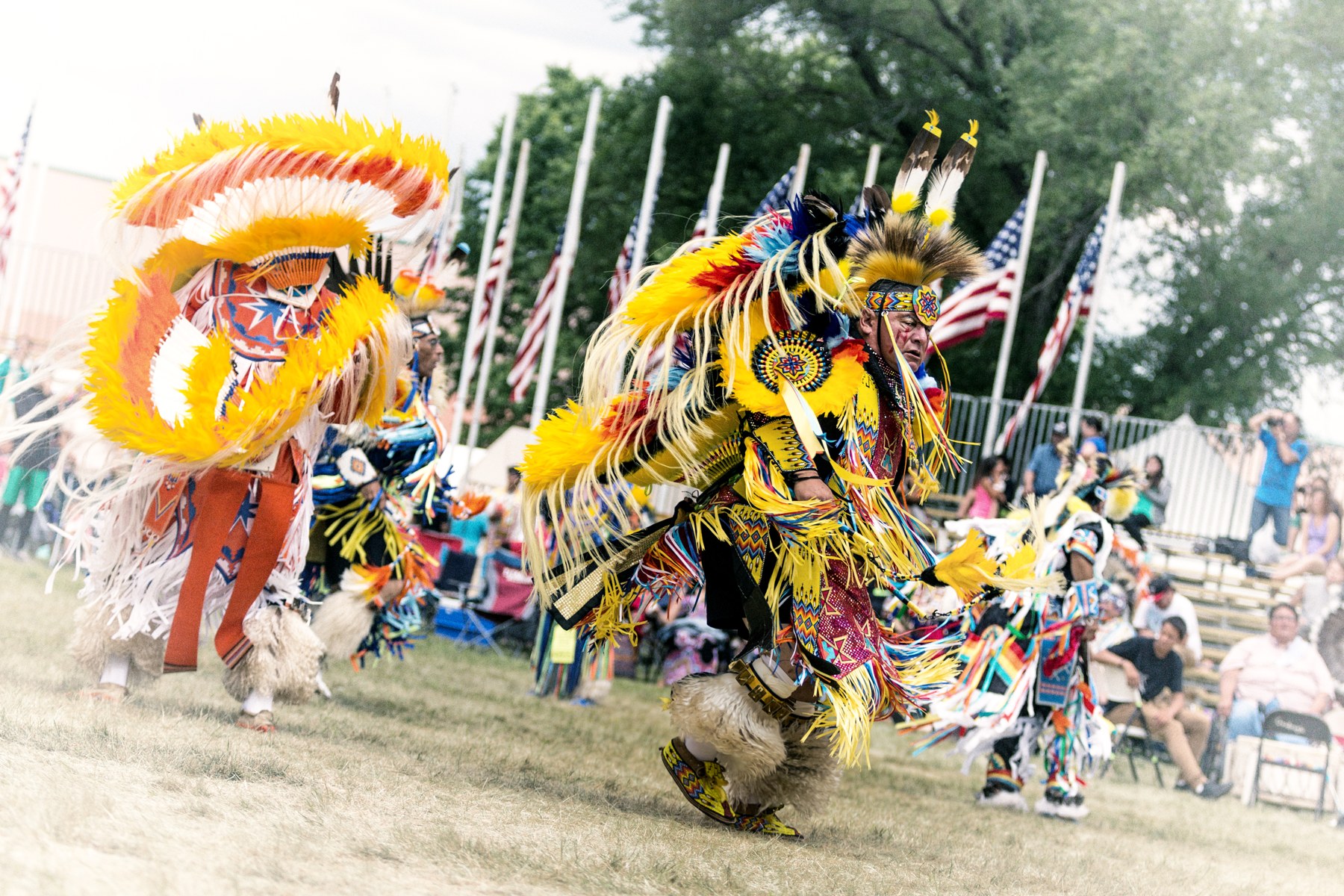
Prairie Island Indian Community Wacipi, 2017 Lorie Shaull, 2017; Flickr / Wikimedia Commons. CC BY-SA 2.0.
Photographer Lorie Shaull's explicitly titled 2017 Prairie Island Indian Community Wacipi photograph provides an event-specific connection to this named Community. People in the frame are not individually identified as Prairie Island citizens, and their regalia is not presented as a uniform Community style or assigned symbolic meanings. This image depicts one event at one time, not all Community life. The complete original 4731-by-3154 JPEG linked explicitly in the Commons record was retrieved from the photographer's actual static Flickr URL. The complete composition was visually inspected in a scaled 1920-by-1280 view; no pixel-by-pixel original-resolution inspection is claimed. The preserved source is the original composition, not the later Commons cropped/rotated derivative; the web copy is proportionally resized as described below. No pixel crop. Complete4731×3154 frame proportionally resized to1800×1200 and JPEG recompressed; source pixels preserved privately. CSS crops/overlays affect display only. Derivative remains CC BY-SA2.0 with creator/source/license credit.
Image, association, and reuse record reviewed 2026-10-27.
Full photographs are displayed proportionally above. A translucent background copy may be cropped by the viewport; it does not replace the complete image or its record.
The visual treatment does not change the research status, evidence, or remaining gaps recorded in this profile.
Start reading here
Named government/community route; wider Dakota or Ojibwe reading profiles remain related context rather than interchangeable identities.
Connect cultural preservation with the Community's public stewardship priorities.
These are selected starting points. The full annotated collection, source perspectives, inspection limits and remaining research questions follow below. A starting guide is not an exhaustive history or community endorsement.
01
Land and continuity
The Community's historical account describes identity, return and reservation formation, followed by development pressures affecting land and community life. Its concerns are attributed to the Community's narrative. This starting guide does not independently determine legal liability, radiation exposure or present safety. It also omits sensitive cultural-place details and avoids turning historical associations into exact territorial boundaries.
The Dakota Language page describes renewal through community programs, public learning and work connected with Red Wing High School. It offers a direct community explanation of educational priorities. Its statement that an app was expected in spring 2023 remains a dated plan: current availability was not verified. Outbound dictionaries, lessons and applications are further leads rather than separately inspected works.
The Community describes its preservation office, repatriation work and public historical-place partnerships as ways of carrying responsibilities forward. Its archaeological statements remain attributed to that account, and sensitive burial details are excluded. Read these materials as a government explaining its own priorities, rather than a complete assessment of every project or a substitute for community permission concerning cultural knowledge.
Broaden local voices and compare land chronology with original records.
Verify current language-resource access and outcomes before making availability claims.
Environmental effects and safety require separate appropriate evidence; no community review is recorded.
A community-specific starting guide reuses selected earlier actual-content reviews with their original dates/scopes. It does not add new global works merely because a URL appears on this route. Picture identification/rights are separate from historical adequacy or community endorsement.
Follow the reading path
Sources & further reading
Open any title to read the original source. Annotations explain what each link can help you explore.
No Indigenous-led source is identified in this entry yet. This is a gap in this collection, and does not imply an absence of community knowledge or organization.
Indigenous-ledPrairie Island Indian CommunitySource 1
Publication: Undated; footer 2026 is not treated as the article date
Prairie Island speaks from its own Bdewakantunwan community history. Development pressures are attributed to the Tribe's account, without independently assessing legal liability, radiation exposure or current safety. No burial details, precise sensitive places or media are reproduced.
Inspection: Content reviewed for the stated scope
Scope: Actual complete historical body, lines 49–123: identity, Dakota history, reservation formation, development pressures, governmental economy and future generations. Synthesis selects identity, return/land history and attributed development concerns.
Publication: Undated; footer 2026 does not date the page body
The Community describes language learning and outreach in its own institutional voice. The page still says an app was expected in spring 2023; its current availability was not verified, so no current app claim is made. Linked dictionaries and lessons were not opened and are not counted.
Inspection: Content reviewed for the stated scope
Scope: Read the complete visible body, especially lines 50–76 on language renewal and community programs and lines 115–120 on the Red Wing High School program and public exhibits. Outbound lesson, dictionary and app links were not independently inspected.
Publication: Undated; footer 2026 does not date the historical examples
The Community describes its preservation office, selected repatriation work and public historical-site partnerships. Its archaeological statements are attributed and not independently evaluated in this source review. Details about burials and sensitive cultural places were excluded from synthesis.
Inspection: Content reviewed for the stated scope
Scope: Read the complete visible substantive body at lines 51–65, covering preservation priorities, repatriation examples, He Mni Can restoration, the public Grand Meadow Chert Quarry partnership and THPO mission. Burial-specific details, media and linked external materials were not reproduced or counted.
Related entries may represent alternate names, constituent communities, wider groupings, or historical connections. Read the naming notes before treating entries as equivalent.
Robey’s Atlas of Indigenous North America · Compiled October 19, 2026 · Prairie Island Indian Community