Garden River’s selected history follows the Shingwauk family’s educational aims and later community participation in land and highway negotiations. The sources offer distinct views of nineteenth-century pressures and a 1994 agreement process.
See each region’s evidence for historical or present-day scope.
Homeland / region
Ontario, Canada — Lake Huron region member listing
Research depth
Source guide
Source collection
2 annotated resources · 0 Indigenous-led
Inspected sources
2 substantive works · selected content reviewed
Initial adequacy
Still unfinished
Source review
October 27, 2026
Names & relationshipsListed as an Anishinabek Nation member First Nation. Membership alone is not treated as proof of Ojibwe, Anishinaabe or other ethnic identity.
A source guide for a deeper dive.This entry provides a brief orientation and an organized reading path. A comprehensive deep dive has not yet been completed. Follow the annotated sources and distinguish primary community accounts from outside reference material.
Still unfinished
Two directly relevant works have been read for a bounded starting guide. The selected perspectives and periods leave substantial community history and later developments unreviewed.
Assessment recorded October 27, 2026. This is separate from research completion and community review.
Add Garden River’s own current public history and community-authored works beyond these selected education and negotiation accounts.
Read the underlying agreements and later implementation history before drawing conclusions about present land or highway arrangements.
Expand language, environmental stewardship and everyday community history; the selected sources cover particular institutions and events.
Backdrop photographs & credits
These photographs have individual, documented connections to this entry. Their captions and source records define the people, place, object, and period shown; no one photograph represents every community within a broader label.
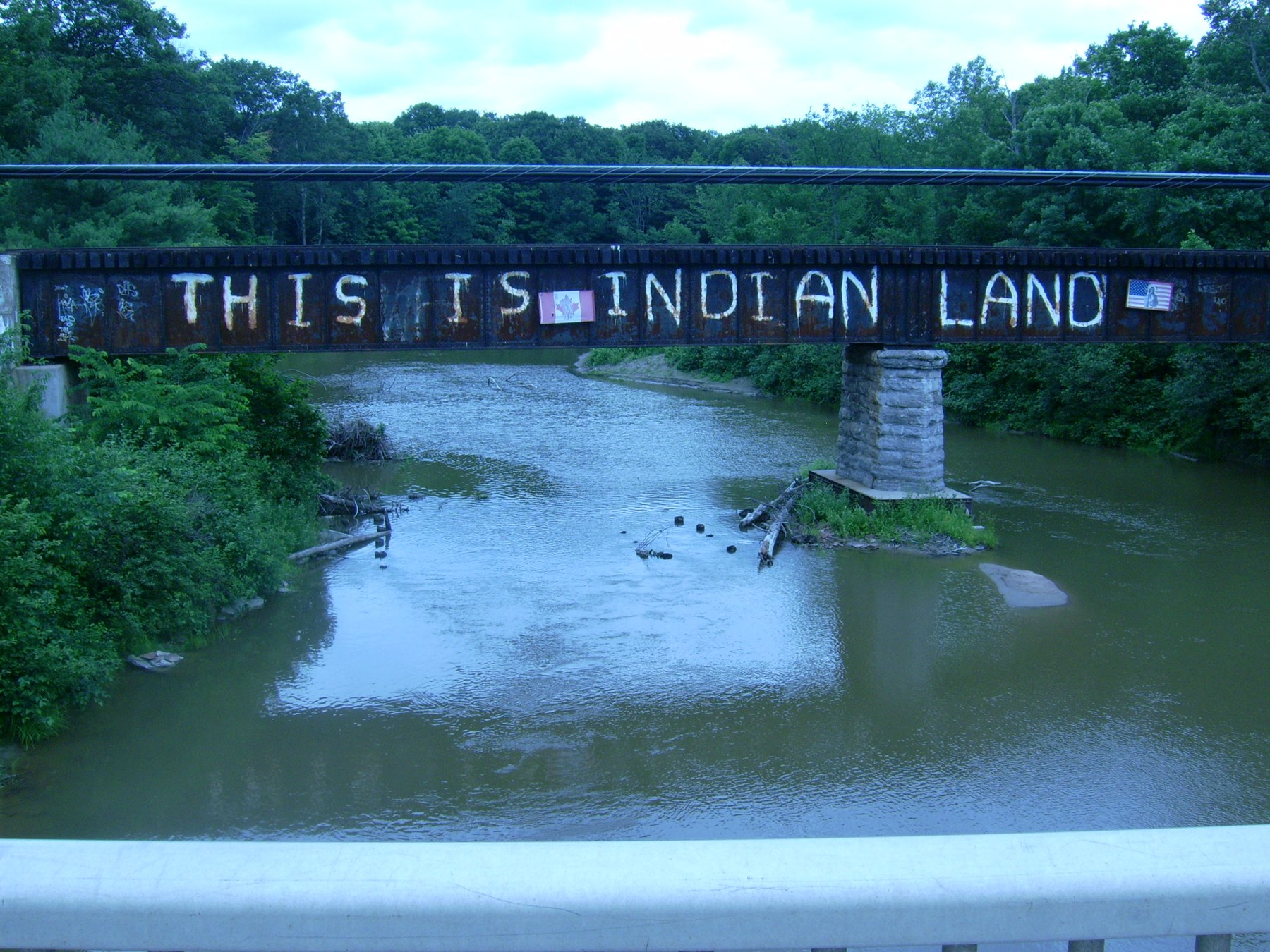
Rail bridge at Garden River First Nation, August 2005 Fungus Guy / Wikimedia Commons · CC BY-SA 3.0 · resized and recompressed
Exact Commons item identifies the rail bridge and inscription at Garden River First Nation. The photograph supplies a specific community landscape and public inscription; it does not independently establish legal boundaries. Complete available 2560×1920 source frame proportionally resized to 1800×1350 and JPEG recompressed; no pixel crop or retouching. Original source copy retained privately. CSS crops/overlays affect display only.
Image, association, and reuse record reviewed 2026-10-27.
Full photographs are displayed proportionally above. A translucent background copy may be cropped by the viewport; it does not replace the complete image or its record.
The visual treatment does not change the research status, evidence, or remaining gaps recorded in this profile.
Read a named participant’s detailed explanation of communication and member involvement in the 1994 negotiations.
These are selected starting points. The full annotated collection, source perspectives, inspection limits and remaining research questions follow below. A starting guide is not an exhaustive history or community endorsement.
01
The Shingwauk family’s educational vision
The Shingwauk Residential Schools Centre describes Shingwaukonse’s Teaching Wigwam vision as a place of shared learning and traces his family’s efforts to obtain educational resources. Its account also describes weakening government support, missionary changes and the growth of industrial schooling. Those changing colonial purposes matter when reading the family’s educational aims and the later institution’s history.
In a 2003 article, negotiations coordinator Alice Corbiere describes Garden River’s 1994 land and highway agreements. The negotiating team opened meetings, distributed information to members living both on and away from the reserve, and arranged information sessions around work and family schedules. She credits communication and community inclusion in the referendum’s acceptance while noting that expectations about employment timing needed clearer explanation.
Add Garden River’s own current public history and community-authored works beyond these selected education and negotiation accounts.
Read the underlying agreements and later implementation history before drawing conclusions about present land or highway arrangements.
Expand language, environmental stewardship and everyday community history; the selected sources cover particular institutions and events.
Selected actual-content works support a bounded starting guide. Earlier source objects retain their original review dates and limits. Reused URLs, images and identity-only checks are not new global historical works. Full history and community review remain open.
Follow the reading path
Sources & further reading
Open any title to read the original source. Annotations explain what each link can help you explore.
No Indigenous-led source is identified in this entry yet. This is a gap in this collection, and does not imply an absence of community knowledge or organization.
Public history / residential school archive educationShingwauk Residential Schools CentreSource 1
The archive’s educational history distinguishes the Shingwauk family’s educational vision from changing church and government policies. Its mission narrative requires attention to those differing purposes.
Inspection: Content reviewed for the stated scope
Scope: Actual chapters 7 and 8 read: Shingwauk family body (web lines 55–82) and early mission schools body (55–67). One work, two selected chapters.
Garden River·Education·Shingwaukonse·Colonial history
Community practitioner account / scholarshipThe Journal of Aboriginal Economic Development 3(2), 20–23; public copy at University of Saskatchewan I-PortalSource 2
Alice Corbiere, identified in the article as the negotiations coordinator, explains communication and member participation in the 1994 agreements. This is a participant’s retrospective, not a current implementation audit.
Inspection: Content reviewed for the stated scope
Scope: Full four-page article, printed 20–23, downloaded and read through pypdf extraction: negotiations, member information, referendum, agreement structure and retrospective assessment.
Related entries may represent alternate names, constituent communities, wider groupings, or historical connections. Read the naming notes before treating entries as equivalent.
Robey’s Atlas of Indigenous North America · Compiled October 19, 2026 · Ojibways of Garden River First Nation