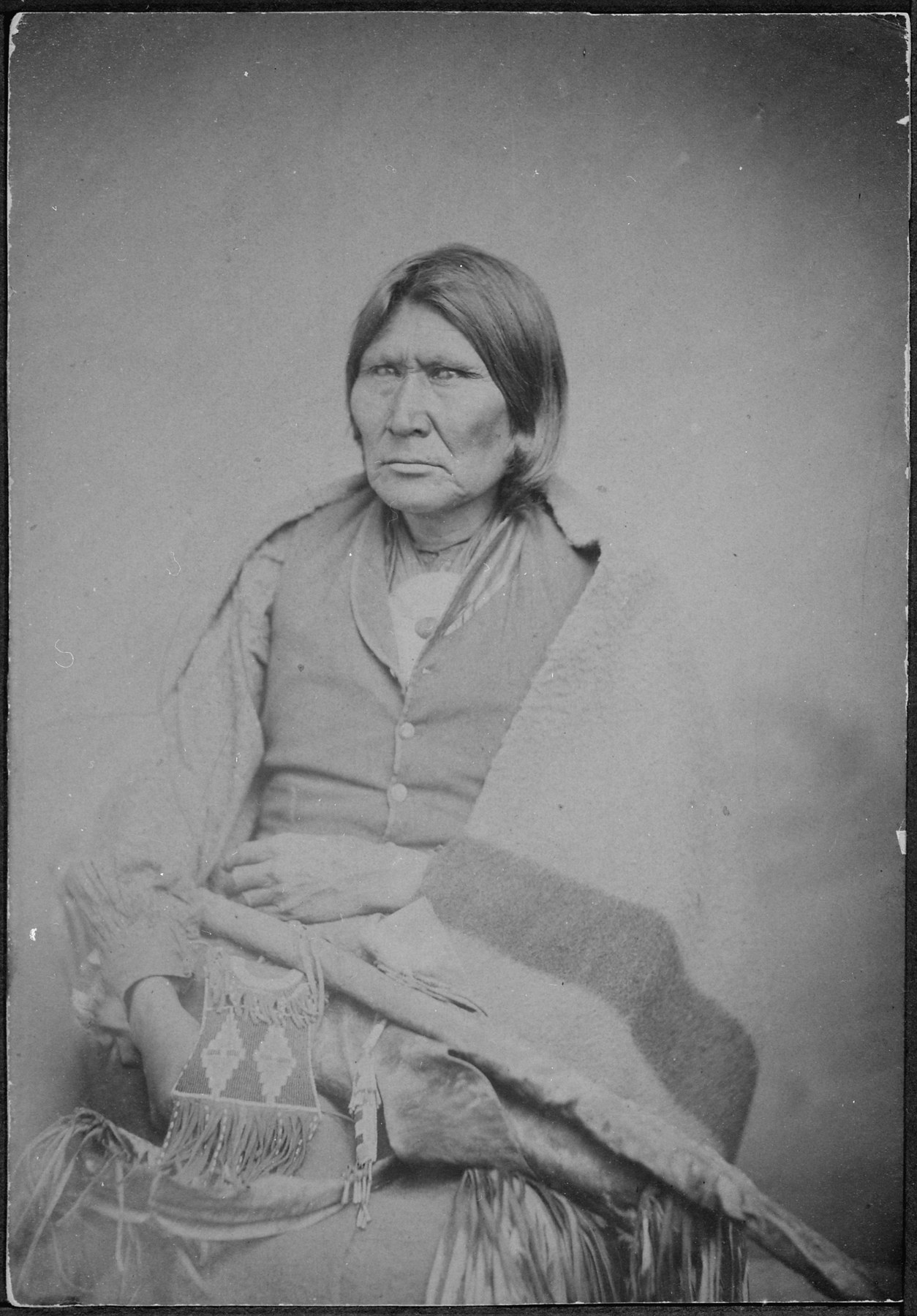
Portrait in the NARA record naming Horseback, a Nakoney chief, and his bodyguardWilliam S. Soule; National Archives, NAID 533053, local identifier 165-AI-12 / Wikimedia Commons. Public domain in the United States. Archival title names Horseback, a Nakoney chief, and his bodyguard; the retrieved frame shows one sitter.
Historical Comanche band / division name · Added to the original list
Nokoni
Nokoni is a historical Comanche band/division name with its own directory route. The Texas report connects the name with a wider history of local bands and divisions and describes a historical range extending beyond today’s Texas boundary. Anderson’s account of the 1868–1869 winter campaign provides a specifically named episode involving Horseback’s Nokoni camp. It should be read as an outside military-history interpretation, alongside further community histories and original records.
See each region’s evidence for historical or present-day scope.
Homeland / region
Texas
Research depth
Source guide
Source collection
2 annotated resources · 0 Indigenous-led
Inspected sources
2 substantive works · selected content reviewed
Initial adequacy
Still unfinished
Source review
October 27, 2026
Names & relationshipsThe December 2021 report identifies this name within historical Comanche band/division organization. This is a historical name-only access route linked to the broader Comanche collection, not a newly established separate people, present-day government, citizenship category or exclusive descendant group. The report describes band formation and political organization as fluid. Printed spellings in the inspected December 2021 synthesis, attributed there to CLCPC 2010. They are not independently verified community-preferred present orthography; no translations or pronunciation claims are adopted.
A source guide for a deeper dive.This entry provides a brief orientation and an organized reading path. A comprehensive deep dive has not yet been completed. Follow the annotated sources and distinguish primary community accounts from outside reference material.
Still unfinished
A bounded historical-band starting path from two actual-content works, with attributed perspectives and explicit limits; further community-directed research remains open.
Assessment recorded October 27, 2026. This is separate from research completion and community review.
Seek band-specific community-authored histories and further Indigenous scholarship; the current path relies partly on outside historical synthesis.
Read underlying manuscripts, negotiations, oral-history publications and later community histories before expanding the chronology.
Historical band labels do not establish a separate present government, exact territory, citizenship or individual descent. No community review or endorsement is recorded.
Backdrop photographs & credits
These photographs have individual, documented connections to this entry. Their captions and source records define the people, place, object, and period shown; no one photograph represents every community within a broader label.
Portrait in the NARA record naming Horseback, a Nakoney chief, and his bodyguard William S. Soule; National Archives, NAID 533053, local identifier 165-AI-12 / Wikimedia Commons. Public domain in the United States. Archival title names Horseback, a Nakoney chief, and his bodyguard; the retrieved frame shows one sitter.
The exact NARA-derived Commons item title names Fer-ha-yer-quoip/Old Horseback as a Nakoney chief and mentions his bodyguard; the actual complete 2090-by-3000 downloaded JPEG contains ONE seated man. This caption/frame mismatch remains explicit. The photograph is presented as a portrait within that specifically identified Nokoni-related archival record, not as a newly verified identification of the visible individual. Do not name the seated person more confidently, infer an unseen second person or crop to suggest an identification. Hugh Allen Anderson's TSHA account explicitly identifies Horseback's Nokoni band; that supports the named record's band relevance, not a visual identification. Commons credits Soule, preserves the War Department record creator and NAID 533053/local identifier 165-AI-12, and includes a specific federal-work public-domain notice. Its 1881–1885 series-compilation date does not resolve Soule's earlier exposure date. The entire available JPEG frame and edge imperfections were visually inspected; no retouching, pixel crop, generated content or restoration was performed. Root may make a disclosed proportional 1800px derivative; retain full frame on the opened page and disclose CSS display crops. Image review adds no substantive reading-work count. Complete available 2090×3000 source frame proportionally resized to 1254×1800 and JPEG recompressed; no pixel crop or retouching. Original source copy retained privately. CSS crops/overlays affect display only.
Image, association, and reuse record reviewed 2026-10-27.
Full photographs are displayed proportionally above. A translucent background copy may be cropped by the viewport; it does not replace the complete image or its record.
The visual treatment does not change the research status, evidence, or remaining gaps recorded in this profile.
Start reading here
Historical Comanche band/division route; not automatically a separate present government or an exhaustive community history.
Continue to the specifically attributed historical episode or leader account; underlying original records remain further reading.
These are selected starting points. The full annotated collection, source perspectives, inspection limits and remaining research questions follow below. A starting guide is not an exhaustive history or community endorsement.
01
Read the name within a fluid band structure
The consulted report places Nokoni among named historical Comanche divisions and notes relationships with smaller local groups. It describes bands forming and separating through family and political relationships. These changing arrangements should not be converted into a fixed modern nation list or an exclusive genealogy.
Anderson identifies the camp attacked at Soldier Spring as Horseback’s Nokoni village. His account describes the destruction of stored food needed for winter and later movement toward federal posts. This focused episode opens questions about families, survival and diplomacy; original military reports and community accounts remain separate research tasks.
Seek band-specific community-authored histories and further Indigenous scholarship; the current path relies partly on outside historical synthesis.
Read underlying manuscripts, negotiations, oral-history publications and later community histories before expanding the chronology.
Historical band labels do not establish a separate present government, exact territory, citizenship or individual descent. No community review or endorsement is recorded.
Selected actual-content works support a bounded starting guide. Earlier source objects retain their original review dates and limits. Reused URLs, images and identity-only checks are not new global historical works. Full history and community review remain open.
Follow the reading path
Sources & further reading
Open any title to read the original source. Annotations explain what each link can help you explore.
No Indigenous-led source is identified in this entry yet. This is a gap in this collection, and does not imply an absence of community knowledge or organization.
Government / community-consulted researchTexas Department of TransportationSource 1
Texas Department of Transportation. 2021. TxDOT Tribal Histories: Comanche Nation Research Report. December. Selected pages.
Publication: 2021-12
A chronological Texas synthesis prepared with the Nation’s historic-preservation office. Selected text supports a regional starting guide; its sources, dates and interpretations still need comparison.
Inspection: Content reviewed for the stated scope
Scope: Downloaded actual72-page PDF and read selected text: printed/PDFpp3,6–10,35–36,50–54. Map images and cited originals were not inspected; no sensitive-site locations or ceremonial instructions are reproduced.
Review recorded: October 26, 2026
Access status: Public text inspected
Access note: Browser fetch timed out; official file downloaded successfully and selected pages extracted with pypdf. Review is textual, not visual inspection of illustrations. Internal chronology includes Texas annexation as1846 onp36 and a March1882 visit after1891 onp54; these dates are not adopted. Evaluative claims about individual leaders and reported historical counts remain outside this synthesis. Consultation does not make every statement independently verified.
An outside military-history account that specifically identifies Horseback’s Nokoni camp at Soldier Spring and describes the destruction of winter provisions and subsequent movement. Its military framing, labels and broad opening chronology require comparison with Indigenous histories; casualty figures and current legal conclusions are not adopted.
Inspection: Content reviewed for the stated scope
Scope: Actual complete main body and bibliography read, web lines6–28. Synthesis limited to the Soldier Spring camp, winter provisions and subsequent Nokoni movement, especially16–21. Opening Washita chronology, casualty totals, military justifications, underlying reports and cited books are not adopted or independently verified.
Review recorded: October 27, 2026
Access note: Public HTML main body inspected. Bibliography points to further works; those underlying publications and original records were not read here.
Related entries may represent alternate names, constituent communities, wider groupings, or historical connections. Read the naming notes before treating entries as equivalent.
Robey’s Atlas of Indigenous North America · Compiled October 19, 2026 · Nokoni