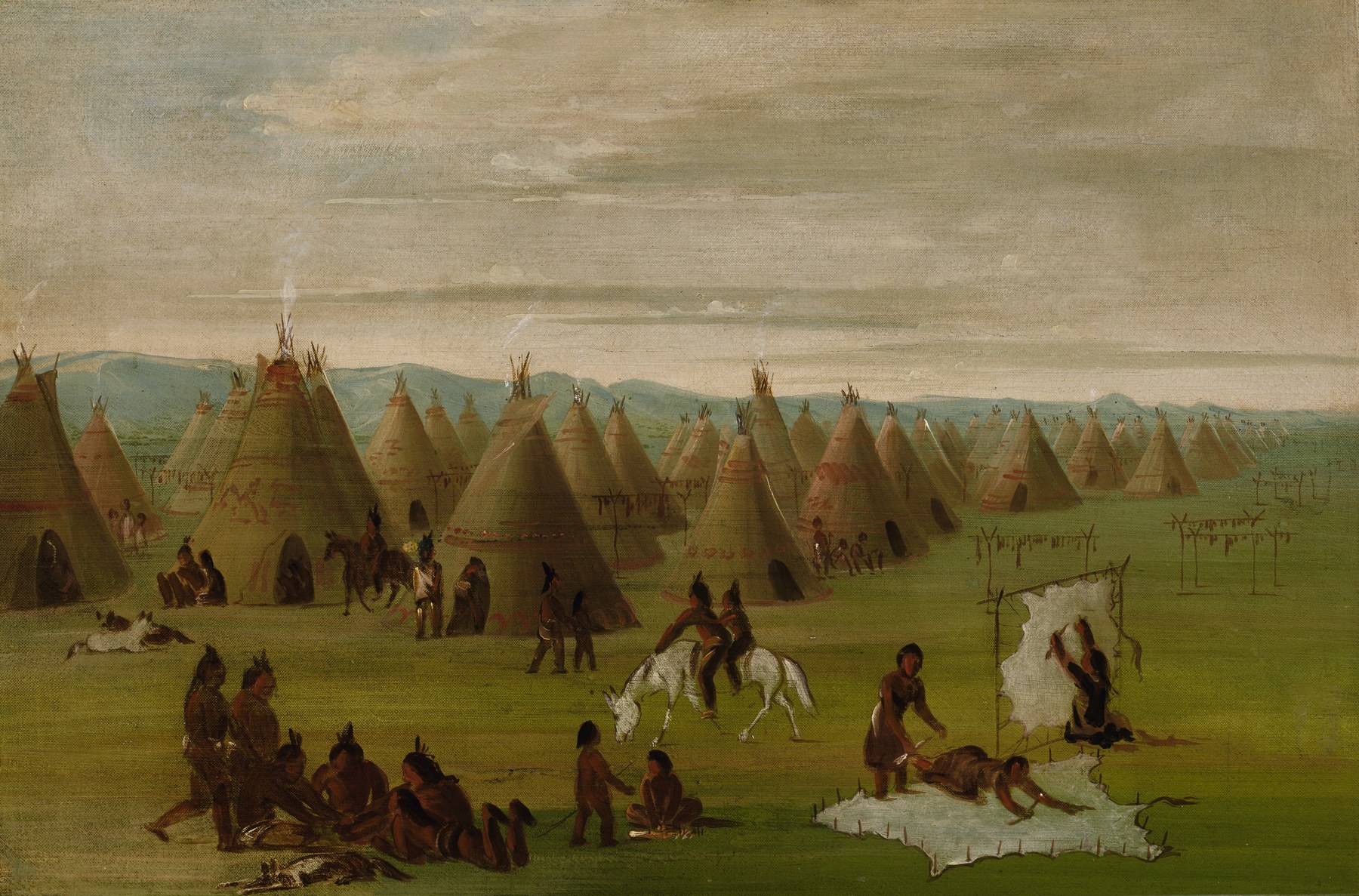
Comanche Village, Women Dressing Robes and Drying Meat, 1834–1835George Catlin, 1834–1835. Smithsonian American Art Museum, Gift of Mrs. Joseph Harrison, Jr., 1985.66.346. Public domain.
Comanche people’s histories connect the Southern Plains, Texas and the present Comanche Nation in Oklahoma. This foundation brings the Nation’s own account together with community-directed language history, a consulted Texas report, an edited treaty and attributed educational accounts. Historical bands, the broader people and the present government retain their own contexts.
See each region’s evidence for historical or present-day scope.
Homeland / region
Southern Plains / Texas / Oklahoma
Research depth
Source guide
Source collection
12 annotated resources · 4 Indigenous-led
Inspected sources
10 substantive works · selected content reviewed
Initial adequacy
Still unfinished
Source review
October 27, 2026
A source guide for a deeper dive.This entry provides a brief orientation and an organized reading path. A comprehensive deep dive has not yet been completed. Follow the annotated sources and distinguish primary community accounts from outside reference material.
Still unfinished
One selected museum educational work strengthens twentieth-century language and individual community-continuity coverage. Ten substantive works still have selected/mediated evidence and uneven historical coverage; original school/military records, fuller community and government histories, and more Comanche-authored scholarship remain unreviewed. Quantity does not establish adequacy, completion or endorsement.
Assessment recorded October 27, 2026. This is separate from research completion and community review.
Selected-page and selected-section review does not imply complete reading of each volume.
Underlying treaty manuscript, negotiations, implementation and later legal interpretation remain unreviewed.
TxDOT internal chronology and evaluative interpretations require comparison rather than automatic adoption.
The 1999 education record is historical; current program outcomes and language-use counts are not verified.
No community review or endorsement is recorded.
The 1844 text is an edited English archival transcription with OCR/signatory-layout limits. Original manuscript, translation, ratification and implementation need separate review.
The 1847 study is outside scholarly interpretation, substantially mediated by settler records. Its two internally problematic date statements are excluded.
The Nation’s remembrance article supplies named experiences but no verified publication year or complete military-history evidence. It is not a program-outcome assessment.
Comanche-authored historical scholarship and distinct band-level histories remain important gaps. Treaty participation alone does not establish every community’s consent or present citizenship.
The Smithsonian addition reviews selected edited Chibitty passages, not full interviews, original school/military records or comprehensive twentieth-century community/government history. A daughter’s statement is read through the museum’s citation to Williams (2005), not through independent review of that article.
Backdrop images & credits
These images have individual, documented connections to this entry. Their captions and source records define the people, place, object, and period shown; no one image represents every community within a broader label.
Comanche Village, Women Dressing Robes and Drying Meat, 1834–1835 George Catlin, 1834–1835. Smithsonian American Art Museum, Gift of Mrs. Joseph Harrison, Jr., 1985.66.346. Public domain.
Smithsonian American Art Museum identifies this George Catlin oil painting specifically as a Comanche village and gives its date as 1834–1835. Its description attributes the 1834 village sketch and the foreground work interpretation to Catlin. This is an outside artist’s historical representation, not a documentary photograph, Comanche-made artwork, a present government depiction, or evidence that every Comanche community lived or worked identically. No exact present-state location, village name, named individual, current cultural practice or territorial boundary is inferred from the scene. Catlin’s quoted village-size claims and stereotypes are not adopted. Complete 3000x1979 delivered museum source JPEG preserved. Proposed web copy resized proportionally to 1800x1187 and recompressed at JPEG quality 88; no pixel crop, retouching, recoloring, generated content or added detail. Card/page CSS crops and overlays must be disclosed. CSS may crop or overlay directory/background copies; the opened-page image preserves the complete delivered source frame.
Image, association, and reuse record reviewed 2026-10-26.
Full images are displayed proportionally above. A translucent background copy may be cropped by the viewport; it does not replace the complete image or its record.
The visual treatment does not change the research status, evidence, or remaining gaps recorded in this profile.
Start reading here
Comanche people, historical bands and the present Oklahoma-based Comanche Nation retain distinct scopes. The TxDOT review covers selected pages, and the NMAI path covers selected text sections rather than a complete exhibition or interview; no audio was evaluated. Automated retrieval failures do not establish a reader paywall.
Selected Charles Chibitty material connects schooling, wartime language work and later teaching through clearly attributed individual and family recollections.
These are selected starting points. The full annotated collection, source perspectives, inspection limits and remaining research questions follow below. A starting guide is not an exhaustive history or community endorsement.
01
Names, a wider people and a present Nation
The Comanche Nation uses Nʉmʉnʉʉ for its people. Its own historical account connects movement onto the Plains with horse-based life and kinship-based bands. This people-level directory route and the present government are related levels of description, rather than one unchanged organization across all periods. Current membership numbers and governing rules require separate dated verification.
The consulted TxDOT report describes changing local bands and wider divisions, with relationships that could form and change. Penateka, Nokoni and Quahadi are among its historical labels. These names should remain individually searchable when their identities and aliases are checked; a list of bands does not prove that each is a separate present government.
The Nation’s account follows movement southward and emphasizes horses and bison. TxDOT’s selected historical chapters connect Texas history to military pressure and removal to reservation life. These broad accounts provide a starting chronology, not precise homeland boundaries. The report contains internal date problems that remain disclosed in its source card.
The Medicine Lodge treaty transcription contains a reservation provision, a reserved hunting clause and a consent requirement for later cession of reservation land. It also sets out federal services and compulsory English-school attendance. The text places promises of protection and services alongside compulsory schooling and requirements to make the reservation a permanent home. The wording alone does not establish implementation, universal agreement or present-day legal rights.
The Language Department’s account traces its planning to community organizing in 2017 and funding for fiscal 2019. It recognizes the earlier preservation committee and describes teacher certification, curriculum and digital resources among its goals. These are the department’s reported history and aims; this review did not test an app, inspect a curriculum or measure fluency.
Fuentes’s 1999 source book records preservation work and a Toya Band language class in Albuquerque and Santa Fe. It describes volunteer teaching, intergenerational participation and materials in that historical setting. The two program entries form one reviewed educational work. They do not establish today’s schedule, participation or separate-government status.
The Boulder report presents Ruth Toathy’s and Rosemary Chibity’s differing memories of language use at home and pressure toward English, alongside Leonard Chibity’s comments on place names. These are named personal accounts within an edited public report. They help readers see lived experiences without turning one recollection into a statement about every Comanche family.
The 1844 Tehuacana Creek text joins peace provisions with regulated trade, government agents and proposed English-language, Christian and agricultural instruction. Its 22 articles make those different aims visible together. The document lists several Indigenous parties separately; a shared instrument does not merge their identities. References to a line do not themselves establish a precise agreed territorial boundary.
Babcock’s study of the 1847 Meusebach agreement gives Comanche leaders and intermediaries a role alongside the German negotiator. He challenges accounts that credit one man alone and places negotiations within settlement pressures. His interpretation is useful to compare with the primary record; it should not become a claim that every Comanche band accepted the same agreement or that later pressures disappeared.
Remembering code talkers through families and language
In the Nation’s report, Lloyd Heminokeky explains the importance of honoring code talkers through family participation and language-department work. LaNora Parker describes her father Simmons Parker as a teacher of Comanche history and pride. These named accounts connect public remembrance with family learning, without defining every family’s experience or reproducing songs and ceremonial material.
Schooling and wartime language use in one person’s account
The museum places Charles Chibitty’s recollection in his Ft. Sill Indian School years: he and his cousin stopped speaking their language when staff approached. Its text distinguishes this from Haskell, where it says Native languages were allowed despite strict discipline. The same resource presents his memories of Comanche military recruitment and collaborative code-making. These are selected, edited recollections, not a record of every school, speaker or military unit.
The exhibition follows Chibitty beyond military service into further education, work as a glazier and continued community life. It cites his adopted daughter Carrie Wilson’s memory of his readiness to teach Comanche, through a 2005 article by Rudi Williams. This is an attributed family account in the museum’s retelling; the original article and complete interview were not independently reviewed. It offers an individual example of continuity rather than a measure of language-program success.
Ten inspected works now offer a wider reading foundation, including Texas diplomacy and selected twentieth-century experiences of schooling, military language work and later teaching. Comanche-authored historical scholarship, original negotiation and implementation records, fuller community and government histories, and careful band-level comparisons remain needed. A selected personal account does not fill all those gaps. No comprehensive history, current legal assessment or community endorsement is claimed.
Selected-page and selected-section review does not imply complete reading of each volume.
Underlying treaty manuscript, negotiations, implementation and later legal interpretation remain unreviewed.
TxDOT internal chronology and evaluative interpretations require comparison rather than automatic adoption.
The 1999 education record is historical; current program outcomes and language-use counts are not verified.
No community review or endorsement is recorded.
The 1844 text is an edited English archival transcription with OCR/signatory-layout limits. Original manuscript, translation, ratification and implementation need separate review.
The 1847 study is outside scholarly interpretation, substantially mediated by settler records. Its two internally problematic date statements are excluded.
The Nation’s remembrance article supplies named experiences but no verified publication year or complete military-history evidence. It is not a program-outcome assessment.
Comanche-authored historical scholarship and distinct band-level histories remain important gaps. Treaty participation alone does not establish every community’s consent or present citizenship.
The Smithsonian addition reviews selected edited Chibitty passages, not full interviews, original school/military records or comprehensive twentieth-century community/government history. A daughter’s statement is read through the museum’s citation to Williams (2005), not through independent review of that article.
Follow the reading path
Sources & further reading
Open any title to read the original source. Annotations explain what each link can help you explore.
No Indigenous-led source is identified in this entry yet. This is a gap in this collection, and does not imply an absence of community knowledge or organization.
The Nation’s own short account of movement, horses, bison and kinship-based bands. Read its historical overview separately from current administrative details.
Inspection: Content reviewed for the stated scope
Scope: Actual complete History body, web lines172–178. No current population, electoral eligibility or administrator-selection rule is adopted without checking governing instruments.
A public institutional history connecting the language planning group, the preservation committee and the department’s teaching goals. Descriptions of aims are not measured learning outcomes.
Inspection: Content reviewed for the stated scope
Scope: Actual complete About Us body, web lines10–130, including How it began, language planning, preservation committee and department goals. Linked videos, dictionary, app, curriculum, certification records and learner outcomes not inspected.
Texas Department of Transportation. 2021. TxDOT Tribal Histories: Comanche Nation Research Report. December. Selected pages.
Publication: 2021-12
A chronological Texas synthesis prepared with the Nation’s historic-preservation office. Selected text supports a regional starting guide; its sources, dates and interpretations still need comparison.
Inspection: Content reviewed for the stated scope
Scope: Downloaded actual72-page PDF and read selected text: printed/PDFpp3,6–10,35–36,50–54. Map images and cited originals were not inspected; no sensitive-site locations or ceremonial instructions are reproduced.
Review recorded: October 26, 2026
Access status: Public text inspected
Access note: Browser fetch timed out; official file downloaded successfully and selected pages extracted with pypdf. Review is textual, not visual inspection of illustrations. Internal chronology includes Texas annexation as1846 onp36 and a March1882 visit after1891 onp54; these dates are not adopted. Evaluative claims about individual leaders and reported historical counts remain outside this synthesis. Consultation does not make every statement independently verified.
Treaty with the Kiowa and Comanche, October 21, 1867, 15 Stat. 581; ratification advised July 25, 1868; proclaimed August 25, 1868. Edited text, Oklahoma State University Libraries.
Publication: 1867-10-21
The edited treaty text juxtaposes reservation and hunting provisions with federal promises and compulsory schooling. Its wording is evidence of the agreement’s terms, not proof of implementation or every Comanche person’s consent.
Inspection: Content reviewed for the stated scope
Scope: Actual HTML preamble, ratification/proclamation metadata, Articles1–16 and signatory columns; selected focus Articles2,7,11,12,16. Manuscript, scan images, negotiations, ratification record and subsequent interpretation not independently inspected.
Review recorded: October 26, 2026
Access status: Public text inspected
Access note: Public HTML transcription. Indigenous Digital Archive RIT364 catalogue separately confirms identification; its catalogue is not a second substantive work. Historical terminology and assimilationist policy are not adopted. This is historical reading, not current legal guidance.
Fuentes, Nancy. 1999. Profiles of Native Language Education Programs: A Source Book for Arkansas, Louisiana, New Mexico, Oklahoma, and Texas. Austin: Southwest Educational Development Laboratory. ERIC ED428921. Selected pp. 19–21.
Publication: 1999
A dated education source describing preservation work and a Toya Band language class. Use it to study the 1990s program record, rather than infer current classes, participation or outcomes.
Inspection: Content reviewed for the stated scope
Scope: Actual PDF text, printedpp19–21/PDFpp26–28: Comanche Language and Cultural Preservation and Comanche Language Class of the Toya Band. Title/author/date metadata inspected. Entire77-page volume, underlying questionnaires and teaching materials not reviewed.
Review recorded: October 26, 2026
Access status: Public text inspected
Access note: Public PDF. Source reports community education in its own1999 setting; old contact details and numerical program claims are not republished. The named class is not automatically a current government or a separate ethnic people.
Named contributors describe language, family memory and changing transmission. Personal recollections remain attributed; the municipal report does not establish one uniform experience or a fixed boundary.
Inspection: Content reviewed for the stated scope
Scope: Actual HTML contributor list and selected explanatory sections The Comanche People and Language, web lines8–19 and53–61. No interview audio, raw transcripts, illustrations, ceremonial details or sensitive locations independently inspected.
Review recorded: October 26, 2026
Access status: Public text inspected
Access note: Public explanatory HTML. Contributors include Ruth Toathy, Rosemary Chibity, Leonard Chibity and Martina Minthorn; the page supplies their roles. No current speaker estimate or independent verification of each recollection is claimed. Its broad Precolonial heading is not a warrant to date later horse or church practices before European contact.
Primary historical treaty / edited archival transcriptionTexas State Library archival edition; later Texas State Historical Association reprint; Texas History Trust digital reading copySource 9
Treaty of Peace, Friendship and Commerce, October 9, 1844, document 76, in Dorman H. Winfrey and James M. Day, eds., The Indian Papers of Texas and the Southwest 1825–1916, vol.2, pp. 114–119. Digital reading copy and UNT record.
Publication: 1844-10-09
The complete edited treaty permits close reading of peace, trade restrictions, agents and educational intervention. Its terms are historical evidence, not proof of implementation, unanimous assent or current rights.
Inspection: Content reviewed for the stated scope
Scope: Document 76, printed pp. 114–119: preamble, Articles I–XXII, commissioner and signatory/interpreter text; actual HTML reading pages 121–126. Preface and repository metadata also read. Original manuscript and images not visually inspected.
Review recorded: October 26, 2026
Access status: Public English HTML page text and university repository record
Access note: OCR has errors, especially in the signatory layout. No individual alias mapping or universal band representation inferred. References to a line do not by themselves define an agreed boundary. Ratification and later fulfillment are not independently established.
Babcock, Matthew. “German-Comanche Diplomacy on the Texas Frontier: Assessing the Meusebach-Comanche Treaty of 1847.” Yearbook of German-American Studies 56 (issue 2021):57–72. Online publication April 19, 2023.
Publication: 2023-04-19
A focused reassessment of the 1847 negotiations and their commemoration. Babcock weighs Comanche agency, intermediaries and settlement pressures; the original memoirs and treaty are not independently read here.
Inspection: Content reviewed for the stated scope
Scope: Actual publisher-hosted 16-page PDF downloaded normally, HTTP 200,165,692 bytes. Complete main article printed pp. 57–68/PDF pp. 1–12 read. Notes encountered selectively; underlying manuscripts, memoirs and artworks not inspected.
Review recorded: October 26, 2026
Access status: Public English PDF with extractable text; public citation record
Access note: Do not repeat the article’s “late December 1847” uprising within a pre-January 1847 sequence, or its 1987/Fredericksburg 150 th-anniversary pairing. Broad claims about permanent peace, all Germans or all Comanches remain attributed interpretations, not settled universals.
A substantial first-party report connects remembrance, language work and family teaching through named speakers. Their experiences remain attributed; an event report is not a comprehensive military history.
Inspection: Content reviewed for the stated scope
Scope: Actual complete main article body, opening event account through final participant paragraph. Normal public HTTP 200 download 57,293 bytes after web-tool restriction; no login or challenge bypass. No photos, audio or song performance inspected.
Review recorded: October 26, 2026
Access status: Public readable English HTML; normal direct retrieval succeeded
Access note: No publication year or byline found in inspected content/metadata. The stated November 24 event is not assigned a year from its weekday or the current calendar footer. No present event schedule, military total or universal family experience inferred.
National Museum of the American Indian. Native Words, Native Warriors. Smithsonian Institution, copyright 2020. Selected sections 3.5, Comanche excerpts in 4.2 and 4.4, and 6.3; credits identify Edwin Schupman as project developer and writer and NMAI 2004 code-talker interviews.
Selected Charles Chibitty material connects schooling, wartime language work and later teaching. The resource distinguishes his recollections, family testimony and museum narration; it is one educational work, not a count per chapter or speaker.
Inspection: Content reviewed for the stated scope
Scope: Actual public HTML: Chapter 3 opening and section 3.5 (web lines 97–110); Chapter 4 Comanche recruitment passage and Chibitty excerpt (lines 63–64, 88–92) and Creating Special Code Words with his account (lines 146–156); Chapter 6 section 6.3 (lines 77–84). Introduction 1.4 and Chapter 2 Comanche orientation were read for identification/context, not counted separately. Actual credits lines 9–20, 70–117 identify production, writer and interview/recording provenance. No complete exhibition, interview, audio, classroom worksheet, code dictionary, image or map inspection claimed.
Review recorded: October 27, 2026
Access status: Public readable English HTML, no login/paywall encountered
Access note: Reading was of text and captions, not audio playback or pictures. Section 3.5 distinguishes Ft. Sill punishment from Haskell, where the museum says Native languages were allowed despite strict discipline. Do not flatten those schools into one identical policy. Section 6.3 attributes daughter Carrie Wilson’s statement through Rudi Williams (2005); the underlying article was not independently inspected. Whole interviews, school files and military records remain unreviewed. No current speaker/membership totals, hereditary-leadership generalization or program-outcome claim is adopted. Web extraction of the actual HTML body succeeded; normal Python direct retrieval returned HTTP403 for all four selected/credit URLs. No retry, access-control bypass or reader-paywall inference was made. The actual web-tool body response is retained privately.
Production and interview credits ↗ — Project developer/writer, Smithsonian copyright 2020 and NMAI 2004 interviews/Comanche recording credits. Neither a separate work nor independent inspection of original media.