Tribal government / contemporary community · Added to the original list
Mille Lacs Band of Ojibwe
The Mille Lacs Band of Ojibwe is a distinct Ojibwe government in Minnesota. The Band’s historical overview, treaty explanation and illustrated Non-Removable Guide provide a community-authored introduction to its relationship with the Mille Lacs region. They connect migration accounts and seasonal food practices with treaties, removal pressure, land loss and the continuing assertion of self-government.
See each region’s evidence for historical or present-day scope.
Homeland / region
Minnesota
Research depth
Source guide
Source collection
3 annotated resources · 3 Indigenous-led
Inspected sources
3 substantive works · selected content reviewed
Initial adequacy
Adequate initial introduction
Source review
October 27, 2026
Names & relationshipsMnDOT explicitly places this individual Minnesota government under its Ojibwe Tribal Nation grouping. It remains a separate government; the broader Ojibwe directory route is related reading, not a substitute identity.
A source guide for a deeper dive.This entry provides a brief orientation and an organized reading path. A comprehensive deep dive has not yet been completed. Follow the annotated sources and distinguish primary community accounts from outside reference material.
Adequate initial introduction
Useful within the disclosed source and image scopes as a starting profile; no fixed source minimum or comprehensive completion claim.
Assessment recorded October 27, 2026. This is separate from research completion and community review.
Inspect the actual 1837 and 1855 treaties and reported judicial opinions before expanding legal conclusions.
Read the linked Social History and additional pages of the Non-Removable Guide as separate, explicitly scoped tasks.
Add direct public language resources, named community voices and a dated account of present priorities.
Backdrop photographs & credits
These photographs have individual, documented connections to this entry. Their captions and source records define the people, place, object, and period shown; no one photograph represents every community within a broader label.
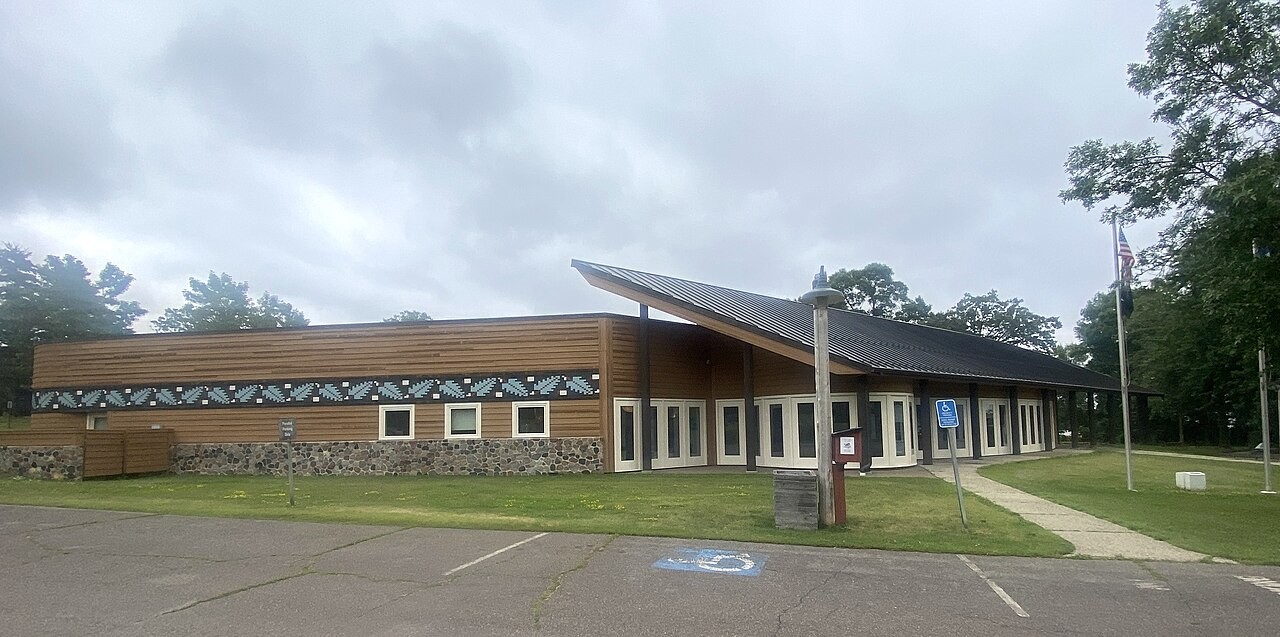
Mille Lacs Indian Museum exterior, 2022 Myotus, 2022-08-13. Via Wikimedia Commons, CC BY-SA 4.0.
Exact museum devoted to Mille Lacs Band history and developed through a Band/Minnesota Historical Society partnership. Modern architectural exterior, not a historical residence or an assertion of community endorsement. The building’s architectural decorative band remains within the full view; its motif is not extracted, copied or explained beyond the institutional identification. No interior objects, ceremonial knowledge or human remains appear. Complete delivered frame retained. Opened-page image should display proportionally; any directory/backdrop CSS crop or overlay is presentation treatment and must not become an altered archival claim. Derivatives remain subject to the stated photo license; no endorsement implied.
Image, association, and reuse record reviewed 2026-10-27.
Full photographs are displayed proportionally above. A translucent background copy may be cropped by the viewport; it does not replace the complete image or its record.
The visual treatment does not change the research status, evidence, or remaining gaps recorded in this profile.
Start reading here
A community-specific starting profile assembled from selected actual-content sources, retaining their earlier inspection dates and exact scopes. The wider Ojibwe profile is related reading, not a substitute government or a claim of equal coverage.
Use the inspected pages of the illustrated guide for an attributed migration, foodways and non-removal account.
These are selected starting points. The full annotated collection, source perspectives, inspection limits and remaining research questions follow below. A starting guide is not an exhaustive history or community endorsement.
01
Community history and persistence
The Band’s public history traces its relationship to the Mille Lacs region and describes dispossession, boarding schools and the rebuilding of government. The inspected pages of the Non-Removable Guide place a community migration account and seasonal subsistence history alongside the Sandy Lake tragedy, removal pressure in the 1860s and later allotment. Read these publications as situated Band accounts rather than a single narrative for all Ojibwe governments. The guide is an illustrated introduction; only pages 2–5 were inspected, and the linked book-length Social History was not opened in the earlier review.
Treaties and the Band’s reading of retained rights
The Band’s treaty page distinguishes the 1837 land cession and retained hunting, fishing and gathering rights from the 1855 treaty establishing its reservation. It explains the Band’s account of federal litigation in the 1990s, the 1999 Supreme Court result and subsequent conservation-code practice. This makes a useful reading sequence from a treaty-era claim to later governmental action. Its legal summaries remain the Band’s interpretation and are not substituted for the actual treaty texts or reported opinions. The museum exterior accompanying this profile identifies a place devoted specifically to Mille Lacs Band history; no exhibit objects or design motifs are reproduced separately.
Inspect the actual 1837 and 1855 treaties and reported judicial opinions before expanding legal conclusions.
Read the linked Social History and additional pages of the Non-Removable Guide as separate, explicitly scoped tasks.
Add direct public language resources, named community voices and a dated account of present priorities.
A community-specific starting guide reuses selected earlier actual-content reviews with their original dates/scopes. It does not add new global works merely because a URL appears on this route. Picture identification/rights are separate from historical adequacy or community endorsement.
Follow the reading path
Sources & further reading
Open any title to read the original source. Annotations explain what each link can help you explore.
No Indigenous-led source is identified in this entry yet. This is a gap in this collection, and does not imply an absence of community knowledge or organization.
Publication: Undated web page; page includes current institutional material
The Band’s own account traces its relationship to the Mille Lacs region, the 1837 and 1855 treaties, dispossession and later reconstruction of tribal government. This is a situated community history; broad legal summaries and undated population claims are not used as independently verified facts.
Inspection: Content reviewed for the stated scope
Scope: Read the complete History and Recognition of Self Government sections (page lines 87–113). The linked Social History of the Mille Lacs Band (1640–1993) was not opened or counted.
This Band-authored reading explains its understanding of the 1837 ceded territory and retained hunting, fishing and gathering rights, and describes the 1994–1999 litigation and later conservation code. The Band’s legal interpretation is identified as its own account; the page is not a substitute for the treaty text or court opinions.
Inspection: Content reviewed for the stated scope
Scope: Read the complete Treaty of 1837, Treaty of 1855 and Today sections (lines 51–76), including the Band’s account of the federal-court and Supreme Court proceedings.
Publication: Undated PDF; no publication date established from the inspected pages
The guide connects an Ojibwe migration account, seasonal food practices, treaties, the Sandy Lake tragedy, removal pressure, boarding schools and Band persistence. Claims and remembered history are presented as the Band’s account; this guide is related to the Band’s website history but is a separate illustrated publication.
Inspection: Content reviewed for the stated scope
Scope: Inspected PDF pages 2–5 (PDF lines 28–141): values, migration and subsistence narrative, treaty summary, Sandy Lake account, 1863–64 non-removal history, allotment and boarding-school discussion. Other pages were not reviewed. Treaty details were not independently checked against full primary records in this pass.
Related entries may represent alternate names, constituent communities, wider groupings, or historical connections. Read the naming notes before treating entries as equivalent.
Robey’s Atlas of Indigenous North America · Compiled October 19, 2026 · Mille Lacs Band of Ojibwe