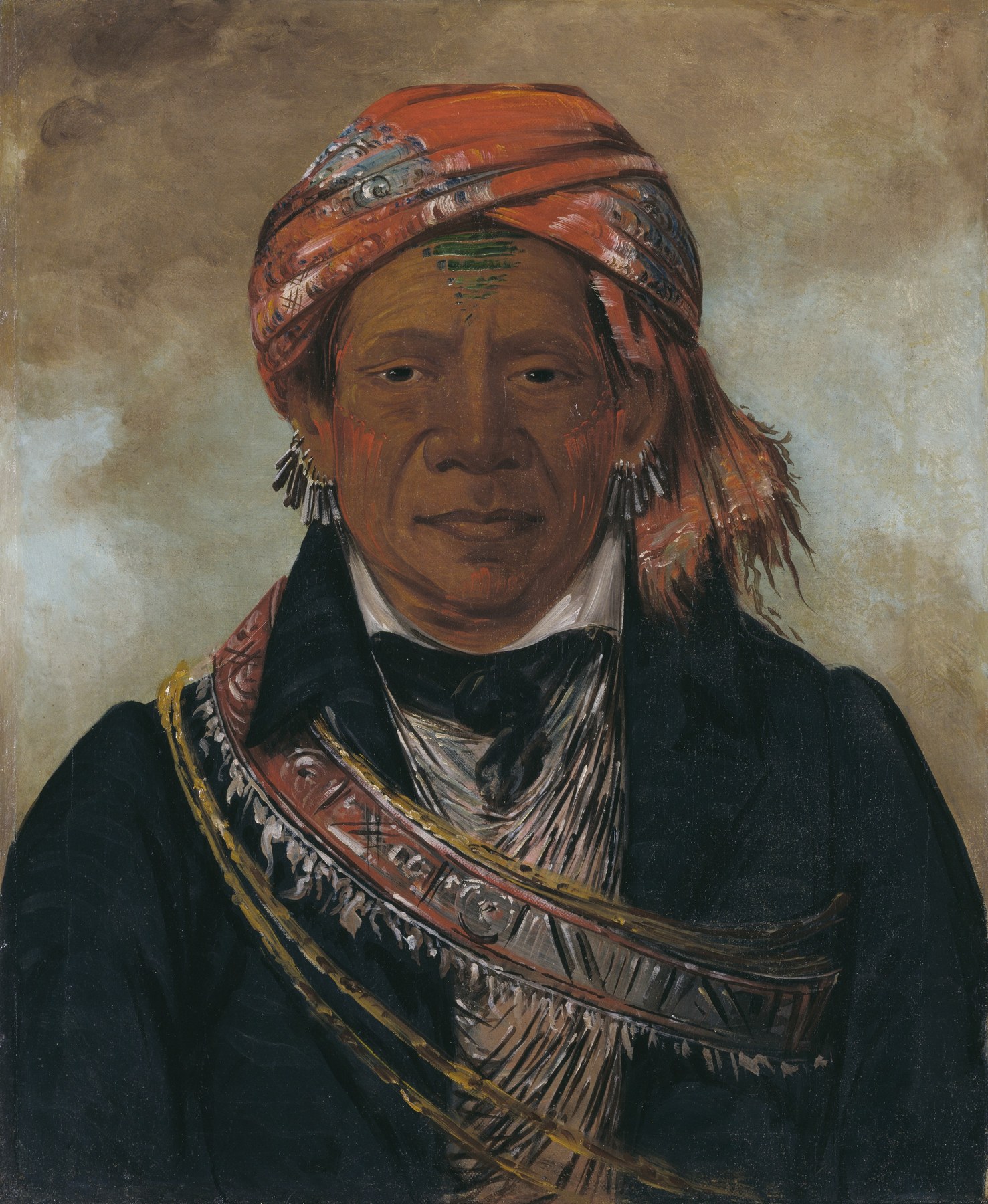
Bód-a-sin, Chief of the Tribe, 1830George Catlin, 1830. Smithsonian American Art Museum, Gift of Mrs. Joseph Harrison, Jr., 1985.66.274. Public domain.
Lenape histories connect an eastern homeland with distinct present communities and different displacement routes. This reading foundation includes community accounts, a primary treaty, language education and critical scholarship. Its Texas coverage is introductory and specifically scoped.
See each region’s evidence for historical or present-day scope.
Homeland / region
Delaware Valley / displaced and continuing communities in Oklahoma, Ontario and elsewhere; scoped Texas history
Research depth
Source guide
Source collection
8 annotated resources · 4 Indigenous-led
Inspected sources
6 substantive works · selected content reviewed
Initial adequacy
Still unfinished
Compiled
October 26, 2026
Names & relationshipsThe original Delaware (Lenape) entry and this entry substantially overlap; keep both search labels while connecting them. Lenape people-level history, specific current governments and language varieties are not interchangeable. Preserve Munsee and community-specific routes without inferred identity or descent.
A source guide for a deeper dive.This entry provides a brief orientation and an organized reading path. A comprehensive deep dive has not yet been completed. Follow the annotated sources and distinguish primary community accounts from outside reference material.
Still unfinished
Six actual-content works provide a varied first reading foundation, with two supporting/index cards excluded. Quantity does not resolve uneven regional coverage, source disagreements, incomplete Texas primary evidence, language breadth or later histories. No automatic adequacy, completion or community review is claimed.
Assessment recorded October 26, 2026. This is separate from research completion and community review.
Texas migration, diplomacy, family histories and removal need directly inspected original records and fuller community-authored scholarship. An encyclopedia account is not a completed Texas foundation.
The 1859 Brazos-reserve relocation and an around-1873 Wichita-allotment narrative describe potentially different stages or scopes; resolve original records before a single detailed chronology.
Current governments, homeland communities, citizenship and recognition require individually scoped contemporary evidence. One publisher’s position in identity disputes is not an Atlas-wide adjudication.
Moraviantown’s battle-outcome description and universal first-treaty assertion are not adopted. Undated population, land figures and legal claims are omitted.
Munsee and other language varieties, Canadian community histories, women’s histories, later land/government changes and wider Lenape-authored work remain unevenly covered.
Original archival records, treaty implementation, current legal instruments and books cited by the institutional histories remain unread. The scholarly article is a selected-page inspection.
No ceremonial narratives, sensitive places, songs, restricted records, current speaker totals or automatic descent/affiliation claims are reproduced.
No researched-count or adequacy change is proposed for Delaware (Lenape) original97; its original bibliography and reciprocal reading route must remain.
Backdrop images & credits
These images have individual, documented connections to this entry. Their captions and source records define the people, place, object, and period shown; no one image represents every community within a broader label.
Bód-a-sin, Chief of the Tribe, 1830 George Catlin, 1830. Smithsonian American Art Museum, Gift of Mrs. Joseph Harrison, Jr., 1985.66.274. Public domain.
Smithsonian American Art Museum explicitly identifies Bód-a-sin as a Delaware/Lenape chief. George Catlin’s 1830 oil portrait is an outside artist’s historical portrayal of one named person, not a documentary photograph, Lenape-made art, a generic Native likeness, or an image of a present government. The museum says it was probably painted at Fort Leavenworth in today’s Kansas; that uncertainty is retained. This image does not establish a Texas connection, exact territorial boundaries, current clothing or cultural practice, descent to a particular government, or community endorsement. No meanings are assigned to the sitter’s clothing or ornaments. The museum’s paired Delaware/Lenape identification supports these two overlapping directory reading labels. They do not count as two distinct nations or imply one present government. Complete 2461x3000 museum-delivered source JPEG inspected and preserved. Web copy resized proportionally to 1477x1800 and recompressed at quality 88; no pixel crop, added detail, generated material, retouching or recoloring. Directory cards and opened-page backgrounds may use disclosed CSS crops/overlays. Preserve a full-frame route where possible. CSS crops/overlays apply to cards and backgrounds; the opened image preserves the complete delivered source frame.
Image, association, and reuse record reviewed 2026-10-26.
Full images are displayed proportionally above. A translucent background copy may be cropped by the viewport; it does not replace the complete image or its record.
The visual treatment does not change the research status, evidence, or remaining gaps recorded in this profile.
Start reading here
Curation of the existing Lenape collection only. Original overview, sections, source objects, review dates, assessment and Texas gaps remain; overlapping Delaware/Lenape directory labels are not two distinct nations.
Follow the selected critical scholarship on deeds and source interpretation, without claiming all underlying records were read.
These are selected starting points. The full annotated collection, source perspectives, inspection limits and remaining research questions follow below. A starting guide is not an exhaustive history or community endorsement.
01
Names and distinct present communities
Lenape is broader than any one government. Delaware Nation’s history distinguishes its Anadarko community from Delaware Tribe of Indians and other Lenape governments. Similar names do not make these institutions interchangeable.
An eastern homeland and overlapping reading labels
The Tribe’s introduction locates Lenape history in the Delaware Valley. This people-level route overlaps the preserved Delaware (Lenape) entry; both labels remain available. Individual governments and language communities need their own specifically supported identities.
Jennings examines the 1737 Walking Purchase through land papers and competing testimony. He argues that proprietary manipulation affected both dispossession and the records used to describe it. Read this as an attributed historical argument: the original manuscripts have not been independently checked here.
The Fort Pitt treaty addresses peace, military passage, trade and territorial guarantees. Article VI proposes a state headed by the Delaware nation with congressional representation, expressly subject to congressional approval. A proposed arrangement is not proof that a state or seat was created. The document’s terms also do not demonstrate their fulfillment.
Delaware Nation connects its Absentee Delaware history with movement toward Texas and the Brazos reservation. Lipscomb’s Texas reference adds diplomacy, scouting and reserve-removal context. These accounts describe particular groups and stages; they do not place every Lenape community in Texas or establish all present families’ descent. Detailed migration and relocation chronology remains unfinished.
Eelünaapéewi Lahkéewiit’s Our Story follows a Moravian-connected community through displacement and rebuilding at Fairfield and New Fairfield. This is an Ontario community’s retrospective, distinct from the Oklahoma government also called Delaware Nation. Its wider historical claims and battle interpretation require comparison rather than automatic adoption.
The Lenape Talking Dictionary identifies its main language scope as Southern Unami. Its introductory lesson explains spelling and everyday greetings, while documentation identifies speakers and other contributors. Selected entry text was read; audio playback was not tested. This resource does not stand for every Lenape language variety, and recordings retain their individual provenance.
Writing in 2002, Rementer and Pearson describe several generations of Oklahoma language classes, learning materials and the early dictionary project. Their different community relationships are explicit. The paper is useful program history, not a current speaker census or proof of learning outcomes. Language loss must not be read as disappearance of a people.
Start with community accounts, compare the treaty’s actual terms, and use the language resources within their stated scope. Jennings provides a focused example of archival criticism. This is a reviewed first reading foundation. Texas primary records, broader community perspectives and later histories still need substantial work; no completion or community endorsement is claimed.
Texas migration, diplomacy, family histories and removal need directly inspected original records and fuller community-authored scholarship. An encyclopedia account is not a completed Texas foundation.
The 1859 Brazos-reserve relocation and an around-1873 Wichita-allotment narrative describe potentially different stages or scopes; resolve original records before a single detailed chronology.
Current governments, homeland communities, citizenship and recognition require individually scoped contemporary evidence. One publisher’s position in identity disputes is not an Atlas-wide adjudication.
Moraviantown’s battle-outcome description and universal first-treaty assertion are not adopted. Undated population, land figures and legal claims are omitted.
Munsee and other language varieties, Canadian community histories, women’s histories, later land/government changes and wider Lenape-authored work remain unevenly covered.
Original archival records, treaty implementation, current legal instruments and books cited by the institutional histories remain unread. The scholarly article is a selected-page inspection.
No ceremonial narratives, sensitive places, songs, restricted records, current speaker totals or automatic descent/affiliation claims are reproduced.
No researched-count or adequacy change is proposed for Delaware (Lenape) original97; its original bibliography and reciprocal reading route must remain.
Selected actual-content works support a bounded starting guide. Earlier source objects retain their original review dates and limits. Reused URLs, images and identity-only checks are not new global historical works. Full history and community review remain open.
Maps with context
Historical maps
Explore authentic historical documents connected to this entry. Their names and boundaries reflect their makers and periods.
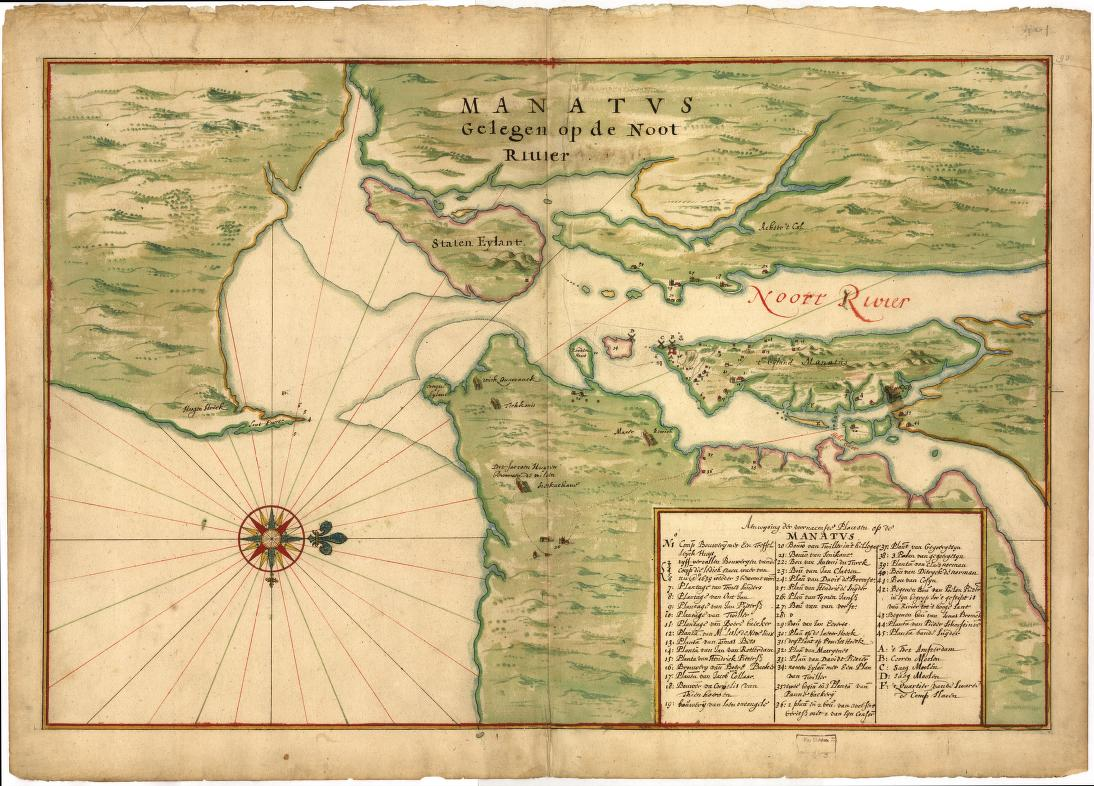
Read the Munsee village within the broader Lenape/Delaware context supported by archival interpretation and community self-description. The two existing directory labels remain separate reading routes; neither identifies a modern government as the village's unique successor.
Historical scope: Seventeenth-century village context, interpreted through modern archival scholarship and community self-description
Library of Congress, The Atlantic World: America and the Netherlands. LOC reuse notice ↗
These map connections are a growing selection. Historical depictions do not establish current boundaries, and a link does not imply community authorship or endorsement.
Follow the reading path
Sources & further reading
Open any title to read the original source. Annotations explain what each link can help you explore.
No Indigenous-led source is identified in this entry yet. This is a gap in this collection, and does not imply an absence of community knowledge or organization.
Substantial community-published history, especially useful for its separately scoped Texas account. Read institutional interpretation alongside original documents.
Inspection: Content reviewed for the stated scope
Scope: Actual complete main historical body, headings and references, lines 29–118. Origin narratives encountered but not retold.
Review recorded: October 26, 2026
Access status: Public readable English HTML
Access note: Conditional 1778 wording checked against treaty. Around-1873 arrival claim and current legal-policy assertions are not adopted. Referenced books and original records remain unread.
A substantial Southern Unami reference and learning resource. Project documentation identifies contributors; selected lexical and lesson text was actually read. Counted once.
Inspection: Content reviewed for the stated scope
Scope: About Us full main text; Getting Started; entry 3901; Lesson 1 spelling and greetings, lines 17–179. No audio playback or story/song inspection claimed.
Review recorded: October 26, 2026
Access status: Public readable English HTML
Access note: The project identifies some recordings as Rementer pronunciations where first-language recordings are absent. Do not imply every sound file has the same provenance or that this covers all Lenape varieties.
Rementer, James, and Bruce L. Pearson. Near the Edge: Language Revival from the Brink of Extinction. 2002. Selected Delaware sections 2a–2c, PDF pp. 1–4.
James Rementer and Bruce L. Pearson describe their positions, language classes and preservation work. This analytical history is distinct from the dictionary itself.
Inspection: Content reviewed for the stated scope
Scope: Actual 11-page PDF text: title, introduction and Delaware sections 2a–2c, PDF pp. 1–4, ending before section 3. Later language-community sections not reviewed for synthesis.
Review recorded: October 26, 2026
Access status: Public English PDF with extractable text
Access note: Dated speaker/population estimates are omitted. Ceremonial descriptions, family generalizations and later sections are not carried into the draft.
Treaty with the Delawares, September 17, 1778, 7 Stat. 13, Articles I–VI. OSU identifier RIT_008.
Read the actual treaty terms rather than a modern summary. Article VI contains a proposal conditional on congressional approval; the text does not establish that it happened.
Inspection: Content reviewed for the stated scope
Scope: Actual complete preamble, Articles I–VI, date and signatories, HTML lines 25–98. Manuscript scans and negotiations not inspected.
Review recorded: October 26, 2026
Access status: Public readable English HTML
Access note: Includes historically coercive and discriminatory language. No present legal interpretation, fulfilled-promises claim or automatic equation with one current government.
A substantive local account of displacement and rebuilding, useful for distinguishing this Ontario community from similarly named Oklahoma institutions.
Inspection: Content reviewed for the stated scope
Scope: Actual complete Our Story body, HTML lines 27–47. Linked institutions, original land instruments and underlying historical records were not inspected.
Review recorded: October 26, 2026
Access status: Public readable English HTML
Access note: No population or land-claim figures adopted. The universal first-treaty assertion and the page’s characterization of the 1813 battle outcome are excluded pending comparison.
Jennings, Francis. Pennsylvania History 37, no. 1 (1970): 19–39. Selected pp. 19–24, 32–39.
Francis Jennings tests competing accounts against deeds and official papers. His argument makes the construction of colonial records part of the historical question.
Inspection: Content reviewed for the stated scope
Scope: Actual 21-page facsimile text: printed pp. 19–24 and 32–39 (PDF pp. 1–6 and 14–21); intervening returned passages encountered, not a full systematic review.
Review recorded: October 26, 2026
Access status: Public English scanned PDF; OCR text available
Access note: OCR contains errors. No mapped boundaries, precise acreage, complete archival verification or present title determination claimed.
Carol A. Lipscomb’s Texas overview identifies useful diplomacy and removal topics. Its obsolete current-government and disappearance claims are excluded; underlying records remain unread.
Inspection: Supporting or limited review; see scope
Scope: Actual complete main article and bibliography, lines 6–33; Texas narrative especially lines 17–27. Citation/date display inspected.
Review recorded: October 26, 2026
Access status: Public readable English HTML
Access note: Display shows 1952 and October 21, 2020 without recovered labels; exact date functions not asserted. Its 1859 reserve-removal chronology is not collapsed with another account’s around-1873 allotment narrative.
Counting note: Supporting only because broad and current-status problems reduce reliability; not used to pad the substantive target.
Related entries may represent alternate names, constituent communities, wider groupings, or historical connections. Read the naming notes before treating entries as equivalent.
Robey’s Atlas of Indigenous North America · Compiled October 19, 2026 · Lenape