Tribal government / contemporary community · Added to the original list
Leech Lake Band of Ojibwe
The Leech Lake Band of Ojibwe is a distinct Minnesota Ojibwe government. Its Division of Resource Management’s historical and co-management booklet is a substantial first-party starting point, written to explain the Band’s history, self-governance and relationships with other agencies. The reviewed twenty-page overview connects treaty-era changes and land tenure with the Band’s account of resource governance and the Chippewa National Forest.
See each region’s evidence for historical or present-day scope.
Homeland / region
Minnesota
Research depth
Source guide
Source collection
1 annotated resources · 1 Indigenous-led
Inspected sources
1 substantive works · selected content reviewed
Initial adequacy
Adequate initial introduction
Source review
October 27, 2026
Names & relationshipsMnDOT explicitly places this individual Minnesota government under its Ojibwe Tribal Nation grouping. It remains a separate government; the broader Ojibwe directory route is related reading, not a substitute identity.
A source guide for a deeper dive.This entry provides a brief orientation and an organized reading path. A comprehensive deep dive has not yet been completed. Follow the annotated sources and distinguish primary community accounts from outside reference material.
Adequate initial introduction
Useful within the disclosed source and image scopes as a starting profile; no fixed source minimum or comprehensive completion claim.
Assessment recorded October 27, 2026. This is separate from research completion and community review.
Compare the historical overview with primary treaties, dated court opinions and the cited archival records.
Inspect the actual 2019 MOU and later implementation materials separately, then check current co-management arrangements.
Add public community language and everyday-life accounts beyond this institutional resource-management publication.
Backdrop photographs & credits
These photographs have individual, documented connections to this entry. Their captions and source records define the people, place, object, and period shown; no one photograph represents every community within a broader label.
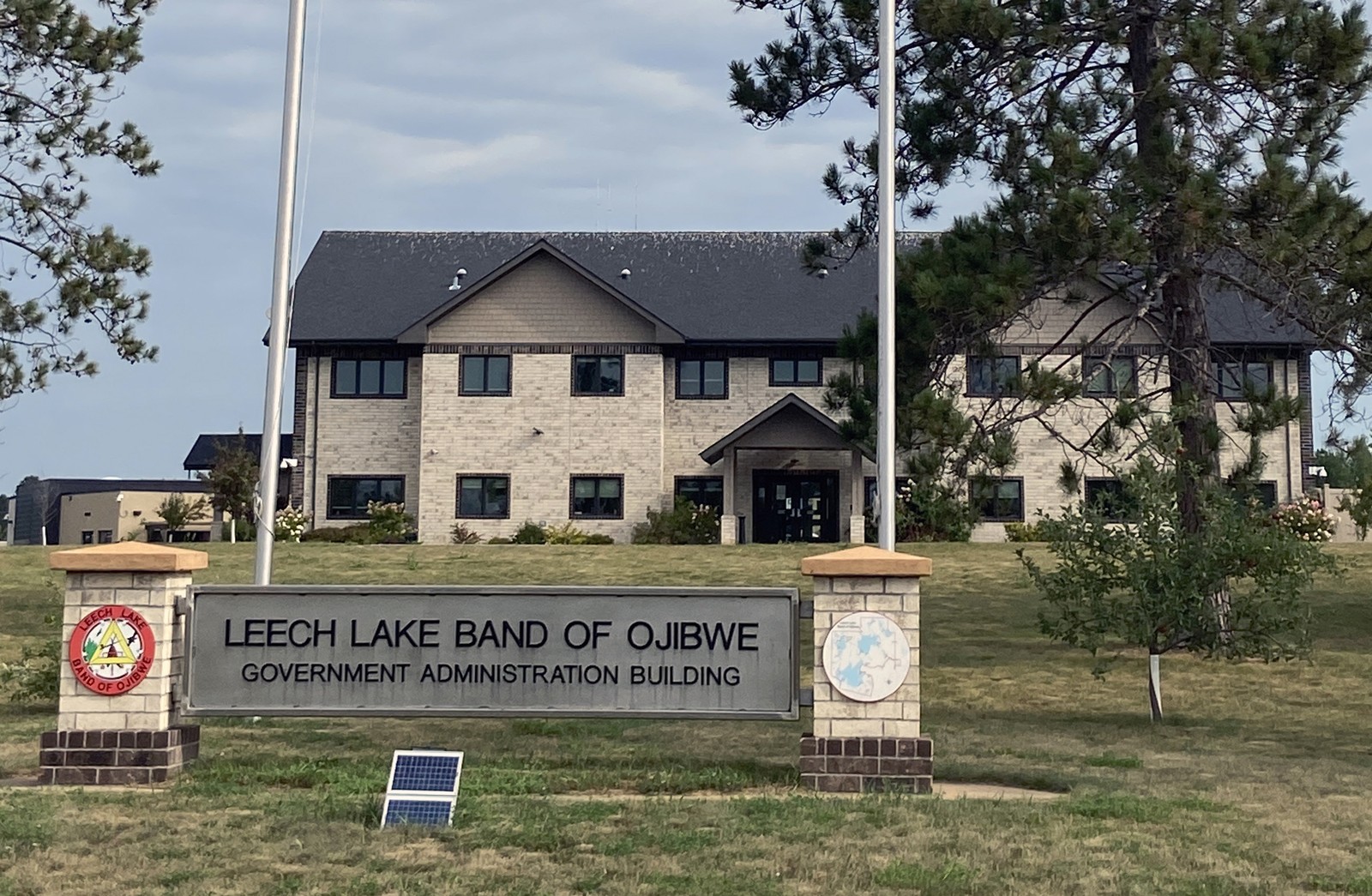
Leech Lake Band of Ojibwe Government Administration Building, 2023 Myotus, 2023-08-27. Via Wikimedia Commons, CC BY-SA 4.0.
Exact Band government institution in Cass Lake, identified by the photographer and legible building sign. Contemporary exterior context, not a historic village, depiction of particular residents or proof of current office operations. The sign’s seal is incidental in the full architectural view; no seal, logo or design is extracted or offered for independent reuse. Complete delivered frame retained. Opened-page image should display proportionally; any directory/backdrop CSS crop or overlay is presentation treatment and must not become an altered archival claim. Derivatives remain subject to the stated photo license; no endorsement implied.
Image, association, and reuse record reviewed 2026-10-27.
Full photographs are displayed proportionally above. A translucent background copy may be cropped by the viewport; it does not replace the complete image or its record.
The visual treatment does not change the research status, evidence, or remaining gaps recorded in this profile.
Start reading here
A community-specific starting profile assembled from selected actual-content sources, retaining their earlier inspection dates and exact scopes. The wider Ojibwe profile is related reading, not a substitute government or a claim of equal coverage.
Begin with PDF pages 4–23, the complete twenty-page historical/current overview; the remaining compilation is not represented as inspected.
These are selected starting points. The full annotated collection, source perspectives, inspection limits and remaining research questions follow below. A starting guide is not an exhaustive history or community endorsement.
01
Treaties, land tenure and historical accounts
The Band’s overview follows the 1837, 1854, 1855, 1864 and 1867 treaty sequence, then discusses the Nelson Act, allotment and logging. It describes the 1864 consolidation and the later creation of White Earth while Leech Lake lands were retained. Its account also includes the 1898 Sugar Point conflict and explicitly records differing Pillager and military explanations of how the fighting began. This is useful because it keeps historical disagreement visible. The booklet’s chronology and legal interpretations remain attributed to the Band; the underlying treaties, court records and cited archival documents were not independently checked in this reading path.
The overview explains the Reservation Business Committee’s assignment of natural-resource law and planning to the Division of Resource Management. It presents cooperation with the Chippewa National Forest as a government-to-government relationship and describes the 2019 co-management agreement in that setting. These passages connect historical land changes with the Band’s institutional explanation of its work. The larger PDF contains 133 pages, including later presentations and agreement materials, but only the opening historical/current overview was read as a substantive work. Its dated 2019–2020 compilation materials should not be assumed to document every current agreement or program outcome.
Compare the historical overview with primary treaties, dated court opinions and the cited archival records.
Inspect the actual 2019 MOU and later implementation materials separately, then check current co-management arrangements.
Add public community language and everyday-life accounts beyond this institutional resource-management publication.
A community-specific starting guide reuses selected earlier actual-content reviews with their original dates/scopes. It does not add new global works merely because a URL appears on this route. Picture identification/rights are separate from historical adequacy or community endorsement.
Follow the reading path
Sources & further reading
Open any title to read the original source. Annotations explain what each link can help you explore.
No Indigenous-led source is identified in this entry yet. This is a gap in this collection, and does not imply an absence of community knowledge or organization.
Indigenous-led / tribal governmentLeech Lake Band of OjibweSource 1
Publication: Undated compilation; contains a 2019 Memorandum of Understanding and a 2020 briefing presentation
A first-party Leech Lake Band educational and resource-management account, created to explain historical events, treaties, the Band’s government, and its agency relationships to Band staff and citizens. The historical overview narrates the 1837, 1854, 1855, 1864, and 1867 treaty sequence, later allotment and logging, the 1898 Sugar Point conflict, and the Band’s resource-governance work. Treaty-right and legal conclusions are presented as the Band’s institutional interpretation; the underlying treaty instruments, court opinions, and cited historical records were not independently checked in this source review. The booklet also includes later co-management materials that should be read as dated documents, not assumed to describe every current policy.
Inspection: Content reviewed for the stated scope
Scope: Read the complete first 20-page “Right to Self-Governance: Historical and Current Overview” (PDF pages 4–23), including its preface, treaty chronology, Nelson Act/allotment and timber discussion, Sugar Point account, present governance and federal/state-agency relationships. The complete PDF has 133 pages; later slide decks, the 2019 MOU, appendices, management letters, implementation guide, and species list were not inspected as separate works. No map or sensitive site information was reused.
Related entries may represent alternate names, constituent communities, wider groupings, or historical connections. Read the naming notes before treating entries as equivalent.
Robey’s Atlas of Indigenous North America · Compiled October 19, 2026 · Leech Lake Band of Ojibwe