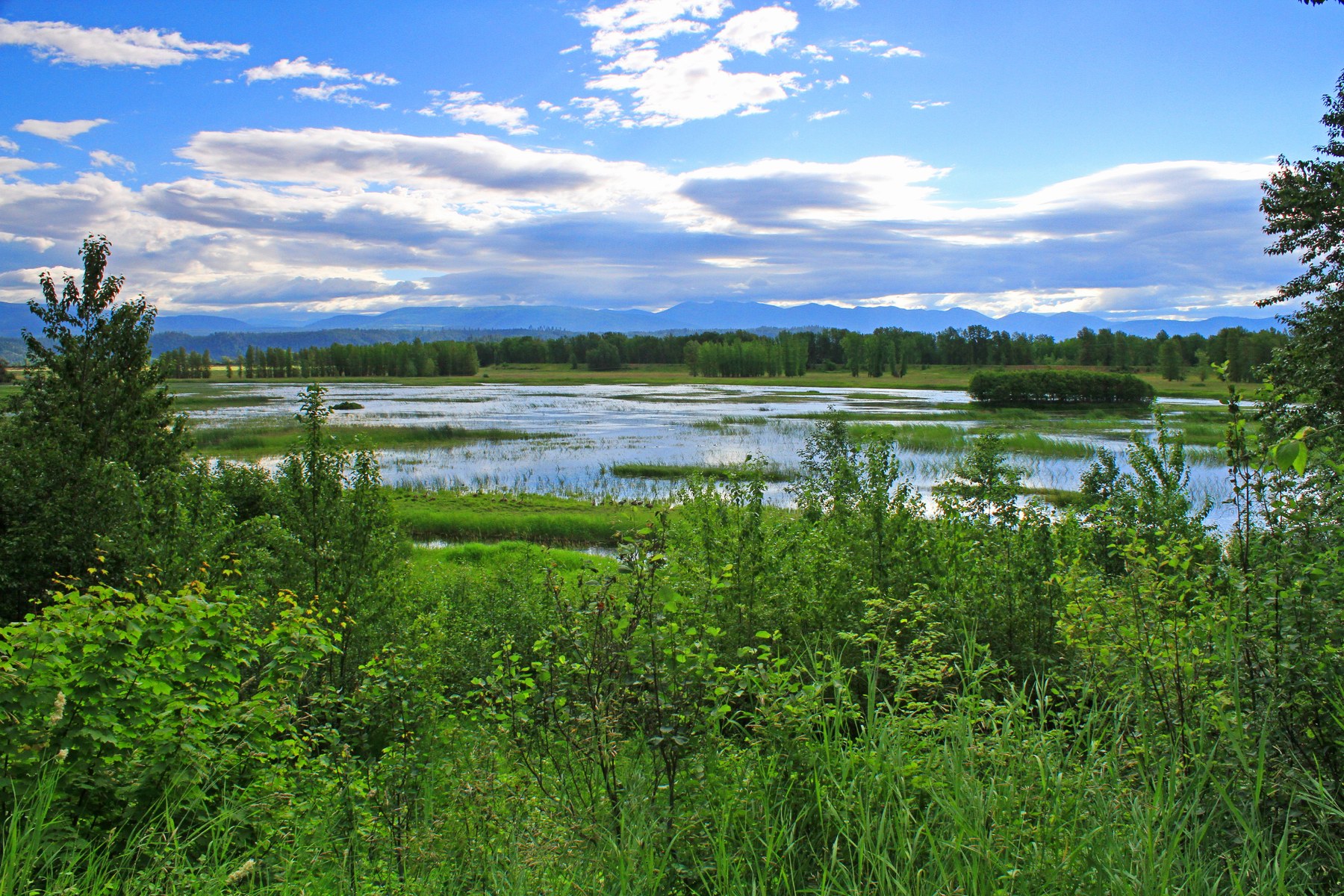
Kootenai National Wildlife Refuge wetlands, Idaho, 2022Carlene Hardt, June 29, 2022. U.S. Fish & Wildlife Service media collection; item designated Public Domain.
Tribal government / contemporary community · Added to the original list
Kootenai Tribe of Idaho
The Kootenai Tribe of Idaho is a separately governed community within the wider Ktunaxa world. Its public history, dated constitutional publication and resource-restoration materials provide three complementary starting points. They connect remaining in Idaho and political organization with continuing responsibilities to the Kootenai River and its living resources.
See each region’s evidence for historical or present-day scope.
Homeland / region
Idaho
Research depth
Source guide
Source collection
3 annotated resources · 2 Indigenous-led
Inspected sources
3 substantive works · selected content reviewed
Initial adequacy
Still unfinished
Source review
October 27, 2026
Names & relationshipsThis is an individually named government and community route. Its own publications and the selected institutional sources provide the scoped context below. Broader people-level reading routes are related context, not interchangeable governments, an individual citizenship determination or a boundary claim.
A source guide for a deeper dive.This entry provides a brief orientation and an organized reading path. A comprehensive deep dive has not yet been completed. Follow the annotated sources and distinguish primary community accounts from outside reference material.
Still unfinished
A compact source-led introduction to this named government. Selected public sources provide useful orientation, with limited voices, historical coverage and outcome evaluation; no comprehensive completion or community endorsement is claimed.
Assessment recorded October 27, 2026. This is separate from research completion and community review.
Compare the community history with underlying treaty and administrative records.
Check later constitutional amendments before describing present law or citizenship.
Add community voices and independent ecological evaluation; program aspirations are not verified recovery outcomes.
Backdrop photographs & credits
These photographs have individual, documented connections to this entry. Their captions and source records define the people, place, object, and period shown; no one photograph represents every community within a broader label.
Kootenai National Wildlife Refuge wetlands, Idaho, 2022 Carlene Hardt, June 29, 2022. U.S. Fish & Wildlife Service media collection; item designated Public Domain.
Modern public-refuge wetland scene in the Kootenai River valley near Bonners Ferry, Idaho. The Kootenai Tribe of Idaho’s history places its continuing community and allotments along the Kootenai River and surrounding uplands. The FWS refuge account locates the photographed facility near Bonners Ferry, adjacent to the river’s west banks. This supports narrow Idaho regional/environmental context in the broader cross-border Kootenai/Ktunaxa collection; the photograph is not a picture of tribal members, reservation land, an identified cultural site, all Ktunaxa communities or a homeland boundary. The relationship comes from those inspected accounts, not merely the refuge sharing the name Kootenai. No legal rights or jurisdiction determination is made. Complete delivered 3500x2333 source frame preserved. Web JPEG resized proportionally to 1800x1200 and recompressed at quality 88; no pixel crop, generated material, retouching or added detail. Cards and opened-page backgrounds may use disclosed CSS crops/overlays. Visual review does not add substantive research counts or community endorsement. For this exact-government route, this is a contextual Kootenai River valley landscape tied to the Tribe's own river/upland history, not evidence that the public refuge is reservation land. FWS actual media record re-read October 27: creator Carlene Hardt, June 29, 2022, original3500x2333, explicit Public Domain designation. Complete delivered 3500x2333 source frame preserved. Web JPEG resized proportionally to 1800x1200 and recompressed at quality 88; no pixel crop, generated material, retouching or added detail. Cards and opened-page backgrounds may use disclosed CSS crops/overlays. Visual review does not add substantive research counts or community endorsement.
Image, association, and reuse record reviewed 2026-10-27.
Full photographs are displayed proportionally above. A translucent background copy may be cropped by the viewport; it does not replace the complete image or its record.
The visual treatment does not change the research status, evidence, or remaining gaps recorded in this profile.
Start reading here
Named government route; nearby people-level profiles remain related reading rather than interchangeable identities. Review dates and selected-content limits are preserved.
Connect that history with the Tribe's own habitat and aquaculture work.
These are selected starting points. The full annotated collection, source perspectives, inspection limits and remaining research questions follow below. A starting guide is not an exhaustive history or community endorsement.
01
Remaining in Idaho and organizing
The Tribe's history recounts pressure to relocate to Montana, continued residence near Bonners Ferry and peaceful protest in 1974 over neglect and inadequate living conditions. It is the Idaho community's own account of dispossession and self-determination. That specific history should remain distinct from the histories of other Ktunaxa governments across the international border and in Montana.
The Tribe-hosted Constitution and Bylaws records adoption on April 10, 1947, and federal approval on June 16. Its compilation labels the latest amendment 1996. The text describes a Tribal Council able to represent the Tribe, manage its affairs and establish a court and law code. This dated framework does not independently establish every present amendment or current legal rule.
The Tribe's habitat-restoration and aquaculture accounts connect environmental change with habitat and subsistence concerns. They explain institutional priorities and related restoration work rather than simply listing offices. Read the program collection as a Tribal account of work and aspirations. It does not independently measure species recovery, prove every project outcome or supply an unchanged schedule for future work.
Compare the community history with underlying treaty and administrative records.
Check later constitutional amendments before describing present law or citizenship.
Add community voices and independent ecological evaluation; program aspirations are not verified recovery outcomes.
A community-specific starting guide reuses selected earlier actual-content reviews with their original dates/scopes. It does not add new global works merely because a URL appears on this route. Picture identification/rights are separate from historical adequacy or community endorsement.
Follow the reading path
Sources & further reading
Open any title to read the original source. Annotations explain what each link can help you explore.
No Indigenous-led source is identified in this entry yet. This is a gap in this collection, and does not imply an absence of community knowledge or organization.
Publication: Undated narrative; 2025 text copyright and 2026 site footer are not established publication dates
The Idaho Tribe's own substantial history distinguishes its community from other Ktunaxa bands and recounts relocation pressures and peaceful protest. It is an attributed community account, without independent review of every underlying treaty or administrative record.
Inspection: Content reviewed for the stated scope
Scope: Actual complete history body, lines 55–92, read. Synthesis selects relocation, continued Idaho residence and 1974 protest; belief narratives, numbers, private family detail and current compact terms excluded.
Publication: Compilation header: original approved 1947, latest amendment 1996. Certificate: adopted April 10, 1947; federal approval June 16, 1947. Compilation publication date unstated
The Tribe-hosted primary text supplies a dated institutional framework. Its header labels the latest amendment 1996; that is not verification of all current law. Adoption and federal approval dates are distinct; membership terms are not summarized.
Inspection: Content reviewed for the stated scope
Scope: Actual five-page text read, including preamble, Council provisions and adoption/approval certificates. Claim uses pages 1–2 and 4–5; no original amendment instruments independently inspected.
Publication: Undated pages; copyright years do not date the descriptions or projected schedules
Related substantive Tribal program accounts are grouped once. They connect environmental change, subsistence access and restoration priorities. Descriptions and aspirations are not independent recovery evaluations, unchanged implementation schedules or verification of every legal assertion.
Inspection: Content reviewed for the stated scope
Scope: Actual habitat body 50–66, aquaculture body 48–62 and linked tribal Fish & Wildlife body 51–57 read. No project maps, datasets, technical plans or photographs reviewed or reused.
Review recorded: October 21, 2026
Inspected material and access routes
Aquaculture ↗ — Actual conservation-program history, partner categories and ecosystem goals read; linked management plans unread.
Related entries may represent alternate names, constituent communities, wider groupings, or historical connections. Read the naming notes before treating entries as equivalent.
Robey’s Atlas of Indigenous North America · Compiled October 19, 2026 · Kootenai Tribe of Idaho