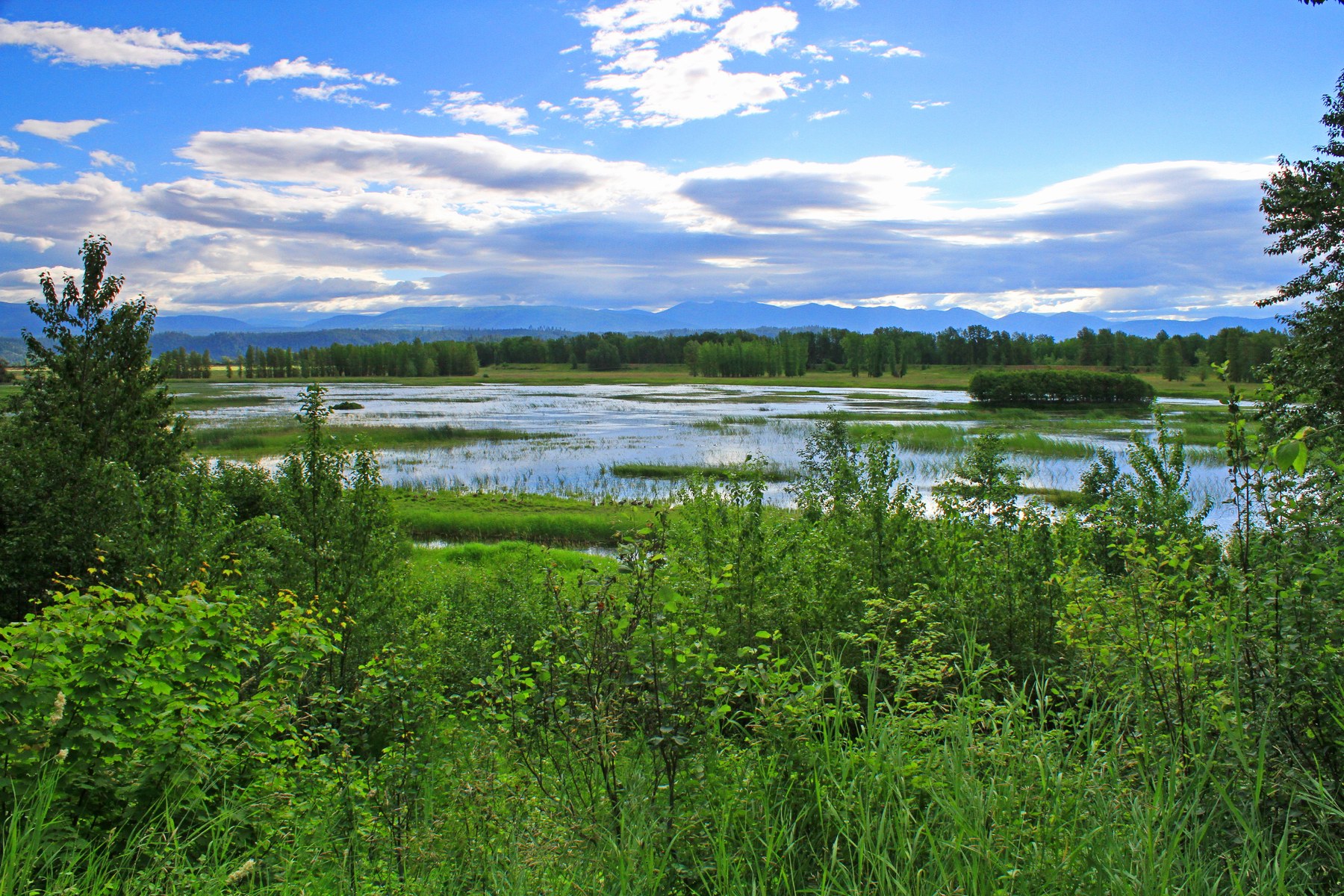
Kootenai National Wildlife Refuge wetlands, Idaho, 2022Carlene Hardt, June 29, 2022. U.S. Fish & Wildlife Service media collection; item designated Public Domain.
Kootenai/Ktunaxa communities have distinct governments across the U.S.–Canada border. This reading path includes the Kootenai Tribe of Idaho and keeps community histories, language work and political relationships in their stated scope.
See each region’s evidence for historical or present-day scope.
Homeland / region
British Columbia / Montana / Idaho
Research depth
Source guide
Source collection
9 annotated resources · 7 Indigenous-led
Inspected sources
8 substantive works · selected content reviewed
Initial adequacy
Still unfinished
Source review
October 23, 2026
A source guide for a deeper dive.This entry provides a brief orientation and an organized reading path. A comprehensive deep dive has not yet been completed. Follow the annotated sources and distinguish primary community accounts from outside reference material.
Still unfinished
Eight substantive works now support a clearer Idaho-centered introduction, including direct Kootenai Tribe history and governance, a dated chairman’s testimony, and a USGS technical study produced in cooperation with the Tribe. This remains unfinished as a profile titled Kootenai (Ktunaxa): the evidence is uneven across the distinct U.S. and Canadian communities, and an environmental report cannot supply the missing community histories or language perspectives.
Assessment recorded October 23, 2026. This is separate from research completion and community review.
Independent Montana-community perspectives are limited to explicit peer identification in these sources.
The Canadian Council’s work is not a substitute for the four member First Nations’ own detailed histories.
The 2003 hearing is a dated coalition policy statement, not a full Kootenai history; the 2025 USGS study covers one restoration reach and selected physical indicators.
Current law, broader program outcomes and quantitative language conditions remain outside the review.
Backdrop photographs & credits
These photographs have individual, documented connections to this entry. Their captions and source records define the people, place, object, and period shown; no one photograph represents every community within a broader label.
Kootenai National Wildlife Refuge wetlands, Idaho, 2022 Carlene Hardt, June 29, 2022. U.S. Fish & Wildlife Service media collection; item designated Public Domain.
Modern public-refuge wetland scene in the Kootenai River valley near Bonners Ferry, Idaho. The Kootenai Tribe of Idaho’s history places its continuing community and allotments along the Kootenai River and surrounding uplands. The FWS refuge account locates the photographed facility near Bonners Ferry, adjacent to the river’s west banks. This supports narrow Idaho regional/environmental context in the broader cross-border Kootenai/Ktunaxa collection; the photograph is not a picture of tribal members, reservation land, an identified cultural site, all Ktunaxa communities or a homeland boundary. The relationship comes from those inspected accounts, not merely the refuge sharing the name Kootenai. No legal rights or jurisdiction determination is made. Complete delivered 3500x2333 source frame preserved. Web JPEG resized proportionally to 1800x1200 and recompressed at quality 88; no pixel crop, generated material, retouching or added detail. Cards and opened-page backgrounds may use disclosed CSS crops/overlays. Visual review does not add substantive research counts or community endorsement.
Image, association, and reuse record reviewed 2026-10-26.
Full photographs are displayed proportionally above. A translucent background copy may be cropped by the viewport; it does not replace the complete image or its record.
The visual treatment does not change the research status, evidence, or remaining gaps recorded in this profile.
Start reading here
A cross-border people-level route: the Idaho Tribe, Montana Ksanka/Kootenai within CSKT, Canadian First Nations and the Council have distinct institutional scopes. The Council's territory narrative is expressly non-exhaustive. The natural-resource pages form one grouped collection; technical plans, datasets and current recovery outcomes are outside that inspection.
The Idaho Tribe's habitat and aquaculture collection connects river change, subsistence access and restoration priorities without equating programs with recovery.
These are selected starting points. The full annotated collection, source perspectives, inspection limits and remaining research questions follow below. A starting guide is not an exhaustive history or community endorsement.
01
Homelands across a later international border
The Ktunaxa Nation Council describes homelands along the Kootenay and Columbia rivers and Arrow Lakes, extending historically beyond British Columbia into neighboring provinces and U.S. states, including Idaho. Its accompanying map expressly warns that its boundaries are not comprehensive or exhaustive. This community account connects land, seasonal livelihoods and stewardship without defining a single modern government or final legal boundary.
Language work and distinct participating communities
The Council's public language article describes work with speakers from four Canadian First Nations, the Kootenai Tribe of Idaho and Montana's Ksanka Band of the Confederated Salish and Kootenai Tribes. It connects classes, curriculum and community activities with intergenerational relationships. This is an institutional account of language work, without a verified speaker census or proof that every participating community operates identical programs.
An Idaho community's history of remaining and organizing
The Kootenai Tribe of Idaho describes a separately governed community within the broader Ktunaxa world. Its history recounts pressure to relocate to Montana, remaining near Bonners Ferry, and peaceful protest in 1974 against neglect and inadequate living conditions. This is the Idaho Tribe's own account of dispossession and self-determination, not a single political history for all Ktunaxa communities.
The Tribe-hosted Constitution and Bylaws records adoption on April 10, 1947, followed by federal approval on June 16. The compilation labels its latest amendment 1996. Its framework assigns a Tribal Council powers to represent the Tribe, manage affairs and establish a court and law code. This is a dated institutional text, without independently verifying all current amendments or rules.
The Kootenai Tribe’s restoration materials connect changes to the Kootenai River with habitat and subsistence concerns. In 2003 testimony, then-chairman Gary Aitken described the Tribe-created Kootenai Valley Resource Initiative around Bonners Ferry and concerns for white sturgeon and burbot, speaking on behalf of the Upper Columbia United Tribes. A later USGS study, prepared in cooperation with the Tribe, examines one reach of the Tribe-led restoration project: it reports increased pool and depth measures after construction, while noting that the tested conditions fell short of the project’s stated depth target and that the measured sediment declines were more consistent with reduced incoming sediment than an effect of the treatments. The study recommends continued monitoring. These dated sources show specific institutional priorities and technical findings; neither establishes overall species recovery or represents all Ktunaxa communities.
Canadian Council work and community-driven planning
The Council's 2026 annual report describes education outreach, tutoring, training support and youth engagement in its Canadian member communities. Its governance chapter discusses data sovereignty and community-driven decision making. These are dated institutional reports and proposals, distinct from the Idaho Tribe's government. The report's draft governance goals do not establish completed agreements or verified outcomes.
The Idaho Tribe's short education page describes school support, adult learning and assistance for higher education. It is a useful access point; the undated description does not establish current eligibility, availability or outcomes.
Further Idaho-community oral-history/public interview perspectives, and original historical records, would broaden the institutional accounts without substituting a colonial author's voice for the Tribe's own.
Separate substantive Ksanka/Kootenai community sources in Montana remain a priority; Salish and Upper Pend d'Oreille people are not interchangeable with Kootenai people within CSKT.
The Canadian Council report and map are situated institutional perspectives, not exhaustive research into each member Nation, boundary, title claim or land declaration.
An actual specialist language-learning publication and dated evaluation would strengthen the public program descriptions. No current speaker census or tested fluency outcome was established.
The Kootenai Tribe’s 2009 restoration master plan, complete technical methods/results, data release and other monitoring studies remain to be read. The 2025 USGS report is a bounded assessment of one reach and selected river-habitat indicators; it does not establish overall ecological recovery.
Substantive works and supporting access routes are counted separately. Actual selected inspection scope and dates appear on the cards; unread references and source media are not counted. This regional batch is an initial educational review, not a complete history or community endorsement. Governmental, historical and language labels retain their specific community and period. Reviewed 2026-10-23: added one 2003 oral congressional statement by Kootenai Tribe of Idaho chairman Gary Aitken, delivered for the five-government Upper Columbia United Tribes coalition, and one 2025 USGS report prepared in cooperation with the Tribe. The report evaluates selected fish-habitat metrics in one reach; results and limitations are attributed to the authors. Neither source adds a historical-map route or substitutes for distinct Ktunaxa community histories.
Follow the reading path
Sources & further reading
Open any title to read the original source. Annotations explain what each link can help you explore.
No Indigenous-led source is identified in this entry yet. This is a gap in this collection, and does not imply an absence of community knowledge or organization.
Publication: Undated; footer copyright does not date the narrative or map
A substantive community homeland account accompanies the map. Its stated limits matter: the depiction is not comprehensive or exhaustive. Historical geography and stewardship perspectives do not establish one government or final legal boundaries.
Inspection: Content reviewed for the stated scope
Scope: Actual map disclaimer and narrative body read, especially lines 156–173. Place-name list screened; linked stories, interactive mapping and source media not investigated or reused.
Publication: Undated article; March 31 names an annual observance, and a 2025 photograph does not establish publication date
A substantive public article connects language work with relationships among generations and land. It explicitly names Canadian and U.S. communities. Institutional goals and growth assertions are not an independently verified speaker census or outcome evaluation.
Inspection: Content reviewed for the stated scope
Scope: Actual complete article body, lines 77–133, read. Synthesis selects community list and teaching descriptions at 96–112. No audio, linked toolkit, recordings, stories or related magazine articles reviewed.
Publication: Undated narrative; 2025 text copyright and 2026 site footer are not established publication dates
The Idaho Tribe's own substantial history distinguishes its community from other Ktunaxa bands and recounts relocation pressures and peaceful protest. It is an attributed community account, without independent review of every underlying treaty or administrative record.
Inspection: Content reviewed for the stated scope
Scope: Actual complete history body, lines 55–92, read. Synthesis selects relocation, continued Idaho residence and 1974 protest; belief narratives, numbers, private family detail and current compact terms excluded.
Publication: Compilation header: original approved 1947, latest amendment 1996. Certificate: adopted April 10, 1947; federal approval June 16, 1947. Compilation publication date unstated
The Tribe-hosted primary text supplies a dated institutional framework. Its header labels the latest amendment 1996; that is not verification of all current law. Adoption and federal approval dates are distinct; membership terms are not summarized.
Inspection: Content reviewed for the stated scope
Scope: Actual five-page text read, including preamble, Council provisions and adoption/approval certificates. Claim uses pages 1–2 and 4–5; no original amendment instruments independently inspected.
Publication: Undated pages; copyright years do not date the descriptions or projected schedules
Related substantive Tribal program accounts are grouped once. They connect environmental change, subsistence access and restoration priorities. Descriptions and aspirations are not independent recovery evaluations, unchanged implementation schedules or verification of every legal assertion.
Inspection: Content reviewed for the stated scope
Scope: Actual habitat body 50–66, aquaculture body 48–62 and linked tribal Fish & Wildlife body 51–57 read. No project maps, datasets, technical plans or photographs reviewed or reused.
Review recorded: October 21, 2026
Inspected material and access routes
Aquaculture ↗ — Actual conservation-program history, partner categories and ecosystem goals read; linked management plans unread.
Publication: 2026 annual report; member/director list explicitly as of July 2026. Selected material includes 2025 activities and 2026 events; report year is not a date for every activity
A substantial dated institutional self-report documents Canadian Council activities and planning. Selected sections provide community priorities, without independently evaluated outcomes. Draft governance goals are not achieved agreements or a constitution governing Idaho or Montana communities.
Inspection: Content reviewed for the stated scope
Scope: Actual 68-page PDF: 1–5 title, vision, contents and structure; 38–41 education; 53–55 governance. Other chapters not reviewed. Undated governance-page institutional history also read as supporting context.
Publication: Undated; footer copyright is not a program publication date
A short undated program description provides an educational access point. Retained as supporting context, without current service, benefit-eligibility or outcomes verification.
Inspection: Supporting or limited review; see scope
Scope: Actual complete brief body, lines 51–62, read. Applications, staff details and eligibility instruments not investigated.
Review recorded: October 21, 2026
Counting note: Brief program orientation, not a substantive educational report or evaluation.
Publication: June 4, 2003 hearing; transcript published by the U.S. Government Printing Office in 2003
A contemporaneous statement by the Tribe’s then-chairman, delivered on behalf of the five-government Upper Columbia United Tribes coalition. Aitken describes the Kootenai Valley Resource Initiative in Bonners Ferry, local fisheries and habitat concerns associated with Libby Dam. The testimony is an attributed institutional perspective in a federal policy hearing, not an independent ecological assessment or a complete history of Ktunaxa communities.
Inspection: Content reviewed for the stated scope
Scope: Actual searchable congressional hearing PDF downloaded from Congress.gov. Read printed pp. 14–16 (PDF pp. 18–20), including the entirety of Aitken’s oral statement; page text was extracted and inspected. The separate prepared-statement appendix was not reviewed or counted. The hearing’s other witnesses are not attributed to Aitken or the Kootenai Tribe.
A technical evaluation of a Kootenai Tribe-led, interagency restoration program in the Kootenai River’s Braided and Straight Reaches. Selected findings report improved pool and depth metrics after construction, but the tested conditions did not meet the stated channel-depth target, and sediment trends did not show that the treatments themselves reduced suspended-sediment transport. The study is geographically and methodologically bounded; it does not evaluate the Tribe’s overall stewardship or establish species recovery.
Inspection: Content reviewed for the stated scope
Scope: Actual 46-page PDF read selectively: abstract; introduction, printed pp. 3–5; discussion, p. 28; and summary/conclusions, p. 30. Title, acknowledgments and contents were checked. Methods, complete results, references, data release and associated figures were not reviewed. The official publication record returned 403 to one automated page fetch, but the linked USGS PDF downloaded successfully; this is not described as a reader paywall.