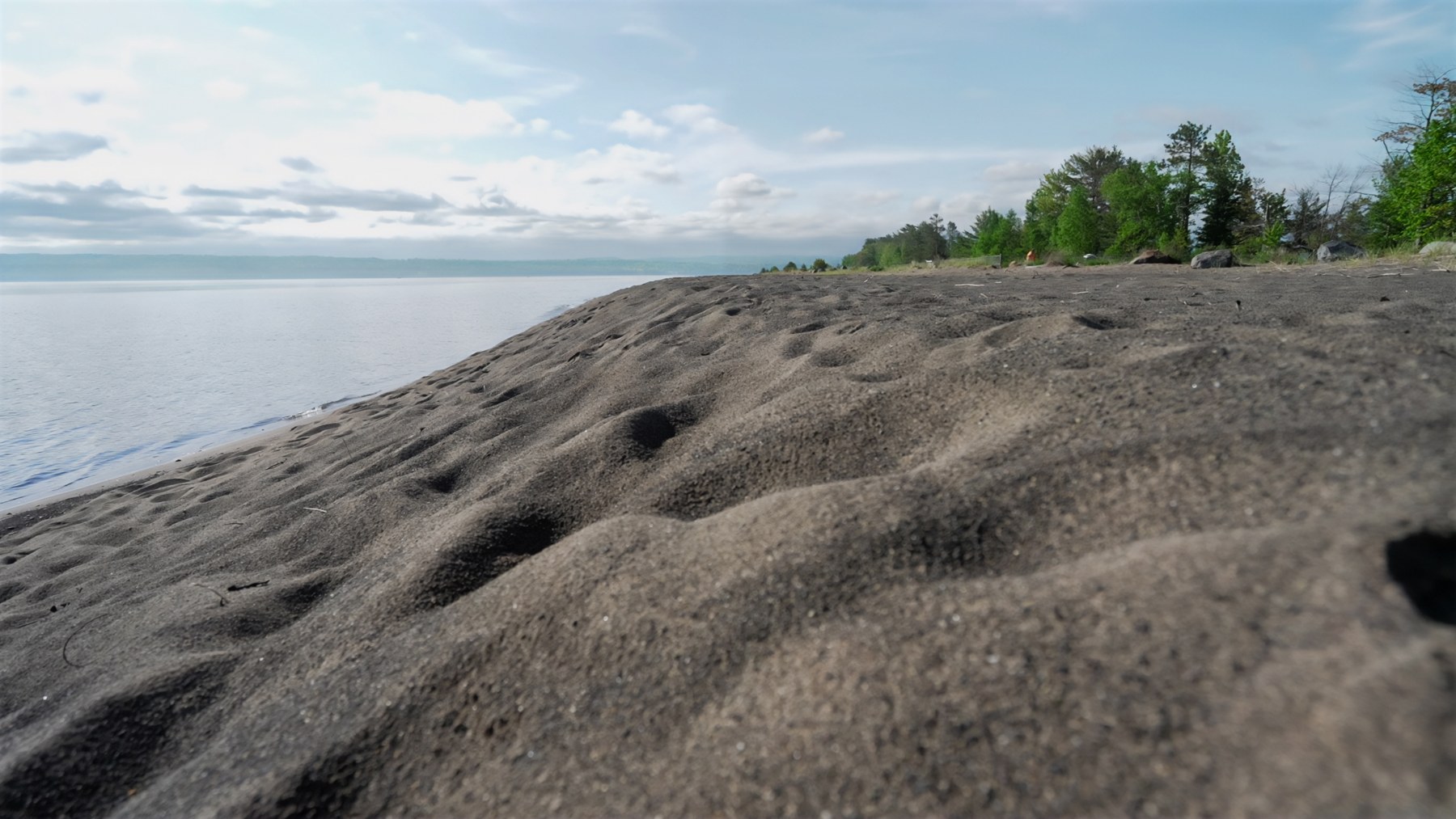
Shoreline and stamp-sand restoration context for Keweenaw Bay Indian CommunityUSDA Forest Service, Flickr image 54087624096 / Wikimedia Commons. Public domain in the United States.
Tribal government / contemporary community · Added to the original list
Keweenaw Bay Indian Community
Keweenaw Bay Indian Community is a distinct Michigan government whose public materials connect formal organization with health and cultural care. Its hosted Constitution and By-Laws is labeled approved in 1936 and amended. The historical preamble names L'Anse, Lac Vieux Desert and Ontonagon bands, while the selected governing-body provisions describe a Tribal Council. Those words belong to the publication's historical framework; they should not erase later governmental changes or determine another present government's identity. The Community's preservation office describes its creation in 2005, care for language, art and historical resources, and archives containing elder interviews and documentary materials. Its public notice also makes clear that some knowledge is withheld and archive access is restricted. A health-service account adds a local institutional history beginning in 1971 and describes recruiting a physician and developing community-run services. This starting selection introduces self-government through concrete institutions while leaving current law, individual eligibility, sensitive knowledge and independently measured program outcomes outside its claims.
See each region’s evidence for historical or present-day scope.
Homeland / region
Michigan
Research depth
Source guide
Source collection
3 annotated resources · 3 Indigenous-led
Inspected sources
3 substantive works · selected content reviewed
Initial adequacy
Still unfinished
Source review
October 27, 2026
Names & relationshipsThe State’s individual entry explicitly describes Keweenaw Bay Indian Community in relation to the Lake Superior Band of Chippewa Indians. This is a specifically named government, not a substitute for every Chippewa community.
A source guide for a deeper dive.This entry provides a brief orientation and an organized reading path. A comprehensive deep dive has not yet been completed. Follow the annotated sources and distinguish primary community accounts from outside reference material.
Still unfinished
A small actual-content collection supports a useful introduction to this named government, with explicit historical, access and interpretation limits. It is not comprehensive research or community endorsement.
Assessment recorded October 27, 2026. This is separate from research completion and community review.
Compare the constitutional publication with later amendments and original instruments before current-law claims.
Broaden community voices, language, land and treaty history beyond these institutional introductions.
Current health access and outcomes are unverified; protected archives and sensitive knowledge remain excluded.
Backdrop photographs & credits
These photographs have individual, documented connections to this entry. Their captions and source records define the people, place, object, and period shown; no one photograph represents every community within a broader label.
Shoreline and stamp-sand restoration context for Keweenaw Bay Indian Community USDA Forest Service, Flickr image 54087624096 / Wikimedia Commons. Public domain in the United States.
The Forest Service's actual caption explicitly connects this shoreline scene with Keweenaw Bay Indian Community projects addressing stamp sands. This is a particular agency-published restoration context, not a universal community scene, a map, current water-safety assessment or proof of ecological recovery. Its date field labels 2024 while its filename begins 2015XXXX; no independent capture date is resolved. Full 2981-by-1677 downloaded frame is preserved; view_image displayed 2048-by-1152. No sensitive cultural places, coordinates or community knowledge are identified. Complete available 2981×1677 source frame proportionally resized to 1800×1013 and JPEG recompressed; no pixel crop or retouching. Source file preserved privately. CSS crops/overlays affect display only; creator/source/rights credit retained.
Image, association, and reuse record reviewed 2026-10-27.
Full photographs are displayed proportionally above. A translucent background copy may be cropped by the viewport; it does not replace the complete image or its record.
The visual treatment does not change the research status, evidence, or remaining gaps recorded in this profile.
Start reading here
Named government route; broader people-level names and related governments remain distinct. Source dates, inspection scope and remaining gaps are retained.
A primary constitutional publication for this government, useful for its dated formal framework. Historical constituent-band naming is not present-day identity equivalence; no citizenship advice or current-law completeness claim is made.
The Community explains its preservation office and explicitly distinguishes public description from restricted knowledge. Its administrative legal summary is attributed, not independently audited; no protected archive content is reproduced.
A community health institution recounts its own development. Broad national-first claims and undated service comparisons are not repeated; this is historical/institutional orientation rather than clinical guidance or an access guarantee.
These are selected starting points. The full annotated collection, source perspectives, inspection limits and remaining research questions follow below. A starting guide is not an exhaustive history or community endorsement.
01
A dated framework and changing institutions
The constitutional publication names the Community and sets out a Tribal Council. Read its 1936 heading and amendment context carefully: a hosted historical framework does not independently establish every rule now in force. Historical band names in a preamble also do not settle the identities of separate present governments.
The preservation office describes care for historical resources and restricted archives; the health service recounts building tribally operated care. These accounts show specific institutional priorities. They do not authorize access to confidential knowledge or establish how well every service currently reaches community members.
Compare the constitutional publication with later amendments and original instruments before current-law claims.
Broaden community voices, language, land and treaty history beyond these institutional introductions.
Current health access and outcomes are unverified; protected archives and sensitive knowledge remain excluded.
This reviewed starting guide records selected actual-content sources, their perspectives and access limits. Reused earlier reviews retain their original dates/scopes; images and repeated URLs do not create new historical works. Comprehensive history and community review remain open.
Follow the reading path
Sources & further reading
Open any title to read the original source. Annotations explain what each link can help you explore.
No Indigenous-led source is identified in this entry yet. This is a gap in this collection, and does not imply an absence of community knowledge or organization.
Indigenous-ledKeweenaw Bay Indian CommunitySource 1
A primary constitutional publication for this government, useful for its dated formal framework. Historical constituent-band naming is not present-day identity equivalence; no citizenship advice or current-law completeness claim is made.
Inspection: Content reviewed for the stated scope
Scope: Actual selected web text lines 202–209 and 242–250 read: dated heading, preamble, territorial statement and governing-body provisions. Membership text was exposed but is not synthesized; later sections, amendment instruments and current implementation not verified.
The Community explains its preservation office and explicitly distinguishes public description from restricted knowledge. Its administrative legal summary is attributed, not independently audited; no protected archive content is reproduced.
Inspection: Content reviewed for the stated scope
Scope: Actual project-history and archive text lines 213–220 read, especially 2005 office creation, mission, archive materials and restrictions. Private/archive contents, requests, sensitive locations and linked materials not investigated.
A community health institution recounts its own development. Broad national-first claims and undated service comparisons are not repeated; this is historical/institutional orientation rather than clinical guidance or an access guarantee.
Inspection: Content reviewed for the stated scope
Scope: Actual mission/vision and history body lines 6–20 read. Synthesis uses 1971 starting point, physician recruitment and tribally operated services. Hours, contacts, patient access and outcomes not verified.
Related entries may represent alternate names, constituent communities, wider groupings, or historical connections. Read the naming notes before treating entries as equivalent.
Robey’s Atlas of Indigenous North America · Compiled October 19, 2026 · Keweenaw Bay Indian Community