Tribal government / contemporary community · Added to the original list
Grand Portage Band of Lake Superior Chippewa
The Grand Portage Band of Lake Superior Chippewa is a sovereign Ojibwe government whose homeplace is Grand Portage on Lake Superior. Its government page identifies its 1854 treaty relationship and membership in the Minnesota Chippewa Tribe. A Band land-return release and the National Park Service’s place-specific interpretation offer a starting path through homeland, land tenure and the portage corridor.
See each region’s evidence for historical or present-day scope.
Homeland / region
Minnesota
Research depth
Source guide
Source collection
3 annotated resources · 1 Indigenous-led
Inspected sources
2 substantive works · selected content reviewed
Initial adequacy
Adequate initial introduction
Source review
October 27, 2026
Names & relationshipsMnDOT explicitly places this individual Minnesota government under its Ojibwe Tribal Nation grouping. It remains a separate government; the broader Ojibwe directory route is related reading, not a substitute identity.
A source guide for a deeper dive.This entry provides a brief orientation and an organized reading path. A comprehensive deep dive has not yet been completed. Follow the annotated sources and distinguish primary community accounts from outside reference material.
Adequate initial introduction
Useful within the disclosed source and image scopes as a starting profile; no fixed source minimum or comprehensive completion claim.
Assessment recorded October 27, 2026. This is separate from research completion and community review.
Add a longer community-authored history and public Ojibwemowin material.
Inspect the actual treaty and parcel title/allotment records before expanding the 2026 release into a legal land history.
The selected photograph dates to 1984 and shows a reconstructed public site; present appearance and visitor information were not audited.
Backdrop photographs & credits
These photographs have individual, documented connections to this entry. Their captions and source records define the people, place, object, and period shown; no one photograph represents every community within a broader label.
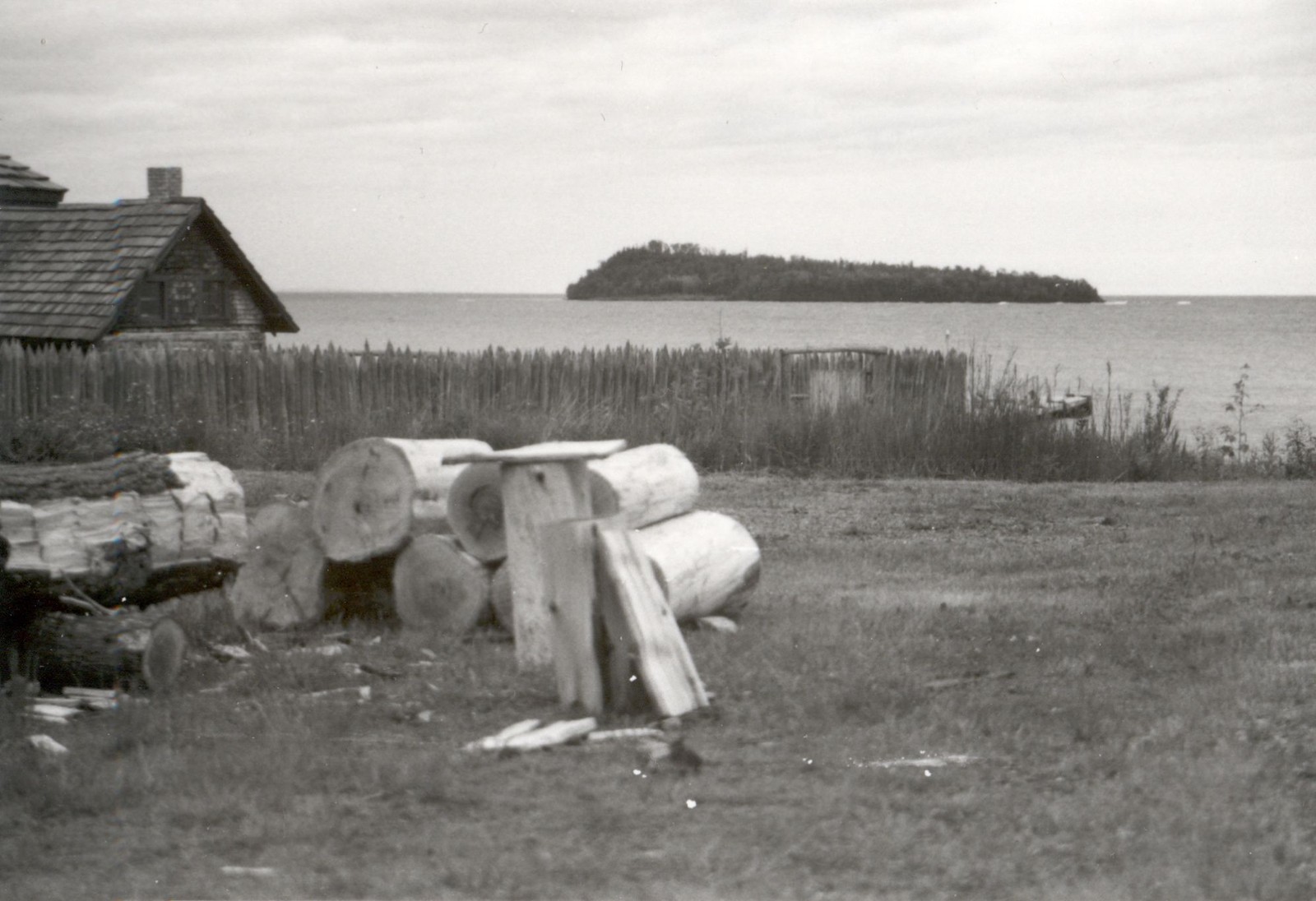
Grand Portage Bay and island from the reconstructed depot, 1984 Chris Light, 1984-07-14. Via Wikimedia Commons, CC BY-SA 4.0.
A 1984 photograph of Grand Portage Bay seen across the reconstructed public depot grounds. The NPS identifies this lakeshore district as a reconstruction within Grand Portage Anishinaabe homeland. It is not an eighteenth-century photograph, an intact historical village or a current appearance claim. No individual, ceremony, artifact detail or territorial boundary is asserted. Complete delivered frame retained. Opened-page image should display proportionally; any directory/backdrop CSS crop or overlay is presentation treatment and must not become an altered archival claim. Derivatives remain subject to the stated photo license; no endorsement implied.
Image, association, and reuse record reviewed 2026-10-27.
Full photographs are displayed proportionally above. A translucent background copy may be cropped by the viewport; it does not replace the complete image or its record.
The visual treatment does not change the research status, evidence, or remaining gaps recorded in this profile.
Start reading here
A community-specific starting profile assembled from selected actual-content sources, retaining their earlier inspection dates and exact scopes. The wider Ojibwe profile is related reading, not a substitute government or a claim of equal coverage.
Add the NPS homeplace and portage interpretation as clearly attributed, geographically specific context.
These are selected starting points. The full annotated collection, source perspectives, inspection limits and remaining research questions follow below. A starting guide is not an exhaustive history or community endorsement.
01
Gichi Onigaming and a living homeplace
The National Park Service identifies Grand Portage National Monument as within the homeland of the Grand Portage Anishinaabe and the community as the Band’s homeplace and governmental center. It explains Gichi Onigaming as the carrying place connecting Lake Superior and the continent’s interior, and records the Band’s donation of approximately half the monument’s land. Read that interpretation with the Band’s own government statement. The reconstructed lakeshore depot pictured here is a public interpretation site within this homeplace; it is not a surviving eighteenth-century village or a portrait of the whole community.
A March 2026 Band release reports the return of three parcels, totaling about 87 acres, through a partnership with the Lloyd K. Johnson Foundation and Minnesota Land Trust. It describes three different routes by which those particular parcels left Band ownership: treaty cession, state school-trust transfer and allotment. This is a direct community account of one land acquisition and its historical meaning. The release usefully distinguishes mechanisms of land loss, while the underlying titles, allotment documents and treaty instruments remain separate research tasks. It does not define the full extent of Grand Portage homeland.
Add a longer community-authored history and public Ojibwemowin material.
Inspect the actual treaty and parcel title/allotment records before expanding the 2026 release into a legal land history.
The selected photograph dates to 1984 and shows a reconstructed public site; present appearance and visitor information were not audited.
A community-specific starting guide reuses selected earlier actual-content reviews with their original dates/scopes. It does not add new global works merely because a URL appears on this route. Picture identification/rights are separate from historical adequacy or community endorsement.
Follow the reading path
Sources & further reading
Open any title to read the original source. Annotations explain what each link can help you explore.
No Indigenous-led source is identified in this entry yet. This is a gap in this collection, and does not imply an absence of community knowledge or organization.
Indigenous-led / governmentGrand Portage Band of Lake Superior ChippewaSource 1Supporting reference · outside substantive inspected count
Publication: Current election information for 2026; historical statement undated
The Band states its inherent sovereignty, its 1854 treaty relationship and membership in the six-band Minnesota Chippewa Tribe. This concise government page is useful for direct identity and present-governance context; detailed historical claims are supported by the NPS history page and treaties.
Inspection: Supporting or limited review; see scope
Scope: Read the page’s complete main government statement (lines 12–31). Counts as supporting context only.
A Grand Portage Band news release reports that a February 2026 acquisition restored three parcels totaling about 87 acres to Band ownership through a partnership with the Lloyd K. Johnson Foundation and Minnesota Land Trust. The Band describes three distinct routes by which those parcels left Band ownership: 1854 treaty cession, state school-trust transfer, and allotment. This is a direct community source for the Bands current action and its historical interpretation; the underlying treaty, land-title chain, tax records, and allotment documents were not independently checked. The Bands broad discussion of allotment policy remains attributed to the release and is not generalized to every Ojibwe Band. A linked map/images package is not included.
Inspection: Content reviewed for the stated scope
Scope: Read the full 83-line public Band news release on October 23, 2026. It reports the February 16, 2026 acquisition of three parcels through a Band/Foundation partnership, describes the Band account of different land-loss mechanisms, and quotes the Band chair and partner representatives. Its linked map/images were not opened or used. The Band statements about federal policy and the parcels past ownership are attributed community interpretation; underlying treaty, land-title and allotment records were not independently inspected.
The park identifies Grand Portage National Monument as within the homeland of the Grand Portage Anishinaabe and identifies the Band as the center of tribal government. It describes the portage corridor and Minong (Isle Royale) as important to Grand Portage. This park interpretation is geographically specific and does not define all Ojibwe homelands.
Inspection: Content reviewed for the stated scope
Scope: Read the complete History & Culture page, especially lines 22–52 on Gichi Onigaming, trade, Grand Portage homeland, land donation and Minong. Linked articles and image files were not opened.
Related entries may represent alternate names, constituent communities, wider groupings, or historical connections. Read the naming notes before treating entries as equivalent.
Robey’s Atlas of Indigenous North America · Compiled October 19, 2026 · Grand Portage Band of Lake Superior Chippewa