Tribal government / contemporary community · Added to the original list
Bay Mills Indian Community
Bay Mills Indian Community is a distinct Ojibwe government and community whose public history work connects photographs, documents, elder interviews and education. Its History Department describes a committee working with scholar Charles Cleland on The Place of the Pike, a history of Bay Mills, and explains Gnoozhekaaning as the local traditional place name. The department's account also connects constitutional organization in 1936 with the first tribal election in 1937. This is Bay Mills' institutional narrative, rather than a claim that every regional Ojibwe community shares the same government history. Bay Mills Community College provides another specific community institution: its account traces a vocational program funded in 1981 and a charter granted by Bay Mills Indian Community in 1984. The college describes serving the local community, other tribal communities and neighbors through several locations and online education. These sources make a useful first path through community memory and institution building. Present program access, educational outcomes and detailed historical chronology remain questions for further review.
See each region’s evidence for historical or present-day scope.
Homeland / region
Michigan
Research depth
Source guide
Source collection
3 annotated resources · 3 Indigenous-led
Inspected sources
2 substantive works · selected content reviewed
Initial adequacy
Still unfinished
Source review
October 27, 2026
Names & relationshipsThe State’s individual Bay Mills entry explicitly relates this government to Sault Ste. Marie bands of Chippewa Indians. It is not the same government as the separately listed Sault Ste. Marie Tribe.
A source guide for a deeper dive.This entry provides a brief orientation and an organized reading path. A comprehensive deep dive has not yet been completed. Follow the annotated sources and distinguish primary community accounts from outside reference material.
Still unfinished
A small actual-content collection supports a useful introduction to this named government, with explicit historical, access and interpretation limits. It is not comprehensive research or community endorsement.
Assessment recorded October 27, 2026. This is separate from research completion and community review.
Read the community history book and underlying records to deepen chronology and a wider range of voices.
Assess current educational access and outcomes with suitable evidence rather than relying on institutional mission statements.
Review current government instruments before describing legal rules; related regional governments remain distinct.
Backdrop photographs & credits
These photographs have individual, documented connections to this entry. Their captions and source records define the people, place, object, and period shown; no one photograph represents every community within a broader label.
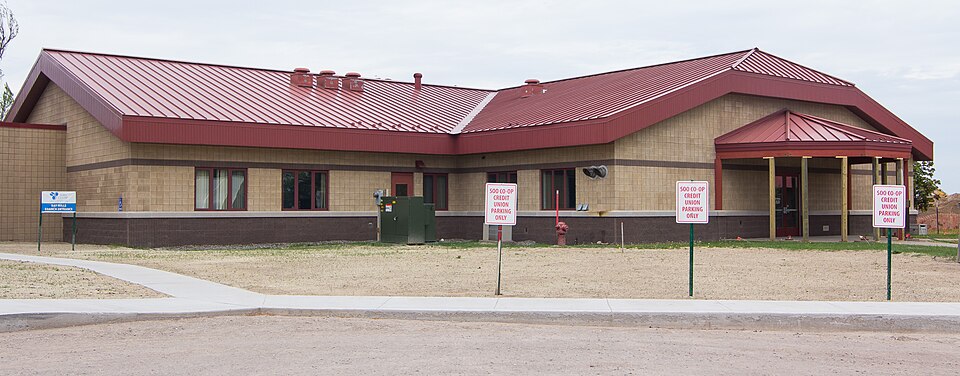
Bay Mills Community College, 2019 rossograph, 2019; Wikimedia Commons. CC BY-SA 4.0. 960px preview; original-resolution file not inspected.
A photograph explicitly identified as Bay Mills Community College. The college's own About account says it was chartered by Bay Mills Indian Community in 1984 and lies within the Community. This bridges the exact government to a particular institution. It is not an image of all citizens or a present course-access claim. The complete published960px preview was retrieved and inspected; no original-resolution inspection is claimed. Root completed normal-browser preview retrieval and full-preview visual inspection. This960px frame is reproduced unchanged; no larger-original pixel inspection is claimed. No challenge bypass or login was used. Any CSS crops and overlays affect presentation only. Exact available960px preview copied unchanged; CSS crops/overlays on directory and backdrop, full preview frame on opened page. Exact available full-frame JPEG copied unchanged; CSS crops and overlays affect card/backdrop display only.
Image, association, and reuse record reviewed 2026-10-27.
Full photographs are displayed proportionally above. A translucent background copy may be cropped by the viewport; it does not replace the complete image or its record.
The visual treatment does not change the research status, evidence, or remaining gaps recorded in this profile.
Start reading here
Named government route; broader people-level names and related governments remain distinct. Source dates, inspection scope and remaining gaps are retained.
The Community describes how its public history collection developed and how the department preserves documents, photographs and knowledge. The linked book itself was not read; exceptional first-woman-president claims and burial details are not adopted.
The tribally controlled college explains its own origins and relationship to the exact Bay Mills government. Institutional mission and history are useful; enrollment, accreditation currency, admissions and measured outcomes are not independently verified.
These are selected starting points. The full annotated collection, source perspectives, inspection limits and remaining research questions follow below. A starting guide is not an exhaustive history or community endorsement.
01
History assembled within the community
The History Department describes collecting photographs and documents and interviewing elders in work that supported Charles Cleland's book. Its public account is a guide to that community effort, not a substitute for reading the book or assessing every underlying archive. Sensitive burial entries are omitted from this profile.
The college traces its origins to a vocational program and its 1984 charter from Bay Mills Indian Community. Its own institutional account places education alongside regional community development. The pictured college is a particular community institution; it does not represent all Bay Mills people or establish current course availability.
Read the community history book and underlying records to deepen chronology and a wider range of voices.
Assess current educational access and outcomes with suitable evidence rather than relying on institutional mission statements.
Review current government instruments before describing legal rules; related regional governments remain distinct.
This reviewed starting guide records selected actual-content sources, their perspectives and access limits. Reused earlier reviews retain their original dates/scopes; images and repeated URLs do not create new historical works. Comprehensive history and community review remain open.
Follow the reading path
Sources & further reading
Open any title to read the original source. Annotations explain what each link can help you explore.
No Indigenous-led source is identified in this entry yet. This is a gap in this collection, and does not imply an absence of community knowledge or organization.
The Community describes how its public history collection developed and how the department preserves documents, photographs and knowledge. The linked book itself was not read; exceptional first-woman-president claims and burial details are not adopted.
Inspection: Content reviewed for the stated scope
Scope: Actual selected body lines 15–24, 34–50, 65–86 read: committee/book, preservation mission, photo/document projects, public services and 1936–37 organization. Burial-specific entries, linked newspaper, images, staffing, prices and opening hours excluded.
The tribally controlled college explains its own origins and relationship to the exact Bay Mills government. Institutional mission and history are useful; enrollment, accreditation currency, admissions and measured outcomes are not independently verified.
Inspection: Content reviewed for the stated scope
Scope: Actual main About body lines 93–101 read, including location, vocational-program origins, 1984 charter, institutional control, education mission and land-grant role. Accreditation subsections, linked charter, policies and other resources not independently investigated.
A short supporting orientation to the Community's published governmental structure. Retained outside the selected substantive reading path; it is not a current-law audit.
Inspection: Supporting or limited review; see scope
Scope: Actual opening organization body lines 7–13 read, distinguishing General Council and delegated Executive Council. Population totals, legal jurisdiction summaries and current personnel are not used.
Related entries may represent alternate names, constituent communities, wider groupings, or historical connections. Read the naming notes before treating entries as equivalent.
Robey’s Atlas of Indigenous North America · Compiled October 19, 2026 · Bay Mills Indian Community