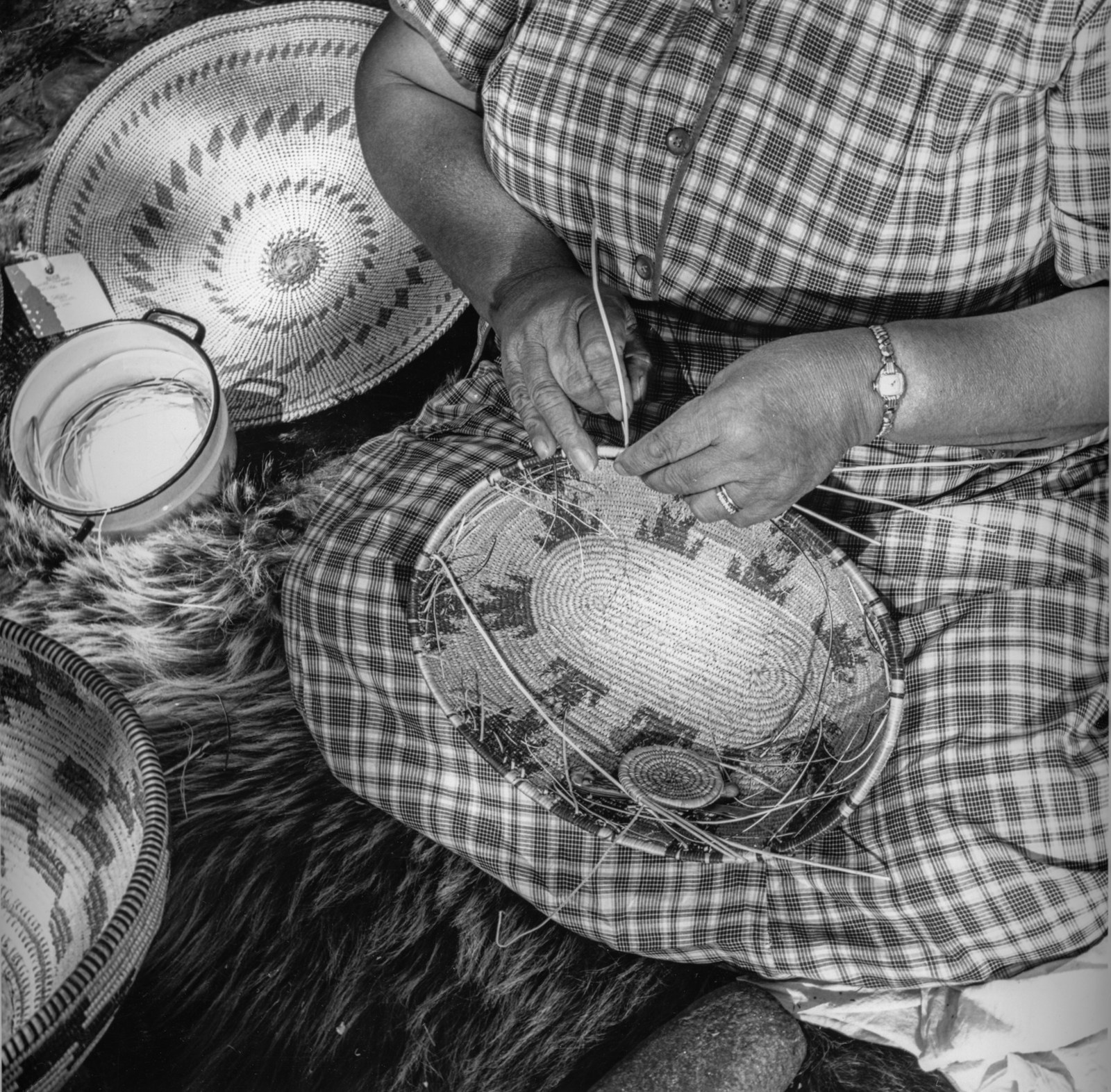
Selena LaMarr practicing Atsugewi basketryNational Park Service, Lassen Volcanic National Park; Hat Creek Atsugewi Historic Photograph Collection. The gallery credit field names Selena LaMarr; this is not treated as evidence that she photographed herself.
Atsugewi homelands lie south of the Pit River in northeastern California, including Hat Creek and Dixie Valley. Atsugewi identity has both local historical dimensions and a place within the present Pit River Tribe. Language archives, seasonal land-use histories and the work of Atsugewi cultural interpreters provide complementary routes into that continuing history.
See each region’s evidence for historical or present-day scope.
Homeland / region
California
Research depth
Source inspection pending
Source collection
4 annotated resources · 1 Indigenous-led
Inspected sources
0 substantive works · selected content reviewed
Initial adequacy
Not assessed
Source review
October 19, 2026
Names & relationshipsAtsugewi is distinct from Achumawi, although the languages are related and the peoples share Pit River connections. Atsugewi is also one of the Pit River Tribe's eleven autonomous bands.
An expanded guide awaiting inspection records.This earlier expanded guide does not yet retain substantive page-level inspection records. Its linked resources are starting points for further review. Image identification and reuse review are separate from historical-source inspection and adequacy assessment.
Backdrop photographs & credits
These photographs have individual, documented connections to this entry. Their captions and source records define the people, place, object, and period shown; no one photograph represents every community within a broader label.
Selena LaMarr practicing Atsugewi basketry National Park Service, Lassen Volcanic National Park; Hat Creek Atsugewi Historic Photograph Collection. The gallery credit field names Selena LaMarr; this is not treated as evidence that she photographed herself.
Actual NPS people-page body read and complete album API read. Exact asset explicitly identifies Selena LaMarr and Hat Creek Atsugewi basketry and carries item-specific public-domain designation. Downloaded the official original JPEG unchanged and visually inspected complete available frame. It is already a close-up excluding her face; this is the archive-delivered composition, not a crop made here. No ceremony or restricted designation identified. Neither the design nor the one demonstrator is claimed to represent all Atsugewi cultural life. API PhotoCredit repeats the subject name; individual photographer remains unrecorded. Delivery copies are proportionally resized/recompressed from the complete archive-delivered frame. Card and page-background CSS may crop or overlay; the page banner preserves the full composition. This visual review does not increase substantive source counts or establish research completion.
Image, association, and reuse record reviewed 2026-10-25.
Full photographs are displayed proportionally above. A translucent background copy may be cropped by the viewport; it does not replace the complete image or its record.
The visual treatment does not change the research status, evidence, or remaining gaps recorded in this profile.
01
Homelands and seasonal movement
Hat Creek connected fishing grounds, winter settlements and routes into the Lassen highlands. In warmer months, Atsugewi people traveled along Hat Creek and Lost Creek into areas now within Lassen Volcanic National Park. Snow and elevation shaped seasonal use rather than making the high country uninhabited or without owners. National Park Service interpretation distinguishes the Atsuge of the pine-covered Hat Creek area from the Apwaruge of the drier country farther east; Berkeley also identifies Dixie Valley within the language's traditional area.
The Pit River Tribe's own introduction identifies eleven autonomous bands, including Atsugewi, whose homeland encompasses parts of Shasta, Siskiyou, Modoc and Lassen counties. Atsugewi is consequently neither a synonym for every Pit River person nor simply an obsolete label. The modern tribal framework brings distinct bands together while acknowledging their autonomy. Readers should also distinguish Ajumawi, a band name in the Tribe's list, from the spellings Achumawi or Achomawi used in linguistic and historical publications.
Berkeley's California Language Archive identifies Atsugewi and Achumawi together as Palaihnihan, while describing the larger Hokan grouping as a hypothesis. Linguistic relatedness does not make the languages identical. The archive's guide points to D. L. Olmsted's 1984 lexicon and Leonard Talmy's 1972 dissertation, Semantic Structures in English and Atsugewi, alongside archival collections. These resources preserve vocabulary and analysis, but each reflects particular speakers, collection circumstances and scholarly questions rather than an exhaustive account of Atsugewi knowledge.
Selena LaMarr began interpreting Atsugewi cultural practices at Lassen in June 1952 and became the park's first woman naturalist. She demonstrated basket weaving and acorn processing outside the Loomis Museum, wearing Atsugewi dress as her park uniform. Dessie Snooks joined the work in 1954; Laverna Jenkins and Lillian Snooks later continued demonstrations. Their teaching documents named Atsugewi people's active roles in deciding what visitors learned, rather than treating baskets and food-processing tools as anonymous remains of the past.
Park accounts describe tribal participation in identifying museum collections and reviewing exhibits and publications. The Tribe's own website also advertises Pit River language sessions, although that announcement alone does not establish their Atsugewi-specific content. Berkeley's statement about the absence of first-language Atsugewi speakers draws on a 2011 linguistic reference. It describes language transmission at that source's date, not the disappearance of a people, the end of learning, or the authority of outsiders to define present Atsugewi belonging.
Add further community-authored perspectives and specialist scholarship for a fuller account.
Seek community review and expand topics not yet covered in this introduction.
Follow the reading path
Sources & further reading
Open any title to read the original source. Annotations explain what each link can help you explore.
No Indigenous-led source is identified in this entry yet. This is a gap in this collection, and does not imply an absence of community knowledge or organization.
GovernmentLassen Volcanic National Park, National Park ServiceSource 1
Park overview describes Hat Creek seasonal travel, Atsuge and Apwaruge regional distinctions, and tribal collaboration on collections and interpretation. Relevant Atsugewi passages are separated from the page's other peoples.
Specialist guide to the language area, proposed relationships, archival collections, Olmsted's lexicon and Talmy's dissertation. Speaker-status wording cites Golla 2011 and should retain that temporal context.
Tribal government's own identification of eleven autonomous bands and their regional homeland. The authoritative starting point for the contemporary political relationship; includes language-program announcements.
Biographical account details LaMarr's 1952–1972 interpretive work and the participation of Dessie Snooks, Laverna Jenkins and Lillian Snooks. Offers named cultural teachers alongside generalized ethnographic descriptions.
Related entries may represent alternate names, constituent communities, wider groupings, or historical connections. Read the naming notes before treating entries as equivalent.
Robey’s Atlas of Indigenous North America · Compiled October 19, 2026 · Atsugewi