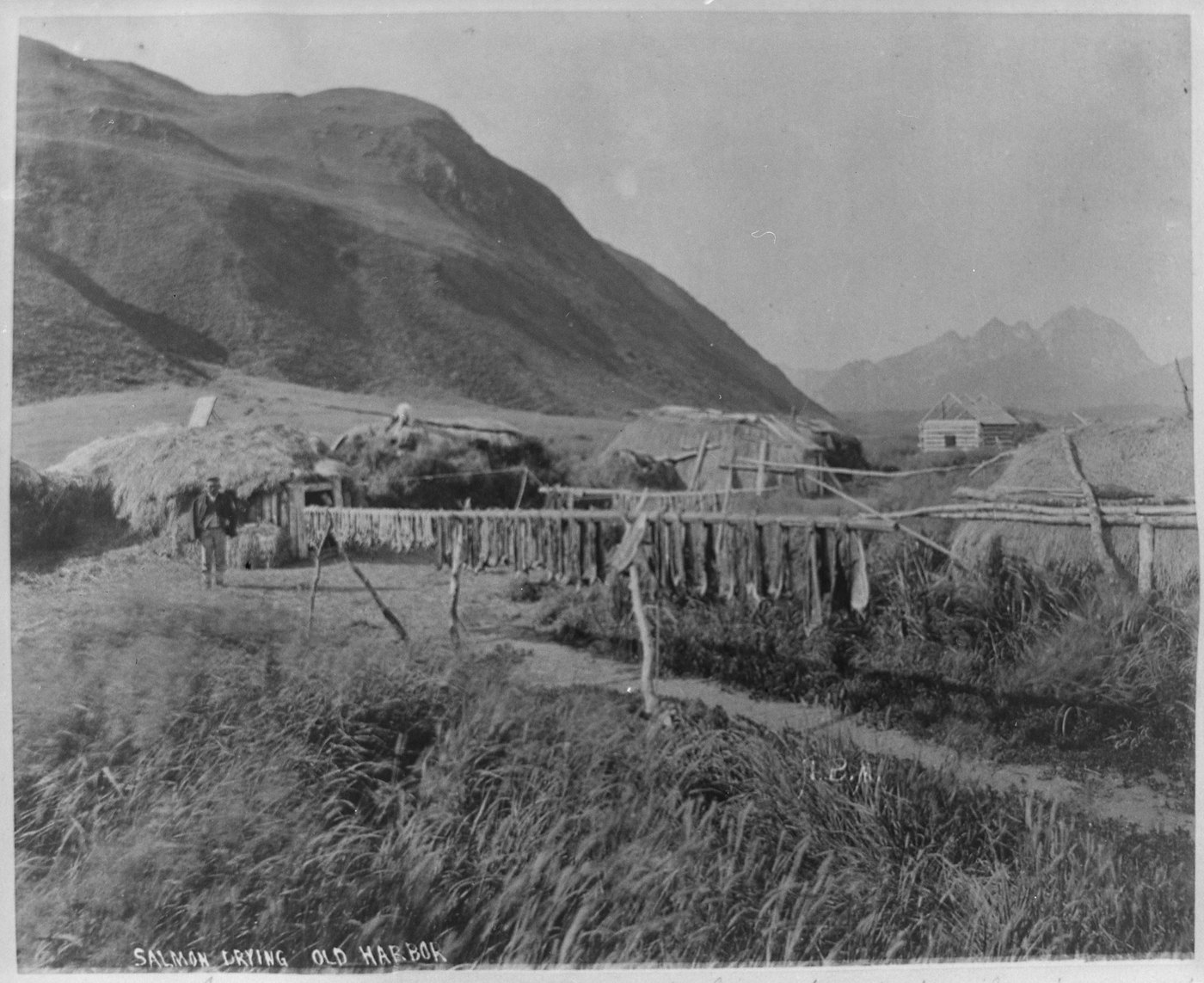
Salmon drying at Old Harbor, 1889Photograph by N. B. Miller, 1889. National Archives and Records Administration, NAID 513089, local identifier 22-FA-264.
Alutiiq/Sugpiaq histories connect distinct Gulf of Alaska communities. This collection brings Kodiak village, food, institutional and language sources together with historical research and a Chugach-region perspective.
See each region’s evidence for historical or present-day scope.
Homeland / region
Alaska / Gulf of Alaska
Research depth
Expanded profile
Source collection
14 annotated resources · 10 Indigenous-led
Inspected sources
10 substantive works · selected content reviewed
Initial adequacy
Adequate initial introduction
Source review
October 21, 2026
Names & relationshipsSugpiaq (entry 362) and Alutiiq overlap as community self-designations rather than representing two wholly separate peoples. Individual preferences vary. Unangax̂/Aleut is a distinct people and language despite colonial use of Aleut across regions.
An expanded introduction, with sources reviewed.This profile develops several themes through identified sources. Citations connect each section to its evidence; remaining gaps appear below. It has not been reviewed or endorsed by the community.
Adequate initial introduction
Ten substantive works or conservative collections support a useful educational introduction across identity, villages, foodways, institutions, language, colonial labor and cultural renewal. Naming and grammar lessons count once; Traditions excerpts count once; the museum history web text and related book excerpt are grouped pending fuller provenance review. Brief introductions and questionable dated web material do not fill the twelve-source target. The documented coverage supports continuing alphabetically, with regional and family-perspective gaps still open.
Assessment recorded October 21, 2026. This is separate from research completion and community review.
The twelve-source quantity target has not been reached. Conservative grouping is intentional, not a claim that every linked page is the same text.
Selected pages and institutional accounts do not establish current conditions, complete research or community endorsement.
Backdrop photographs & credits
These photographs have individual, documented connections to this entry. Their captions and source records define the people, place, object, and period shown; no one photograph represents every community within a broader label.
Salmon drying at Old Harbor, 1889 Photograph by N. B. Miller, 1889. National Archives and Records Administration, NAID 513089, local identifier 22-FA-264.
Historical food-preservation scene at Old Harbor (Nuniaq), an Alutiiq/Sugpiaq community on Kodiak Island. Placement is based on documented community/geography and locally explained naming history. It does not identify the ethnicity, name, status or descent of any person in the photograph, claim continuity of a pictured structure, or depict all Alutiiq communities. Old Harbor is an Alutiiq/Sugpiaq community. The archive preserves the historical label Aleut; Old Harbor Native Corporation explains that Alutiiq, Aleut and Sugpiaq are all names used locally. This image documents a historical place and activity, rather than identifying the individual pictured. Retain the archive's original Aleut wording as historical catalogue terminology. Do not describe the 1889 caption as necessarily an error, and do not reassign this Kodiak community image to the Unangan/Aleut profile solely from that term. The 3000x2449 Commons-hosted NARA reproduction was downloaded unchanged and visually inspected in the first pass. In this follow-up, NARA's own 552x440 reference image was downloaded unchanged and visually inspected; it shows the same scene and frame. The NARA item catalogue returned no readable body, so date/photographer/rights confirmation comes from the actual NARA curated page, item 62 and its introduction. Museum and community bodies were read for scope and naming evidence. No claim is made about the ethnicity of the distant person or details that cannot be read. No private or restricted material was accessed. Any subsequent CSS crop/overlay should be disclosed as presentation treatment. Web copies proportionally resized/recompressed without retouching; CSS crops and overlays are presentation only. Complete image displayed proportionally in the page banner.
Image, association, and reuse record reviewed 2026-10-25.
Full photographs are displayed proportionally above. A translucent background copy may be cropped by the viewport; it does not replace the complete image or its record.
The visual treatment does not change the research status, evidence, or remaining gaps recorded in this profile.
01
Community choices in naming
The museum explains that names vary with community preferences and colonial history. Kodiak leaders selected Alutiiq for their museum, while Sugpiaq is preferred by some people elsewhere. Such choices need local context; historical outsider use of Aleut does not make Alutiiq/Sugpiaq and Unangax̂ interchangeable.
Long coastal histories and archaeological interpretation
The museum describes Ocean Bay, Kachemak and Koniag traditions through changing coastal technologies, fishing and household cooperation. These labels organize archaeological evidence; they are not three successive modern tribes. Kodiak’s deep-history account should not be projected uniformly across the wider Sugpiaq homeland.
The museum’s village histories distinguish physical relocation from the end of a community. Afognak families moved after the 1964 earthquake and tsunamis, but the account describes continued visiting, harvesting and tribal culture camps. Kaguyak residents also resettled elsewhere after the disaster, often where relatives lived; the museum records continuing use of their homeland and a tribal council. These are specific Kodiak histories, rather than one settlement pattern that can be assigned to every Alutiiq community.
Tribal governments, Native corporations and nonprofit service organizations have different roles. The museum’s Kodiak examples distinguish self-government from shareholder relationships and regional services. One person can participate in several institutions; a corporate name therefore does not substitute for identifying a particular government or community.
Chugachmiut’s anniversary publication describes a tribal consortium serving communities that include Nanwalek and Port Graham. It distinguishes Sugpiaq from multicultural member tribes and connects locally directed services with self-determination. Reflections from community leaders explain why village representation matters in decisions about health, social services and cultural work. This account broadens an introduction grounded in Kodiak, while keeping the consortium, its member governments and their different identities distinct.
The museum’s 2013 cookbook presents foodways through named contributors rather than one standardized menu. Selected recipes combine harvested fish, berries and plants with ingredients used in contemporary households. Mary Haakanson’s first-fish soup and Patricia Mullan Kozak’s berry dish, for example, retain personal choices and family memories. The compilation offers evidence of living, varied food practices in a Kodiak publication; it should not be treated as proof that every Alutiiq family prepares or eats the same foods.
According to the museum’s account, the 1784 Russian assault at Awa’uq was part of securing Native labor for the fur trade. Violence, hostage-taking and forced work disrupted families. Numerical casualty estimates are not repeated here; the longer histories below can help readers investigate colonial change and its interpretations.
Archaeology of colonial labor and continuing knowledge
Margaris and colleagues interpret a Kodiak house and associated food remains as evidence of a seasonal Russian-American Company work camp in the 1830s. Cod fishing and trapping helped provision the colonial enterprise. Yet repaired imported ceramics, reworked glass and other evidence indicate continuing Alutiiq technical knowledge and some pursuit of residents' own subsistence needs. Their study shows how coercive work arrangements could coexist with practical choices; imported objects alone do not demonstrate cultural replacement.
Knowledge and unequal opportunity in the American era
Counceller’s selected American-era excerpt explains how Alutiiq bear guides contributed local knowledge and practical skills while facing unequal recognition and licensing arrangements. This is a dated historical interpretation of work and opportunity. The excerpt’s older hunting rules are not presented as current guidance.
In a 2006 account, museum practitioner Amy Steffian connects Kodiak heritage organizing with community archaeology, youth participation and public sharing of research. Programs preceded the museum building. Later, leaders debated how collaboration with outside institutions could serve Alutiiq priorities. The resulting emphasis placed Alutiiq people first while inviting wider education. This history makes cultural renewal a matter of community decisions, institutions and sustained work, rather than suggesting that archaeologists discovered a people who had disappeared.
The museum describes Alutiiq men developing early written records using Cyrillic and translating religious texts. Russian, Slavonic, Alutiiq and later English had different roles in community life. Its account also explains English-only schooling and the pressure it placed on family language transmission. Elder teachers subsequently contributed recordings, mentoring and new terms. This is a history of institutions and people making choices under changing conditions, without adopting the page’s undated speaker totals.
The Qik Committee approved its 2024–2029 plan for the Kodiak region in August 2024. It seeks stronger links with village and off-island learners, progression toward fluency, teacher preparation and sustainable resources. It also proposes a shared base for language learning. These goals show how the community organizes future work; proposed speaker numbers, funding arrangements and institutional changes must not be mistaken for demonstrated results.
The grammar lessons build words from stems and endings. Noun examples distinguish one, two and three-or-more; other endings express relationships or change word functions. Dictionary entries cannot simply be strung together as English words. These are learning aids; recognizing patterns is not the same as learning to speak with people.
The university introduction distinguishes Koniag and Chugach dialect geography across Kodiak, the Alaska Peninsula, Kenai and Prince William Sound. This helps place the Kodiak-centered museum materials within a wider Sugpiaq setting. It is a short orientation, rather than fresh evidence of current speakers, and does not make every regional community or government interchangeable.
Broaden direct family and community perspectives outside Kodiak, especially the Alaska Peninsula, Kenai and Prince William Sound; a regional consortium cannot represent every government or viewpoint.
Investigate provenance between the museum’s Our Stories web text and Imaken Ima’ut before treating them as separate works. Full book chapters and several important scholarly studies remain unread leads.
Review language-plan implementation and present community conditions separately before adding current speaker, population, fishery or regulatory claims.
Seek further oral-history and Indigenous scholarly perspectives on colonial change and continuing cultural life; interpretations of one archaeological site are not regional generalizations.
Historical photographs, recipes and cultural materials have their own rights and contexts. No cooking directions, sensitive places or imagery have been reused here. Community review remains open.
Fourteen cards represent ten conservatively counted substantive works/collections, plus brief supporting introductions and related excerpts outside additional counts. The Sun’aq page with template residue and dated rules is saved as limited evidence in research notes, not promoted to this reading path. The2024 language-plan date is approval, not a separately verified first-publication day. Goals are not outcomes. The2013 cookbook date comes from its imprint, not its 2024 upload path. No full-textbook, full-film, recording or whole-book review is claimed for links encountered in source bibliographies.
Follow the reading path
Sources & further reading
Open any title to read the original source. Annotations explain what each link can help you explore.
No Indigenous-led source is identified in this entry yet. This is a gap in this collection, and does not imply an absence of community knowledge or organization.
Indigenous-ledAlutiiq Museum and Archaeological RepositorySource 1Supporting reference · outside substantive inspected count
Brief introduction and navigation to deeper resources. Supports broad regional orientation; its embedded identity film was not watched. Excluded from the substantive count.
Inspection: Supporting or limited review; see scope
Scope: Read actual main introductory text and navigation, especially homeland paragraph at lines 50–64; no linked work or film review implied.
Museum deep-history text and a selected book excerpt are conservatively grouped. Their relationship needs fuller provenance review; separate authorship is not established.
Inspection: Content reviewed for the stated scope
Scope: Actual Deep History web body read. Linked five-page book excerpt also inspected within its separate scope; full book and films not reviewed.
Selected actual village histories distinguish settlement changes and continuing relationships with place. Count the village series once. Undated present-day population, fish-stock and service claims are not independently verified; photographs are not licensed for reuse here.
Inspection: Content reviewed for the stated scope
Scope: Read introduction and actual Afognak, Karluk, Kaguyak and Port Lions accounts, web lines 45–79, 146–178 and 214–219. Other village entries are not claimed as fully reviewed.
Publication: Undated lesson; file posted under September 2025; statistics dated September 2022
Selected institutional and conquest lessons count together as one Alutiiq Traditions collection. Statistics are dated; current law and every community’s experience are not established.
Inspection: Content reviewed for the stated scope
Scope: Institutional lesson p71 and linked conquest lesson p67 read. Selected excerpts from one book; full book and current institutional rules not inspected.
Review recorded: October 21, 2026
Inspected material and access routes
Awa’uq — Refuge Rock ↗ — One-page printed 67 excerpt; same book, not another substantive work.
Publication: 2024 commemorative publication; filename identifies revision June 25, 2024
A regional tribal consortium’s own commemorative publication includes named leaders’ reflections on representation and services. It explicitly distinguishes Sugpiaq and multicultural member tribes. This institutional retrospective is not an independent outcomes evaluation or a statement that all regional peoples are identical.
Inspection: Content reviewed for the stated scope
Scope: Read cover and printed pages 3,9–10; also selected timeline/service passages on printed pages 12–17,24. Visually checked printed pages 3,9–10 (PDF pages 5,11–12). No full28-page or QR-linked interview review.
This 2013 community recipe compilation credits individual contributors and museum collections. Selected entries show varied household approaches to harvested foods and help readers follow family foodways in their stated contexts.
Inspection: Content reviewed for the stated scope
Scope: Downloaded actual 72-page PDF; read cover/imprint, contents, printed pages 1–2, 7, 17, 32, 41, 53 and acknowledgements 64. Visually checked imprint and frontispiece iv; selected recipes were read as text.
Combines archaeological evidence and historical records to interpret a small seasonal company work camp. Its analysis distinguishes imposed labor from workers' continuing skills and choices. Conclusions are a site-specific interpretation, not proof of identical conditions in every Alutiiq community.
Inspection: Content reviewed for the stated scope
Scope: Selected actual article text: introduction and colonial-labor passages, printed pages 102–105; Discussion and Conclusions passages, pages 121–123. Oberlin metadata verified; full-text host identifies upload by Amy Margaris on August 10, 2015.
Review recorded: October 21, 2026
Inspected material and access routes
Author-uploaded reading copy ↗ — Actual selected article text: printed 102–105 and121–123. Access conditions may differ by reader.
American colonial era·Economic history·Knowledge·Bear guiding
Community-museum practitioner's historySmithsonian Institution, National Museum of the American Indian, in Living Homes for Cultural ExpressionSource 11
A substantial museum practitioner's account of community archaeology, heritage organizing and choices about public education. It records disagreements and an Alutiiq-first mission rather than presenting revival as an outside discovery. Program examples and institutional circumstances are dated to this 2006 chapter.
Inspection: Content reviewed for the stated scope
Scope: Selected actual chapter passages: opening pages 27–28; Programs Create the Museum, pages 32–33; A Philosophy for Programming, pages 34–35; and public-education examples, pages 36–37. Title/copyright pages checked. Not a full-volume review.
Museum account connects early Alutiiq writing, multilingual life, English-only schooling and Elder-led learning. Its undated current speaker totals and class schedules are not adopted. This is a Kodiak-focused introduction, not a survey of every Sugpiaq region.
Inspection: Content reviewed for the stated scope
Scope: Actual HTML Written Alutiiq, New Languages, Schools, Reawakening and Elder Teachers sections read. Images and recordings not reused or played; spiritual symbolism, archaeological locations and unverified current figures excluded.
Community-developed plan approved August 8,2024 sets goals for learners, teachers, partnerships, funding and a learning home base. Read it as a dated statement of intended work. Targets and proposed institutional changes are not verified outcomes.
Inspection: Content reviewed for the stated scope
Scope: All three actual PDF pages read: mission, vision, five overarching goals and approval footers. No subsequent annual-review documents, measured outcomes or implementation audit inspected.
Short university orientation distinguishes Koniag and Chugach dialect geography and points to literacy scholarship. Retained as supporting context; its undated population and speaker figures are not presented as current. Linked grammars and dictionaries require separate review.
Inspection: Supporting or limited review; see scope
Scope: Actual naming, dialect and literacy paragraphs read; no linked publication or audio reviewed. Short supporting introduction, outside substantive target.
Related entries may represent alternate names, constituent communities, wider groupings, or historical connections. Read the naming notes before treating entries as equivalent.
Robey’s Atlas of Indigenous North America · Compiled October 19, 2026 · Alutiiq