Also find this entry through: Unangax̂; Unangan / Unangas
Unangax̂ histories connect the Aleutian Islands and western Alaska Peninsula with the Pribilofs, urban Alaska and wider family networks. This reading collection brings community publications into conversation with university resources, survivor recollections, an official wartime investigation and original restitution legislation. It distinguishes regional institutions from individual tribal governments and historical evidence from current conditions.
See each region’s evidence for historical or present-day scope.
Homeland / region
Alaska / Aleutian Islands, western Alaska Peninsula and Pribilof communities
Research depth
Expanded profile
Source collection
15 annotated resources · 7 Indigenous-led
Inspected sources
13 substantive works · selected content reviewed
Initial adequacy
Adequate initial introduction
Source review
October 21, 2026
Names & relationshipsUnangax̂/Aleut and Alutiiq/Sugpiaq are distinct peoples and languages. Russian colonial use of Aleut for more than one people can obscure that distinction. Individual Unangax̂ tribes and regional organizations require separate identification.
An expanded introduction, with sources reviewed.This profile develops several themes through identified sources. Citations connect each section to its evidence; remaining gaps appear below. It has not been reviewed or endorsed by the community.
Adequate initial introduction
Thirteen substantive distinct works or bounded collections were inspected within stated scopes. Community history, two government examples, teaching programs, university language context, selected survivor memoir passages, a wartime investigation and original redress legislation support a useful educational introduction. A directory and archival finding aid remain outside the substantive target. Coverage is broad enough to continue alphabetically, while the gaps below remain open.
Assessment recorded October 21, 2026. This is separate from research completion and community review.
Selected excerpts do not establish full-work review or current conditions.
Many community viewpoints and specialist historical questions remain underrepresented.
Backdrop photographs & credits
These photographs have individual, documented connections to this entry. Their captions and source records define the people, place, object, and period shown; no one photograph represents every community within a broader label.
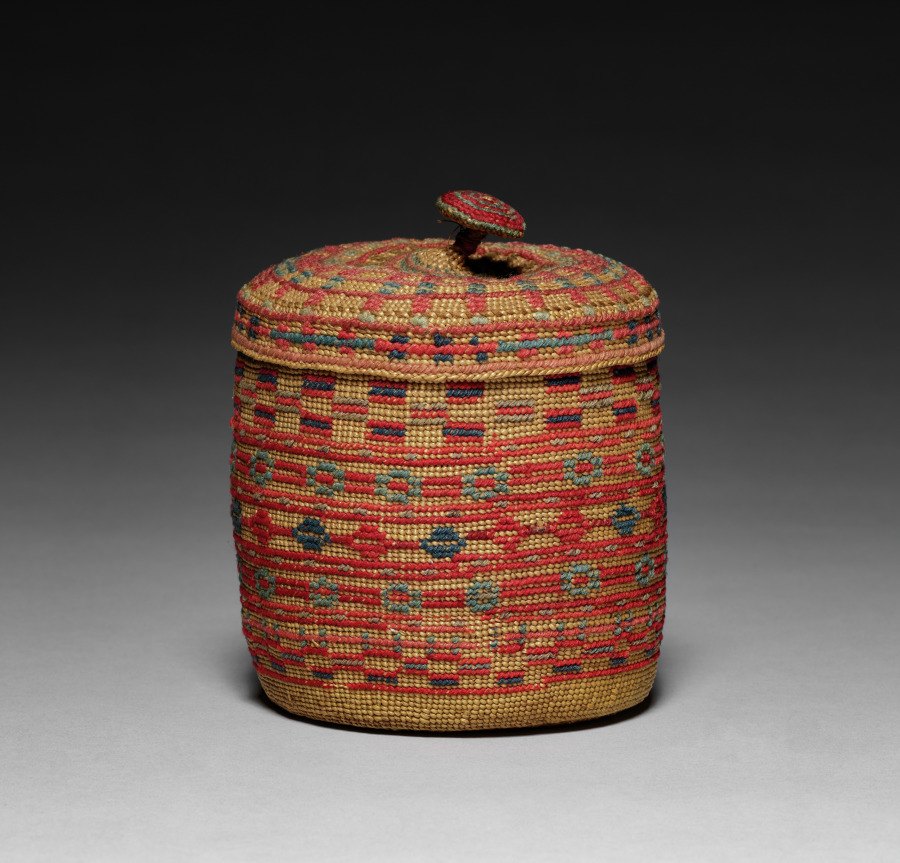
Covered Basket, Unangan (Aleut) Cleveland Museum of Art, presented by William Albert Price in memory of Mrs. William Albert Price, 1917.430
Museum catalogue culture: Arctic, Aleut, late 19th-early 20th century. Specific island/community and maker not identified; do not assign one. Actual museum item page, Open Access policy and official API fields read. Official 900x863 web photograph downloaded unchanged and visually inspected. Lid and body records are parts of the same basket, not separate works for counting purposes. Web copies proportionally resized/recompressed; display backgrounds may be cropped by CSS. Full image remains proportional in the page banner.
Image, association, and reuse record reviewed 2026-10-24.
Full photographs are displayed proportionally above. A translucent background copy may be cropped by the viewport; it does not replace the complete image or its record.
The visual treatment does not change the research status, evidence, or remaining gaps recorded in this profile.
01
Names, dialects and distinct neighboring peoples
Unangam Tunuu is the language name. The university introduction distinguishes Eastern and Western dialects and explains Unangan and Unangas as plural forms, alongside singular Unangax̂. Older Russian use of Aleut covered more than one Alaska Native people. Unangax̂ and Alutiiq/Sugpiaq should therefore remain distinct directory entries; a shared colonial label does not make their languages or governments interchangeable.
Homelands, colonial movement and distinct institutions
APIA’s historical synthesis places Unangax̂ homelands across the Aleutian chain, Shumagin Islands and western Alaska Peninsula. It describes Russian fur-trade coercion and the compelled movement of Aleutian villagers to the Pribilof Islands, where year-round settlements developed by the early nineteenth century. These colonial movements form part of community history rather than a single unchanging settlement pattern. The account also distinguishes the Aleut Corporation, a shareholder-owned regional business, from APIA, a nonprofit providing tribal services. Neither institution should be substituted for the governments of individual communities.
The NPS introduction describes ulax̂ houses built partly into the ground and seasonal camps supporting harvesting. Skin-covered iqyax̂ kayaks joined carefully fitted frames with waterproof sewing. Animal materials supplied food, clothing, tools and containers; grass weaving produced baskets. These are historical technologies requiring skill and environmental knowledge. The contemporary teaching accounts below help connect this material history with continuing cultural learning.
The Qawalangin constitution speaks for a particular Unangan government connected with Unalaska, Sedanka and Amaknak islands. Its preamble links self-government with collective cultural, social and economic wellbeing. The posted document provides for a seven-member elected council and protects civil rights, including a qualified right for members to review tribal records. Its certification records an adoption election on May 3, 1997. This is evidence of this government’s constitutional framework at adoption; it does not establish that all Unangax̂ communities share one constitution or that no amendments followed.
Qawalangin’s environmental program makes another part of self-government visible: maintaining an inventory, reviewing technical documents, seeking community input and coordinating assessment or cleanup. Its linked public record distinguishes proposed investigation from completed actions and identifies work that remains incomplete. These distinctions matter when learning about the continuing responsibilities created by contamination. The record supports an account of oversight and ongoing work; it is not a general assurance that a listed place is safe or unrestricted.
In its February 2023 newsletter, the Aleut Community of St. Paul Island connects economic resilience with the health of the surrounding sea. Leadership describes the crab-fishery crisis and efforts to diversify the island economy. Conservation staff report community engagement around the PRIME initiative and work on Indigenous monitoring, including attention to data sovereignty and intellectual-property rights. These are dated accounts of priorities and work underway, not confirmation that every proposed project was completed. The sanctuary nomination discussed there should not be described as an established marine sanctuary.
APIA describes its Anchorage culture camp as a gathering connecting participants from the islands, urban Alaska and farther afield. Learning involves different ages: Elders share memories and family connections, children rotate through activities, and older participants choose areas of interest. Activities offered over the years include sewing, basketry and boat-building. The page presents cultural learning as something communities continue to shape in an urban setting. Its historical list of activities should not be read as the schedule for any particular year.
The university traces writing and teaching materials through work involving Unangax̂ speakers, including William Dirks Sr. and Moses Dirks, alongside linguists. Its CoLang 2016 examples describe reuse of earlier learning materials. This introduction is a route into that history; the linked dictionaries, grammars and digital tools have not all been reviewed here.
APIA describes lesson creation, learning from speakers, intensives and oral proficiency assessment. Its 2019 grant sought a regional teacher-certification pilot; a target of additional teachers is not a measured outcome. Elders, speakers and community members selected through tribal councils advise regional language work. The page also describes Eastern and Atka classes, but its undated timetable is not presented here as a verified current schedule.
After the 1942 attacks, U.S. authorities removed villagers to Southeast Alaska. The NPS account documents makeshift camp buildings, unsafe water, inadequate care and deadly illness. It also describes evacuees finding work, repairing housing and establishing community facilities. These actions belong in the account alongside government neglect: displaced families continued organizing daily life under conditions they had not chosen.
The 1982 commission distinguished the Aleut evacuation from Japanese American exclusion: it considered removal from islands under attack a reasonable safety precaution. It nevertheless documented failures to plan, deplorable camps, looted homes and delayed return. Keeping those findings together explains how an evacuation prompted by a real attack became a history of preventable official harm.
Attu residents faced a separate ordeal: Japanese forces took them to Japan. In Attu Boy, Nick Golodoff recalls confinement, hunger and illness through a child's memories; his granddaughter and editor make their uncertainties visible. His return account describes being sent to Atka, where relatives provided housing. Survival and release therefore did not mean restoration of his former home on Attu.
Survivors and community members pressed for recognition by recounting traumatic experiences, documenting losses and taking their case to Washington. The NPS restitution account presents this as sustained Unangax̂ organizing. Its survivor perspectives also show why acknowledgment and funds could assist rebuilding without replacing lost relatives, homes or cultural belongings.
Public Law 100–383 acknowledged U.S. failures of care and property protection. Title II separated community losses from individual compensation for defined eligible persons. It addressed Attu land losses principally through compensation while also authorizing limited site conveyances. These historical provisions do not establish that every authorized action occurred or that Attu village was restored.
The university archive guide identifies linguistic and educational collections, including materials concerning the Commander Islands. Its finding aid can guide further investigation, but a collection description is not inspection of every item. Reproduction and use restrictions apply to some material; linked records and recordings need their own contextual review.
Extend community-specific coverage beyond the two government examples, including women, families and differing island perspectives; this introduction is not representative of every community.
Read stronger community and specialist evidence for early history, Russian-period change, and Commander Islands communities. The archive finding aid alone does not fill those gaps.
Verify contemporary language outcomes, constitutional amendments, fishery conditions and project status before adding present-day figures or advice.
Review additional camp-specific survivor accounts and the later implementation of redress; the selected memoir and report passages are not full-book reviews.
Seek community review; source quantity and introductory adequacy do not imply endorsement or completed research.
Renewals replace six older source cards; they are not additional works. The Qawalangin program and linked public record count as one collection. NPS update dates are not original publication dates. Inspection scope is visible on each reviewed source card. The 1988 law distinguishes forms of redress; its Attu provision includes a limited conveyance authorization. Statutory authorization does not prove implementation. No community review or research completion is claimed.
Follow the reading path
Sources & further reading
Open any title to read the original source. Annotations explain what each link can help you explore.
No Indigenous-led source is identified in this entry yet. This is a gap in this collection, and does not imply an absence of community knowledge or organization.
Indigenous-ledAleutian Pribilof Islands Association; Douglas W. VeltreSource 1
APIA publishes this substantial condensation by anthropologist Douglas W. Veltre. Selected sections explain homeland geography, colonial coercion, Pribilof settlement and institutional differences. Undated present-day statistics and broad biological or religious generalizations require separate verification.
Inspection: Content reviewed for the stated scope
Scope: Read Introduction/Population and Territory, Russian and American Periods, Pribilof Islands, and Unangax̂ Today. This is the web condensation, not inspection of a longer original work.
Illustrated historical introduction to houses, seasonal camps, maritime harvesting, kayaks and grass basketry. Pair its generalized descriptions with the named community programs below; they are not a statement that every family followed identical practices.
Inspection: Content reviewed for the stated scope
Scope: Actual HTML introduction, homes, hunting/gathering, transportation, tools and clothes sections read. Population-loss estimates, sensitive ritual detail and linked archaeological-site pages not used. A later automated follow-up timed out after the successful content read.
Community directory for navigating to individual tribal settings. This supporting listing is outside the substantive inspected count; linked community pages require their own review.
Inspection: Content review not recorded
Scope: Previously accessed directory retained as navigation; no new original-content check claimed in this batch.
Publication: Adoption election certified May 3, 1997
A government-authored constitutional document expresses collective purposes, council arrangements and rights. The final page certifies a May 3, 1997 adoption election. The posted copy does not establish whether every subsequent amendment is incorporated or current rules remain unchanged.
Inspection: Content reviewed for the stated scope
Scope: Downloaded the 11-page scanned PDF with valid TLS/HTTP 200; visually read pages 1–3 and 10–11. No claim of full-document review or legal currency.
Publication: Undated program; linked public record headed August 21, 2026
The program and linked public record show assessment, monitoring and proposed cleanup as continuing responsibilities. Treat them as one collection. The August 21, 2026 record header conflicts with an older 2024 footer; no general safety clearance or completed remediation is inferred.
Inspection: Content reviewed for the stated scope
Scope: Read the substantive program page and the linked two-page public record, including distinctions between recommended, completed and incomplete work. Site coordinates and archaeological locations are not reproduced.
The February 2023 issue supplies leadership and conservation-office perspectives on the 2022 crisis and proposed responses. It is one community-government publication, not evidence of universal agreement, realized project outcomes or present fishery conditions.
Inspection: Content reviewed for the stated scope
Scope: Downloaded HTTP 200, 6,645,280 bytes, 11 PDF spreads. Read cover and printed pages 2–5, 14–17 in extracted text; visually checked pages 2–3 and 14–15. Synthesis uses pages 2–3 and 15–16.
Publication: Undated program page; contains inconsistent year references
A substantive program account describes participation, mentoring and activities offered across different years. Its conflicting 2026/2027 scheduling sentence is excluded. Listed activities do not establish an identical annual curriculum, attendance or measured outcomes.
Inspection: Content reviewed for the stated scope
Scope: Read the program description and age-group participation sections, web lines 129–205. Embedded videos, mentor biographies and linked media were not reviewed.
University introduction to names, dialects and collaborative literacy work, followed by descriptions of CoLang 2016 learning projects. Its undated population and speaker estimates are not adopted as current figures. Linked courses, books and recordings need their own inspection.
Inspection: Content reviewed for the stated scope
Scope: Actual language, literacy and CoLang 2016 project descriptions read. Bibliography links observed; full dictionary, grammar, audio and external learning tools not inspected.
Community account of teacher preparation, dialect learning and advisory roles. The 2019 grant states objectives, rather than verified results; a photograph identifies a 2025 intensive. Read for program design, with schedules and outcomes requiring separate confirmation.
Inspection: Content reviewed for the stated scope
Scope: Actual HTML body: 2019 grant, certification activities, community classes, partners and advisory committee; roster explicitly dated 2019. No classes attended, linked recordings played or teaching outcomes independently evaluated.
Illustrated account of U.S. removal, inadequate Southeast Alaska camps and evacuees' work rebuilding daily life. Includes attributed survivor excerpts. Read it alongside the commission report for the different rationales of wartime evacuation and prolonged confinement.
Inspection: Content reviewed for the stated scope
Scope: Main narrative, photograph captions and attributed testimony above Learn more; update metadata. Opening paragraphs through the community rebuilding/elections discussion. No linked audio, film or camp-specific articles inspected; approximate duration and totals not reused.
Official 1982 investigation distinguishes evacuation under attack from failures of planning, camp administration and return. Selected opening and concluding pages inspected, rather than the entire report. Read its dated cultural-loss framing alongside contemporary community accounts.
Inspection: Content reviewed for the stated scope
Scope: Printed pp. 317–323 and 358–359; PDF pages 2–8 and 43–44. Opening policy distinction, agency responsibilities, and Effects of Evacuation conclusion. No whole-report reading claim; dated totals and predictions of cultural disappearance not adopted.
Indigenous-authored memoirNational Park Service, Aleutian World War II National Historic Area, in cooperation with the Aleutian Pribilof Heritage GroupSource 12
Golodoff's childhood recollections are presented with other Attuan accounts and Mason's commentary. Maly explains the uncertainties of early memory. Selected passages on captivity and resettlement provide a personal perspective without treating one narrator as every survivor.
Inspection: Content reviewed for the stated scope
Scope: Title/edition; Maly pp. vi–vii; Mason pp. viii–x; Golodoff pp. 67–72 and 91–96. PDF pages 2–3, 8–12, 81–86 and 105–110. Selected memoir passages, not whole book. Archaeological/sensitive ritual detail and personal kinship charts not used.
Explains survivors' testimony, advocacy and the limits of financial redress, with excerpts attributed to Flore Lekanof and Alice Snigaroff Petrivelli. Its legal summary should be checked against the original statute.
Inspection: Content reviewed for the stated scope
Scope: Seek Justice, Act of 1988, both legal-summary panels, Legacy of Injustice, credits and date. Headings and expanded text of the accessible HTML. Original film not viewed. Title I's Japanese American apology is not automatically an identical Aleut provision.
Original law enacted August 10, 1988. Distinguishes congressional findings, defined individual eligibility, community-loss compensation and Attu land restitution. This historical enactment is more precise than a general account of compensation.
Inspection: Content reviewed for the stated scope
Scope: Selected original enactment: §1(5), §2(b), Title II §§201–207, 102 Stat. 903–904 and 911–916. Independent reviewer also read the §207(e) continuation. Historical authorization, not proof of payment or conveyance; no current-law or eligibility advice.
Finding aid describes historical word lists, manuscripts, educational materials and dialect organization. It helps readers locate future research and notes reproduction restrictions; it does not substitute for reading the individual works or listening to recordings.
Inspection: Supporting or limited review; see scope
Scope: Collection abstract, language information, scope and content notes inspected; no individual archival item inspected through this guide. Supporting reference, outside substantive count.
Related entries may represent alternate names, constituent communities, wider groupings, or historical connections. Read the naming notes before treating entries as equivalent.
Robey’s Atlas of Indigenous North America · Compiled October 19, 2026 · Aleut (Unangax̂)