People / language / distinct community governments
Alabama
Explore Alabama history, language and continuing community life through annotated sources. This introduction follows southeastern connections, Texas and Oklahoma settings, original government documents and community language work, with remaining gaps kept visible.
See each region’s evidence for historical or present-day scope.
Homeland / region
Southeast / Alabama River; Louisiana migration; Texas and Oklahoma communities
Research depth
Expanded profile
Source collection
16 annotated resources · 7 Indigenous-led
Inspected sources
15 substantive works · selected content reviewed
Initial adequacy
Adequate initial introduction
Source review
October 21, 2026
Names & relationshipsAlabama is a people and language entry. The Alabama-Coushatta Tribe of Texas and Alabama-Quassarte Tribal Town in Oklahoma are distinct governments. Coushatta/Quassarte is closely related to Alabama rather than simply an alternate name; shared institutions and Muscogee relationships need their own historical context.
An expanded introduction, with sources reviewed.This profile develops several themes through identified sources. Citations connect each section to its evidence; remaining gaps appear below. It has not been reviewed or endorsed by the community.
Adequate initial introduction
Fifteen substantive inspected works provide an educational starting point across southeastern and westward history, distinct Texas and Oklahoma governments, original constitutional/federal documents, a named educator, community language work, an attributed student account and everyday planning. One brief language orientation is supporting only. The judgment concerns initial coverage within disclosed scopes, not comprehensive research, current legal status in every detail or community endorsement.
Assessment recorded October 21, 2026. This is separate from research completion and community review.
Earlier records, migration/land instruments and conflicting Oklahoma chronology need closer comparison.
Broader community voices, present learning outcomes and later government/planning implementation remain open.
Backdrop photographs & credits
These photographs have individual, documented connections to this entry. Their captions and source records define the people, place, object, and period shown; no one photograph represents every community within a broader label.
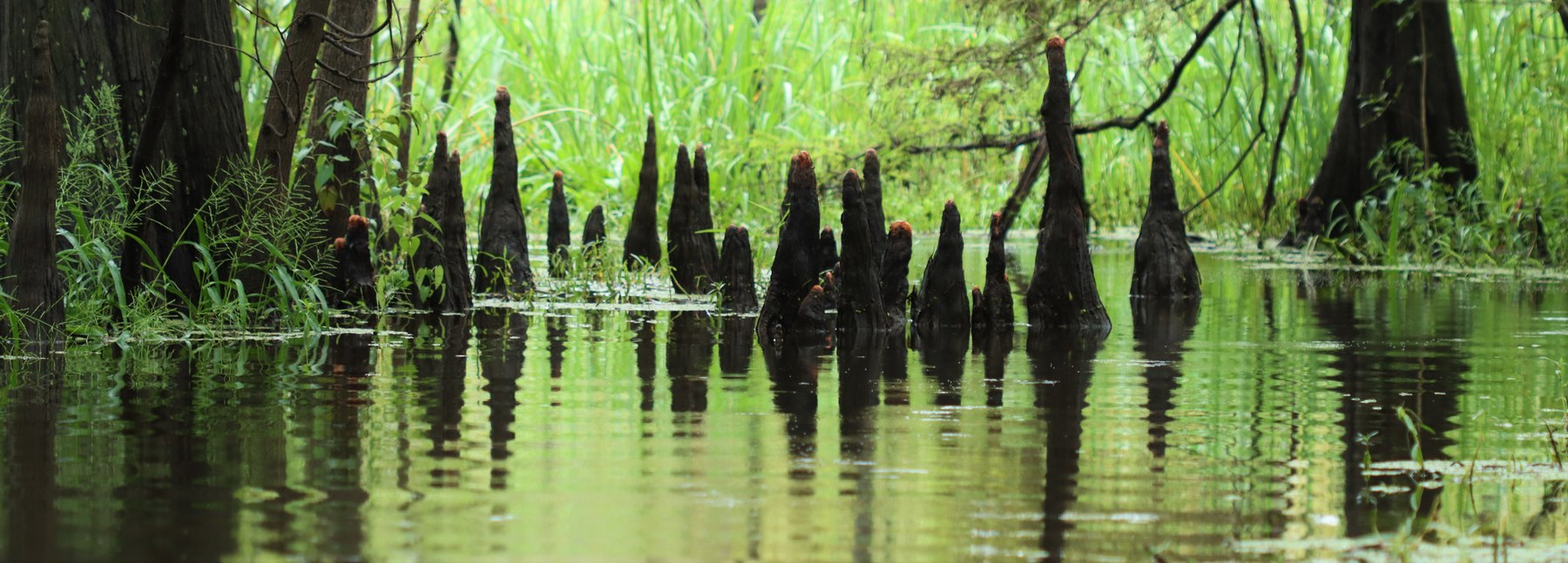
Cypress knees in Big Thicket National Preserve, Texas NPS Photo / Scott Sharaga. Big Thicket National Preserve, U.S. National Park Service.
Modern Big Thicket landscape, credited on the actual NPS page as NPS Photo / Scott Sharaga. The Tribe’s own history locates the Alabama-Coushatta Tribe of Texas in this region, while distinguishing the two peoples before their westward migration. The image illustrates regional environmental context; it does not show a reservation boundary, an identified cultural site, or every Alabama community. The NPS ownership policy identifies agency-created material as generally public domain unless otherwise indicated; this image has an explicit agency credit and no contrary notice. The complete 6960×2499 available source frame was visually inspected. Its primary JPEG frame is proportionally resized/recompressed to 1800×646; no content is generated, retouched or added. Cards and background copies use CSS crops/overlays. No source-count increase is claimed.
Image, association, and reuse record reviewed 2026-10-25.
Full photographs are displayed proportionally above. A translucent background copy may be cropped by the viewport; it does not replace the complete image or its record.
The visual treatment does not change the research status, evidence, or remaining gaps recorded in this profile.
Start reading here
Alabama names a people and language; the Texas Alabama-Coushatta government and Oklahoma Alabama-Quassarte Tribal Town are distinct, and Coushatta is closely related rather than an alternate Alabama name. Public accounts and a sampled language collection do not establish current rules, speaker totals or every family’s experience.
Silva’s attributed family and research experiences give the language work a particular personal perspective.
These are selected starting points. The full annotated collection, source perspectives, inspection limits and remaining research questions follow below. A starting guide is not an exhaustive history or community endorsement.
01
A people and language, with several community settings
Alabama is a people and language name, distinct from the modern state’s broader Indigenous population. Closely related Coushatta/Quassarte communities share parts of this history. The reading below follows Texas and Oklahoma settings separately.
Southeastern towns and different westward journeys
John H. Moore’s historical reference follows Alabama and Quassarte towns along the Alabama River into French trade relationships and the Creek Confederacy. It describes westward movement in separate groups, including settlements in central Louisiana and Texas, while people who remained with the Creeks underwent forced removal to Indian Territory. These were different community histories, rather than one journey followed by everyone.
The Tribe's public history places Alabama and Coushatta origins in neighboring areas of what is now Alabama, followed by westward movement into Texas. It connects the Texas community's history with alliances, assistance to refugees during the 1836 conflict and the restoration of federal recognition in 1987. This is the Tribe's concise account of its past. Its references to promised or recognized lands should be read alongside the underlying agreements, rather than converted into a present property map.
Howard Martin’s Handbook history describes Alabama settlements along waterways including the Angelina and Neches rivers. Peach Tree, Fenced-In and Cane Island appear as distinct villages connected through trails. The account links hunting, cultivation and travel to the Big Thicket landscape, then follows settler pressure and land disputes. Read its route descriptions as a historian’s reconstruction, with particular family movements still requiring closer archival comparison.
Chief History separately presents leaders of Alabama villages, Coushatta villages and the later Alabama-Coushatta community. That structure preserves distinctions within a connected history. Its biographies describe Colabe's multilingual interpreting and John Scott's role as a school trustee, linking leadership with diplomacy and education. The introductory settlement account explains how sharing the Polk County reservation encouraged the joint Texas name. It should not be stretched into a claim that all Alabama or Coushatta people everywhere became one government.
The 1954 federal act authorized conveyance of tribal land to Texas to hold in trust. It tied termination of the federal trust relationship to conveyance and a subsequent proclamation, and withdrew status-based federal Indian services while retaining specified school and hospital eligibility. This legislation changed federal administration and obligations. The enactment and its later implementation should be distinguished: the proclamation has not been inspected for this introduction.
Title II of the act approved August 18, 1987 restored federal recognition and the trust relationship for the Alabama and Coushatta Indian Tribes of Texas. It treated the two as one tribal unit for federal-law purposes and addressed the council’s powers, constitution and reservation. The act’s separate title for Ysleta del Sur Pueblo should not be applied to Alabama-Coushatta. This primary document explains an important historical change; later legal developments need their own sources.
Constitutional government and cultural responsibilities
The July 2023 constitutional consolidation records an original adoption in 1971 and later amendments. It names the Alabama-Coushatta Tribe of Texas as the joint legal and governmental unit, then distinguishes chiefs, a seven-member council, administration and courts. Chiefs have cultural, historical and advisory responsibilities; council members serve staggered three-year terms under that text. Its preamble connects self-government with education, language, arts and cultural preservation. These provisions belong to the Texas government's constitutional history.
An undated community account distinguishes Alabama and Quassarte towns while describing their Muscogee relationships. It presents southwestern migration and removal to Indian Territory as different historical paths, and describes traditional government continuing through federal changes. Read this as a particular Oklahoma community's interpretation, alongside primary records. Its account does not make the Oklahoma and Texas governments interchangeable; claims about present membership or administration require separately dated evidence.
The 1939 government printing identifies Alabama and Quassarte No. 1 as former towns within Alabama-Quassarte Tribal Town. Its purposes include land, economic cooperation, health, welfare and continuing traditions. The Interior approval block is dated November 17, 1938; certification separately records ratification on January 10, 1939. Article IX protects existing rights as citizens of the Creek Nation. These are historical provisions, not an independent statement of present citizenship, leadership or governing law.
The Tribal Council's 2023 tribute describes Millie Ann Thompson Williams as the first woman elected to a chief position for the Alabama-Coushatta Tribe. It connects her leadership with many years of Head Start teaching and identifies her as an Alabama-language teacher and preservation consultant. This public remembrance makes a named educator's contribution visible alongside formal government history. Her biography connects community education with formal political leadership.
Alabama belongs to the Muskogean family and is closely related to Koasati, also called Coushatta. Their relationship should be kept distinct from the shared name of the Texas tribal government. A resource for one language is not automatically a description of the other.
Cora Sylestine’s educator-led dictionary work underlies a continuing learning collection. The 1993 preface credits her initiative and later collaboration with Heather K. Hardy and Timothy Montler. The current Alabama Dictionary Online adds grammatical explanations and teaching materials through a Texas tribal–WOLF Lab partnership. Its June 2025 verb handout moves from introductions to changing verb forms and partner exercises; the noun guide explains how endings mark a noun’s role. The project says speakers approve public recordings and collected material is owned by and shared with the tribe. The lessons make vocabulary and grammatical relationships accessible through a community collaboration.
In a 2024 interview, Ava Silva connects Alabama learning with listening to her grandmother and with the older generation’s painful experiences of punishment at school. Rojas’s article identifies Silva as the project’s community coordinator and a participant in research on verb conjugations. It also describes recordings shared with the community and findings presented to the tribal council. This attributed account helps readers understand the family and community relationships within documentation, while Silva’s experience should not be generalized to every Alabama family.
Fernandes and Silva’s January 2026 conference presentation examines how Alabama changes verbs to identify participants in an action. They compare earlier placement rules with additional examples and propose that different stages of word formation help explain why agreement markers appear in different positions. Worked derivations and an unresolved question about negation make the talk a substantial research resource. Readers should distinguish the authors’ proposed analysis from established consensus; the presentation offers neither a complete grammar nor a guide to every speaker’s usage.
Harvard’s September 2026 report describes three June community workshops, including pronunciation, greetings, possession and verb grammar. It also reports weekly online instruction and tribal approval of one paid hour a week for employees to attend. These are concrete, dated actions supporting access to learning. The report does not measure proficiency gains or establish that everyone participates; its value lies in documenting how a particular collaboration was being organized in 2026.
The Tribe's April 2025 transportation plan connects infrastructure with the daily needs of residents and visitors. It describes drainage and road-surface problems, coordinating health, education, emergency and transportation departments with external partners. Its strategies include further investigation, seeking funds and developing longer-lasting maintenance solutions. This is a practical example of government planning for community life. The published final draft records goals and a schedule; it does not independently establish that every project was adopted, funded or completed.
Compare early southeastern history, separate family migrations and East Texas land negotiations with original records and specialist scholarship. Compressed accounts and Martin’s related publications are not independent corroborations; the 1836/1839 instruments and the 1954 implementation proclamation remain to inspect.
Resolve what separate event or instrument may explain the Oklahoma community history’s April 1939 statement. The historical constitution records Interior approval in November 1938 and ratification in January 1939; these dates are kept distinct.
Review later constitutional amendments, ordinances and implementation before describing present governing or citizenship rules. No current officeholders, enrollment totals, territorial boundary or individual legal rights are determined here.
Expand community voices and publicly shared cultural life, including artists, foodways, land use, families and Oklahoma perspectives. A named educator and one student interview are valuable particular accounts, not a complete account of everyone’s experience. Community review has not been recorded.
Establish current teaching access, learner experiences and outcomes through suitable community evidence. No speaker census or independent pronunciation/audio evaluation is supplied; older language studies remain further-reading leads where full content access was limited.
Follow the 2025 transportation final draft through adoption, funding and implementation records. Its schedule and goals are not completed improvements or current verified safety rates.
Recheck current website editorial provenance and dated institutional information. The earlier aqtt.org page is excluded as current community authority pending verification; this does not establish fraud, compromise or a reconstruction. Linked institutional records support the replacement historical publication’s attribution, not the currency of every assertion.
Confirm rights and appropriate community context before later image reuse or mapping. Broad state associations are evidence notes, not homeland polygons, sensitive-site locations or an exhaustive regional directory.
Fifteen substantive works and one short supporting relationship reference were inspected within recorded scopes on October 21, 2026. The supporting card is excluded from the substantive count. Dictionary/web/lesson manifestations count as one continuing collection; the related grammar manuscript and conference presentation are not counted twice. Long documents retain actual selected-page ranges. No complete dictionary-book, recording, private-session or community review is implied. Bibliographic correction: the 1993 dictionary credits Timothy Montler, despite a different first name on the live project About page. Oklahoma constitution approval and ratification are distinct from the later April 1939 narrative. The Texas 1971 adoption, July 2023 consolidation and 1987 federal restoration concern different events. Proposals, dated reports and provisional grammar analysis retain their limits.
Follow the reading path
Sources & further reading
Open any title to read the original source. Annotations explain what each link can help you explore.
No Indigenous-led source is identified in this entry yet. This is a gap in this collection, and does not imply an absence of community knowledge or organization.
Indigenous-ledAlabama-Coushatta Tribe of TexasSource 1
The Tribe's account of origins, Texas alliances and restoration. A concise institutional synthesis whose treaty/title statements require comparison with actual instruments. Undated population, acreage and officeholders are not adopted as current. The footer is not a publication date.
Inspection: Content reviewed for the stated scope
Scope: Full substantive introduction, Origins, The Tribe's Triumph in Texas History, and Timeline.
Biographical sequence based on the 2014 Tribal Chief Inauguration Program, with later web additions. Distinguishes Alabama, Coushatta and joint chiefs. Some dates conflict internally or with other Tribe pages. Do not infer current officeholders or linguistic classification from this overview.
Inspection: Content reviewed for the stated scope
Scope: Introductory attribution and all three chief groupings, Antone through Millie Thompson Williams.
A focused historical reference on related towns, westward movements and Creek relationships. Its compressed account of the 1936 legislation should be read alongside the original constitution’s separate approval and ratification dates. Not a current citizenship or population source.
Undated community historical account read in full through the web research tool. The domain has an independent Oklahoma government directory cross-link. Retain its community perspective while comparing chronology with primary records. Undated enrollment and current-rule assertions are not adopted; its April 1939 claim differs from the constitution's approval and ratification dates.
Inspection: Content reviewed for the stated scope
Scope: Complete substantive About Us text, web lines 50–59, plus identifying contact/footer context; not the separate generic History stub.
Review recorded: October 21, 2026
Access note: Actual page text was read through the web research tool. Normal Python requests failed certificate verification; no TLS bypass was used. Institutional provenance supports this publication's attribution, not a claim that all website information is current.
One continuing collection, combining the 1993 dictionary with later collaborative lessons. Inspected real grammar and exercises, not just its introduction. Speaker approval and tribal ownership describe the project’s collected materials; they do not establish unrestricted reuse of every book or recording. The website misnames Montler; the book credits Timothy Montler.
Inspection: Content reviewed for the stated scope
Scope: About; Basic Noun Grammar; selected Agent Conjugation sections; June 2025 verb handout pp.1–11; five everyday dictionary entries. Original preface opening p.ix read in publisher-indexed text; not the complete 1993 book.
Public dictionary data ↗ — Five ordinary entries retained: oki, naaɬiilka, bitli, Albaamo, ifa. Audio references checked as metadata, not played.
Dictionary preface ↗ — Opening p.ix rendered in indexed publisher result; direct PDF failed. Project-origin and collaboration paragraphs, not whole two-page preface.
Dated original program account describing June 2026 research, three workshops, weekly community instruction and approved paid employee learning time. Useful for specific institutional actions; it provides no independent outcomes evaluation, complete speaker count or guarantee that arrangements remain unchanged.
Inspection: Content reviewed for the stated scope
Scope: Complete Summer Research With the WOLF Lab report and image captions; June activities and weekly-session paragraph. Dated 2026-09-08. Read through live research tool; separate scratch fetch returned 403.
Primary constitutional text with amendment history and preservation responsibilities. July 2023 is the consolidation date, not original adoption. This does not establish the absence of later amendments. Territorial provisions are not a property map or a case-specific jurisdictional assessment.
Inspection: Content reviewed for the stated scope
Scope: Cover; pp. 3–4, 7–12, 18–19: preamble, territory/name, organization, chiefs, council, powers, administration and courts. Printed and PDF page numbers coincide.
Council tribute documenting Millie Ann Thompson Williams's teaching, Head Start service and Alabama-language preservation alongside her historic election. Community-authored biography, not a complete autobiography or present programme evaluation. Family, medical and religious details are not reproduced.
Inspection: Content reviewed for the stated scope
Scope: Full dated tribute, especially the Head Start paragraph and Alabama-language teaching/preservation paragraph. Photograph not republished.
Tribe-published planning work dated April 2025 and posted November 2025 as a final draft. Connects maintenance, service access and funding. Goals and scheduled milestones do not establish completed construction or independently verified adoption. Inconsistent numerical rates are not repeated.
Inspection: Content reviewed for the stated scope
Scope: Cover; printed pp. 2–8, 10–16 (PDF 3–9, 11–17): context, summary, goals, partners, process, data limitations and strategies. Map on p. 9 not interpreted.
Complete seven-page 1939 printing inspected. Separates Interior approval on November 17, 1938 from ratification on January 10, 1939. Historical evidence of town organization and constitutional purposes; no amendments, present officeholders or current citizenship rules were verified. The alternate university scan is the same work, not another source.
Inspection: Content reviewed for the stated scope
Scope: PDF pp. 1–7; printed pp. 1–5 are PDF pp. 3–7. Read all articles, bylaws, approval and certification. University mirror cross-checked for the two dates.
Review recorded: October 21, 2026
Access note: GovInfo PDF returned HTTP 200 through a normal verified-TLS request and was read in memory. Web-tool access was intermittently successful. No access control or certificate check was bypassed.
Substantive coauthored conference presentation with data, derivations, an alternative analysis of agreement, and acknowledged open questions. It is provisional scholarship, not a peer-reviewed consensus or a complete grammar. A related 2024 manuscript and this talk count as one work.
Inspection: Content reviewed for the stated scope
Scope: PDF1–27: title, background, paradigms, critique, staged derivations, speaker acknowledgments and open questions; 29-page file, final two bibliography slides not used. No speaker estimate or 2023 project-start claim adopted.
Original reported interview foregrounding Silva’s family experience, community-coordination role and participation in grammatical research. Her accounts are attributed personal and community testimony. The 2024 project description is not a present population survey or proof of the same experience in every family.
Inspection: Content reviewed for the stated scope
Scope: Complete article body, from Silva’s family recollections through council presentation and future plans; captions checked, images not reused. No audio interview or independent assessment of fluency.
Language·Community voices·Education·Contemporary life
Museum / archiveSam Noble Oklahoma Museum of Natural History, University of OklahomaSource 13Supporting reference · outside substantive inspected count
Short specialist orientation distinguishing Alabama from closely related Koasati/Coushatta and other Muskogean languages. Its bibliography and archival references are discovery aids, not evidence that those works were read. Excluded from the substantive inspected-source count.
Inspection: Supporting or limited review; see scope
Scope: Introductory relationship paragraph, selected bibliography and archival list. No listed manuscript consulted through this page; publication date unestablished.
Publication: 1976; page metadata updated September 29, 2020
Detailed historical synthesis connecting migration, East Texas settlements, land pressures and institutions. Its sweeping cultural generalizations, assimilation framing and dated figures are not adopted here. Martin also wrote the tribe-hosted chief history: overlap is not independent corroboration.
Inspection: Content reviewed for the stated scope
Scope: Substantive article and bibliography, especially migration, village networks and land-policy passages; no current demographic or officer claims adopted.
Original enactment, not a statement of present law. Sections link land conveyance, a later proclamation and withdrawal of federal supervision/services, with specified exceptions. Read with the 1987 restoration act. The neighboring Public Law 628 concerns a different subject.
Inspection: Content reviewed for the stated scope
Scope: 68 Stat.768–769, complete chapter831, sections1–8 and approval date; two-page PDF also contains parts of unrelated laws, excluded from synthesis. Actual PDF text inspected; no implementation proclamation inspected.
Original act’s Alabama-Coushatta title restores federal recognition and the trust relationship and addresses government and reservation matters. Title I concerns a different nation. This historical reading does not determine later amendments, litigation, present gaming rules or individual rights.
Inspection: Content reviewed for the stated scope
Scope: TitleII, sections201–207 and approval date, 101 Stat.669–672 (PDF4–7); actual PDF text inspected. TitleI is not used as Alabama-Coushatta evidence.
These collections preserve links from supplied studies and further research leads. The collection notes explain their provenance and review status. Links already used above point to their source cards. Supporting references and unread leads are excluded from the substantive inspected-source count.
Alabama — further language scholarship · 4 links
Research lead found during the renewed review, not an owner-supplied DOCX URL.
Abstract and author-upload notice only. Author PDF opened as a 20-page file without extracted text; screenshots timed out and ordinary download returned 403. Article not inspected. Full-work content review is pending; not counted as a substantive inspected work.
Publisher-indexed title and first-page text; direct PDF 403. Detailed older analysis not adopted second-hand. Full-work content review is pending; not counted as a substantive inspected work.
Related entries may represent alternate names, constituent communities, wider groupings, or historical connections. Read the naming notes before treating entries as equivalent.
Robey’s Atlas of Indigenous North America · Compiled October 19, 2026 · Alabama