Coushatta histories connect distinct communities in Texas, Louisiana and Oklahoma. This reading path distinguishes the peoples and their governments while introducing community history, archives and public language work.
See each region’s evidence for historical or present-day scope.
Homeland / region
Southeast / Louisiana / Texas
Research depth
Expanded profile
Source collection
16 annotated resources · 9 Indigenous-led
Inspected sources
14 substantive works · selected content reviewed
Initial adequacy
Adequate initial introduction
Source review
October 27, 2026
Names & relationshipsSome sources use “Koasati” for the language associated with Coushatta communities; here, “Coushatta” names the people/community collection and “Koasati” primarily names the language. Neither label is a synonym for Alabama. The Coushatta Tribe of Louisiana, Alabama-Coushatta Tribe of Texas and Alabama-Quassarte Tribal Town in Oklahoma are distinct governments and communities. Their connections do not make every family’s route, language use or political history identical. A joint Texas government is not evidence that Alabama and Coushatta were originally one people. The 1987 federal act and the Texas Tribe’s constitution describe one joint legal/governmental status for the Alabama-Coushatta Tribe of Texas while also recognizing that Alabama and Coushatta were formerly distinct peoples; this legal arrangement does not make the three present governments interchangeable.
An expanded introduction, with sources reviewed.This profile develops several themes through identified sources. Citations connect each section to its evidence; remaining gaps appear below. It has not been reviewed or endorsed by the community.
Adequate initial introduction
Thirteen substantive inspected works now include distinct Texas, Louisiana and Oklahoma community perspectives; community historical and language materials; the Louisiana Tribe’s public Koasati digital dictionary; federal legal texts; and dated scholarship. Together they support a bounded educational introduction while keeping the Texas, Louisiana and Oklahoma governments distinct. The language dictionary was sampled through four entries, and the source count does not establish completion, exhaustive coverage, endorsement or current legal advice.
Assessment recorded October 23, 2026. This is separate from research completion and community review.
The Texas statute’s contemplated proclamation and its implementation record were not inspected; later legal interpretation remains outside scope.
The treaty is an edited transcription; manuscript, ratification record and Indigenous responses were not examined here.
The 1932 secondary article is dated and draws on older terminology and sources; further Coushatta-authored history and direct archival research would improve the account.
The digital dictionary was sampled through four entries; full vocabulary coverage, grammar, additional teaching materials and present-day language context remain open.
Current community conditions and each Texas, Louisiana and Oklahoma government’s own contemporary publications require further review; no present census or language-use estimate is claimed.
No community review or endorsement has been recorded.
Backdrop photographs & credits
These photographs have individual, documented connections to this entry. Their captions and source records define the people, place, object, and period shown; no one photograph represents every community within a broader label.
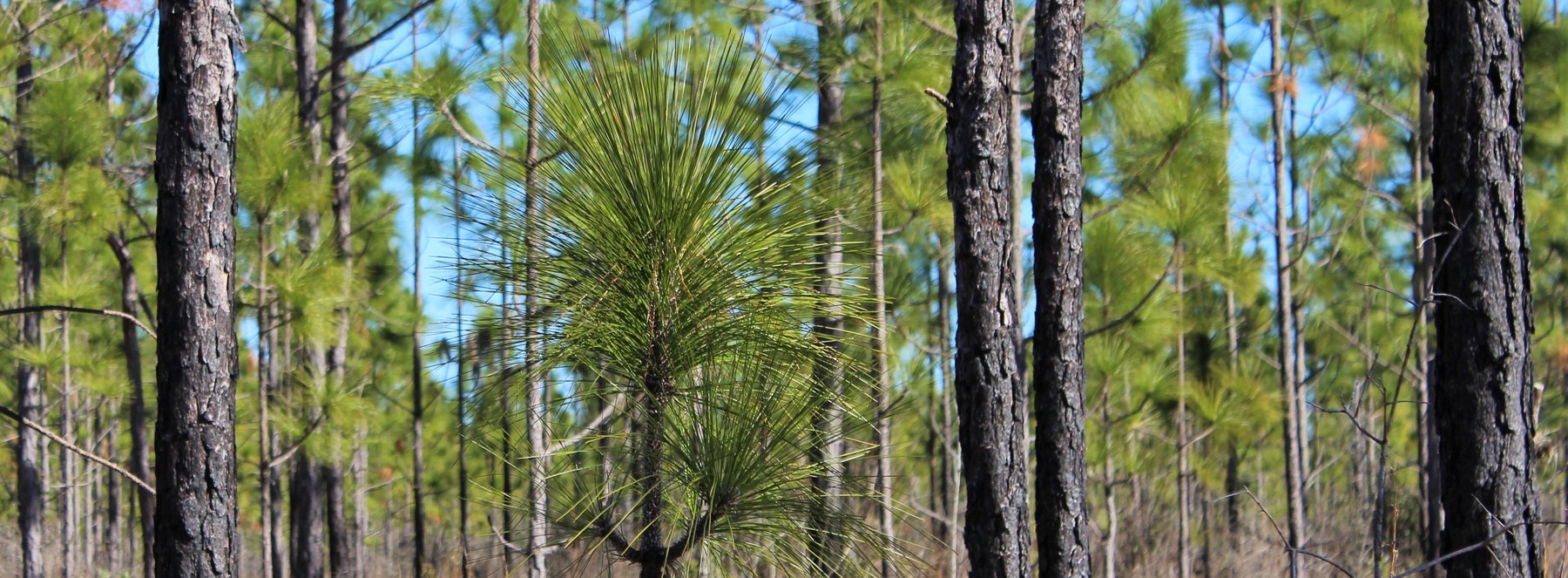
Young longleaf pines in Big Thicket National Preserve, Texas NPS Photo / Scott Sharaga. Big Thicket National Preserve, U.S. National Park Service.
Modern Big Thicket National Preserve longleaf-pine landscape, explicitly credited to NPS photographer Scott Sharaga. The Alabama-Coushatta Tribe of Texas history locates its shared Texas community in the Big Thicket and distinguishes Alabama and Coushatta as separate peoples. This supports limited Texas regional/environmental context within the broader Coushatta collection; it does not depict Louisiana or Oklahoma Coushatta communities, a named community member, a cultural object, reservation land, all Coushatta homelands or a historic territorial boundary. No claim is made that the pictured pines supplied a particular basket or that a style or technique belongs to all Coushatta communities. The photographed national-preserve stand is not asserted to lie on the Tribe’s reservation. Proportional resize/recompression from 4103x1511 to 1800x663, JPEG quality 88; entire delivered frame retained, no pixel crop or generated material. CSS display crops/overlays must be disclosed with credits. CSS may crop or overlay directory/background copies; the opened-page image preserves the complete delivered source frame.
Image, association, and reuse record reviewed 2026-10-26.
Full photographs are displayed proportionally above. A translucent background copy may be cropped by the viewport; it does not replace the complete image or its record.
The visual treatment does not change the research status, evidence, or remaining gaps recorded in this profile.
Start reading here
Coushatta/Koasati connections cross Texas, Louisiana and Oklahoma; the three governments are distinct and Alabama is not a synonym. Dictionary evidence is limited to its introduction and four actual entries, with no full vocabulary, audio or outcome review.
The Louisiana community dictionary offers an approachable route into Koasati words and explains its teaching purpose and named collaborators.
These are selected starting points. The full annotated collection, source perspectives, inspection limits and remaining research questions follow below. A starting guide is not an exhaustive history or community endorsement.
01
The shared Texas government has a particular history
The Alabama-Coushatta Tribe of Texas describes Alabama and Coushatta as separate peoples with a long association. Its history connects migration into East Texas with relationships under successive colonial and state governments. The Tribe’s timeline dates federal restoration to 1987. This public account concerns the joint Texas institution, rather than making Louisiana and Oklahoma Coushatta communities branches of that government.
The Tribe’s Chief History distinguishes leaders of Alabama villages, leaders of Coushatta villages and later Alabama-Coushatta chiefs. It names Coushatta leaders associated with different Texas communities and describes movement onto the Alabama reservation beginning in 1859. The publication’s structure makes village-level histories visible; it should not be read as proof that every earlier Coushatta community belonged to one unchanged modern government.
The treaty text records a proposal, not a settled outcome
An edited transcript of the February 23, 1836 treaty names Alabama and Coushatta among groups styled “associate Bands” of the Cherokee, then proposes that those groups form one community within a described area. The document records a Republic of Texas negotiating position in that moment. Later historical accounts report that the agreement was not ratified; its text alone does not establish implementation, Indigenous acceptance of the proposed terms, or a continuing boundary.
Federal law changed the Texas government’s legal relationship
The 1954 federal statute provided for transfer of trust lands to Texas and termination of federal supervision and services following a proclamation. In 1987, Congress restored federal recognition, the trust relationship and services for the Alabama and Coushatta Tribes of Texas, treating them as one tribal unit for federal-law purposes. The Tribe’s constitution, amended through 2023, says the Alabama and Coushatta were formerly distinct tribes and describes their shared legal government, territory and governing institutions. These legal texts concern the Texas government; they do not erase separate peoplehood or describe other Coushatta governments.
A 1932 history is useful only with its period and viewpoint visible
Harriet Smither’s long article follows Alabama history in Texas through colonial records, nineteenth-century land negotiations and federal reports. It provides a route into dated records, including petitions and land actions, but its terminology and descriptions reflect an early twentieth-century outside historian. This page uses it selectively as a historical source and does not carry its old population statements or character judgments forward as current fact.
A state history article revisits the Texas Revolution story
The Texas Historical Commission’s 2026 article summarizes the Alabama-Coushatta role in events around the Texas Revolution, quoting historical sources and an attributed statement by Chief Colita. It also reports that the Texas Senate declined to ratify the 1836 treaty. Because this is a modern state-agency retrospective, its quotations and historical interpretations remain attributed to that article and its named sources.
The original Coushatta tribal-archive link remains available as a reading route, but its body could not be retrieved in this pass. No underlying collection item, narrative, image, recording or access permission was reviewed through it.
Louisiana’s account of movement and institutional renewal
The Louisiana Tribe’s history describes successive settlements across a changing colonial borderland and an enduring community near Elton. It attributes renewed federal recognition in 1973 to years of community organizing and advocacy after services were withdrawn. These are the Tribe’s institutional historical statements. Its trajectory differs from the Texas restoration chronology and does not establish current eligibility, services or every family’s migration.
Bertney and Linda Langley describe a Koasati Language Committee whose members made spelling decisions and shaped practical teaching materials. Their account connects workshops, documentation training and collaborative review with community control of the resulting work. It records activities beginning in 2006–2007, rather than current program delivery. The chapter explains a process; its reported successes are not an independently measured learner-fluency outcome.
Texas connections extend beyond present government locations
TxDOT’s April 2021 report explicitly acknowledges collaboration with the Coushatta Tribe of Louisiana’s heritage staff. It describes several Coushatta communities in Texas and related travel networks connecting Texas and Louisiana. The account treats village decisions and movements separately. This history helps explain why a Louisiana-based government can have Texas interests; it is not a new territorial boundary or a claim that everyone followed one route.
Alabama-Quassarte Tribal Town describes Alabama and Quassarte as earlier distinct towns within the Muscogee Confederacy. Its history differentiates people who moved southwest into Louisiana and Texas from those removed with the Creeks to Indian Territory. The Oklahoma community’s continuing institutional story is therefore a separate reading path, rather than another name for the Texas or Louisiana government.
Community language work and a public Koasati dictionary
A community-coauthored AILDI chapter describes Koasati documentation workshops and the Language Committee’s decisions about writing and teaching materials. The Louisiana Coushatta Tribe’s public digital dictionary names its committee, guides and editor and provides word forms, definitions and selected examples. A separate short language page identifies Alabama as related to Koasati, not another name for it. Together these sources document Louisiana-centered language work; they do not establish identical practice across Texas and Oklahoma Coushatta institutions, a current speaker count, or measured learning outcomes.
A scholarship packet posted by the Alabama-Coushatta Tribe of Texas in October 2025 shows how its education office organized an application process for college support. It connects admission records, transcripts, a student's study plans and a college financial-aid assessment; its agreement ties funds to educational expenses. This dated administrative source offers a route into the Texas government's institutional life. Student experiences and results remain unexamined, and the packet does not describe the Louisiana or Oklahoma governments.
The public Koasati Digital Dictionary is now represented through its introduction and four selected entries. Review its full vocabulary and community teaching resources, and consult specialist Koasati grammar where accessible; do not infer current language vitality or learning outcomes from a partial dictionary sample.
Expand current Coushatta-authored historical and institutional accounts without treating Texas, Louisiana and Oklahoma communities as interchangeable.
Inspect the 1954 proclamation, relevant state records and original treaty/ratification documents where accessible; keep statutory text distinct from later implementation.
Resolve contradictions in chief dates and organizational chronology through further evidence; do not silently choose whichever source sounds convenient.
Restore legitimate archive access if available later, with collection-level cultural permissions respected; no contact or restricted-material access attempted.
No present population, language vitality census, private genealogy or program outcome has been established.
The selected2025 Texas higher-education packet is an administrative publication, not a study of student experiences, awards or outcomes. Current program operation and other Coushatta governments require separate review.
Twelve sources have countsTowardMinimum:true after actual substantive content inspection; two short or unavailable supporting references remain excluded. Every new source card records its exact inspection scope and review date. The 1836 treaty is an edited Republic of Texas diplomatic text and a proposal; it is not used as proof of ratification, implementation, Indigenous acceptance or present homeland boundary. The 1954 statute is cited as Public Law 83-627, 68 Stat. 768 (verified against the official Statutes at Large index); the 1987 restoration act is discussed only for Title II concerning the Texas Alabama-Coushatta Tribe. Smither (1932) is explicitly treated as older outside scholarship with period language; claims are attributed and present-day generalizations are avoided. This remains an initial, open educational profile, not a complete history, legal opinion or community endorsement. Reviewed 2026-10-23: added the Coushatta Tribe of Louisiana’s digital Koasati dictionary as one substantive work after inspecting its landing page and four actual entries. Community attribution is explicit; full dictionary coverage, audio and outcomes remain unreviewed. It strengthens the Louisiana-language path without merging the Texas or Oklahoma governments.
Follow the reading path
Sources & further reading
Open any title to read the original source. Annotations explain what each link can help you explore.
No Indigenous-led source is identified in this entry yet. This is a gap in this collection, and does not imply an absence of community knowledge or organization.
Indigenous-ledAlabama-Coushatta Tribe of TexasSource 1
Publication: Undated page; 2026 footer is not publication
The Texas Tribe’s historical account distinguishes Alabama and Coushatta peoples while tracing their association and Texas experience. Read it as a particular government’s public interpretation. Current membership, land totals, officials, services and legal entitlements are excluded.
Inspection: Content reviewed for the stated scope
Scope: Actual Origins, Texas-history narrative and timeline read. Selected historical relationships and the Tribe’s own restoration chronology; no linked treaty, map, statutory instrument or present administrative record inspected.
Publication: Core attributed to 2014 inauguration program; later web additions through 2023 events are undated
A separate extended biographical publication distinguishes Alabama, Coushatta and later shared chiefs. Its introduction credits tribal historian Howard Martin and a 2014 inauguration program; later entries are additions. Contradictory dates and sweeping identity statements are not adopted.
Inspection: Content reviewed for the stated scope
Scope: Actual provenance/introduction, Coushatta village-chief entries and selected shared-chief history read. Ceremonial titles, burial details, exact sites and current officeholder assertions excluded; not every biography independently verified.
Publication: Undated page; described event dates are not publication dates
The Louisiana Tribe narrates migration, local settlement and efforts to restore its relationship with the federal government. This is its own institutional account, distinct from Texas history. Present population, promotional employment rankings and service claims are not used.
Inspection: Content reviewed for the stated scope
Scope: Actual historical body, lines 27–46, read; later enterprise paragraph screened but not synthesized. No recognition instrument, contemporary demographic record, maps or source images independently inspected.
Publication: Excerpt imprint not established; reports 2006–2009 activities and a planned fall 2010 opening
A Heritage Department administrator and university collaborator explain community decisions in language documentation. The substantial chapter covers planning, spelling, training and teaching materials. Reported achievements remain the authors’ dated account, without present fluency estimates or independent outcome claims.
Inspection: Content reviewed for the stated scope
Scope: Actual seven-page excerpt, printed 20–26: selected project development, community ownership, workshop and methods passages on 21–25 plus alphabet-development note on 26. No linked textbook, recordings, narrative corpus or original survey reviewed.
A substantial geographic history was developed with Louisiana tribal heritage staff using recommended and approved sources. It examines Coushatta presence in Texas, rather than equating a government’s present address with its whole history. Maps and precise sites are not reused.
Inspection: Content reviewed for the stated scope
Scope: Actual 24-page PDF: title/contents, introduction and selected history on 3–7, village/trail discussion 9–12 and settlement/reservation discussion 16–17. Not a complete report, underlying-reference, GIS or rights review.
Publication: Undated page; footer is not publication
A substantive Oklahoma community history distinguishes earlier Alabama and Quassarte towns, southwestern migration and removal. It supplies a situated perspective, not proof of every historical date or current citizenship rule. Current enrolment, revenue, leadership and service claims are excluded.
Inspection: Content reviewed for the stated scope
Scope: Actual historical body, lines 50–57, read. Specific ceremonial content and present statistics excluded. Underlying laws, constitutional dates, administrative records and individual citizenship not independently established.
Original archive route retained for future reading. Repeated retrieval errors prevented a fresh body inspection. No underlying item, recording, narrative, image, access permission or current archival service is claimed as reviewed through this link.
Inspection: Content review not recorded
Scope: URL attempted; homepage body unavailable. Original metadata retained as a reading lead, not independently refreshed content.
Access recorded: October 21, 2026
Access status: Unavailable in this review
Counting note: No actual homepage/item body was retrieved; preservation of an original route is not a substantive inspection.
Brief official language orientation names Koasati and its language-family relationship. Retained as supporting context rather than a separate substantial linguistic work. No contemporary speaker count, uniform community competence or grammar knowledge follows from this short page.
Inspection: Supporting or limited review; see scope
Scope: Actual three-paragraph language body, lines 27–30, read. No audio, linked lesson, dictionary or underlying comparative study inspected.
Review recorded: October 21, 2026
Counting note: Short introductory orientation, not a substantial grammar, educational publication or documentation study.
Publication: Revised and annotated; amendments through July 2023
The Tribe’s own governing document describes the current legal name and says the Alabama and Coushatta were formerly distinct peoples but constitute one federally recognized tribe for legal and governmental purposes. Its preamble identifies self-government, language, arts, crafts and cultural preservation among its stated purposes. This is an authoritative text of the Texas Tribe’s own law, not a complete account of all Coushatta communities.
Inspection: Content reviewed for the stated scope
Scope: Actual 25-page PDF, title/publication and amendment history, preamble and Articles I–V (printed pp. 3–8), and selected later amendment material through printed p. 23 read. The profile uses only the public name, organizational structure and stated purposes; detailed enrollment provisions and personal data are omitted. No independent legal opinion is offered.
The enacted 1954 law describes conveyance of federally held trust lands to Texas to be held in trust for the Alabama and Coushatta Tribes, and provides for termination of the federal relationship and services following the proclamation specified in the act. The page header/OCR is inconsistent about the public-law number; the Statutes at Large front matter identifies the Alabama-Coushatta act at 68 Stat. 768 as Public Law 83-627, while Public Law 83-628 begins at p. 769. Citation follows the official index and page range. The law is not evidence that the people or Tribe ceased to exist.
Inspection: Content reviewed for the stated scope
Scope: Both scanned pages, all operative sections 1–8 (68 Stat. 768–769), read from GovInfo. Effective language is tied to the proclamation named in the statute; the proclamation itself and state implementation were not inspected in this review.
Title II of the 1987 restoration law treats the Alabama and Coushatta Tribes of Texas as one tribal unit for federal-law purposes, restores federal recognition and the trust relationship, and makes federal services available under the act. The joint legal status is not a claim that Alabama and Coushatta are one people or that other Coushatta communities share the Texas government.
Inspection: Content reviewed for the stated scope
Scope: Actual 7-page Statutes at Large PDF; complete Title II, §§201–206, on printed pp. 669–673 read. Title I concerns Ysleta del Sur Pueblo and is not attributed to Coushatta. No later case law or current legal advice is claimed.
Publication: Document dated February 23, 1836; edited volume issued 1995
The printed treaty text lists Alabama and Coushatta among groups it calls Cherokee “associate Bands” and proposes that the named bands form one community within specified bounds. This is a Republic of Texas diplomatic document in colonial/state language, mediated through a later edited transcription. Its text does not establish that the proposed agreement was ratified, implemented, or accepted as a lasting boundary by the named peoples. It is not a present homeland map.
Inspection: Content reviewed for the stated scope
Scope: Transcript of the February 23, 1836 document on printed pages 14–15 of volume I reviewed through the Texas History Trust/University of North Texas text. The treaty’s opening and land-boundary article were inspected; the full volume, manuscript original, signatures and implementation record were not reviewed.
A substantial 1932 state-history article drawing on earlier colonial, Texas and federal records. Selected passages describe westward movement, Texas land petitions and reservation developments. The article uses period terminology, a dated outside scholarly frame and language that can be paternalistic; it is a source for what its author and cited records report, not a neutral or current community account. Historical population statements and characterizations are not reproduced as present facts.
Inspection: Content reviewed for the stated scope
Scope: Selected actual pages of the 27-page PDF / printed pp. 83–108 inspected, including early migration, the 1850s land/reservation narrative and federal reports through the 1928 land purchase (PDF pp. 1–5, 13–16, 19, 25). The entire article and cited archival records were not independently checked. JSTOR terms appear in the scan; no reuse of its text or images is made.
A state historical agency’s 2026 educational article recounts Alabama-Coushatta histories and their role in the Texas Revolution, drawing on named secondary books, a state resolution, the 1836 treaty record and an attributed statement by Chief Colita. It represents a modern state-commemoration frame. Claims are attributed to the article and its cited works; its interpretive summary is not treated as community-authored history or independent corroboration.
Inspection: Content reviewed for the stated scope
Scope: Complete article body, dated February 24, 2026, read, including its named sources and displayed image captions. The underlying cited books, resolution, original manuscript and image rights were not separately reviewed. Only the article’s cautious historical context is used.
Publication: Undated digital resource; the site footer’s copyright date is not treated as a publication date
An open community digital dictionary whose landing page describes Koasati as a living language of the Coushatta Tribe of Louisiana, explains its teaching and intergenerational purpose, and names its Language Committee, guides, editor and university partners. Four selected entries demonstrate listed word forms, definitions, English reversals and one example sentence. This is a Louisiana Coushatta language resource, not evidence that every Coushatta community shares identical current language practice; no speaker census or learning outcomes are claimed.
Inspection: Content reviewed for the stated scope
Scope: Actual landing-page text read for the resource purpose, collaborators, full named Language Committee, guides and editor. Four actual entries inspected: aibachilka, ahoobalaho, chaihalaho and chinto palki. Reviewed their parts of speech, listed forms, English definitions/reversals and the one displayed example sentence. Full dictionary coverage, audio, linked materials and current use or learning outcomes were not assessed.
Publication: 2025-10-27 posting date; PDF revision date unstated
A substantial first-party administrative packet documenting an education-support process. Read as a dated institutional publication, not a report of awards, student experiences or outcomes. The Texas government's joint name does not collapse the Alabama and Coushatta peoples or extend this process to Louisiana or Oklahoma governments.
Inspection: Content reviewed for the stated scope
Scope: Selected actual text in the 10-page PDF: p. 1 and p. 4 procedure lists; p. 5 educational-use paragraph; p. 6 academic-progress agreement; p. 7 educational-purpose and no-award-guarantee paragraphs; p. 8 financial-aid coordination; p. 10 intent directions. Page numbers are one-based PDF pages, not printed folios. Blank personal-information fields were encountered but are not evidence about any person. No full-packet verification claimed.
Review recorded: October 27, 2026
Access status: Public English HTML post and text-extractable PDF read through web research tool without a login or paywall encountered
Access note: No application submitted, fields filled, office contacted or personal records accessed. Internal rules may change; no current deadline, amount, eligibility determination, citizenship rule, tax interpretation or legal advice is supplied. No original scans, images or maps reused.
Inspected material and access routes
Dated hosting post ↗ — Actual title, institutional byline, date and attachment link; web lines 18–29. Provenance only, no separate count.
Related entries may represent alternate names, constituent communities, wider groupings, or historical connections. Read the naming notes before treating entries as equivalent.
Robey’s Atlas of Indigenous North America · Compiled October 19, 2026 · Coushatta