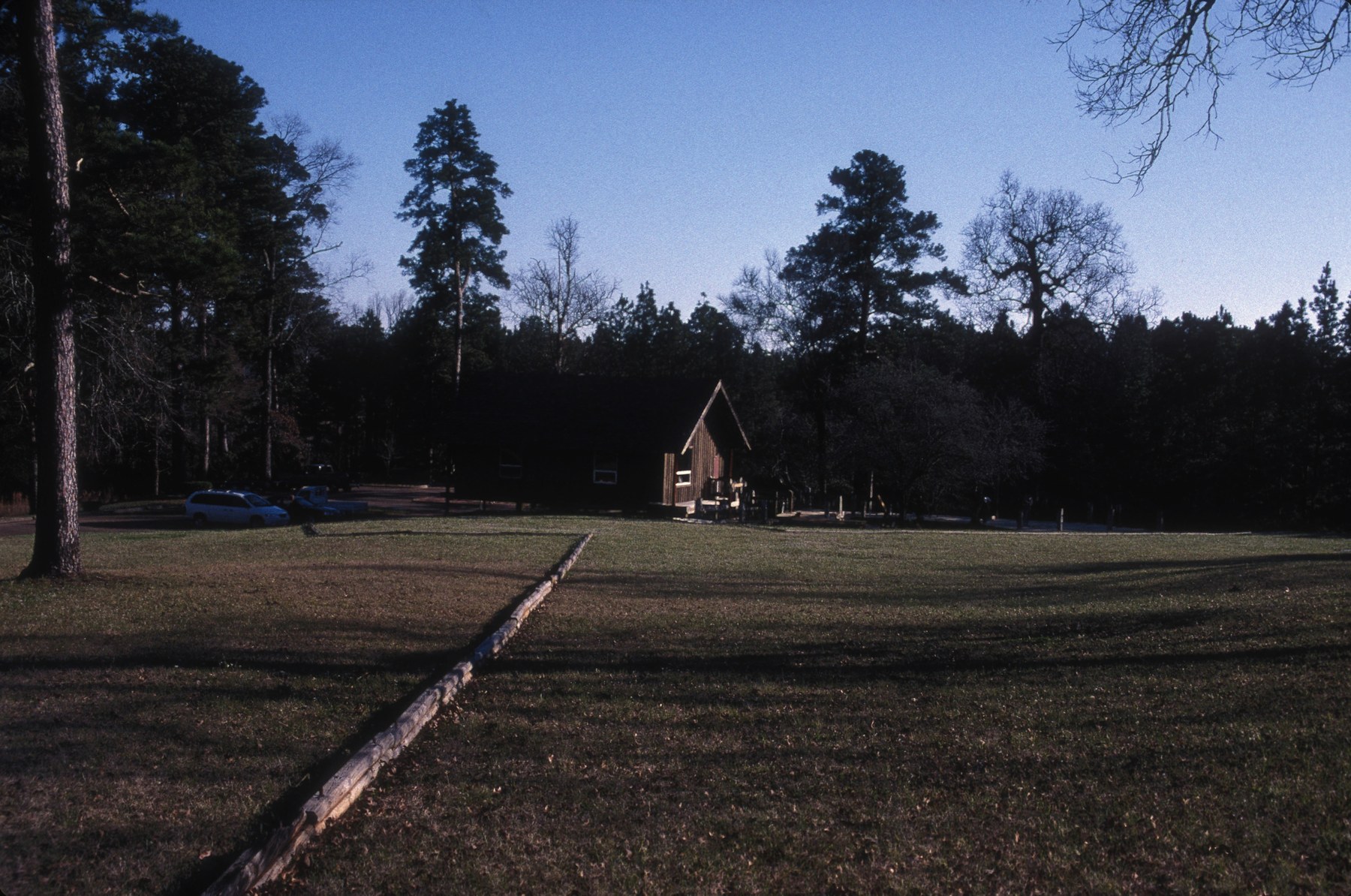
Los Adaes State Historic Site grounds, photographed 2007Jerrye & Roy Klotz, MD; Wikimedia Commons, CC BY-SA 3.0. Current Commons source frame cropped by YuviPanda in 2012.
People / historical language / contemporary community
Adai
Also find this entry through: Adai Caddo
Explore Adai histories and the contemporary Adai Caddo community through public community accounts, institutional records, language scholarship, historical documents and archaeology. Keep the people, the language and the colonial establishment called Los Adaes distinct.
See each region’s evidence for historical or present-day scope.
Homeland / region
Southeast · northwestern Louisiana, including the Natchitoches–Robeline region
Research depth
Expanded profile
Source collection
19 annotated resources · 5 Indigenous-led
Inspected sources
15 substantive works · selected content reviewed
Initial adequacy
Not assessed
Source review
October 20, 2026
Names & relationshipsAdai Caddo Indian Nation and Caddo Nation of Oklahoma are distinct contemporary political names. The Caddo and Natchitoches entries provide regional and historical connections, not interchangeable identities. Los Adaes names a colonial mission, presidio and settlement; not every person called Adaeseño in that regional history can be assigned Adai ancestry.
An expanded introduction, with sources reviewed.This profile develops several themes through identified sources. Citations connect each section to its evidence; remaining gaps appear below. It has not been reviewed or endorsed by the community.
Backdrop photographs & credits
These photographs have individual, documented connections to this entry. Their captions and source records define the people, place, object, and period shown; no one photograph represents every community within a broader label.
Los Adaes State Historic Site grounds, photographed 2007 Jerrye & Roy Klotz, MD; Wikimedia Commons, CC BY-SA 3.0. Current Commons source frame cropped by YuviPanda in 2012.
Modern view of the public Los Adaes historic-site grounds and the outlined colonial presidio footprint. The site is historically connected to Adai accounts, but the mission/presidio is not identical to an Adai village or present Adai community. Texas Beyond History explicitly names Adai as the people for whom Los Adaes was named, describes visits/trade, and distinguishes communities north of the mission and presidio. This photograph is a narrowly labeled place/history illustration, not Adai-made architecture, an ancestral territory boundary, a photograph of Adai people, or proof of occupancy throughout the photographed grounds. Its overall image is dark and the modern visitor building and vehicles remain visible; do not mislabel them as Indigenous structures. The current Commons file was cropped by a later editor before this review; the full delivered current frame is preserved, not claimed to be the original uncropped camera frame. Proportional resize/recompression from 5314x3524 to 1800x1194, JPEG quality 88; entire delivered frame retained, no pixel crop or generated material. CSS display crops/overlays must be disclosed with credits. CSS may crop or overlay directory/background copies; the opened-page image preserves the complete delivered source frame.
Image, association, and reuse record reviewed 2026-10-26.
Full photographs are displayed proportionally above. A translucent background copy may be cropped by the viewport; it does not replace the complete image or its record.
The visual treatment does not change the research status, evidence, or remaining gaps recorded in this profile.
01
Names and a living community
Adai, Adaes, Adaize and Adaizan appear in different historical, linguistic and contemporary contexts. Today the Adai Caddo Indian Nation publishes an account centered on family relationships, teaching and enduring connections with northwestern Louisiana. Its history page combines community self-description with quotations from older writers. Begin with that public voice, then compare the particular claims with the dated records below. The historical people, the language, the colonial establishment called Los Adaes and the present organization require distinct descriptions. Caddo affiliation in contemporary identity does not, by itself, settle the historical language’s classification.
An undated briefing prepared by historian Michael Lawson with Rufus Davis and anthropologist Maria Wade describes relatives living away who return for family occasions. Its later pages connect Depression-era and wartime work migration with continuing visits, church and homecoming. The community’s current history page also gives Catholic faith a prominent place. Together these sources offer attributed accounts of connection across distance, rather than proof that every family shares one religious experience or an identical migration history.
The bylaws effective March 2, 2024 name the corporation Caddo Adais Indians, Inc., with Adai Caddo Indian Nation among its public names. They distribute responsibilities among six council offices, prescribed elections and appointed officers. A Council of Elders advises on social and cultural activities, youth mentoring and elders’ needs. These published rules reveal how the contemporary organization assigns work and preserves records; they should not be treated as an unchanged model of historical Adai government. On October 20, 2026, Louisiana’s official directory placed Adai Caddo Indians of Louisiana under State Recognized Tribes. The January 30, 2026 BIA list, still linked by its live directory, includes Caddo Nation of Oklahoma and contains no Adai entry. These records concern distinct political names and administrative systems; absence from this list is not a documented petition denial.
Los Adaes names a Spanish mission, presidio, and settlement whose history intersects with Adai history. The Texas Beyond History exhibit describes Adai communities maintaining settlements around waterways while visiting and trading with the colonial establishment. Its account also distinguishes the wider region’s peoples and explains why European spellings and administrative categories require scrutiny. A place bearing the Adai name is therefore evidence of a relationship, rather than a complete map of where all Adai families lived. The exhibit’s later heritage discussion acknowledges living communities, even where other passages use older language of disappearance.
Choices around the mission and the limits of its records
In May 1768, Franciscan inspector Gaspar José de Solís described the Los Adays mission and presidio as separate buildings across a small plain. He reported no resident Indigenous congregation while describing numerous Indigenous people nearby who preferred visiting the presidio. The account records limits on Spanish conversion efforts; its explanations of baptism motives partly reflect settlers’ reports and the inspector’s suspicions. Lack of a mission congregation does not establish absence from the surrounding country. George Avery’s archival study supplies another caution: a 1766 Louisiana list omitted the Adaes because officials placed them under Texas jurisdiction. Avery also left the meaning of an unfilled Adaes symbol on a 1757 map unresolved. Omissions and uncertain map symbols require investigation with particular records and family histories. A Spanish surname alone does not prove an Indigenous woman’s ancestry.
Adai communities in the early United States records
John Sibley’s 1805 account describes an Adaize community at Lac Macdon, connected with the Bayou Pierre branch of the Red River. He places the old Spanish establishment some distance to its south and says it was named for the people. The passage distinguishes a community from the mission and presidio. His estimate concerns about twenty men, with more women; it cannot be quoted as twenty people in total. A distinct 1807 journal records parties and chiefs arriving on August 13 from several nations, including the Adaize, and discusses provisions, travel and horses. This is evidence of named Adai presence within a regional network, filtered through an administrator’s priorities. A later formal council list does not name Adai: the earlier visit cannot establish a treaty signature or participation in every subsequent meeting.
The same account says the Adai had a language of their own while also speaking Caddo and, in many cases, French. Those statements can coexist: using a neighboring language does not establish that one's ancestral language belongs to the same family. Mithun's 2017 discussion revisits the limited documentation and reports Chafe's rejection of identifying the recorded language as Caddo. She argues that an isolate is suggested, while explaining the broader difficulty of distinguishing an isolate from a language whose record is too limited to classify. This linguistic question should remain separate from contemporary Adai Caddo identity and the community's own reconstruction work.
Swanton's 1942 sourcebook assembles estimates whose units vary between men, families, and total inhabitants. Its table even calculates some totals by multiplying warrior counts. These figures are evidence of what particular observers counted or estimated, rather than directly comparable modern censuses. Swanton also quotes land records using Adaes or Adaise and acknowledges uncertainty about the identity of a later village bearing that name. A place name alone cannot establish the inhabitants' identity or a complete genealogy. His further claim that Adai were entirely merged with other Caddo should be identified as his historical interpretation, rather than used to erase a present community's account of continuity.
Webb and Gregory’s state-published study gives the Adaes a distinct section within a wider Caddo account. It considers dispersed hamlets, trade, pottery and possible village identifications. Those identifications remain attributed hypotheses; broad archaeological periods do not establish when the Adai people began. A separate 2004 journal article compares documentary expectations with pottery, imported goods, buildings and food remains at Los Adaes. Indigenous-made vessels were central to this mixed settlement alongside French and Spanish objects. Its authors interpret combinations through exchange and accommodation. A vessel alone does not establish an Adai maker, and cooperation in particular activities does not establish equal power in every relationship. Both works are useful for understanding how scholars connect documents and material evidence, with their different dates, classifications and assumptions kept visible.
Language teaching and practical community programs
The organization describes rebuilding Adaizan teaching materials from limited documentation, comparing John Sibley’s spellings and developing a writing system. Its programs page reports translations and instructional videos, with a dictionary and children’s book underway. These are accounts of reconstruction and teaching work, rather than a current speaker census or independent linguistic classification. The same page describes member-led seminars at quarterly council meetings, field trips and a volunteer emergency-management program offering supplies, training and communications resources. These reported activities give a broader view of community priorities; the page does not independently measure participation, educational outcomes or emergency readiness.
A March 31, 2026 report describes a weeklong trip through public historical and cultural institutions in the Natchitoches region. Organizer Robert Brevelle framed the visits around education and relationships with ancestors and land, while historian Dee Niette Thompson thanked participating institutions. This dated report makes the field-trip program more concrete. Its historical and genealogical assertions still need their own evidence. The community’s cultural-center page describes a museum and meeting facility near Robeline. Its public explanation of the Great Seal, attributed to Paige Holsapple and Robert Brevelle, connects particular motifs with its own historical memory and faith. That interpretation belongs to this community and this seal; it is not a universal guide to Caddo designs. A public facility location is also distinct from an ancestral territorial boundary.
Acknowledgment priorities in a participant’s words
In a May 2025 Native America Calling interview, council member Robert Brevelle connected federal acknowledgment with elder health care, young people’s education and cultural preservation. He also described the cost and specialized work involved in pursuing acknowledgment. The tribal-posted transcript preserves these priorities in an identified participant’s voice. His hopes and account of the process should be distinguished from an agency ruling, current petition status or grants actually awarded.
Compare more community-authored histories and publicly shared family accounts; this profile is an introduction and has not received community review.
Obtain and read the full Pleasant 2013 settlement-location article before adopting its proposed geography. Colonial place names and candidate archaeological sites do not establish a single precise homeland boundary.
Reconcile language classifications through surviving documentation and specialist analysis; neither an old categorical classification nor a modern political affiliation settles linguistic descent.
The Solís translation and Avery study report different baptism totals. Compare the underlying manuscript and alternative translations; baptism entries are not a census of the Adai people.
Verify land-grant and cession chronology against original instruments. The collaborative briefing contains internally inconsistent dates, so this article does not adopt a land-title conclusion.
No present acknowledgment petition disposition, complete documentary petition, current speaker census or comparable membership series was verified. Interview advocacy and dated counts have limited scopes.
The community cultural-center address and state directory disagree on the highway number. Resolve that discrepancy before any later geocoding; do not infer wider territory from a public facility.
Extend coverage of nineteenth- and twentieth-century change, community livelihoods, teaching outcomes and the range of family experiences without generalizing one representative’s account to everyone.
Fifteen substantive works were inspected on October 20, 2026. Four short supporting records are explicitly excluded from that substantive count. Identified pages or excerpts were read where annotations specify a limited scope; no unread book is counted. Sources sharing earlier records are distinct works but not independent corroboration of every claim. Historical statements about language loss or absorption are not evidence of a people’s disappearance.
Follow the reading path
Sources & further reading
Open any title to read the original source. Annotations explain what each link can help you explore.
No Indigenous-led source is identified in this entry yet. This is a gap in this collection, and does not imply an absence of community knowledge or organization.
Read the complete substantive history page, including its contemporary self-description and church affiliations. It presents the organization’s own account of identity and continuity alongside quotations from older writers. Useful as community public history, with historical priority, land-title, genealogy and broad Caddoan-language claims requiring separate verification. The general About directory is not an additional resource.
Read the complete page. Describes language reconstruction, seminars, field trips and volunteer emergency services. Dictionary and children’s-book projects are described as underway. The page’s categorical Caddoan classification is not adopted as linguistic consensus. Listed equipment is reported capacity, not an independent readiness audit; page sections and links do not count as separate works.
Read PDF pages 1–10 of 12, including Articles I–II, IV, VI and VIII–IX. The document states a March 2, 2024 revision and effective date. It identifies the corporation and its Adai Caddo public name, council responsibilities, elections, elders and appointed roles. These are published institutional rules, not a federal acknowledgment decision or proof of unchanged historical government.
Read pages 1–7 and 15–19 of the 19-page briefing. Michael L. Lawson prepared it in cooperation with Chief Rufus Davis and anthropologist Maria D. Wade. Its community-collaborative account discusses dispersed relatives, work migration, church and homecoming. Undated; PDF creation metadata does not establish publication date. Recognition arguments are advocacy; inconsistent grant/cession dates are not used. This is not an agency determination.
Read the complete March 31, 2026 report and visually checked all three pages of the tribal-hosted archived screenshots. Reports a March field trip and quotes organizer Robert Brevelle and historian Dee Niette Thompson. Evidence for a reported educational activity and participants’ aims; historical site identifications, genealogy and land-ownership assertions are not independently established here. Original article and archived PDF are one work.
Read all six pages of the tribal-posted transcript of Shawn Spruce’s interview with council member Robert Brevelle; also checked the official episode page. Brevelle discusses acknowledgment, elder health, youth education and cultural preservation. These are attributed priorities and advocacy, not proof of petition status, eligibility or funding received. Recording not independently audited against this transcript; other episode interviews are not represented as reviewed.
Community voices·Federal acknowledgment·Education·Health
Academic / referenceJohn Sibley; reprinted in American State Papers, Boston: Munroe, Francis, & Parker, 1808; scan from Internet Archive via Wikimedia CommonsSource 7
1805 account, communicated with Jefferson's 1806 message; inspected in a dated 1808 Boston reprint, printed pp. 42–44, especially the complete Adaize entry on p. 44 (PDF p. 52). Sibley distinguishes the community at Lac Macdon from the old Spanish establishment and describes multilingualism. His estimate concerns men, not the whole population. This is an official observer's account, containing judgments and secondhand claims; it is not an independently verified census or a tribal-authored history.
1922 edition of Sibley's 1807 journal. Read the introduction's printed pp. 5–8 and August entries on pp. 49–56, especially August 13 on p. 50. Adai parties and chiefs appear among visitors receiving provisions. The August 18 formal council list on p. 56 does not name Adai, so the earlier visit must not be turned into a treaty-signature claim. The publication and its introduction reflect two different periods of outsider authorship.
Academic / referenceSmithsonian Institution, Bureau of American Ethnology Bulletin 132; full-text transcription hosted by the Louisiana AnthologySource 9
1942 sourcebook. Inspected selected Adai passages on printed pp. 13–15, 21–23, 75, and 84–85. Swanton compares discrepant population estimates, reports Caddo recollections, and warns that a later village called Adaise cannot securely be identified as Indigenous. Its historical synthesis and quoted records require source-specific reading. His assertion that Adai were entirely merged with other Caddo is a dated author's conclusion, not a verdict on today's communities or their identities.
2017 chapter, DOI 10.4324/9781315750026-8. Read printed pp.193–195 of the author-posted full text, including the Adai analysis. Mithun explains documentation limits and argues the evidence suggests an isolate, citing Wallace Chafe. Use this for linguistic reasoning, not compressed mission chronology. The underlying vocabulary manuscript and Chafe’s unpublished communication were not inspected. A later automated availability request returned403; this does not establish a reader paywall.
Read Cultural Worlds, Los Adaes Archival Research, Legacy, and the contributor credits. The exhibit distinguishes Adai communities from the colonial establishment and discusses Indigenous-made pottery, trade, and later heritage. Its contributors include an Adai specialist and acknowledge Chief Rufus Davis’s assistance. Some language about disappearance and colonial cultural hierarchies is dated; do not adopt it as a verdict on living identity. The linked exhibit sections count as one resource, not four.
Inspected the cover, reissue foreword, historical context, and The Adaes section on PDF pp. 22–24. The foreword says this edition largely reissues a 1978 text. A substantial, explicitly Adai-focused account considers dispersed settlement, mission connections, pottery, and possible village identifications. Several sites and affiliations are hypotheses. Its confident Caddoan classification and colonial mission dates require comparison with later specialists; regional archaeological periods do not date the origin of the Adai people. Sensitive locations and funerary details are not reproduced.
Actual scanned article visually inspected at printed pp. 65, 67–71, and 74–75, including the excavation overview and conclusions. Compares documentary expectations with Indigenous pottery, French and Spanish goods, architecture, and food remains at the presidio. Material patterns concern a mixed colonial settlement; they do not identify every maker as Adai or prove equal power and universal harmony. Site-specific counts and social interpretations need their original contexts. This authored journal study is distinct from the later public exhibit.
Read printed pp.65–67,70,77,80–85; visually checked pp.65,77,80. A directly relevant archival study explains why jurisdiction, inconsistent names and ambiguous mapping limit conclusions about Adai presence. Its baptism total conflicts with the inspected Solís translation. The displayed Spring 1996 issue date also conflicts with later references; neither anomaly is silently corrected.
Academic / referenceGaspar José de Solís; translated by Margaret Kenney Kress, introductory note by Mattie Austin Hatcher — Southwestern Historical Quarterly 35(1), July 1931:28–76Source 15
Read printed pp.28–29 and 61–66 of the public issue scan; visually checked 65–66. The translated 1768 inspection distinguishes mission and presidio and discusses surrounding Indigenous people and selective participation. This Franciscan account, filtered through a 1931 translation, is not Indigenous testimony or a population census. Original Spanish manuscript and the complete diary were not read.
Read the complete government page and public explanation of the seal, attributed to Paige Holsapple and Robert Brevelle. The community interprets particular motifs through its own history and faith. Short supporting interpretation, kept outside the substantive-source count. It does not establish universal Caddo symbolism, historical title or the historical accuracy of every association.
Inspection: Supporting or limited review; see scope
Read the complete short page: public museum/exhibit and meeting-facility description, photographs and published street address. Supporting visitor and geographic information only. It supplies a present facility location, not a historical homeland boundary. The community publishes LA-485, while the state directory prints LA-486; no coordinates were inferred from the conflicting roads.
Inspection: Supporting or limited review; see scope
Read the federal and state headings and Adai entry on the live official directory on October 20, 2026. It places “Adai Caddo Indians of Louisiana” under State Recognized Tribes. Supports that precisely attributed listing, without establishing its legal origin date, federal status or equivalence to another Caddo government. Name/contact listing kept outside the substantive-source count.
Inspection: Supporting or limited review; see scope
Read the notice introduction and relevant alphabetical entries in the official five-page PDF, 91 FR 4102–4106, and searched its complete extracted text. Caddo Nation of Oklahoma is listed; Adai/Adais is absent. BIA’s live directory still points to this notice. Supports a dated list comparison, not a finding that any particular petition was denied. Supporting status check outside the substantive count.
Inspection: Supporting or limited review; see scope
These collections preserve links from supplied studies and further research leads. The collection notes explain their provenance and review status. Links already used above point to their source cards. Supporting references and unread leads are excluded from the substantive inspected-source count.
Adai — further research and earlier reference links · 9 links
Research leads retained from the earlier profile or found during renewed research. These are not contributed DOCX references, and are outside the substantive inspected-source count unless a matching inspected source card says otherwise.
Earlier reference URL retained. Use the more specific inspected source and its scope where linked; no new content check is inferred for this earlier link.
Earlier reference URL retained. Use the more specific inspected source and its scope where linked; no new content check is inferred for this earlier link.
Earlier reference URL retained. Use the more specific inspected source and its scope where linked; no new content check is inferred for this earlier link.
Repository abstract inspected; the full article has not yet been obtained. The abstract challenges the assumption that villages clustered immediately around the mission. Do not count the abstract as a completed full-article inspection or draw a boundary from it. Publisher download blocked for automated requests; the linked Caddo Archeology Journal 23 issue failed normal TLS verification in Python and PowerShell. No certificate validation or access controls were bypassed.
Publisher description and Google Books catalog only inspected. No substantive preview pages retrieved; not a content-reviewed source or an additional counted work.
Record and Paperity opening excerpt through early printed p.43 inspected; full download returned403 at SFA and CORE. Excerpt concerns colonial soldier-settlers and does not establish Adai family ancestry. Not counted.
Full 8-page scan downloaded; printed pp.89–90 visually read. Records Nahuatl-derived words within regional Spanish from 45 interviewees across Ebarb, Grady Hill, Sulphur Springs, Zwolle and Spanish Lake. Does not identify these as Adaizan words or all interviewees as Adai. Not a source for Adai language reconstruction, not counted toward the present direct Adai collection.
Read the complete Adaizan discussion on printed pp. 45–47, including its bibliographic synonyms and qualification of Gatschet's proposed Caddoan relationship. Powell explicitly says sufficient evidence to establish that relationship was unavailable. His claims about disappearance, character, population, and early identification are period interpretations requiring independent checks. This optional work explains the history of classification; it is not present-day linguistic consensus or an independent modern community history.
Read the dedicated Adai section on printed pp. 41–42 and the following Caddo list on pp. 43–44, attributed to an unnamed Caddo speaker in 1882. Gatschet questions the older vocabulary's orthography while describing social affiliation. His manuscript attribution and broad linguistic suggestions require archival checking. This is optional evidence about an ethnographer's reasoning, not a second modern classification authority. Other peoples' migration narratives and ceremonial material are outside the inspected scope and proposed prose.
Related entries may represent alternate names, constituent communities, wider groupings, or historical connections. Read the naming notes before treating entries as equivalent.
Robey’s Atlas of Indigenous North America · Compiled October 19, 2026 · Adai