Pueblo nation / tribal government · Added to the original list
Ysleta del Sur Pueblo
Also find this entry through: Ysleta del Sur Pueblo · Tigua
Ysleta del Sur Pueblo is a distinct living Pueblo nation and tribal government in the El Paso area of Texas. The Pueblo identifies its community as Tigua and describes histories linking Quarai, Isleta in New Mexico, and Ysleta del Sur. Federal law redesignated the earlier Tiwa Indians of Ysleta, Texas, as Ysleta del Sur Pueblo in 1987. These names and histories connect communities without making their governments interchangeable.
See each region’s evidence for historical or present-day scope.
Homeland / region
El Paso / West Texas / Southern Tiwa-Pueblo history
Research depth
Source guide
Source collection
12 annotated resources · 6 Indigenous-led
Inspected sources
9 substantive works · selected content reviewed
Initial adequacy
Adequate initial introduction
Source review
October 23, 2026
Names & relationshipsYsleta del Sur Pueblo is a distinct Pueblo nation and tribal government in Texas; Tigua is the community name used by the Pueblo. The 1987 statute links the present name to the earlier legal designation Tiwa Indians of Ysleta, Texas. NPS sources describe historical movement connecting Ysleta del Sur with Isleta Pueblo in New Mexico, and the 2025 report documents Tiwa language teaching with Isleta consultants. These are historical and linguistic relationships, not grounds to merge the two present governments, treat all Tiwa speakers as Ysleta citizens, or make the broad Pueblo label a single people.
A source guide for a deeper dive.This entry provides a brief orientation and an organized reading path. A comprehensive deep dive has not yet been completed. Follow the annotated sources and distinguish primary community accounts from outside reference material.
Adequate initial introduction
Nine substantive inspected works provide a clearly bounded introduction grounded in the Pueblo’s own history, current reporting and public language-preservation description, community-directed planning, federal legal texts and National Park Service accounts of the related Isleta/Ysleta landscape. The directly inspected Cultural Development Division page adds specific account of the Pueblo’s Southern Tiwa teaching and archival safeguards; a separate brief Cultural Preservation page remains supporting-only. This supports an adequate starting guide, not a full deep dive, current legal opinion, comprehensive linguistic study or community-reviewed account.
Assessment recorded October 23, 2026. This is separate from research completion and community review.
Further Pueblo-authored and community-controlled public historical scholarship is needed; the 2016 report and 2025 annual report each have limited purposes, and TxDOT’s consulted synthesis does not replace a Pueblo-authored monograph.
Primary Spanish records and additional independent scholarship are needed to compare the chronology, route, and differing historical counts associated with movement to Ysleta.
No community review or endorsement is recorded, and protected digital archive materials were not accessed.
The Pueblo’s undated online language-program description was inspected, but the actual curriculum, materials, audio, language-variety details, teaching outcomes and present class schedule were not; future claims should be limited to what the Tribe publicly describes.
Backdrop photographs & credits
These photographs have individual, documented connections to this entry. Their captions and source records define the people, place, object, and period shown; no one photograph represents every community within a broader label.
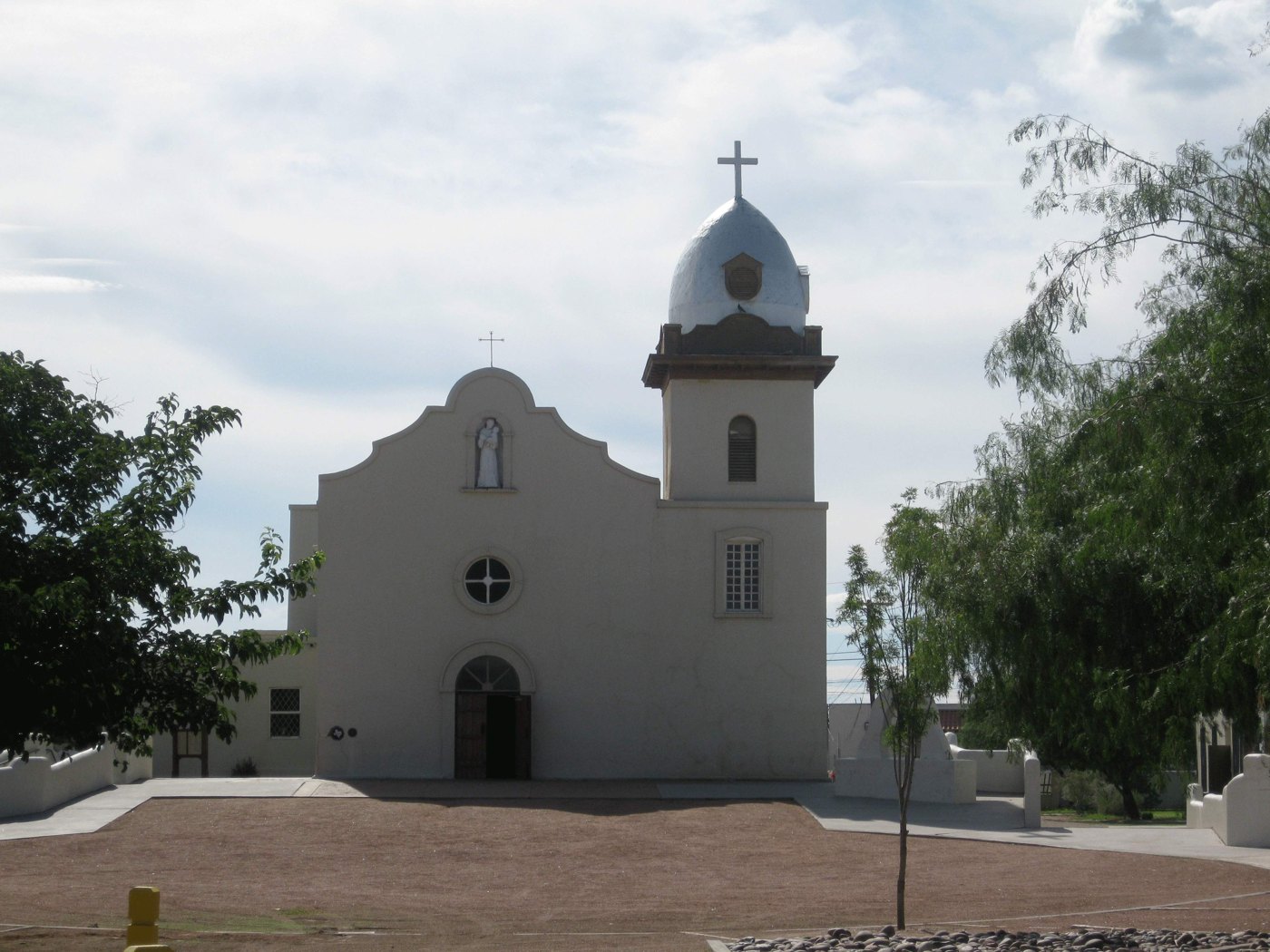
Ysleta Mission exterior, El Paso, Texas James Reyes / Wikimedia Commons; JPEG derivative by Materialscientist
Public exterior of Ysleta Mission in El Paso, Texas, associated with Ysleta del Sur Pueblo and the Tigua community. The existing profile's ydsp-s6 National Park Service account specifically identifies this mission as a continuing spiritual hub of the Tigua. This is not the Pueblo of Isleta mission in New Mexico, a reservation-boundary illustration, or a portrayal of every Tigua religious practice. Do not label the present photographed building as the original 1682 structure. Commons exact JPEG derivative record, creator/license and original-upload provenance read; original JPEG downloaded and visually inspected in full. Existing Ysleta del Sur profile evidence and https://www.nps.gov/places/ysleta-mission.htm were checked for community relationship. No church interior, ceremonies, private sites or people shown. No historical source count or profile claims added. Web copies proportionally resized/recompressed without retouching; CSS crops and overlays are presentation only. Complete image displayed proportionally in the page banner.
Image, association, and reuse record reviewed 2026-10-25.
Full photographs are displayed proportionally above. A translucent background copy may be cropped by the viewport; it does not replace the complete image or its record.
The visual treatment does not change the research status, evidence, or remaining gaps recorded in this profile.
Start reading here
A distinct Pueblo nation and Texas government, with historical and Tiwa-language ties to Isleta Pueblo in New Mexico; those ties do not merge the governments. The year-end report and TxDOT report were selectively read. Public cultural education is distinguished from member-only classes and secure archives, and sensitive planning locations are excluded.
The Pueblo's own concise About account introduces Tigua identity, Ysleta settlement and continuing institutions without repeating conflicting undated totals.
Selected TxDOT report pages add historical and land-tenure context with explicitly documented Pueblo cultural-preservation input.
These are selected starting points. The full annotated collection, source perspectives, inspection limits and remaining research questions follow below. A starting guide is not an exhaustive history or community endorsement.
01
A distinct Pueblo and tribal government in Texas
The Pueblo identifies itself as a federally recognized sovereign nation in Texas and describes the Tigua as the community that established Ysleta del Sur. Congress used a separate title for Ysleta del Sur in the 1987 Restoration Act, redesignating the people previously called the Tiwa Indians of Ysleta, Texas, by the 1968 Tiwa Indians Act. The same 1987 law restored a federal trust relationship and defined the reservation through specified land categories in El Paso and Hudspeth Counties. These are distinct legal and community records; the statute does not collapse Ysleta del Sur into the Pueblo of Isleta in New Mexico, or make the broad Tiwa grouping a single government.
The Pueblo’s public history describes a route from Quarai to refuge at Isleta and then south to Ysleta during the upheavals of the Pueblo Revolt period. National Park Service accounts and the TxDOT report describe Spanish retreat, relocation, and the establishment of Ysleta del Sur, while noting that some Isletans remained in New Mexico and that some descendants later returned. These accounts give different emphases to the sequence and circumstances of movement. Older historical summaries also report different population counts for people who went south. This profile therefore avoids adopting a single number or turning a complex history into a claim that all Isleta people relocated or that the two present-day Pueblos share one government.
Land, settlement, and a changing cultural landscape
The Pueblo’s 2016 planning report and its current historical account place the community in the El Paso area and describe the importance of farming and acequia irrigation in the early settlement. The 2021 TxDOT report adds a longer, source-cited account of settlement and land tenure, developed for transportation planning with the Pueblo’s Department of Cultural Preservation. Its colonial and state-era accounts remain interpretations of cited historical sources, not a complete map of Tigua homelands. The National Park Service’s account of Ysleta Mission situates the Pueblo within a wider lower Rio Grande landscape shaped by Indigenous movement, Spanish colonial roads, missions, and later urban development. Each publication has a different purpose: the 2016 report records a dated community planning snapshot, TxDOT synthesizes historical and cultural-landscape sources, and the Park Service describes a historic place and trail. Present administrative boundaries and mission locations should not be read as limits on historical relationships or contemporary community connections.
The 2025 Year-End Report describes the Pueblo’s elected Tribal Council alongside traditional leadership roles, and explains that governance draws on oral tradition and the Tribal Code of Laws. The 1987 federal statute records a dated legal framework for the tribe, its land, federal services, and the relationship with the United States. The accompanying Senate committee report records the bill’s stated purpose, background, and amendments; it is evidence of legislative process and congressional framing, not an independent community history or current legal interpretation. Its colonial-era and land-loss summary is attributed to that committee. The TxDOT report also summarizes earlier land-grant records and later federal recognition, with claims tied to the sources it cites. Neither the statute nor the reports supplies a complete account of later court decisions, present jurisdiction in every circumstance, or the Pueblo’s own full constitutional history. Current governmental details should be checked against the Pueblo’s own dated reports and official publications.
The Pueblo’s 2025 report describes Tiwa classes and language-learning materials as part of its own cultural and educational work. Its Cultural Development Division separately describes Southern Tiwa language-preservation classes, the use of Miromaa software for archiving and teaching materials, collaboration with linguists and fluent speakers, and Traditional Council review intended to prevent teaching materials from sharing sacred or traditional information. These are the Pueblo’s own descriptions of program design; this guide does not reproduce restricted content or claim measured learning outcomes, current fluency, or a comprehensive account of Southern Tiwa. The Department of Cultural Preservation also distinguishes public-facing exhibits, tours and demonstrations from some member- and family-restricted classes. Shared language connections with Isleta are evidence of relationship, not proof that every community or variety is identical.
A dated community study and the limits of current figures
Ysleta del Sur Pueblo’s 2016 Socioeconomic Profile was prepared under tribal direction to describe members’ geographic and economic circumstances for planning. Its methods and tables offer a substantial look at the questions the Pueblo was studying at that time, including member residence beyond the El Paso area. The figures are a 2016 snapshot, not present-day population or migration estimates. The Pueblo’s current webpages display differing, undated membership totals, so no such total is repeated here. The 2025 Year-End Report offers a newer institutional view of programs and priorities but likewise should be read as the Pueblo’s own annual account, not an independent evaluation of outcomes.
Read further Pueblo-authored historical essays and publicly released educational material, while respecting community-controlled archival access.
Compare the Pueblo’s oral-history framing with relevant Spanish-language colonial records and independent historical scholarship; preserve disagreement over the chronology and number of people who moved south.
Review later federal laws, court opinions, and current Pueblo legal materials before making claims about present jurisdiction, land status, or implementation of the 1987 Act.
The 2016 socioeconomic study is a dated community planning snapshot. Present-day member distribution and demographics have not been independently established; undated membership totals on Pueblo webpages conflict and are not repeated.
The Cultural Center lists some programming for Tribal Members only. No private archive, sensitive site, ceremonial detail, or community review is included in this public guide.
A Pueblo-published language-preservation page now describes program methods and safeguards. Inspect publicly released Southern Tiwa learning materials only when clearly authorized; the page does not supply a grammar, audio sample, fluency count, measured outcomes or dated current schedule.
Initial focused review completed 2026-10-22. Follow-ups on 2026-10-23 inspected the substantive first nine pages of the 1987 Senate committee report accompanying the Restoration Act and selected non-sensitive sections of TxDOT’s 2021 Ysleta del Sur Pueblo research report. They are counted as distinct works with different purposes: legislative process and a community-consulted cultural-landscape synthesis. The first follow-up had eight substantive works; the 2026-10-23 Southern Tiwa language-preservation page raises the profile to nine substantive works. Later Senate-report pages remain unread and OCR errors are disclosed. The TxDOT report’s identified culturally sensitive planning section was excluded from profile synthesis. The Pueblo’s 2016 report is limited to its actual inspected pages and dated purpose; the 2025 report is an institutional annual report, not an independent evaluation. Migration accounts differ in emphasis and older headcounts conflict; no single number is adopted. No historical map association was added. The Texas map connection records the present-day Pueblo/community location only; it is not a homeland boundary. No private cultural materials or generated imagery were used.
Follow the reading path
Sources & further reading
Open any title to read the original source. Annotations explain what each link can help you explore.
No Indigenous-led source is identified in this entry yet. This is a gap in this collection, and does not imply an absence of community knowledge or organization.
Read the full public About Us account on identity, the Tigua community, the Pueblo Revolt period, settlement in Ysleta, agriculture, and the Pueblo’s institutional history. It is the Pueblo’s own concise public narrative. Its approximate membership statement is undated and differs from another undated figure on the Pueblo homepage, so neither number is used here.
Inspection: Content reviewed for the stated scope
Scope: Full substantive About Us text, paragraphs on identity, history, current location, agriculture, institutions, and economic/governmental context; page links were not treated as separately inspected works.
A substantial Pueblo-published annual report. It documents dated governance, education, cultural-preservation, language-learning, and repatriation activities. Program claims are attributed to the Pueblo’s own report and are not independently evaluated here. Its discussion of secure member access is not permission to access or reproduce protected archive materials.
Inspection: Content reviewed for the stated scope
Scope: Actual PDF text read in the 53-page report: title/credits and governor letter (PDF pp. 2–3), council and government account (pp. 5–6), language/cultural programming and secure archive description (pp. 45–50). Other program sections and source records were not comprehensively reviewed.
A 68-page community-directed study designed to inform planning and describe the member population’s geographic and socioeconomic circumstances. Used here for its stated research purpose, methods, brief historical section, and dated geographic scope only. Its numerical tables are not presented as current figures or independent estimates.
Inspection: Content reviewed for the stated scope
Scope: PDF pages 12–14 (study purpose, history, methodology), 24–25 (geographic footprint), 34–35 and 38–39 (dated employment/business context). The whole 68-page report was not read cover to cover; detailed tables outside these pages were not used.
The original enacted seven-page statute is primary evidence of its 1987 legal text. Title I separately redesignates the Tiwa Indians of Ysleta, Texas, as Ysleta del Sur Pueblo, restores the federal trust relationship, and defines reservation land through specified categories. This review does not state later law, litigation, or present legal effects beyond the text read.
Inspection: Content reviewed for the stated scope
Scope: Actual statute text in PDF pages 0–3: Title I, sections 101–105 and 108, including redesignation, restoration, and statutory land framework; Title II is not used as Ysleta evidence. No later amendments or case law were reviewed.
A Park Service interpretive article that combines Camino Real history and archaeological evidence at Isleta with an account of Indigenous movement to Ysleta del Sur. It distinguishes people who remained at Isleta and later return movements. This is a federal interpretive account, not a Tigua community-authored history; archaeological and colonial records do not replace oral history.
Inspection: Content reviewed for the stated scope
Scope: Full substantive article text, especially paragraphs on the 1680–1682 revolt and retreat, movement to Ysleta del Sur, later return to Isleta, and archaeological interpretations of ceramics and trails; embedded media and linked pages were not reviewed.
A dated Park Service place account of Ysleta Mission and its regional setting. It describes Ysleta del Sur as one of several post-Revolt communities and the mission as a continuing spiritual hub for Tigua people. Its place-based interpretive scope does not define a homeland boundary or represent the Pueblo’s full account.
Inspection: Content reviewed for the stated scope
Scope: Full substantive page text on post-Revolt communities, the lower El Paso Valley, mission, surrounding roads, and current site location; page last updated June 16, 2023. Linked trail pages were not reviewed.
Read as an older secondary synthesis for comparison, not as a current community account. It records interpretations and population figures that differ from other published accounts and uses unqualified language-status and cultural generalizations that this profile does not adopt. Kept as a supporting reference for readers to assess its cited bibliography and dated framing.
Inspection: Supporting or limited review; see scope
Scope: Full online entry, introductory/history paragraphs, citations, and author-provided bibliography. Claims about present conditions, language endangerment, gender roles, membership, and legal status were not adopted as current.
Review recorded: October 22, 2026
Counting note: Older synthesis is retained for critical comparison; its central claims require independent and community-led review before it can serve as a substantive source for this profile.
A concise community page describing the Cultural Center and publicly shared education. It explicitly states that some activities are reserved for Tribal Members. Included as a current public access point, not as a substantive standalone cultural history; no member-only material is linked or reproduced.
Inspection: Supporting or limited review; see scope
Scope: Actual Cultural Center and heritage grant text, including the statement that gardening programs are for Tribal Members only and description of a preservation planning project. Linked planning report was not accessible as substantive text and is not counted.
Review recorded: October 22, 2026
Counting note: Short program description/access point; excluded from the substantive target.
The Senate committee report accompanying H.R. 318 records the proposed restoration bill, its legislative purpose, background, and committee amendments. It complements the enacted statute by documenting congressional process, but the report’s historical narrative and terms are the committee’s dated governmental framing, not a Pueblo-authored account or independent corroboration. Its 1987 membership and population statements are not used as current facts.
Inspection: Content reviewed for the stated scope
Scope: Substantive PDF pages 1–9 of 16 (including bill text, the committee’s purpose/background and legislative/amendment discussion) read via the GovInfo text layer. Remaining PDF pages were not inspected; the OCR layer contains visible transcription errors, so claims are limited to clear passages and attributed to the committee.
A 2021 TxDOT research report prepared for transportation planning and public education. Its introduction says the source set was recommended and approved by Ysleta del Sur Pueblo’s Director of Cultural Preservation, who also commented on the draft. The report combines historical scholarship, archival material, community publications, oral history and GIS work. It is a collaboratively informed government research synthesis, not a Pueblo-authored monograph; colonial-era accounts and interpretations remain attributed to the sources it cites. This profile uses public historical context and omits location-level details identified as culturally sensitive for future planning.
Inspection: Content reviewed for the stated scope
Scope: PDF text was extracted and substantive pages 3–4, 21–22, 28–35 and the bibliography on 37–40 were read for project method, movement/settlement framing, land-tenure history, military service and federal recognition. Page 36’s culturally sensitive planning section and its location-level information were deliberately excluded from profile synthesis. Appendices/GIS data, maps and photographs were not independently inspected; no coordinates or sensitive locations were used.
Publication: Undated webpage; publication date not stated
The Pueblo describes its language-preservation program as using classes on Southern Tiwa history and phonetics, Miromaa software for archival and teaching materials, collaboration with linguists and fluent speakers, and Traditional Council review to protect sacred and traditional information. This is the Pueblo’s undated description of its program and safeguards, not a language grammar, fluency census or independently evaluated outcome.
Inspection: Content reviewed for the stated scope
Scope: Complete visible language-preservation section read (page body, lines 136–139 in the inspected text): purpose, class content, Miromaa use, collaboration, Traditional Council review and curriculum partnership with the Institute of Indigenous Languages. No teaching materials, audio, software content or language data inspected.
Publication: Undated webpage; publication date not stated
A brief institutional page describes how the Pueblo organizes public-history education through museum exhibits, guided tours, lectures, and public demonstrations, while identifying some arts and scholarly classes as reserved for members and their families. Retained as a short supporting source; it is not evidence of unrestricted access to all cultural knowledge.
Inspection: Supporting or limited review; see scope
Scope: Complete visible body, lines 136–141 in the inspected text: department scope, accuracy and cultural-sensitivity aims, public exhibits/tours/lectures/demonstrations, member-restricted classes and public community events. No restricted programming or exhibit content accessed.
Review recorded: October 23, 2026
Counting note: Brief department orientation useful for context but too short to count as a substantive source toward the target.
Cultural preservation·Public education·Community access
Continue the research
Suggested reading and supporting references
These collections preserve links from supplied studies and further research leads. The collection notes explain their provenance and review status. Links already used above point to their source cards. Supporting references and unread leads are excluded from the substantive inspected-source count.
Ysleta del Sur Pueblo follow-up research · 1 links
Strong next full-text lead for community history, identity, migration and land dispossession. Only the repository record/abstract and citation metadata were read on 2026-10-23; the PDF download request returned HTTP 403. Full content remains unread and does not count toward the substantive source total.
Related entries may represent alternate names, constituent communities, wider groupings, or historical connections. Read the naming notes before treating entries as equivalent.
Robey’s Atlas of Indigenous North America · Compiled October 19, 2026 · Ysleta del Sur Pueblo