Yaqui or Yoeme people have homelands in Sonora’s Yaqui River valley and continuing communities across the modern U.S.–Mexico border. This guide begins with the Texas Band’s own account and keeps it distinct from Pascua Yaqui institutions in Arizona and the Sonora-focused works.
See each region’s evidence for historical or present-day scope.
Homeland / region
Mexico / Sonora / Arizona / Texas
Research depth
Cited overview
Source collection
15 annotated resources · 6 Indigenous-led
Inspected sources
9 substantive works · selected content reviewed
Initial adequacy
Still unfinished
Source review
October 27, 2026
Names & relationshipsThis is a broad people-level reading route. The Texas Band of Yaqui Indians, Pascua Yaqui Tribe and Sonora communities are not treated as one government. A source about one community does not establish another community’s affiliation, legal status or territorial boundaries.
A cited introduction, with more to explore.This overview draws together the linked sources below. It is an introduction, and does not replace community-authored histories or a full scholarly study.
Still unfinished
One selected historical ethnography adds a narrowly Texas-relevant crossing recollection and source comparison to the eight-work foundation. Nine inspected works still do not provide balanced Texas migration history or comprehensive Sonora coverage. The new account is partial and mediated, not independent corroboration of the specific Presidio/Fort Davis narrative. Supporting references and unread leads stay excluded.
Assessment recorded October 27, 2026. This is separate from research completion and community review.
Independent Texas migration records and fuller Sonora community-directed historical publications remain needed; the new scholarly works do not corroborate the Texas Band’s specific Presidio/Fort Davis narrative.
The 2017 environmental-history article was inspected only in the selected pages; its underlying archives were not inspected. Current land and water questions remain outside this bounded review.
The 2023 oral-history study concerns two women in Pótam and the researcher’s interpretations. It is not a survey or community endorsement.
The earlier 1936 book and 2016 dictionary remain selected-excerpt reviews; existing legal-status uncertainties and the unavailable INPI route remain open.
No community review or endorsement is recorded.
Spicer’s selected 1940 account supplies an undated El Paso crossing recollection within a 1930s Pascua, Arizona study. Original crossing/interview records, a connection to the Texas Band narrative and a full-book review remain unestablished.
Backdrop photographs & credits
These photographs have individual, documented connections to this entry. Their captions and source records define the people, place, object, and period shown; no one photograph represents every community within a broader label.
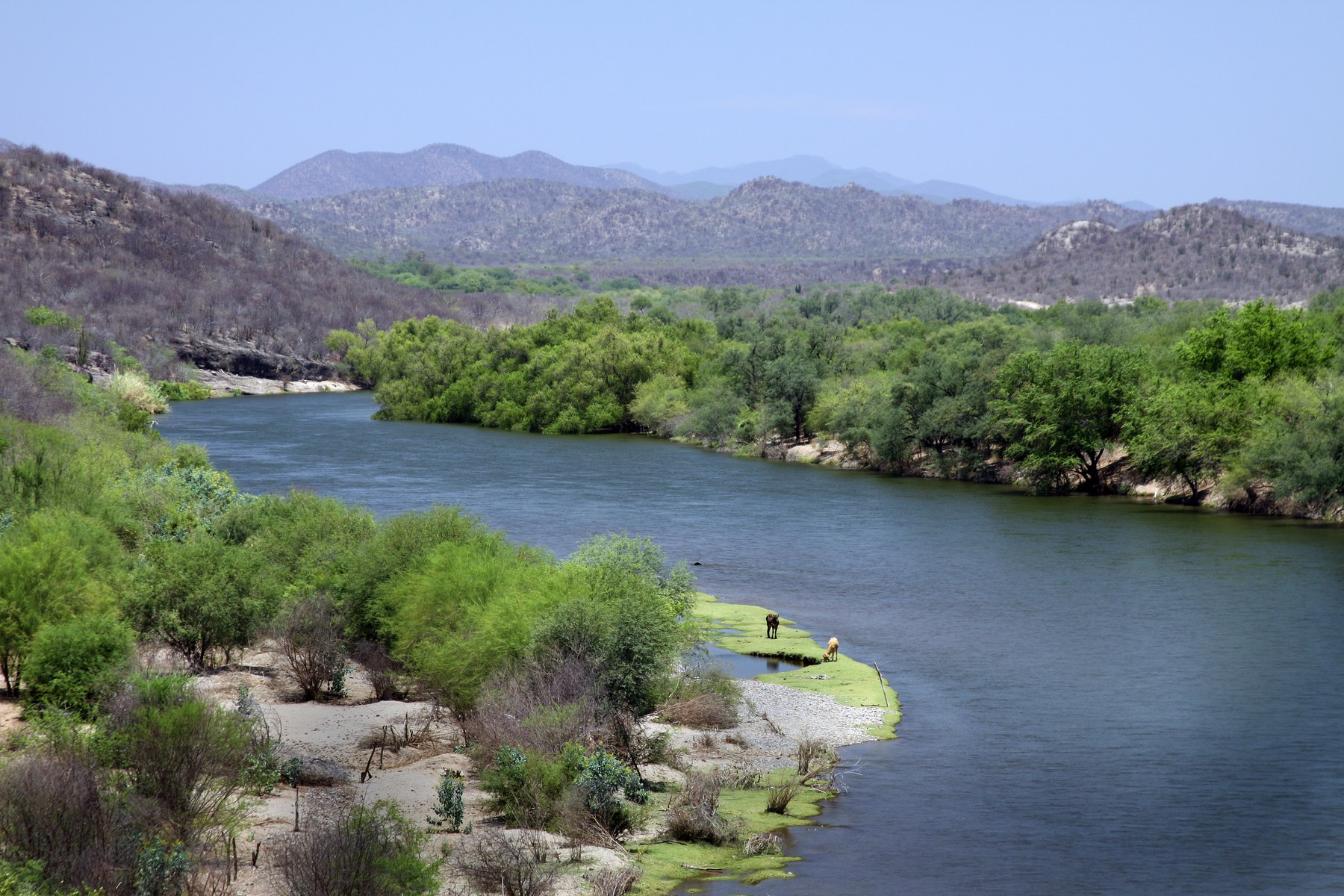
The photographer’s Commons record identifies this as the Yaqui River in Sonora, Mexico and declares own work under CC BY-SA 3.0 (also offered under GFDL; this reuse selects CC BY-SA 3.0). The complete downloaded 4752×3168 frame and the identification/license/EXIF sections were inspected. The museum orientation and the 2016 Yaqui dictionary foreword provide the people-level Yaqui River/Sonora context. This is a modern river landscape, not a photograph of Texas Band members or proof of Indigenous territorial boundaries. It does not identify the cattle as belonging to Yaqui people. EXIF records June 4, 2009, but camera timestamps are not independent dating evidence. Web copy is proportionally resized/recompressed to 1800 × 1200, preserving the complete frame; card and backdrop use CSS crops/overlays. No content is generated, retouched or added. The photograph and resized derivative remain CC BY-SA 3.0; creator/source/license credit is retained. This visual review does not increase substantive source counts.
Image, association, and reuse record reviewed 2026-10-25.
Full photographs are displayed proportionally above. A translucent background copy may be cropped by the viewport; it does not replace the complete image or its record.
The visual treatment does not change the research status, evidence, or remaining gaps recorded in this profile.
Start reading here
A cross-border people-level route spanning distinct Texas Band, Pascua Yaqui and Sonora communities. The Sonora articles are Spanish full text with English abstracts; the river study was read only in selected pages and the oral-history narrative through pp. 9–18. Neither establishes the Texas Band's migration narrative, current water rights or all Yaqui women's experience.
The Texas Band's self-account introduces its own family and migration narrative without treating its recognition assertions as independently established law.
Two Pótam women's attributed memories bring displacement, return and community responsibility into view through an explicit oral-history method.
These are selected starting points. The full annotated collection, source perspectives, inspection limits and remaining research questions follow below. A starting guide is not an exhaustive history or community endorsement.
01
A Texas community account
The Texas Band of Yaqui Indians describes its community through Yoeme family histories of displacement from Sonora and continuing relationships with Yaqui pueblos there. Its longer institutional account places a Presidio/Fort Davis connection in the 1870s. These details are attributed to this publisher; the underlying family and archival records were not inspected. The two pages form one institutional account, not two independent historical confirmations.
An El Paso crossing remembered in an Arizona study
In his 1940 study of Pascua, Arizona, Spicer reports a recollection that Francisco Valencia crossed at El Paso with a circus troupe. He places it among residents’ memories of travel and escape from Sonora. This is a mediated local recollection, without a crossing date in the selected passage. It does not establish permanent El Paso settlement, present-day descent or the Texas Band’s specific Presidio/Fort Davis migration account.
Texas Senate Resolution 989 was adopted on May 27, 2015. Its operative clauses honor the Band’s members and request a commemorative copy. The historical recitals should be read alongside the community account rather than treated as an independent archival investigation. This review does not determine broader legal effects or equate the resolution with federal acknowledgment.
Public Law 95-375, enacted September 18, 1978, addresses the named Pascua Yaqui association and Tribe in Arizona. It provides for federal-service eligibility and includes trust-land, governing-document and membership provisions. This is an historical enactment, not a statement of every Yaqui community’s status or of current membership rules. Later amendments were not reviewed.
The Pascua Yaqui Teacher Language Institute describes goals for preparing language instructors, curriculum and family language use. These are stated educational aims, not measured outcomes. On the same page, instructor Graciela Garcia describes growing up with Yaqui as a first language and facing difficulties learning English at school. Her account is an individual experience, not a generalization about all Yaqui speakers or Texas education.
The 2016 Diccionario yaqui de bolsillo presents Yaqui–Spanish and Spanish–Yaqui material. Its acknowledgments credit Yaqui-speaking teachers, and its teacher-written foreword explains educational and intergenerational purposes. The inspected front matter supports that collaborative context; it does not establish present fluency, universal dialect coverage or a full review of the entries.
The Pascua Yaqui Tribal Library describes Hiaki special collections, literacy support and family programming. Its page links readers to books, catalogues and digital services. The library account is useful educational context; each linked book still needs its own review. Availability and account requirements of the individual services were not checked.
In the selected introduction to the 1936 Texas Technological College study, Holden describes how intermediaries and translation shaped the expedition’s access to Sonora communities in 1934. This helps readers examine who recorded an account and how. The excerpt is not direct evidence of Texas settlement. The later chapters and illustrations were not reviewed, and hosting by a present-day Tribal library is not blanket endorsement.
This remains a foundational source guide. The Sonora studies and Spicer’s selected Arizona history add different perspectives; an El Paso crossing recollection does not settle the Texas Band’s migration account. Continue with community-directed history, documented migration records and language scholarship. The museum sheet is brief orientation; the retained INPI route remains unread. Follow cultural materials through the relevant community publisher and stated scope.
Historian Esther Padilla Calderón explains how the Yaqui River’s floods supported cultivation while sometimes damaging or relocating settlements. Her selected historical account describes a major channel change in 1833 and later attempts to control the river through irrigation works and dams. This helps readers see the Sonora homeland as a changing lived landscape. Her explanation combines archival material with earlier scholarship; the underlying archival files were not inspected for this guide. It does not establish present water allocations or Texas settlement history.
Edna Lucía García Rivera’s 2023 study follows the memories of two older women living in Pótam. They recall ancestors’ displacement, survival and return, and connect those memories with responsibilities to family and community. García Rivera interprets their accounts through oral history and postcolonial feminist scholarship. These are named individual perspectives shaped by remembrance and the research encounter. They enrich the history without standing for every Yaqui woman or independently confirming each event recalled.
Substantive Texas migration history still rests mainly on one institutional account; primary records and distinct community perspectives remain needed.
No comprehensive Sonora community-history, land/water-history or language review has been completed.
The 2015 resolution’s broader legal effects, the older About page’s reservation/treaty assertion and related certificates remain unassessed; no federal-status equivalence is inferred.
The 1936 book and 2016 dictionary were inspected only in the selected front matter/introduction, not in full.
Program descriptions establish stated activities/aims, not outcomes, speaker counts or universal practice.
The INPI original page remained unavailable to direct retrieval; indexed search text was not counted.
No community review or endorsement is recorded.
The new 2017 river-history work was read only in selected pages, and its underlying archival files were not inspected.
The 2023 Pótam study offers two women’s memories and a scholar’s interpretation, not a representative survey or independent verification of every recalled event.
The existing Sonora river photograph provides landscape context; a specifically relevant Texas Band picture remains a separate gap.
Spicer’s selected 1940 account supplies an undated El Paso crossing recollection within a 1930s Pascua, Arizona study. Original crossing/interview records, a connection to the Texas Band narrative and a full-book review remain unestablished.
2026-10-25: integrated the saved Texas Yaqui review after reinspection and added public educational sources. Existing three source URLs and all prior directory/map routes retained. The two Texas Band routes count once; SR 989 and the museum/cultural orientations are supporting. The 1978 act is read as a dated enactment. Selected 1936 and 2016 excerpt scopes are explicit. Six works count; four supporting content checks and two unread/navigation leads do not. No map or documentary image added. 2026-10-26: added two actually inspected scholarly works for selected Sonora river history and attributed oral-history research. Eight substantive works now count, while supporting references/unread leads remain excluded and adequacy remains Still unfinished. Texas migration claims were not independently corroborated. The existing credited Sonora river image is preserved; the stale claim that no photo existed was corrected. A new Texas Band identity-only route is separate from the Pascua Yaqui Tribe and does not imply a legal-status finding.
Follow the reading path
Sources & further reading
Open any title to read the original source. Annotations explain what each link can help you explore.
No Indigenous-led source is identified in this entry yet. This is a gap in this collection, and does not imply an absence of community knowledge or organization.
Retained INPI government reading lead for Sonora. Direct retrieval returned 502 during both saved review and this follow-up. Search-index material was not used as a completed original-page review.
Inspection: Content review not recorded
Access recorded: October 19, 2026
Access note: Automated 502 is not evidence of a reader paywall or of missing community records.
Counting note: Original page content not successfully inspected.
A short Pascua Yaqui Tribe cultural orientation. Its public introductory text was read, but detailed ceremonial descriptions and location links are outside this guide’s synthesis. It does not describe Texas Band institutions.
Inspection: Supporting or limited review; see scope
Scope: Public Culture page main text, including opening orientation; no linked ceremony/location pages or images inspected.
Review recorded: October 25, 2026
Counting note: Short orientation, retained as supporting context.
Retained official Pascua Yaqui departmental navigation lead. Linked program pages are separate works below; this index is not counted as substantive evidence.
Inspection: Content review not recorded
Access recorded: October 19, 2026
Counting note: Navigation lead only; no substantive original content review recorded.
The publisher describes its Yoeme family history through displacement from Sonora and continuing community relationships. Read with its longer About account as one institutional self-account. Its legal-authority and recognition assertions are not independently verified here.
Inspection: Content reviewed for the stated scope
Scope: Complete readable main body, naming and relationship statements; web lines 17–35. The longer About route was also read and is excluded as a second work.
Review recorded: October 25, 2026
Access note: Public readable text. Publication/revision date unstated. No images, certificates, genealogy or private records inspected.
Inspected material and access routes
Longer About account ↗ — Complete readable body, lines20–84; same institutional account, not an independent additional work.
A longer account of the publisher’s Presidio/Fort Davis migration history and relationship to other Yaqui communities. Retained as an alternate reading route to the same institutional account, not additional corroboration. A paragraph linking an 1864 arrangement with the Treaty of Guadalupe Hidalgo was not adopted.
Inspection: Supporting or limited review; see scope
Scope: Complete readable substantive body, lines 20–84. No underlying census, genealogy, certificates or reservation documents inspected.
Review recorded: October 25, 2026
Counting note: Same institutional self-account as Source 4; excluded to avoid duplicate counting.
Adopted May 27, 2015. The operative clauses honor Texas Band members and request a commemorative copy. Historical recitals are not an independent archival audit. This short instrument does not resolve the wider status questions in this review.
Inspection: Supporting or limited review; see scope
Scope: Entire enrolled resolution and adoption certification, lines 4–61.
Review recorded: October 25, 2026
Counting note: Short commemorative primary record; supporting, not a substantial historical study.
A brief museum orientation locating the homeland in Sonora’s Yaqui River valley and noting communities in Texas, Arizona and California. Its generalized recognition wording should be read with the specific 1978 statute below. Population totals, war chronology and ceremonial narratives are not adopted here.
Inspection: Supporting or limited review; see scope
Scope: All searchable text of the two-page PDF, lines 0–34; no separate visual image/map review.
Review recorded: October 25, 2026
Access note: Public PDF. Document date unstated; current figures and the linked website’s services were not checked.
Counting note: Brief orientation rather than a substantive people-level history.
One 1936 expedition account, inspected only in its introduction and front matter. Holden describes intermediaries, translation and the party’s 1934 Sonora fieldwork. This is evidence about that research encounter, not proof of Texas settlement; modern hosting does not imply endorsement.
Inspection: Content reviewed for the stated scope
Scope: Title/imprint, acknowledgments and contents; printed pp. 7–8 and opening p. 9 through the visits-to-Vícam/Tórin passage (PDF pp. 9–11). Remaining chapters, illustrations, anthropometric, medical and ceremonial material were not selected.
Review recorded: October 25, 2026
Access note: Public reading copy linked by the Pascua Yaqui Tribal Library. No reuse license established; link-only. Not a full-book content check.
The two-page enactment concerns the named Pascua Yaqui association/Tribe in Arizona, including eligibility for federal services, trust-land provisions, governing documents and membership. It is a dated primary record; later amendments and current consolidated law were not reviewed.
Inspection: Content reviewed for the stated scope
Scope: Complete two-page statute,92 Stat.712–713, including sections 1–3 and legislative-history footer.
Review recorded: October 25, 2026
Access note: Official publicPDF. Used for historical scope, not current enrollment criteria, jurisdiction or legal advice.
The Tribe describes teacher preparation, language instruction and family/curriculum goals, with educator perspectives. These are the publisher’s stated aims and individual accounts; certification totals, outcomes and a Texas program are not established.
Inspection: Content reviewed for the stated scope
Scope: TLI program information, goals/core values and Graciela Garcia/Celia Gonzales accounts, web lines 173–211. Other linked programs and images not inspected.
Review recorded: October 25, 2026
Access note: Undated public program page; no current participant count or measured outcomes used.
A community-published account of literacy, Hiaki collections, family programming and technology access. Linked books are reading routes, not additional completed source checks. Services are described as posted, without checking enrollment or access requirements.
Inspection: Content reviewed for the stated scope
Scope: Mission and department-services sections, web lines 163–193; catalogue/database links noted but not used. Hours, contact records and images not used.
Review recorded: October 25, 2026
Access note: Public text. Individual digital services and library-card/account requirements were not tested.
Community-collaborative scholarshipCrescencio Buitimea Valenzuela, Zarina Estrada Fernández, Aarón Grageda Bustamante, Manuel Carlos Silva Encinas; Universidad de SonoraSource 12
A 2016 bilingual dictionary whose acknowledgments and teacher-written foreword describe collaboration with Yaqui-speaking educators and educational purposes. Only front matter and the foreword were inspected; no comprehensive vocabulary or dialect-coverage review is claimed.
Inspection: Content reviewed for the stated scope
Scope: Title/copyright (printed pp. 5–6), acknowledgments (p. 7) and Prólogo (pp. 9–12), corresponding PDF pp. 7–9 and 11–14 of the 239-page hosted copy. The ResearchGate cover sheet is not counted as another edition/work.
Review recorded: October 25, 2026
Access note: Public PDF supplied through the Tribal Library. Copyright statements retained; no image/text reproduction or reuse license claimed. Hosting is not blanket endorsement of every passage.
A historian’s analysis of changing relationships among river floods, cultivation and hydraulic infrastructure. The selected pages connect Yaqui settlement and farming with river change; this is a Sonora historical study, not Texas migration evidence. Its arguments and cited archival documents should be distinguished from directly inspected primary records.
Inspection: Content reviewed for the stated scope
Scope: Publisher record plus actual publisher PDF: printed pp. 67–69, 75–80 and 97–99 (PDF pages 1–3, 9–14 and 31–33 of 40). Title page visually inspected. Remaining narrative and bibliography were not content-reviewed; figure captions in selected text were read, but maps/figures were not visually evaluated or reused.
Review recorded: October 26, 2026
Access note: Public Spanish full text, with English abstract; no account or paywall encountered. Web-tool PDF retrieval failed, but the publisher PDF downloaded normally with PowerShell; the PDF text and title frame were inspected. Publisher states CC BY 4.0 and PDF title page bears CC BY; link-only use proposed. Historical generalizations are attributed; present water rights, allocation and conditions were not established.
Inspected material and access routes
Publisher full-text PDF ↗ — Selected printed pages 67–69, 75–80 and 97–99; complete available PDF downloaded for private reading, not fully reviewed.
García Rivera, Edna Lucía. 2023. “La recuperación de la memoria de la mujer yaqui: una mirada a la solidaridad, colectividad y agencia.” Alteridades 33(65): 9–19. https://doi.org/10.24275/uam/izt/dcsh/alteridades/2023v33n65/Garcia
Publication: 2023-04-11
An oral-history study centered on two older women living in Pótam, Sonora. Their family memories and the author’s analysis address displacement, return and community responsibility. It supplies attributed individual perspectives and an explicit method, not a representative survey of all Yaqui women or independent verification of every remembered event.
Inspection: Content reviewed for the stated scope
Scope: Actual publisher PDF narrative and notes, printed pp. 9–18 (PDF pages 1–10 of 11), including introduction/method, historical context, both interview cases and final considerations. Bibliography on pp. 18–19 inspected as references only; cited books/articles not separately reviewed. Title page visually inspected.
Review recorded: October 26, 2026
Access note: Public Spanish full text with English abstract; no account/paywall encountered. The researcher identifies herself as non-Indigenous and describes a Yaqui intermediary and family participation. No interview transcript, audio, private records, restricted cultural material or documentary photographs reproduced; original publication remains linked.
Inspected material and access routes
Publisher full-text PDF ↗ — Narrative and notes on printed pp. 9–18; references are leads rather than additional checked works.
Academic / historical ethnography with attributed recollectionsEdward H. Spicer; University of Chicago Press (1940); University of Arizona Press open-access reprint (2019)Source 15
Spicer, Edward H. 1940. Pascua: A Yaqui Village in Arizona. Chicago: University of Chicago Press. Chapter I, selected History paragraphs. Open Arizona reprint, University of Arizona Press, May 2019, ISBN 9780816540327.
Publication: 1940
Spicer places migration memories within his study of Pascua, Arizona, including an El Paso crossing recollection. This outside anthropologist’s mediated local account does not corroborate the Texas Band’s specific Presidio/Fort Davis narrative.
Inspection: Content reviewed for the stated scope
Scope: Chapter I: History opening paragraph (including Francisco Valencia’s reported El Paso crossing), following historical-context/migration paragraphs, and selected Yaquis in Arizona/local-founding paragraphs; Population opening establishes the May 1937 study context, and Summary opening was read. The indexed body omits intervening text, so this is noncontinuous selected content, not a complete chapter or book review. No printed pagination was available in the inspected HTML; none is invented.
Review recorded: October 27, 2026
Access status: Publisher-designated open-access English reprint; selected substantial indexed chapter body inspected
Access note: Normal chapter retrieval returned a JavaScript reader shell (HTTP 200), while search exposed substantial primary-publisher chapter text. Only the selected body is claimed as inspected; this was not a paywall or challenge bypass. Full-book text, maps, images, raw interviews and a paginated PDF were not inspected. Historical population, racial classifications, blanket migration/language claims and culturally governed descriptions were excluded from synthesis.
Inspected material and access routes
Publisher edition record ↗ — Title/subtitle, author, open-access reading link, original 1940 publication statement, 325-page description, May 2019 open-access edition and ISBN; web lines 12–26.
Related entries may represent alternate names, constituent communities, wider groupings, or historical connections. Read the naming notes before treating entries as equivalent.
Robey’s Atlas of Indigenous North America · Compiled October 19, 2026 · Yaqui