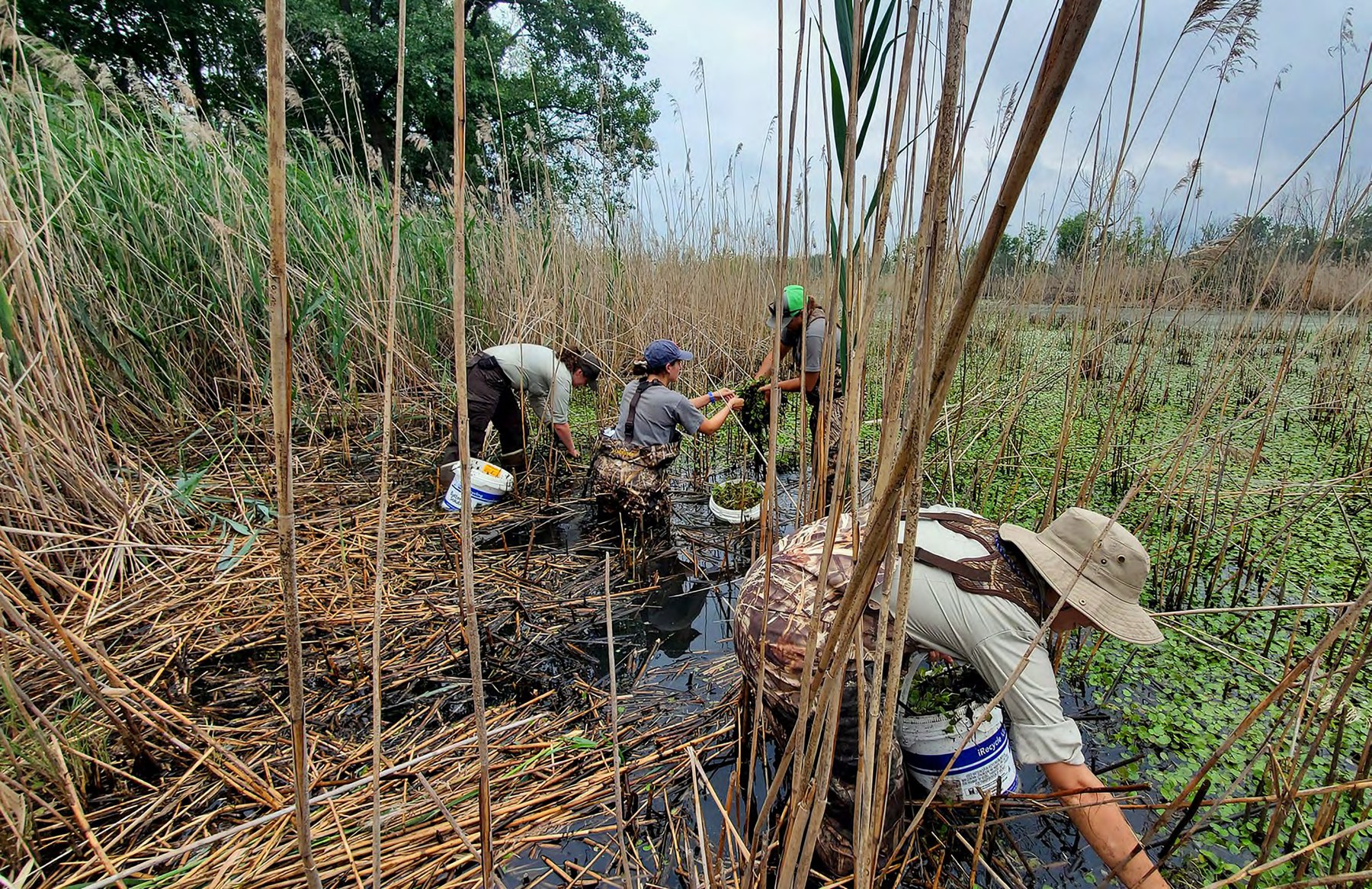
Invasive-plant removal at Six Points — USFWS report photographU.S. Fish and Wildlife Service, invasive European frog-bit removal at Six Points;2022 Coastal Program Accomplishment Report, printed 19-20.
Contemporary community and self-governing organization · Added to the original list
Wyandot of Anderdon Nation
The Wyandot of Anderdon’s public history follows families around the Detroit River region. A federal conservation report documents collaborative work at Six Points.
See each region’s evidence for historical or present-day scope.
Homeland / region
Trenton, Michigan — public mailing location
Research depth
Source guide
Source collection
2 annotated resources · 0 Indigenous-led
Inspected sources
2 substantive works · selected content reviewed
Initial adequacy
Still unfinished
Source review
October 27, 2026
Names & relationshipsThe Nation’s public pages identify a Wyandot community with an elected council and describe its nonprofit corporate form. Wyandotte Nation’s history separately names the Anderdon community in Michigan. This outline keeps the community and organization context visible and does not equate corporate status, federal acknowledgment, shared peoplehood or individual citizenship.
A source guide for a deeper dive.This entry provides a brief orientation and an organized reading path. A comprehensive deep dive has not yet been completed. Follow the annotated sources and distinguish primary community accounts from outside reference material.
Still unfinished
A bounded starting path now uses inspected public content, with scope and access limits recorded. This is not comprehensive research or community review.
Assessment recorded October 27, 2026. This is separate from research completion and community review.
Compare the public synthesis with the underlying dated records and additional publicly shared Anderdon voices; the embedded historical timelines remain unreviewed.
Check later cultural-project publications and documented restoration monitoring before describing present operation or outcomes. Respect restrictions on citizens’ and ceremonial material.
The community’s nonprofit description, its elected council, federal acknowledgment and wider Wyandot peoplehood remain distinct matters. No status, individual descent, land-rights conclusion or community endorsement is supplied.
Backdrop photographs & credits
These photographs have individual, documented connections to this entry. Their captions and source records define the people, place, object, and period shown; no one photograph represents every community within a broader label.
Invasive-plant removal at Six Points — USFWS report photograph U.S. Fish and Wildlife Service, invasive European frog-bit removal at Six Points;2022 Coastal Program Accomplishment Report, printed 19-20.
Physical PDF page 11/printed 19-20 was rendered and read, including the media-specific caption Invasive European frog-bit removal / USFWS and the body explicitly identifying Six Points and pictured restoration. The Service copyright statement was read: outside images can be copyrighted and are identified separately. This photograph is credited to USFWS with no external copyright notice; federal-work public-domain basis is used. No agency logo is copied. Extracted image XObject Im 0.jp 2,2555x1655, from that page; preserved its exact extracted bytes privately and decoded the entire frame to RGB PNG for review. Actual full-frame pixels inspected against the printed spread. No caption overlays, crop, retouching or generated content added. This is public conservation work, not a ceremonial activity. Individuals are not assigned Tribal identity or names; no claim of present visitor access. Complete available 2555×1655 source frame proportionally resized to 1800×1166 and JPEG recompressed; no pixel crop or retouching. Original source copy retained privately. CSS crops/overlays affect display only.
Image, association, and reuse record reviewed 2026-10-27.
Full photographs are displayed proportionally above. A translucent background copy may be cropped by the viewport; it does not replace the complete image or its record.
The visual treatment does not change the research status, evidence, or remaining gaps recorded in this profile.
Add the specific dated report of ecological work with named partners at Six Points.
These are selected starting points. The full annotated collection, source perspectives, inspection limits and remaining research questions follow below. A starting guide is not an exhaustive history or community endorsement.
01
Reading the community’s own history
Anderdon’s public history describes movement to Detroit in the early eighteenth century, settlement near Amherstburg and continuing family histories on both sides of the Detroit River. It also describes language and historical-archive work. The page’s account of a project ending in 2025 is retained as a dated report, with its later continuation still to investigate.
The U.S. Fish and Wildlife Service’s 2022 report describes cooperation with the Wyandot community, the International Wildlife Refuge Alliance and local volunteers at Six Points. It reports removing invasive plants to restore more than five acres of wetlands. This specific public conservation activity adds another way into the community’s relationship with place; the report is not a current visitor-access guide.
Compare the public synthesis with the underlying dated records and additional publicly shared Anderdon voices; the embedded historical timelines remain unreviewed.
Check later cultural-project publications and documented restoration monitoring before describing present operation or outcomes. Respect restrictions on citizens’ and ceremonial material.
The community’s nonprofit description, its elected council, federal acknowledgment and wider Wyandot peoplehood remain distinct matters. No status, individual descent, land-rights conclusion or community endorsement is supplied.
Selected actual-content works support a bounded starting guide. Earlier source objects retain their original review dates and limits. Reused URLs, images and identity-only checks are not new global historical works. Full history and community review remain open.
Follow the reading path
Sources & further reading
Open any title to read the original source. Annotations explain what each link can help you explore.
No Indigenous-led source is identified in this entry yet. This is a gap in this collection, and does not imply an absence of community knowledge or organization.
Community historical synthesisWyandot of Anderdon NationSource 1
The community’s public history follows movements around the Detroit River and describes later efforts in language, history and archives. Read as its situated synthesis rather than a universal Wyandot history.
Inspection: Content reviewed for the stated scope
Scope: Entire publicly exposed Short History body read, including expanded paragraphs about the Detroit River, Anderdon Reserve, southeast Michigan and cultural work. No login, citizen-only Facebook page or restricted material accessed; embedded Prezi timelines not inspected. The page anticipates a grant ending in 2025, so that project is not described as currently running. Underlying treaties, family archives and legal claims were not verified.
A concrete account of wetland restoration at the Six Points Wyandot Tribal Heritage Site, identifying the Wyandot community and its collaborators. It complements the community history with a dated activity record.
Inspection: Content reviewed for the stated scope
Scope: Physical PDF page 11, a spread printed 19-20, full Michigan/Six Points body and image caption read as extracted text and rendered pixels. Regional headline statistics were not attributed to this site. Other projects and later outcomes were not reviewed.
Related entries may represent alternate names, constituent communities, wider groupings, or historical connections. Read the naming notes before treating entries as equivalent.
Robey’s Atlas of Indigenous North America · Compiled October 19, 2026 · Wyandot of Anderdon Nation