Wiikwemkoong’s public history places its community on Odawa Mnis, or Manitoulin Island, within Three Fires relationships. A speaker’s dictionary account offers a second, locally situated route into language work.
See each region’s evidence for historical or present-day scope.
Homeland / region
Ontario, Canada — listing address only
Research depth
Source guide
Source collection
2 annotated resources · 0 Indigenous-led
Inspected sources
2 substantive works · selected content reviewed
Initial adequacy
Still unfinished
Source review
October 27, 2026
Names & relationshipsListed as an Anishinabek Nation member First Nation. This is an organizational relationship; membership alone does not establish ethnicity, language, ancestry, citizenship, jurisdiction or representation of another named community.
A source guide for a deeper dive.This entry provides a brief orientation and an organized reading path. A comprehensive deep dive has not yet been completed. Follow the annotated sources and distinguish primary community accounts from outside reference material.
Still unfinished
Two directly relevant works have been read for a bounded starting guide. The selected perspectives and periods leave substantial community history and later developments unreviewed.
Assessment recorded October 27, 2026. This is separate from research completion and community review.
Extend community-directed history beyond the selected public narrative, including independently contextualized treaty-era documents.
Read more Wiikwemkoong-authored language and education works; the selected dictionary paper is one speaker’s account.
Verify later dictionary developments separately; no present speaker totals or complete dictionary review is supplied.
Backdrop photographs & credits
These photographs have individual, documented connections to this entry. Their captions and source records define the people, place, object, and period shown; no one photograph represents every community within a broader label.
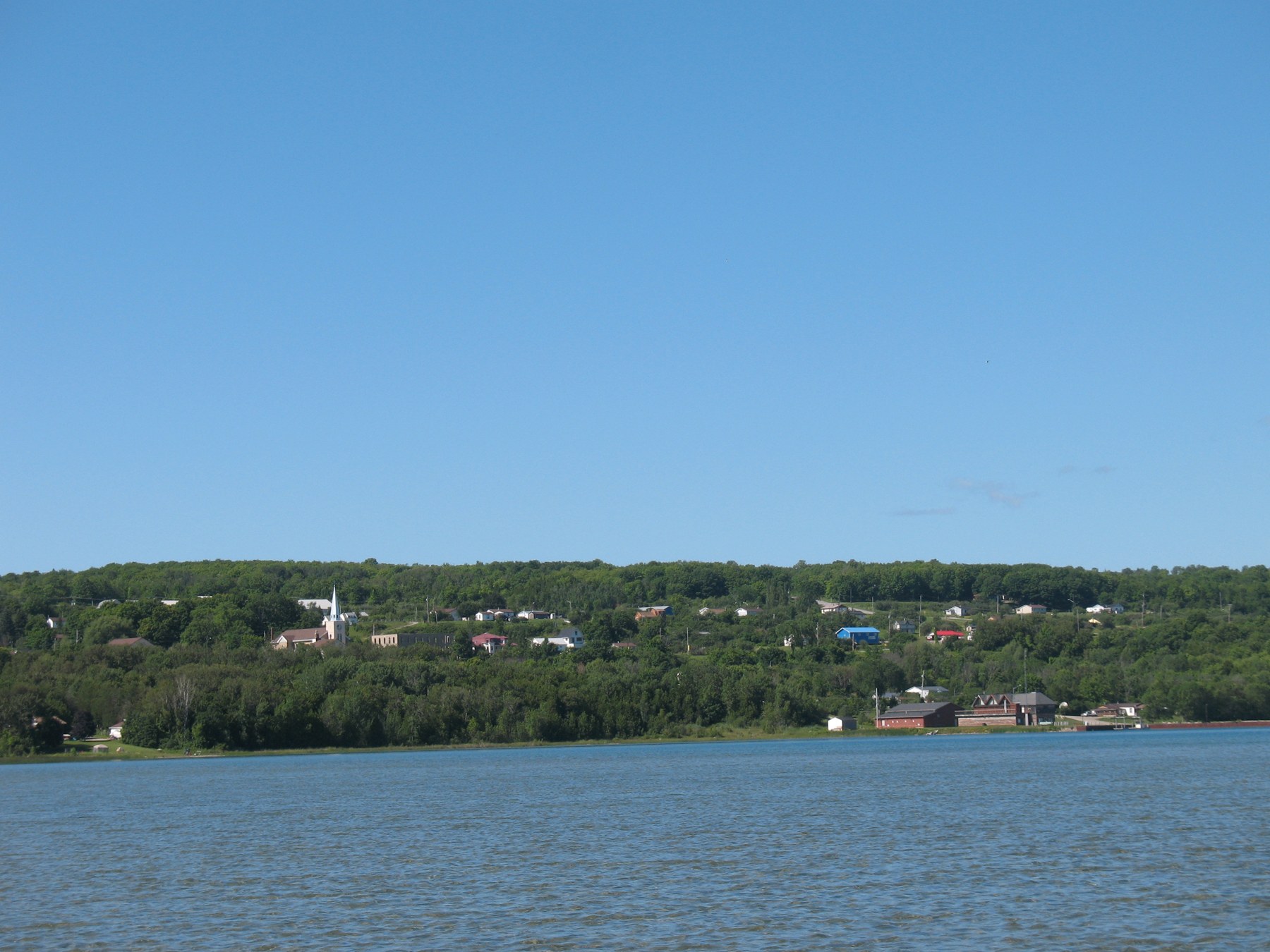
View across a bay toward part of Wiikwemkoong, July 2010 Hans-Jürgen Hübner / Wikimedia Commons · CC BY 3.0 · resized and recompressed
Commons item explicitly identifies a view over a bay toward part of Wikwemikong. Community history identifies Wiikwemkoong on Manitoulin Island. This is a dated community landscape, not a claim that visible buildings typify Indigenous architecture. Complete available 3264×2448 source frame proportionally resized to 1800×1350 and JPEG recompressed; no pixel crop or retouching. Original source copy retained privately. CSS crops/overlays affect display only.
Image, association, and reuse record reviewed 2026-10-27.
Full photographs are displayed proportionally above. A translucent background copy may be cropped by the viewport; it does not replace the complete image or its record.
The visual treatment does not change the research status, evidence, or remaining gaps recorded in this profile.
Read an explicitly Wiikwemkoong speaker’s account of how documentation decisions were made.
These are selected starting points. The full annotated collection, source perspectives, inspection limits and remaining research questions follow below. A starting guide is not an exhaustive history or community endorsement.
01
Diplomacy, migration and community history
Wiikwemkoong’s historical account describes Odawa life on Manitoulin Island, relations among the Odawa, Ojibway and Potawatomi, and diplomacy with French and British newcomers. It records Wiikwemkoong’s refusal to sign the 1862 Manitoulin treaty and the 1968 amalgamation of the Manitoulin Island Unceded, Point Grondine and South Bay bands. These events are presented through the Nation’s account of its political history.
Mary Ann Corbiere explains that her way of speaking reflects Wiikwemkoong. Teaching prompted her to gather words absent from available dictionaries for an Odawa and Eastern Ojibwe project. Repeated workshops checked usage and generated further vocabulary; she also identifies limits where new entries could not be checked with every group. Her account treats documentation as continuing collaboration and judgment.
Extend community-directed history beyond the selected public narrative, including independently contextualized treaty-era documents.
Read more Wiikwemkoong-authored language and education works; the selected dictionary paper is one speaker’s account.
Verify later dictionary developments separately; no present speaker totals or complete dictionary review is supplied.
Selected actual-content works support a bounded starting guide. Earlier source objects retain their original review dates and limits. Reused URLs, images and identity-only checks are not new global historical works. Full history and community review remain open.
Follow the reading path
Sources & further reading
Open any title to read the original source. Annotations explain what each link can help you explore.
No Indigenous-led source is identified in this entry yet. This is a gap in this collection, and does not imply an absence of community knowledge or organization.
Community historyWiikwemkoong Unceded TerritorySource 1
The Nation’s public historical narrative connects Great Lakes diplomacy, nineteenth-century treaty pressures, amalgamation and language work. Treaty interpretations remain attributed to this account.
Inspection: Content reviewed for the stated scope
Scope: Actual history body, paragraphs from Odawa Mnis and early contact through the 1968 amalgamation, 2014 constitution and 2006 language strategy (web lines 146–169).
Indigenous-authored language education scholarshipProceedings of the 27th Stabilizing Indigenous Languages Symposium; Queen’s University journal platformSource 2
Mary Ann Corbiere situates dictionary work in her Wiikwemkoong speech and teaching experience. Repeated speaker checking expands the material while exposing limits in community attribution.
Inspection: Content reviewed for the stated scope
Scope: Fresh actual PDF reading of printed 105–109 (PDF pages 2–6): introduction, Wiikwemkoong speech context, teaching motivation and repeated checking workshops. Official landing page inspected for release date.