The Tonkawa Tribe of Oklahoma is a contemporary sovereign community. The Tribe’s public history centers the 1884–1885 forced removal from Fort Griffin, Texas, to Oakland in present-day Oklahoma. Historical records describe Tonkawa-speaking communities and named groups across Texas and the southern plains, but their composition, earlier locations, and relationships remain debated. This guide puts the Tribe’s present account beside archival and scholarly records, including a treaty, federal reports, and a later Tonkawa memorial challenging a land cession.
See each region’s evidence for historical or present-day scope.
Homeland / region
Great Plains / Texas / Oklahoma
Research depth
Source guide
Source collection
17 annotated resources · 5 Indigenous-led
Inspected sources
12 substantive works · selected content reviewed
Initial adequacy
Still unfinished
Source review
October 23, 2026
A source guide for a deeper dive.This entry provides a brief orientation and an organized reading path. A comprehensive deep dive has not yet been completed. Follow the annotated sources and distinguish primary community accounts from outside reference material.
Still unfinished
Twelve substantive inspected works support a careful initial guide: the Tribe’s public history and language materials, TxDOT’s 2021 historical synthesis, Jones’s 1969 Smithsonian study, the 1837 Texas treaty, the 1846 multination Council Springs treaty, the 1891 federal agreement record, a council-adopted Tonkawa memorial with member affidavits, the corrected Fifth Circuit opinion on the 1866 Texas act, a scholarly study of the 1862 massacre, an 1866 Texas governor’s letter, and an 1876 federal compilation on Tonkawa and Lipan people at Fort Griffin. Five supporting access/context references remain excluded. The new congressional document adds government correspondence about ration decisions and proposed relocation; it is not Tonkawa testimony and does not show that proposals were implemented. The collection still relies heavily on government and outside written records and does not provide a full Tonkawa-authored account of the massacre. It remains unfinished and does not settle the causes of the 1862 attack, consent to the 1891 cession, or all questions about historical Texas relationships.
Assessment recorded October 23, 2026. This is separate from research completion and community review.
The 1862 massacre article is a secondary interpretation. Tonkawa-authored or community-held public accounts of the event and the original underlying government records need further review; no single-cause explanation is adopted.
The timing/direction of earlier movement, composition of named bands, language classification, and archaeological associations remain contested or uncertain.
The 1837 treaty, 1891 agreement, and 1907 memorial have been read, but related federal/Republic records, ratification/implementation documentation, and later claim disposition still require systematic review.
The 1846 Council Springs treaty scan’s transcribed text and signatory pages were read; separate ratification instruments, later implementation, and Tonkawa-specific interpretations remain unreviewed.
Current community-authored cultural, language-program, and historical publications need broader review. The 2020 museum booklet and large dictionary were not fully inspected; failed automated access is not treated as a paywall.
The documentary site describes collaboration and an oral-history film project, but neither film nor interviews were viewed; culturally sensitive footage may require limits on public use.
Current population, enrollment, acreage, and program-status figures are not claimed from undated pages.
This review did not inspect or add maps.
The 1996 appellate decision addresses a specific claim under the 1866 Texas act; the underlying legislative record and later case treatment were not reviewed, and the ruling is not extended to broad homeland or present-identity questions.
Backdrop photographs & credits
These photographs have individual, documented connections to this entry. Their captions and source records define the people, place, object, and period shown; no one photograph represents every community within a broader label.
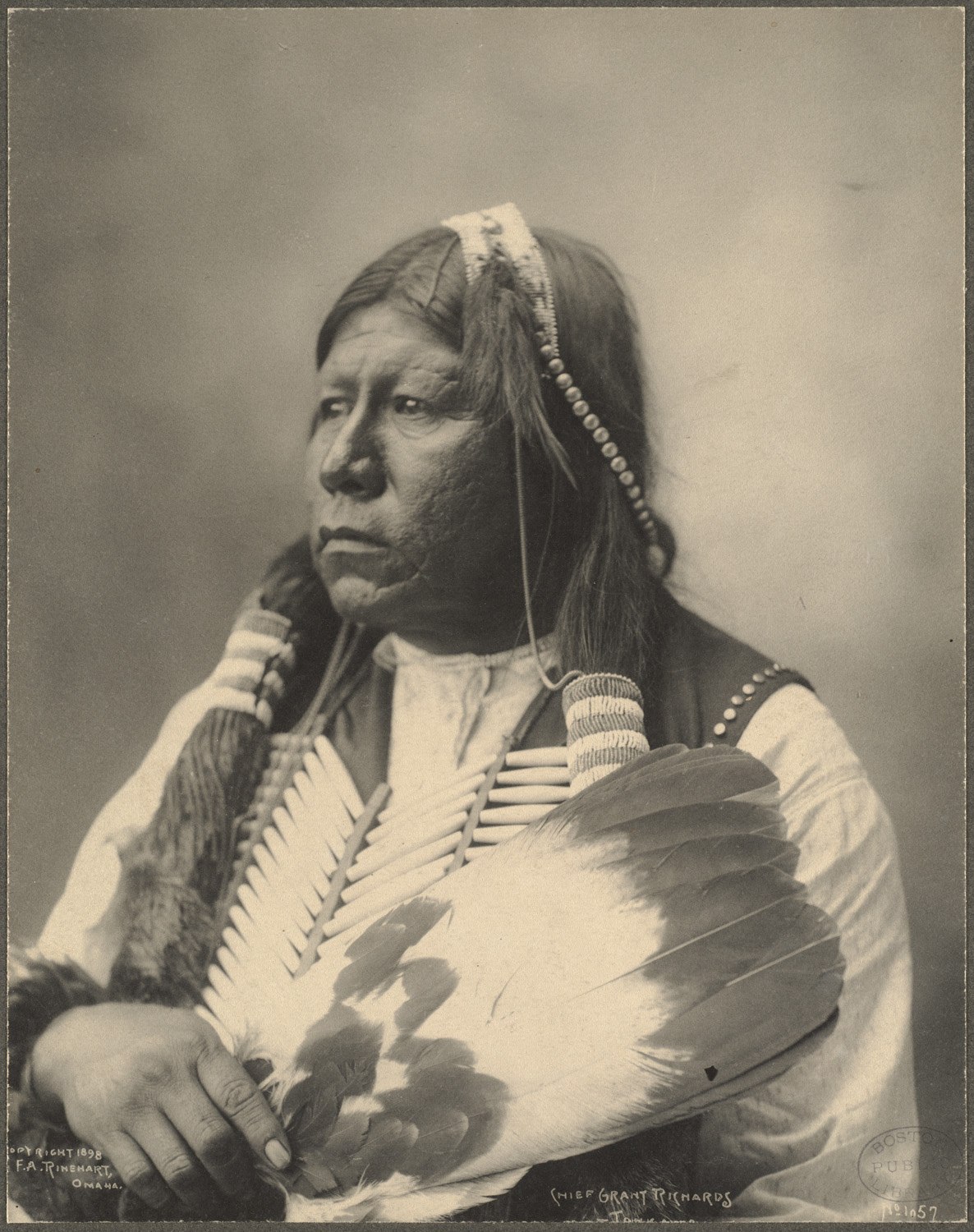
Chief Grant Richards, Tonkawa (1898) Frank A. Rinehart / Boston Public Library, Print Department, 09_06_000019, Rinehart no.1057 · CC BY2.0
An individually identified Tonkawa portrait, catalogued with the 1898 Omaha exposition. Appropriate for the broad Tonkawa profile. It does not establish a Texas photograph location, identify current officials, or represent every Tonkawa person or all historical clothing. Read the primary BPL Flickr item's subject, photographer, date, collection identifiers and rights notice; followed its CC BY2.0 link and read the license deed. Read Commons copying provenance and license. Visually inspected the complete1186×1500 available image, including original print edges and BPL stamp. The image is monochrome; no colorization, generation or retouching was performed. The web reader's Flickr image request returned403. The openly linked Commons copy downloaded normally; no access control was bypassed. The primary Flickr text and license remained readable. Complete-frame web copies are proportionally compressed/resized; CSS crops/overlays apply to background/card displays. No colorization, generation or retouching. The full available frame remains in the opened-page banner.
Image, association, and reuse record reviewed 2026-10-26.
Full photographs are displayed proportionally above. A translucent background copy may be cropped by the viewport; it does not replace the complete image or its record.
The visual treatment does not change the research status, evidence, or remaining gaps recorded in this profile.
Start reading here
The present Tonkawa Tribe of Oklahoma is distinct from changing historical band labels and outsider classifications. The selected report is partially inspected government synthesis, the language booklet is dated, and the memorial is the Tribe’s later claim rather than a judicial finding.
The council memorial and named affidavits preserve a Tonkawa challenge to the 1891 land cession’s terms and negotiation.
These are selected starting points. The full annotated collection, source perspectives, inspection limits and remaining research questions follow below. A starting guide is not an exhaustive history or community endorsement.
01
A contemporary Tribe and the scope of this entry
The Tonkawa Tribe of Oklahoma’s public profile places its headquarters and community in Kay County and describes an elected Tribal Committee and a constitution adopted in 1938 with amendments listed through 2014. The same undated page lists population, enrollment, and acreage totals; those figures are omitted as current statistics. This entry centers the present-day Tribe while examining older Tonkawa and Tonkawa-associated names as historical records use them.
The Tribe’s public history gives “Tickanwa-tic” as its self-name and identifies “Tonkaweya” as a Waco/Wichita name. Spellings in older records vary. Don Paterson’s introductory language outline was prepared for the Tribe’s language-restoration program; it includes a pronunciation guide and a first lesson, and explains its intended learning context. It documents a public educational resource, not the current reach of language programs or a count of speakers.
TxDOT’s 2021 report follows references from the seventeenth century through the nineteenth, including mission activity around the San Xavier/San Gabriel rivers and later locations across central Texas. Jones’s 1969 Smithsonian study assembles older colonial and American accounts. These records are uneven and mediated; their named bands and locations do not form a precise boundary map. TxDOT describes the statewide project as collaborative with participating Tribes, but this specific Tonkawa report does not identify a Tribal reviewer or approval.
A November 1837 treaty records terms negotiated by Tonkawa head chiefs and a Republic of Texas commissioner, including mutual peace language and a Republic-appointed trading agent. The 1846 Council Springs treaty text names Long-wha among ten participating Native groups; a signatory page separately labels a group of marks “Tonkaways.” Its articles describe U.S. control of trade, prisoner exchanges, rules for movement and criminal complaints, and proposed blacksmiths and schoolteachers. The archival title gives a March 1847 ratification date, but the linked advice-and-consent and ratification instruments, implementation, and Tonkawa interpretations were not inspected. The archive’s normalized nation fields omit Tonkawa even though the title and treaty pages name the group. These documents show what governments recorded in particular proceedings; they do not establish a modern boundary or one Tonkawa view of every agreement.
The Tribe dates removal from Fort Griffin to October 1884 and describes travel through the Sac and Fox and Ponca agencies before arrival at Oakland on June 30, 1885. It calls this forced journey its “Trail of Tears” and connects the date with its annual powwow. TxDOT’s later government chronology adds federal-policy context. The Tribe’s commemorative language is presented in its own voice; details are not extended beyond the sources.
The 1862 Fort Cobb attack and Texas’s request for relief
Joseph Connole’s 2019 scholarly article reviews several explanations for the 1862 Fort Cobb attack and massacre, including accusations about cannibalism, the wider assault on the agency, and accumulated intertribal and political conflicts. Connole argues that changing alliances and the failure of U.S. and Confederate authorities to protect the Tonkawa were central to their exposure; he also states that the immediate instigation remains uncertain and that only one first-hand account of the agency attack is known. A September 1866 letter from Texas Governor J. W. Throckmorton asks the federal commissioner for food, land and an agent for Tonkawa survivors who had returned to Texas. The letter describes events from the governor’s perspective and links relief to state frontier policy. Neither work supplies a Tonkawa-authored narrative of the massacre, and the article’s interpretation and numbers remain attributed. A separate 1876 congressional document prints earlier federal correspondence on Tonkawa people at Fort Griffin. Army officers discuss ration stoppages, brief relief, and possible reservation placement; these statements show the government’s administrative record and proposals, not a Tonkawa account or proof that a proposed relocation occurred.
An 1866 Texas law provided for a league of unappropriated state land to be used as a Tonkawa home while the Tribe lived there; the governor was to select the site and the fee remained with the state. In a corrected 1996 opinion, the Fifth Circuit reviewed the Tonkawa Tribe of Oklahoma’s later suit against Texas officials and affirmed summary judgment for the State. The court held that the act did not itself perfect a vested land grant because the State had not designated a site and the Tribe had not used the designated land as a homeland. This is the panel’s interpretation of a specific Texas statute and claim, not a ruling on the full extent of Tonkawa homelands or on the Tribe’s present existence. Later treatment of the case was not reviewed.
A 1892 federal Senate document transmits the 1891 agreement and reproduces agency and commission reports about allotments, the land involved, compensation, and the commissioners’ view of Tonkawa title. A memorial adopted by the Tonkawa Tribe in council in 1907 and presented to Congress in 1908 challenges the agreement’s terms and describes members’ understandings and absences. The memorial and affidavits are primary evidence of the Tribe’s later claim and testimony, not a judicial ruling; the federal reports are evidence of government reasoning, not a neutral account of consent. Reading both makes the disagreement visible without deciding it. Individual allotment schedules and burial-location details are not reproduced.
Historical sources disagree about the timing and direction of Tonkawa movement, which named bands became associated with the Tonkawa, and possible archaeological links. The proposed Toyah connection in Jones is explicitly uncertain. Secondary accounts give differing casualty estimates for the 1862 massacre; underlying records and community accounts need more direct comparison. A 1996 Handbook entry’s statement that the Tonkawa were no longer distinguishable as a tribe is contradicted by the present-day Tonkawa Tribe and is not used to describe current identity.
Start with the Tribe’s own history and government pages, then read its public language-learning outline. Compare the complete visible 1837 treaty transcription and selected 1846 Council Springs treaty pages with the 1891 federal agreement record and the council-adopted 1907 memorial, noting their different authors, purposes, and limits. The 1846 archive page links the main scan and separate ratification records; only treaty text through the signatory pages was inspected. The corrected Fifth Circuit opinion is useful for understanding the Tribe’s later 1866-law claim and its narrow legal disposition; it is not a general homeland history or current legal advice. Connole’s scholarly account and Throckmorton’s 1866 letter add a secondary interpretation and a contemporary state-government response to the 1862 violence; read both with their perspectives and limits visible. TxDOT’s chronology and Jones’s Smithsonian study offer historical syntheses whose cited records and assumptions should be checked. This remains an initial source guide rather than a full history or a community-reviewed account. The documentary is a lead for future work; the film and its interviews were not viewed. The 1876 Fort Griffin correspondence offers a government-side record of ration decisions and proposed placement for Tonkawa and Lipan people; read it as administrative evidence and distinguish recommendations from completed action.
The 1862 massacre article is a secondary interpretation; seek further public Tonkawa-authored or community-held accounts and compare more of the original government records. Do not force a single-cause explanation from the present evidence.
The timing/direction of earlier movement, composition of named bands, language classification, and archaeological associations remain contested or uncertain.
The 1837 treaty, 1891 agreement, and 1907 memorial have been read, but related federal/Republic records, ratification/implementation documentation, and later claim disposition still require systematic review.
The 1846 Council Springs treaty text and signatory pages have been inspected, but its separate 1847 advice-and-consent and presidential ratification instruments, implementation record, and Tonkawa-specific interpretations remain unread.
Current community-authored cultural, language-program, and historical publications need broader review. The 2020 museum booklet and large dictionary were not fully inspected; failed automated access is not treated as a paywall.
The documentary site describes collaboration and an oral-history film project, but neither film nor interviews were viewed; culturally sensitive footage may require limits on public use.
Current population, enrollment, acreage, and program-status figures are not claimed from undated pages.
This review did not inspect or add maps.
The 1996 Fifth Circuit opinion resolves a narrow dispute over the Texas 1866 act on the record before that court; its underlying legislative/administrative materials and later treatment have not been surveyed. Do not extend its holding to broader Tonkawa homeland history or current identity.
Review supplemented 2026-10-23. Eleven works count toward the substantive inspected-source target; five supporting/context references remain excluded. Each source card records authorship, actual inspection scope, review date, access limits and perspective. The 1837 treaty records terms negotiated with the Republic of Texas; it does not prove implementation. The 1891 federal Senate document records agency and commission positions. The 1907 Tonkawa memorial and affidavits are direct evidence of the later community claim and named testimony, not a legal finding. The two land-cession perspectives are cited together. The Tribe’s history and language pages are community-government publications. Older stereotyping and any page descriptions that the Tribe’s site itself identifies as secret are not reproduced. TxDOT describes its statewide Tribal Histories project as collaborative; the individual Tonkawa report does not name a specific Tonkawa reviewer. Jones’s Smithsonian work is a dated scholarly publication based on historical records and museum objects. The archaeology and broad historical classifications are not treated as settled. No undated population or enrollment figure is stated as current. The individual allotment schedules and burial location in the federal records are not copied into the narrative. Connole’s full article adds a scholarly interpretation of 1862 while acknowledging uncertain immediate causes and a limited firsthand record. Its casualty figures and conclusions remain attributed; the underlying cited records were not all independently reviewed. Throckmorton’s full 1866 letter is a contemporary state-government appeal for relief after Tonkawa survivors returned to Texas. It also frames state interests and frontier policy; it is not the Tonkawa community’s account, and requested aid is not proof of implementation. The owner-supplied Jumano-study URLs remain in the distinct reading-lead catalogue and are not treated as Tonkawa research or completed content checks. No map was inspected or added. The 1846 Council Springs scan viewer’s treaty text was read through the signatory pages. It names Long-wha / Tonkaways in the treaty text and signature roster while the archive’s normalized named-nation field omits Tonkawa. The record’s ratification date is catalogued as March 8, 1847, but the separate Senate and Presidential instruments and later implementation were not inspected; no acceptance or implementation claim is inferred. The corrected 1996 Fifth Circuit opinion is used for its narrow interpretation of the 1866 Texas act and the Tribe’s later lawsuit. The court affirmed summary judgment for the State, holding that the statutory one-league land provision was not a self-executing vested grant under the conditions before it. This is not a determination of the whole Tonkawa homeland history or present identity; underlying records and later case treatment remain unchecked.
Follow the reading path
Sources & further reading
Open any title to read the original source. Annotations explain what each link can help you explore.
No Indigenous-led source is identified in this entry yet. This is a gap in this collection, and does not imply an absence of community knowledge or organization.
Indigenous-led / community historyTonkawa Tribe of OklahomaSource 1
Publication: Undated; site footer 2025 does not date this page
The Tribe’s own public account identifies its self-name as Tickanwa-tic and describes the 1884–1885 removal from Fort Griffin to Oakland, which the Tribe calls its “Trail of Tears.” It also gives a short account of earlier Texas history and connects the June powwow date to the removal commemoration. The page is undated and contains older stereotypes and generalized language; this guide avoids those passages and attributes its historical account to the Tribe.
Inspection: Content reviewed for the stated scope
Scope: Read the complete visible page body, including the Tribe’s naming statement, brief early-history account, removal sequence, and commemorative framing (page lines 17–46). No linked images or map were inspected.
Publication: Undated; site footer 2025 does not date this page
Retained as a community-published access point, but excluded from the substantive count. The page mixes public powwow material with descriptions that it itself identifies as secret; the profile does not reproduce those passages or treat the page as an unrestricted source for ceremonial knowledge.
Inspection: Supporting or limited review; see scope
Scope: Read the complete visible page body to identify its scope and explicit restriction language. No ceremony-specific descriptions are reproduced; no associated images or events were independently inspected.
Publication: Filming described as June 2022–April 2025; site copyright 2020–2025
The filmmakers describe a four-year project made in collaboration with the Tonkawa Tribe and say tribal leaders and elders reviewed footage. This statement is the production company’s account of its process, not independent verification. The full film and trailer have not been viewed, so their contents are not used as evidence and this card remains outside the substantive count. The project is a promising lead for future review of public oral-history and contemporary community material; do not assume that all filmed ceremonies are intended for unrestricted circulation.
Inspection: Unread suggested media
Scope: Read the complete public project/about pages (turns 2211view3 and 2217view1; visible text lines 5–42 and 7–42 respectively). The trailer, feature film, footage, interviews, and oral histories were not played or read.
Publication: Undated; site footer 2025 does not date the profile figures
The Tribe’s institutional page locates its headquarters and reserve in Kay County and describes its elected three-member Tribal Committee and 1938 constitution with listed amendments. Acreage, enrollment, population, businesses, and service listings on the page are undated and are not presented here as current figures.
Inspection: Supporting or limited review; see scope
Scope: Read the complete visible body, especially the location/land-status and government sections (lines 23–49). Undated population and acreage figures are excluded from synthesis; the linked elder interview was not played.
This 30-page chronological research report compiles scholarship and records for Texas transportation planning and public education. TxDOT describes its broader Tribal Histories project as collaborative with participating Tribes, but the Tonkawa report itself does not identify a specific Tribal reviewer or approval; it is therefore treated as a government synthesis, not as a Tonkawa-authored account. Its reconstructions of early bands, locations, and 1862 casualty totals remain attributed to the report and cited literature.
Inspection: Content reviewed for the stated scope
Scope: Read the report introduction and selected chronology: PDF pages 3–10, 15–29, including bibliography entries at pages 29–30. Pages 11–14 and most bibliography entries were not reviewed. Figures/maps were not visually inspected and are not used as map evidence.
Jones places a historical sketch alongside a study of objects collected by U.S. Army surgeon Henry McElderry at Fort Griffin in 1868. The work is valuable for its named documents and the history of the collection, but it reflects a 1969 museum and ethnological framework and relies on older colonial and scholarly accounts. Its proposed archaeological links and broad identity/language classifications are uncertain or dated and are not treated as settled evidence. Object descriptions and images are not reproduced here.
Inspection: Content reviewed for the stated scope
Scope: Read the title/contents, introduction, selected historical-sketch pages (printed pp. 65–71), the conclusion section (printed p. 77), and selected bibliography/context passages. The full object catalogue on printed pp. 74–76 was not reviewed; maps listed by the work were not inspected as images.
Indigenous-led language-learning resource prepared for the TribeTonkawa Tribe of Oklahoma, Language Restoration and Preservation Program SeriesSource 7
Publication: 2015 program series; PDF does not provide a more precise release date
Paterson prepared this 24-page learning outline for the Tonkawa Tribe’s language-restoration and preservation program. Its introduction describes an educational goal of renewed use and bilingual community life, and the text includes a pronunciation guide, teaching guidance, and a first lesson. This is a language-learning resource, not a substitute for a current account of community language programs; the instructor guidance should be understood in its stated classroom context.
Inspection: Content reviewed for the stated scope
Scope: Read the cover and introduction, pronunciation guide, teaching goals/methods, and the first lesson’s question-and-answer material (PDF pages 1–15 and 18–22). Remaining pages and any associated audio were not reviewed.
Publication: 1996; accessed through current Handbook of Texas Online page
A concise older synthesis that can be compared with the Tribe’s account, TxDOT’s 2021 report, and Jones’s 1969 study. The article includes unsourced or broad claims, dated cultural generalizations, and a 1951 statement implying the Tonkawa were no longer a distinct tribe; that last claim conflicts with the contemporary Tonkawa Tribe government and must not be repeated as a fact about present-day identity. Kept as a contextual reference, not counted toward the substantive target.
Inspection: Supporting or limited review; see scope
Scope: Read the complete visible article body and its “Learn More” bibliography (lines 6–47). No linked books or underlying works were read as part of this review.
Publication: Undated; site footer 2025 does not date the page
The Tribe’s public language page provides a sound guide and points learners to a series of lessons, a dictionary, and other materials. The linked dictionary was too large for the normal content reader and a direct ordinary request returned 403; neither event establishes a reader paywall, and no restriction was bypassed. The dictionary remains unread and uncounted. This index is supporting-only; the inspected Lesson 1 is catalogued separately.
Inspection: Supporting or limited review; see scope
Scope: Read the complete visible page body, including the sound guide, learning-resource descriptions, and language references (lines 18–128). Lesson 1 was reviewed separately; linked dictionary, audio, other lessons, coloring book, and story were not counted as inspected.
Publication: January 6, 1892; agreement dated October 21, 1891
This federal document transmits the 1891 Tonkawa land agreement and reproduces reports from the Department of the Interior and the Cherokee Commission. It states aggregate acreage and compensation and records the commissioners’ own description of the transaction and their view of Tonkawa land rights. It is strong evidence of the government’s position and the document sent to Congress, not a neutral account of the negotiation or proof that Tonkawa participants shared the commissioners’ understanding. The individual allotment schedule and burial-location details are not reproduced in this guide.
Inspection: Content reviewed for the stated scope
Scope: Read the full 16-page public PDF’s transmittal, agency/commission reports, agreement articles, and selected contextual pages (PDF pages 1–6). The individualized land schedule was not reviewed in detail or reproduced; the Senate document is a government record of the agreement, not an independent account of consent or implementation.
Publication: Treaty dated November 22, 1837; volume published 1995
This transcribed treaty records an agreement between Tonkawa head chiefs and the Republic of Texas. Its articles describe reciprocal promises of peace and a state-appointed trading agent with a controlling role in trade. The document captures the contracting governments’ written terms and the language of its period; it does not establish how each provision worked in practice or provide a complete account of Tonkawa political decision-making. The digitized pages are part of an edited compilation of Texas Indian papers.
Inspection: Content reviewed for the stated scope
Scope: Read the complete treaty transcription across printed pp. 28–29 (digital pages 34–35), including the articles, signatures/marks, and ratification note. The surrounding volume is not counted as read.
Tonkawa–Republic of Texas relations·trade regulation·peace agreement·1837 diplomacy
Primary community petition and member testimony in a congressional recordTonkawa Tribe of Oklahoma; printed by the U.S. Senate in the Congressional Serial SetSource 12
Publication: Memorial adopted January 2, 1907; presented to Senate January 28, 1908
This six-page Senate document reproduces a memorial adopted by the Tonkawa Tribe in council and affidavits from members contesting the 1891 cession’s terms and the way it was negotiated. Their claims are direct evidence of the Tribe’s later position and named members’ recollections, not a judicial finding or independent valuation. The memorial’s account should be read alongside the 1892 federal document, which records commissioners’ contrasting assessment. It also reprints older federal agent reports with their own colonial and comparative framing; those passages are attributed rather than adopted.
Inspection: Content reviewed for the stated scope
Scope: Read all six PDF pages, including the council memorial, affidavits by Frank E. Mason, John Rush Buffalo, and John Allen, and appended excerpts from federal agents’ reports. Claims about the negotiation are attributed to the memorialists and affiants; the appended agent language is not treated as Tonkawa testimony. No individualized allotment or burial site details were published.
Tonkawa claims about 1891 land cession·community testimony·land and allotment history·federal relations
Primary treaty text and archival recordNational Archives and Records Administration and Indigenous Digital Archive (Museum of Indian Arts and Culture)Source 13
Publication: Treaty concluded May 15, 1846; ratified March 8, 1847
The National Archives / Indigenous Digital Archive record supplies the treaty title, a scan viewer with transcribed text, and links to separate Senate and presidential ratification records. The treaty preamble and signatory pages name the Tonkawa as “Long-wha” / “Tonkaways” among multiple Native parties. Its articles record the U.S. government’s terms on trade, prisoners, criminal complaints, and proposed services. This is a federal treaty text in its own period language, not a Tonkawa-authored interpretation or proof of implementation. The archive’s normalized named-nation fields omit Tonkawa despite the title and treaty pages; that indexing discrepancy is retained.
Inspection: Content reviewed for the stated scope
Scope: Read the complete visible metadata and the scan viewer’s transcribed/OCR text for viewer pages 2–10: treaty preamble and articles (pages 2–7) plus signatory lists, including the Tonkawa/Tonkaways page (page 10). The 22-page archival object’s linked Senate advice-and-consent and presidential ratification instruments, other duplicate copies, and later implementation records were not inspected. No signatory marks were individually identified or interpreted.
1846 Council Springs treaty·multinational treaty context·Tonkawa under the recorded name Longwha
Academic / referenceChronicles of Oklahoma, 97(4), Winter 2019–2020, pp. 450–467; Oklahoma Historical Society / Gateway to Oklahoma History, UNT LibrariesSource 14
An 18-page article in the Oklahoma Historical Society’s scholarly journal. Connole compares explanations for the 1862 attack and argues that long-running political alliances and failures of federal and Confederate protection shaped the Tonkawa’s vulnerability. This is the author’s secondary interpretation, not a Tonkawa-authored account or a settled consensus; his own opening discussion says the instigators and immediate reasons remain unclear.
Inspection: Content reviewed for the stated scope
Scope: Complete article body, printed pp. 450–465, and selected endnotes pp. 466–467 inspected from the UNT/Oklahoma Historical Society digital copy. The author relies on cited historical scholarship and government reports; most cited underlying records were not independently re-read in this pass. The article notes one known first-hand account of the Fort Cobb attack. Its casualty estimate and causal interpretation remain attributed. The map and archival photograph were not separately inspected.
1862 massacre·Civil War·Texas and Indian Territory·Government relations
Primary sourceIndian Papers of Texas and the Southwest, vol. IV, no. 80, printed pp. 110–112; Texas History Trust / University of North Texas LibrariesSource 15
Publication: September 20, 1866 (document); edited volume publication date not established in this review
A contemporary state-executive letter asking federal officials to provide Tonkawa survivors with food, land, an agent and other assistance after their return to Texas. Throckmorton gives one official explanation for the attack and presents the survivors’ needs alongside frontier-security concerns. The language, reported figures and causal account are the governor’s claims, not a Tonkawa voice, a neutral count, or proof that the requests were implemented.
Inspection: Content reviewed for the stated scope
Scope: Full transcribed letter read across printed pp. 110–112 in the edited volume. The archive page OCR and displayed text were inspected; the original Executive Record Book manuscript, federal response and any later appropriation or land transfer were not checked. The unrelated next letter beginning on p. 112 was excluded.
Publication: Corrected opinion filed February 9, 1996; substituted after rehearing for the October 23, 1995 opinion
The corrected February 9, 1996 appellate opinion recounts the Tonkawa Tribe of Oklahoma’s suit over the 1866 Texas act, which provided for a one-league home site selected by the Governor. The Fifth Circuit affirmed summary judgment for Texas and held that the act did not create a perfected, self-executing grant under the record and statutory language before the panel. The decision addresses that statute and case; it is not a general historical-homeland survey, a statement about present Tonkawa identity, or current legal advice. The court states that the opinion replaced its October 1995 version after rehearing to correct a factual error; only the corrected text is used here.
Inspection: Content reviewed for the stated scope
Scope: Read the official 20-page opinion’s opening and procedural history, its reproduction of the 1864 resolution and 1866 act, the background to the Tribe’s later claim, the statutory and Nonintercourse Act analysis, the court’s conclusion, and the rehearing correction (PDF pp. 1–5, 8–10, 12–17, 20). The underlying 1866 legislative record, district-court docket, original 1992–1994 correspondence, and later treatment of the ruling were not independently checked. Historical facts recounted by the opinion remain attributed to the court and cited sources.
Texas·1866 Texas act·land claim·legal history·Tonkawa Tribe of Oklahoma
Primary government correspondence / Congressional Serial Set documentU.S. Government Publishing Office, Congressional Serial Set; digitized by the Law Library of CongressSource 17
Publication: February 1, 1876; compiles correspondence from 1872–1876
This 1876 federal compilation reproduces correspondence about Tonkawa people at Fort Griffin. Army officers describe the cessation and temporary resumption of rations and recommend a reservation or other assistance; the Interior Department discusses possible destinations. These records document government decision-making and administrative language, not Tonkawa testimony or the community’s own understanding. Proposed transfers are not treated as completed events, and no current status is inferred from the period’s categories.
Inspection: Content reviewed for the stated scope
Scope: Read the full searchable text of the eight-page public PDF, including its letters and reports dated 1872–1876. The OCR text was inspected; the page images, handwriting, signatures, and original correspondence files were not independently inspected. The authors write from federal and military administrative positions, not as Tonkawa or Lipan narrators. No reader access restriction was encountered.