See each region’s evidence for historical or present-day scope.
Homeland / region
Southeast / Florida / Oklahoma
Research depth
Source guide
Source collection
3 annotated resources · 2 Indigenous-led
Inspected sources
0 substantive works · selected content reviewed
Initial adequacy
Not assessed
Compiled
October 19, 2026
A source guide for a deeper dive.This entry provides a brief orientation and an organized reading path. A comprehensive deep dive has not yet been completed. Follow the annotated sources and distinguish primary community accounts from outside reference material.
01
Identity and context
Seminole people continue through distinct contemporary nations and communities in Florida and Oklahoma.
Focus the next stage of research on: Community-authored history, resistance, removal, languages and individual governments. The sources below are selected reading paths; their authorship, dates and community scope should guide how they are used.
Explore authentic historical documents connected to this entry. Their names and boundaries reflect their makers and periods.
1837–1838 (archive date range) · Historical military-conflict context
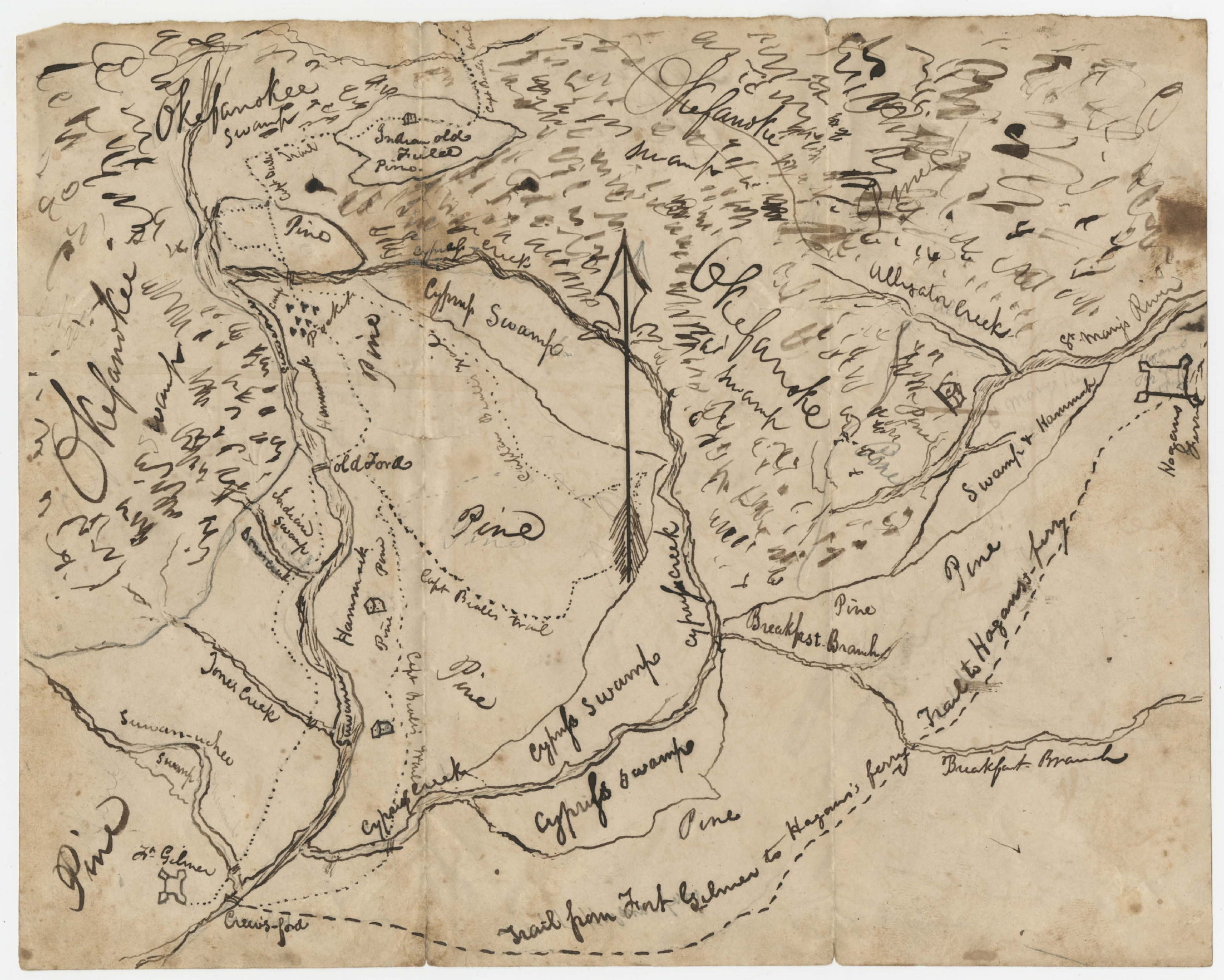
Second Seminole War: Okefenokee region manuscript map
Greenleaf Dearborn (attributed by the archive)
The archive dates this military map to 1837–1838 during the Second Seminole War. It depicts forts and routes around the Okefenokee, providing historical context rather than Seminole-authored territorial information.
Second Seminole War, Okefenokee region manuscript map, ms4209, Box1 Folder1, Hargrett Rare Book and Manuscript Library, University of Georgia Libraries; presented by the Digital Library of Georgia. No Copyright — United States ↗
[1902] · Named historical subject in archival guide
Creek & Seminole Nations, Indian Territory
C. H. Dana; U.S. Department of the Interior, Commission to the Five Civilized Tribes
The archive identifies the Creek and Seminole Nations as the map’s historical subjects. No current boundaries or particular modern government are inferred.
Library of Congress, Geography and Map Division; compiled and drawn by C. H. Dana. Rights record ↗
These map connections are a growing selection. Historical depictions do not establish current boundaries, and a link does not imply community authorship or endorsement.
Follow the reading path
Sources & further reading
Open any title to read the original source. Annotations explain what each link can help you explore.
No Indigenous-led source is identified in this entry yet. This is a gap in this collection, and does not imply an absence of community knowledge or organization.
Historical context for this entry. Read “History of the Seminole Tribe of Florida | Florida State University” with attention to the author, period covered, and communities named; compare with community-published accounts where available.
Community or Indigenous-organization perspective linked for this entry. Use “2A • The Seminole Tribune • November 30, 2020” to begin with the publisher’s own account; check whether its scope is one community or a wider people.
Community or Indigenous-organization perspective linked for this entry. Use “Seminole Tribe of Florida” to begin with the publisher’s own account; check whether its scope is one community or a wider people.
Related entries may represent alternate names, constituent communities, wider groupings, or historical connections. Read the naming notes before treating entries as equivalent.
Robey’s Atlas of Indigenous North America · Compiled October 19, 2026 · Seminole