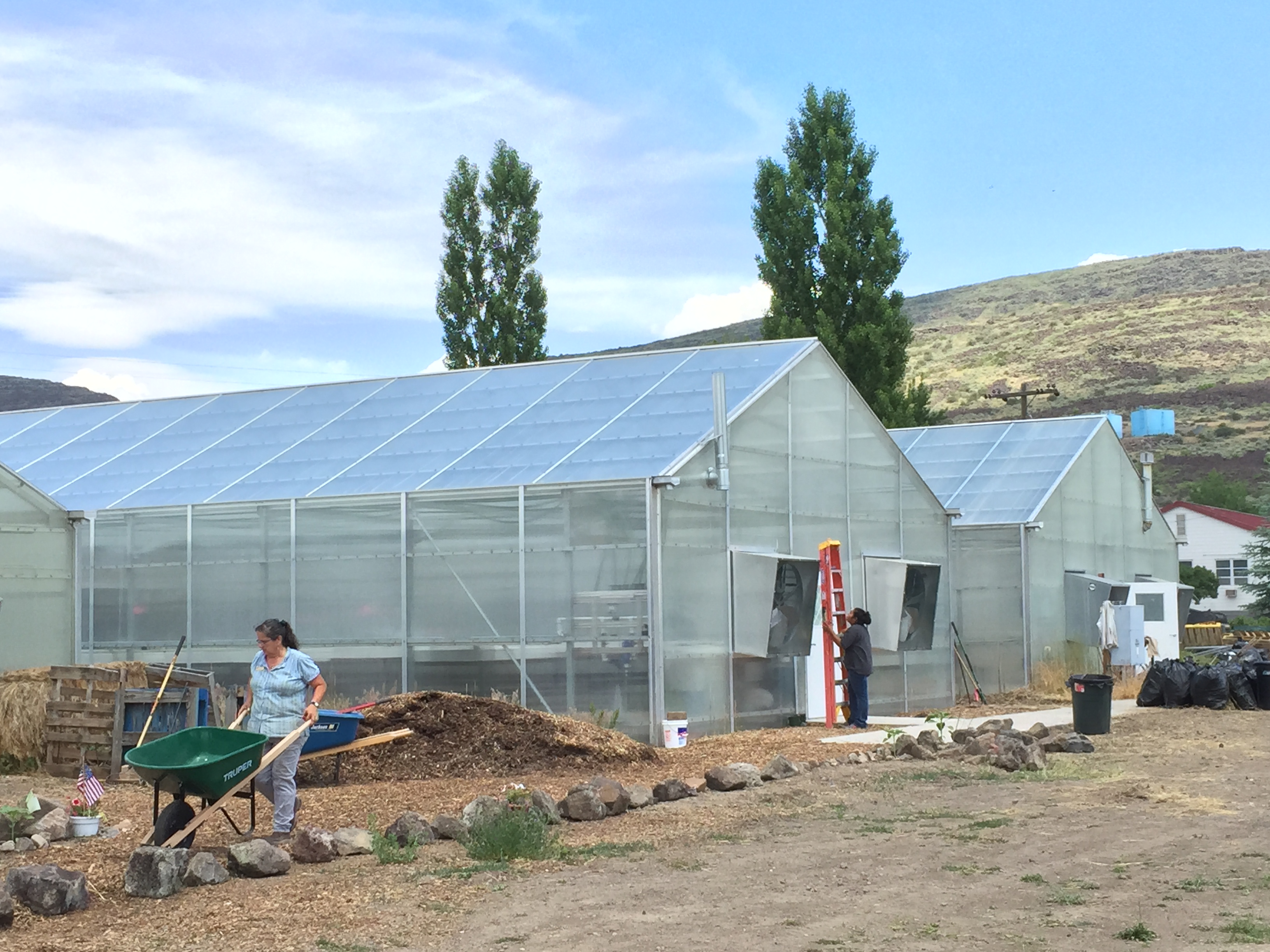
Sho-Pai Greenhouses at Duck Valley,2015A. Hedrick, Bureau of Land Management Idaho,2015; BLM and Sho-Pai Greenhouses / Flickr / Wikimedia Commons. CC BY2.0; U.S. federal-government work also marked public domain.
Paiute is a broad label used in distinct Northern and Southern language and community histories. This route introduces separate Northern Paiute and San Juan Southern Paiute examples and directs attention to particular nations; it does not identify a single Paiute people, government or territory.
See each region’s evidence for historical or present-day scope.
Homeland / region
Great Basin / Southwest
Research depth
Source guide
Source collection
6 annotated resources · 4 Indigenous-led
Inspected sources
3 substantive works · selected content reviewed
Initial adequacy
Still unfinished
Source review
October 27, 2026
A source guide for a deeper dive.This entry provides a brief orientation and an organized reading path. A comprehensive deep dive has not yet been completed. Follow the annotated sources and distinguish primary community accounts from outside reference material.
Still unfinished
Three actual scoped works offer a navigational comparison: Northern Paiute linguistic orientation, Duck Valley joint-community history and San Juan Southern Paiute's own account. Two works reuse dated Northern Paiute draft reviews, and the third is a fresh selected-body review. This remains far from an adequate wider history.
Assessment recorded October 27, 2026. This is separate from research completion and community review.
Paiute is a broad route through distinct Northern and Southern usages, not a single people, government, language or territory. Additional individual nations need their own community sources.
The Northern Paiute language account does not supply a full Southern Paiute linguistic comparison; Southern Paiute and Chemehuevi community-authored language scholarship remain to be reviewed.
Duck Valley and San Juan Southern Paiute are different, specifically scoped examples. Neither supplies a universal Paiute history, and a joint Shoshone-Paiute project should not be presented as exclusively Paiute.
The San Juan account's current land/treaty status, original documents and outcomes were not evaluated. No current legal, acreage, demographic or membership claim is made.
Northern Paiute language/Duck Valley evidence retains actual October 24/23 review dates from the saved draft; it is reused evidence, not newly read global scholarship. No community review or endorsement is recorded.
Backdrop photographs & credits
These photographs have individual, documented connections to this entry. Their captions and source records define the people, place, object, and period shown; no one photograph represents every community within a broader label.
Sho-Pai Greenhouses at Duck Valley,2015 A. Hedrick, Bureau of Land Management Idaho,2015; BLM and Sho-Pai Greenhouses / Flickr / Wikimedia Commons. CC BY2.0; U.S. federal-government work also marked public domain.
Copy the existing cleared A. Hedrick/BLM photograph with its CC BY 2.0 credit and license link, preserving the old Shoshone-Paiute government mapping. The joint Tribes explicitly identify Northern Paiute and Western Shoshone descendants at Duck Valley (actual body lines 43–51 reopened October 27, 2026; prior substantive review October 23 retained). Show the specifically identified Sho-Pai Greenhouses project in 2015 as one joint-community example; do not infer individual citizenship or wider Northern Paiute representation. Publicly published BLM photograph of the specifically identified Duck Valley Sho-Pai Greenhouses. The record describes Owyhee High School FFA participation in growing sagebrush seedlings for mine reclamation and wildfire restoration. The inspected image shows the exterior greenhouses and two people working; their names, citizenship and governmental roles are not inferred. The photo documents this particular community-linked project and date, not all Shoshone or Paiute peoples, present program outcomes or a complete reservation landscape. Actual Commons file description, credit, source, Flickr license review and licensing read; the record explicitly displays the original Flickr URL downloaded here. Full3264x2448 JPEG downloaded, decoded and visually inspected after completion. No crop, retouching or generated pixels. Cards/backgrounds may use disclosed CSS cropping. Provide visible A.Hedrick/BLM credit and CC BY2.0 license link. Image evidence adds no substantive reading-source count. Use the same new copy-only registry record as Northern Paiute, with both slugs, while leaving the existing government image untouched. This image specifically depicts the Sho-Pai Greenhouses at Duck Valley in 2015, where the joint government identifies Northern Paiute and Western Shoshone descendants. Caption it as one Northern Paiute–Western Shoshone community example, not as a generic image of a single Paiute people or a Southern Paiute community. Retain A. Hedrick/BLM and CC BY 2.0 attribution, exact source date, original image-review facts and display-crop disclosure.
Image, association, and reuse record reviewed 2026-10-27.
Full photographs are displayed proportionally above. A translucent background copy may be cropped by the viewport; it does not replace the complete image or its record.
The visual treatment does not change the research status, evidence, or remaining gaps recorded in this profile.
Use the archive for Northern Paiute linguistic classification, not as a definition of all Paiute peoples.
These are selected starting points. The full annotated collection, source perspectives, inspection limits and remaining research questions follow below. A starting guide is not an exhaustive history or community endorsement.
01
Identity and context
Paiute is a broad label whose Northern and Southern usages refer to distinct language and community histories.
Focus the next stage of research on: Distinguish Northern Paiute, Southern Paiute and individual nations. The sources below are selected reading paths; their authorship, dates and community scope should guide how they are used.
A Northern Paiute route includes distinct joint communities
The California Language Archive distinguishes Northern Paiute from the Chemehuevi–Southern Paiute–Ute language grouping. Its linguistic geography is not a government boundary. At Duck Valley, the Tribes' own history identifies Western Shoshone and Northern Paiute descendants and describes their shared community and joint government. These sources offer one Northern route while preserving the different peoples involved.
San Juan Southern Paiute: a particular nation's account
The San Juan Southern Paiute Tribe describes its communities in northern Arizona and southern Utah and explains a long history of living alongside Navajo neighbors. It dates its federal recognition to December 1989 and explicitly distinguishes its identity from Navajo and Hopi relatives and neighbors. That community account should be read on its own terms, not extended to all Southern Paiute nations or to Northern Paiute histories.
Paiute is a broad route through distinct Northern and Southern usages, not a single people, government, language or territory. Additional individual nations need their own community sources.
The Northern Paiute language account does not supply a full Southern Paiute linguistic comparison; Southern Paiute and Chemehuevi community-authored language scholarship remain to be reviewed.
Duck Valley and San Juan Southern Paiute are different, specifically scoped examples. Neither supplies a universal Paiute history, and a joint Shoshone-Paiute project should not be presented as exclusively Paiute.
The San Juan account's current land/treaty status, original documents and outcomes were not evaluated. No current legal, acreage, demographic or membership claim is made.
Northern Paiute language/Duck Valley evidence retains actual October 24/23 review dates from the saved draft; it is reused evidence, not newly read global scholarship. No community review or endorsement is recorded.
Selected actual-content works support a bounded starting guide. Earlier source objects retain their original review dates and limits. Reused URLs, images and identity-only checks are not new global historical works. Full history and community review remain open.
Follow the reading path
Sources & further reading
Open any title to read the original source. Annotations explain what each link can help you explore.
No Indigenous-led source is identified in this entry yet. This is a gap in this collection, and does not imply an absence of community knowledge or organization.
Community or Indigenous-organization perspective linked for this entry. Use “Discover the History and Culture of the San Juan Southern Paiute Tribe” to begin with the publisher’s own account; check whether its scope is one community or a wider people.
Community or Indigenous-organization perspective linked for this entry. Use “Constitution of The San Juan Southern Paiute Tribe” to begin with the publisher’s own account; check whether its scope is one community or a wider people.
Context and further reading linked for this entry. The publisher’s “Las Vegas Paiute Tribe | Official Tribal Government Website” is a starting point; verify the geographical and community scope before applying its account more broadly.
Academic orientation to Northern Paiute as a Western Numic language with regional varieties. Distinguish its linguistic geography from governments and historical borders; dated speaker/population estimates are not current statistics.
Inspection: Content reviewed for the stated scope
Scope: Main body lines0–54: language geography, classification, grammatical overview, documentation and reading links. Audio, linked scholarship and images not inspected.
The joint government identifies Western Shoshone and Northern Paiute descendants at Duck Valley and recounts reservation creation/expansion, resistance to relocation, schooling and constitutional organization. This is its institutional history, not a uniform history of all Northern Paiute communities. Undated membership and present-program figures are not used.
Inspection: Content reviewed for the stated scope
Scope: Complete visible history body, lines43–61, read October23. Linked history videos were not played and photographs not reused.
A particular Southern Paiute government's account of its communities in northern Arizona and southern Utah, distinction from Navajo and Hopi neighbors, and federal recognition in 1989. Its account of the 2000 intertribal treaty is a situated historical/political position, not a verified statement of present reservation status. Neither the linked news story nor current gaming or legal arrangements were evaluated. A stray marketing-template quotation on the page is not tribal evidence.
Inspection: Content reviewed for the stated scope
Scope: Actual official narrative lines 10–19 read, including local communities, historical relationship with Navajo neighbors, 1989 recognition and the page's 2000 treaty explanation. Synthesis uses only identity/local-history paragraphs 12–16; current treaty approval/status was not checked or asserted. Embedded media, reproduced newspaper story at lines 21–26, preamble, linked original documents, images, gaming section and unrelated template copy excluded. Baseline p276-s1 retained exactly; this fresh review has a new ID.
Related entries may represent alternate names, constituent communities, wider groupings, or historical connections. Read the naming notes before treating entries as equivalent.
Robey’s Atlas of Indigenous North America · Compiled October 19, 2026 · Paiute