
Brief History
Community-produced reading on identity, history, cultural continuity, and present-day priorities.
Inspection: Content review not recorded
Access recorded: October 19, 2026
IdentityHistoryCulture
Menominee is the broader reading label here; the Menominee Indian Tribe of Wisconsin has a separate government route. These sources introduce restoration, community life and cultural continuity.
Read the sources [3] Menominee Indian Tribe of Wisconsin [4] Menominee Indian Tribe of Wisconsin
A bounded starting path from selected public community accounts; chronology, wider voices and underlying records remain to be reviewed.
Assessment recorded October 27, 2026. This is separate from research completion and community review.
These photographs have individual, documented connections to this entry. Their captions and source records define the people, place, object, and period shown; no one photograph represents every community within a broader label.
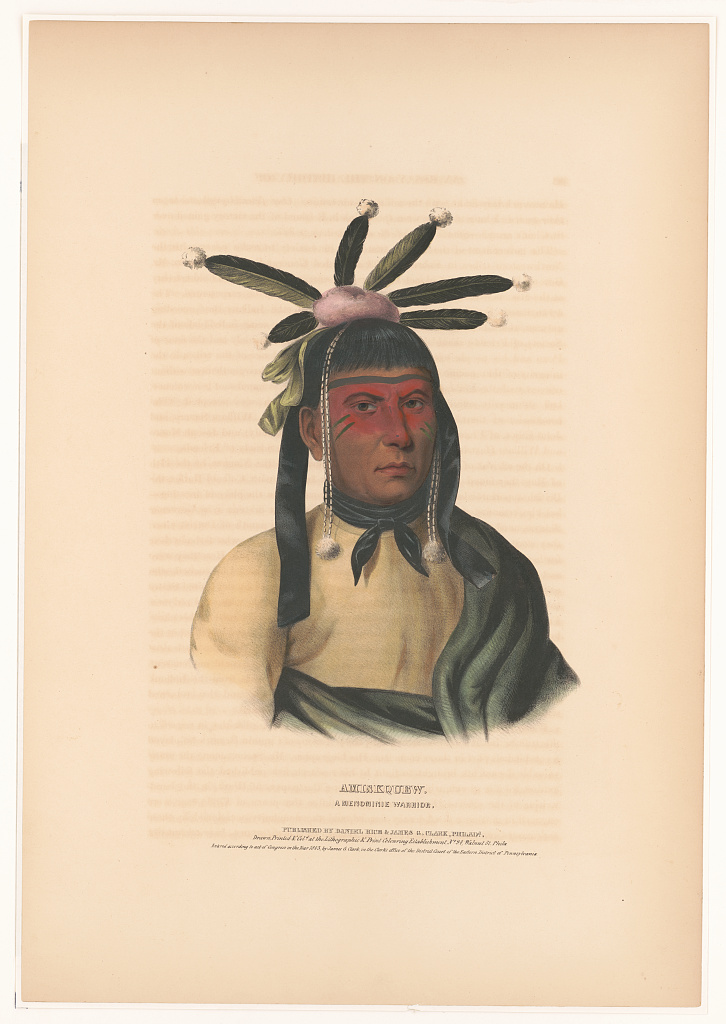
Amiskquew, historical Menominee portrait print, c.1843
Amiskquew, c.1843. Lithographic & Print Colouring Establishment; published by Daniel Rice & James G. Clark, Philadelphia. Library of Congress,95502208,pga.07485. McKenney & Hall are catalogued contributors; individual portrait artist not identified in the inspected LOC record. No known restrictions on publication.
Source & image record ↗ · Public-domain c.1843 U.S. print; Library of Congress rights advisory: No known restrictions on publication.
LOC actual JSON item record read for Menominee subject headings, c.1843 Philadelphia publication, resource identity and explicit rights_advisory. Exact digital file from original item downloaded and visually inspected,726×1024. This is a historical print of a specifically identified Menominee individual, not a photograph or a contemporary officeholder. Shared across the broader people route and Tribe route as precisely labelled historical context; it does not depict the present government or claim endorsement. Original catalogue vocabulary is historical. No biography, dress symbolism or cultural uniformity inferred. The print’s183-year publication basis and LOC advisory support reuse; no claim that LOC owns or licenses the work. Exact complete available JPEG copied unchanged. CSS crops/overlays affect display only.
Image, association, and reuse record reviewed 2026-10-27.
Full photographs are displayed proportionally above. A translucent background copy may be cropped by the viewport; it does not replace the complete image or its record.
The visual treatment does not change the research status, evidence, or remaining gaps recorded in this profile.
Begin with the Tribe’s concise restoration and community account.
Read the museum introduction for its statement of cultural continuity.
These are selected starting points. The full annotated collection, source perspectives, inspection limits and remaining research questions follow below. A starting guide is not an exhaustive history or community endorsement.
Menominee origin traditions begin at the Menominee River, near the Nation’s present reservation in Wisconsin.
Read the sources [1] Menominee Indian Tribe of Wisconsin
Treaties reduced the land base; federal termination in the 1950s was reversed through grassroots organizing and the Menominee Restoration Act of 1973.
Read the sources [1] Menominee Indian Tribe of Wisconsin
The Nation’s cultural museum and public history connect sovereignty and the homeland with language, culture, and contemporary community life.
Read the sources [2] Menominee Indian Tribe of Wisconsin
The Tribe’s brief history attributes restored federal recognition in 1973 to sustained grassroots organizing. It also locates the government at Keshena. This is a starting account from the Tribe; original statutes and their legal consequences require separate reading.
Read the sources [3] Menominee Indian Tribe of Wisconsin
The Cultural Museum’s introduction emphasizes continuing leadership, language and tradition within the homeland. Its voice presents Menominee life as ongoing through adversity. The public page supplies an institutional perspective; the linked videos, original collections and wider range of community voices remain a further reading task.
Read the sources [4] Menominee Indian Tribe of Wisconsin
Selected actual-content works support a bounded starting guide. Earlier source objects retain their original review dates and limits. Reused URLs, images and identity-only checks are not new global historical works. Full history and community review remain open.
Open any title to read the original source. Annotations explain what each link can help you explore.
No Indigenous-led source is identified in this entry yet. This is a gap in this collection, and does not imply an absence of community knowledge or organization.
Community-produced reading on identity, history, cultural continuity, and present-day priorities.
Inspection: Content review not recorded
Access recorded: October 19, 2026
Community-produced reading on identity, history, cultural continuity, and present-day priorities.
Inspection: Content review not recorded
Access recorded: October 19, 2026
Publication: Undated; site footer and crawl dates are not publication dates
The Tribe’s concise history and location account. Numerical totals are not adopted as current facts.
Inspection: Content reviewed for the stated scope
Scope: Actual complete visible prose26–35 read. Synthesis uses historical recognition/restoration paragraph27, location and named communities29, and attributed infrastructure concerns34–35. Ancient dates, treaty count, acreage, population totals, current officeholders and legal rules are not independently established. Facts & Figures supplement and original statutes were not opened.
Review recorded: October 27, 2026
Access note: Public HTML actual selected body text read; linked documents and media are outside this inspection.
Publication: Undated; site footer and crawl dates are not publication dates
The Tribe’s public museum introduction connects cultural continuity and homeland. Linked object videos remain unviewed.
Inspection: Content reviewed for the stated scope
Scope: Actual Background body26–30 and museum/public-history context31–38 read. Synthesis uses homeland and continuing leadership/language statements29 only. Prophecy and religious instructions are not reproduced; ancient dates and Eurocentric fur-trade causation are not adopted. Hours not verified as current; virtual tour, object videos and camp application not opened.
Review recorded: October 27, 2026
Access note: Public HTML actual selected body text read; linked documents and media are outside this inspection.
Robey’s Atlas of Indigenous North America · Compiled October 19, 2026 · Menominee