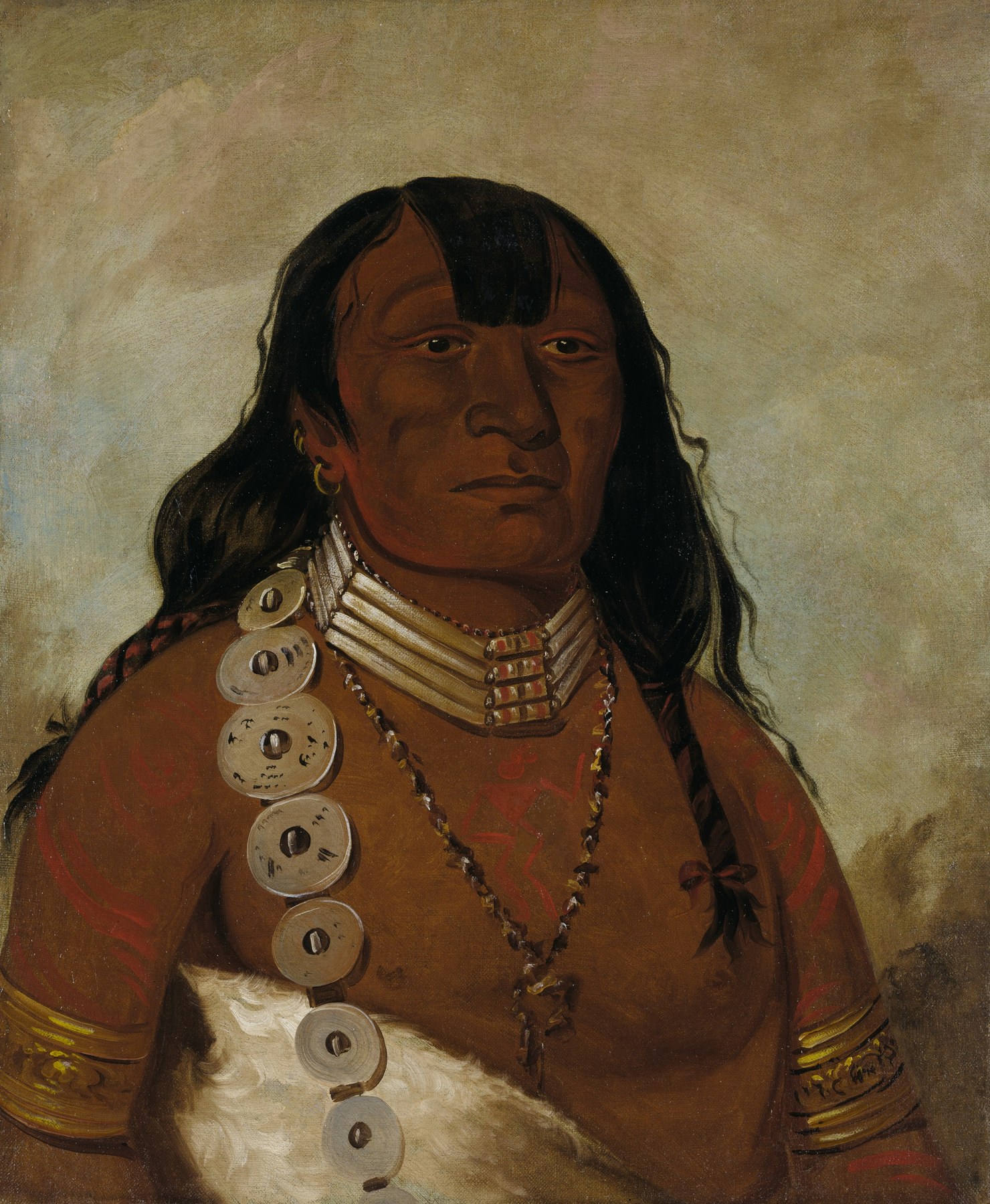
Téh-tóot-sah (better known as Tohausen, Little Bluff), First Chief, 1834George Catlin, 1834. Smithsonian American Art Museum, Gift of Mrs. Joseph Harrison, Jr., 1985.66.62. Public domain.
Kiowa histories connect northern and southern Plains movement, Texas and Oklahoma, while the present Kiowa Tribe publishes accounts of its government and community institutions. This foundation brings a short Tribal history together with an edited treaty, dated education reporting, a Kiowa educator’s first-person reflection, a collaborative scholarly account and art history. Alliances, the wider people, present institutions and individual voices retain their own scope. Additional reading brings an earlier primary agreement, community remembrance and a partially inspected local land-history study into the foundation.
See each region’s evidence for historical or present-day scope.
Homeland / region
Southern Plains / Texas / Oklahoma
Research depth
Source guide
Source collection
12 annotated resources · 6 Indigenous-led
Inspected sources
9 substantive works · selected content reviewed
Initial adequacy
Still unfinished
Source review
October 27, 2026
Names & relationshipsKiowa people-level history, the present Kiowa Tribe government, named art groups and allied Plains Apache/Comanche histories require separate scopes. Shared treaties, alliances or a similar label do not establish identical identities, ancestry, citizenship or governments. Preserve the separate Plains Apache reading route and verified current-government outline.
A source guide for a deeper dive.This entry provides a brief orientation and an organized reading path. A comprehensive deep dive has not yet been completed. Follow the annotated sources and distinguish primary community accounts from outside reference material.
Still unfinished
A complete readable community-communication page extends the existing institutional report without adding a work or source card. Nine inspected works remain uneven across historical periods and community perspectives, including Texas primary evidence, later history and community review. The report is a publisher account, not an independent evaluation; unread museum pages remain deferred.
Assessment recorded October 27, 2026. This is separate from research completion and community review.
Early origins, migration dates and archaeological identifications need stronger comparison. The Tribal history’s Black Hills date and Kracht’s date differ; no precise origin conclusion is settled here.
Nineteenth-century Texas diplomacy, warfare, captivity, removal and reservation implementation need directly inspected Kiowa perspectives and primary records beyond the two edited agreements reviewed here.
Allotment, land loss and later government history need specifically dated legal/historical sources. No current landownership, jurisdiction, citizenship or benefits determination is made.
The annual report is a selected-page first-party account of education, language and community communication, not a complete report review, independent outcomes audit or survey of every Kiowa perspective. Figures and program guarantees are omitted. Image-only pp.46–47 remain unread; no museum-stewardship claim is adopted from search snippets.
First-person educational aims and published recollections are situated perspectives. The teacher-training notice is dated, and apps, recordings, live classes and language-proficiency outcomes were not tested.
Art-group membership is introduced, but artist biographies, dates, community meanings and image rights require more work. No artwork reproduction right follows from a linked essay.
Private family documents, raw interviews and restricted underlying materials were not accessed. Published culturally governed stories, songs and sensitive-place details were excluded from the synthesis and were not reproduced.
The nine-work collection remains uneven across historical periods and community perspectives. No community review, endorsement, comprehensive coverage or research completion is claimed.
Original 1865 negotiations, translation, implementation and subsequent land changes remain unreviewed; the edited terms are not a present legal determination.
The Palo Duro account concerns a dated commemoration and institutional memory. Original Kiowa accounts, military/civilian records and detailed battle chronology still need comparison.
Palmer review is substantial but partial and mediated through indexed article text. Direct PDF/image/underlying applications were unavailable or unread. Recover fuller readable access later, without bypassing controls.
Later economic and land-tenure analysis is locally scoped. No universal Kiowa percentage, individual parcel identification, current title or legal-status assessment is made.
Backdrop images & credits
These images have individual, documented connections to this entry. Their captions and source records define the people, place, object, and period shown; no one image represents every community within a broader label.
Téh-tóot-sah (better known as Tohausen, Little Bluff), First Chief, 1834 George Catlin, 1834. Smithsonian American Art Museum, Gift of Mrs. Joseph Harrison, Jr., 1985.66.62. Public domain.
Smithsonian American Art Museum identifies the sitter as Téh-tóot-sah, also known as Tohausen or Little Bluff, a Kiowa chief, and dates George Catlin’s oil portrait to 1834. Its actual subject classification explicitly names Kiowa. This is an outside artist’s historical portrait of an individually identified person, not a generic Native likeness, a documentary photograph, Kiowa-made art, or a current tribal-government representative. Exact portrait location, clothing/design meanings, current cultural practice and community endorsement are not established by this image check. The named leader and date are retained without claiming that one person represents all Kiowa communities or periods. Complete 2466x3000 museum-delivered source JPEG inspected and preserved. Web copy resized proportionally to 1480x1800 and recompressed at quality 88; no pixel crop, added detail, generated material, retouching or recoloring. Cards and opened-page backgrounds may use disclosed CSS crops/overlays. Preserve a full-frame route where possible. CSS crops and overlays apply to directory/background copies; the opened-page image retains the complete delivered frame.
Image, association, and reuse record reviewed 2026-10-26.
Full images are displayed proportionally above. A translucent background copy may be cropped by the viewport; it does not replace the complete image or its record.
The visual treatment does not change the research status, evidence, or remaining gaps recorded in this profile.
Start reading here
A Kiowa people-and-Tribe starting route, with separate scopes for the government, named artists and an educator's experience. Plains Apache and Comanche alliances do not merge identities. Only annual-report pp. 24, 39–40 and 45 and the recorded selected text were inspected; image-only museum pages remain unread.
The Kiowa Tribe's own short history provides a first orientation to movement, alliances and reservation change, with disputed early chronology left open.
Melody Windsong Redbird-Post's first-person education account connects family experience, immersion teaching and proposed work without treating plans as outcomes.
This museum-authored essay introduces six named artists and their painting and mural work while its inconsistent dates and gender generalizations remain qualified.
Selected annual-report pages show how the Tribe describes education, language and community communication in a defined fiscal period.
These are selected starting points. The full annotated collection, source perspectives, inspection limits and remaining research questions follow below. A starting guide is not an exhaustive history or community endorsement.
01
A people, a present Tribe and related reading routes
Kiowa is a people-level reading route, while the Kiowa Tribe’s publications describe a present government and its institutions in Oklahoma. The Tribe’s history discusses alliances with Comanche and Plains Apache people. Those relationships do not make the names interchangeable: Plains Apache has its own directory route, and shared treaties or institutions do not by themselves establish one timeless identity.
Movement, Texas connections and uncertain early dates
The Tribe’s historical account and Kracht’s article both describe movement from the northern toward the southern Plains and connections with present-day Texas. Their Black Hills chronologies differ. These accounts provide a broad route into the history; precise origins, dates and archaeological identifications need further research. The Atlas does not turn a migration outline into a fixed homeland boundary or treat a community history page as an inspected archaeological report.
The Tribe’s overview describes historical mobility, bison hunting, horse use and gathering. Read that account in its period and regional setting. It helps explain the Southern Plains history being discussed, while contemporary education, work and family life require their own sources rather than a picture of every Kiowa person living in one historical way.
The edited October 21, 1867 Kiowa and Comanche treaty includes reservation and conditional hunting provisions, promises of federal services, a requirement concerning later land cessions and compulsory schooling in English branches. Its terms give readers a primary document to examine. They do not alone prove implementation, universal consent or present-day rights. This named instrument should also be distinguished from the separate treaty involving Kiowa, Comanche and Apache representatives.
Reservation change and the limits of this first history
The Tribal history and Kracht’s account describe reservation confinement, allotment and settlement pressures. Their compressed narratives are starting points for reviewing nineteenth-century Texas and Oklahoma history. The original military, removal, allotment and implementation records have not been read in this foundation, so precise legal conclusions, landownership totals and a complete chronology remain open.
The Tribe’s FY 2025–2026 report describes its Education Agency across child care, school partnerships, higher education, career learning and community activities. It presents Kiowa language, heritage and contemporary life as part of its educational aims. These are the institution’s reported purposes and activities. The Atlas does not promise assistance, repeat financial figures or treat the report as an independent evaluation of results.
The Tribe’s FY2025–2026 report describes Media & Outreach as a communication service for Tribal members, programs and departments. It identifies the newsletter, website and event calendar among its channels and says community members may contribute announcements, editorials and other submissions. The report also describes editorial discretion and a final-content approval process. This helps readers understand how one community institution presents information; it does not establish independent reporting, participation outcomes or representation of every Kiowa perspective.
The same dated report describes a teacher-credentialing process and language classes delivered in schools, community settings and online. Melody Windsong Redbird-Post’s first-person essay gives another perspective: she recounts child-care language work, family learning and collaboration with elders, educators and parents. Her experience and future project plans remain attributed to her; neither source supplies a verified current count of speakers or proof of every learner’s proficiency.
In their 2018 article, Rachel C. Jackson with Kiowa Elder Dorothy Whitehorse DeLaune describe the Kiowa Clemente course and a classroom shaped by community interests. Their account explains how listening, shared decisions and language work inform their teaching. This is a situated educational interpretation and relationship, not a rule for every Kiowa person or a present course schedule. Specific stories, songs and culturally governed materials in the publication are not retold here.
Lydia L. Wyckoff’s art-historical essay identifies Jack Hokeah, Monroe Tsatoke, Spencer Asah, James Auchiah, Stephen Mopope and Lois Smoky within the group known as the Kiowa Six or Kiowa Five. It follows their painting, university-era work and mural commissions. The essay describes plain backgrounds and areas of flat color as part of this history. These are named artists and an art-group label; the account does not define all Kiowa art or authorize reuse of the artworks.
The 1865 agreement predates Medicine Lodge. Its reservation provisions sit alongside written-permission requirements for hunting travel and rules about where people could camp. Article 6 discusses people not present at the council. Reading those clauses together helps distinguish the written agreement from universal assent or actual implementation; they do not determine current land rights.
The District 7 newsletter describes the 2024 commemoration of the 1874 Battle of Palo Duro Canyon as a setting for remembrance and public education involving several Southern Plains communities. This is a dated community account of how history is remembered and shared. Its battle narrative still needs comparison with Kiowa testimony and original military and civilian records.
Palmer’s 2011 study examines later Kiowa allotment sales through land-tenure applications and geographic comparison. He describes economic needs, relocation and divided inheritance as factors within his case-study area. He also notes difficulty separating relocation policy’s effects. This attributed local analysis is not a current ownership assessment or a single explanation for every Kiowa family’s history.
Read community publications alongside the actual 1865 and 1867 agreements, keeping promises, interpretation and implementation separate. The newsletter offers a dated route into remembrance; Palmer’s partially accessible study extends the land-history questions. Nine substantive works form a reviewed foundation, with substantial gaps in Texas primary evidence, community-authored historical depth and later history. No completion or community endorsement is claimed.
Early origins, migration dates and archaeological identifications need stronger comparison. The Tribal history’s Black Hills date and Kracht’s date differ; no precise origin conclusion is settled here.
Nineteenth-century Texas diplomacy, warfare, captivity, removal and reservation implementation need directly inspected Kiowa perspectives and primary records beyond the two edited agreements reviewed here.
Allotment, land loss and later government history need specifically dated legal/historical sources. No current landownership, jurisdiction, citizenship or benefits determination is made.
The annual report is a selected-page first-party account of education, language and community communication, not a complete report review, independent outcomes audit or survey of every Kiowa perspective. Figures and program guarantees are omitted. Image-only pp.46–47 remain unread; no museum-stewardship claim is adopted from search snippets.
First-person educational aims and published recollections are situated perspectives. The teacher-training notice is dated, and apps, recordings, live classes and language-proficiency outcomes were not tested.
Art-group membership is introduced, but artist biographies, dates, community meanings and image rights require more work. No artwork reproduction right follows from a linked essay.
Private family documents, raw interviews and restricted underlying materials were not accessed. Published culturally governed stories, songs and sensitive-place details were excluded from the synthesis and were not reproduced.
The nine-work collection remains uneven across historical periods and community perspectives. No community review, endorsement, comprehensive coverage or research completion is claimed.
Original 1865 negotiations, translation, implementation and subsequent land changes remain unreviewed; the edited terms are not a present legal determination.
The Palo Duro account concerns a dated commemoration and institutional memory. Original Kiowa accounts, military/civilian records and detailed battle chronology still need comparison.
Palmer review is substantial but partial and mediated through indexed article text. Direct PDF/image/underlying applications were unavailable or unread. Recover fuller readable access later, without bypassing controls.
Later economic and land-tenure analysis is locally scoped. No universal Kiowa percentage, individual parcel identification, current title or legal-status assessment is made.
Follow the reading path
Sources & further reading
Open any title to read the original source. Annotations explain what each link can help you explore.
No Indigenous-led source is identified in this entry yet. This is a gap in this collection, and does not imply an absence of community knowledge or organization.
The Tribe’s own account follows movement, alliances, horse/bison-based life and reservation change. It is a useful short community-published orientation. Exact early dates, archaeology and present landownership claims require comparison; the page is not independent verification of its referenced history.
Inspection: Content reviewed for the stated scope
Scope: Actual complete historical body, lines 11–26. Emblem/ceremonial interpretation, photographs and underlying archaeology/records were not adopted or independently inspected.
Review recorded: October 26, 2026
Access status: Public readable English HTML
Access note: The page gives a Black Hills chronology around 1650, while Kracht’s historical article gives arrival by 1775. The draft preserves the broad movement account but does not resolve that difference. The asserted archaeological Kootenay origin, generalized warlike language, present-only-landownership statement and precise war-ending chronology are not adopted as independently verified facts.
Preserved original official website route. Read substantive history and dated institutional publications through the separately identified records; a homepage is not another inspected historical work.
Inspection: Supporting official access route; not another substantive content check
Access recorded: October 19, 2026
Counting note: Original navigation link retained without source-count inflation.
Kiowa Tribe. Annual Report FY 2025–2026. Selected printed/PDF pp. 24, 39–40 and 45; cover inspected in the earlier review.
A first-party account of education, language teaching and community communication in the stated fiscal period. The Media & Outreach page explains publication purposes, contributions and editorial approval; the education and language pages retain their earlier inspection scope. These are institutional aims and reported activities, not independently evaluated outcomes or a guarantee that every community perspective is represented. All selected departments remain one work.
Inspection: Content reviewed for the stated scope
Scope: Earlier October26 review retained: cover and full extracted text of printed/PDF pp.39–40 and45 of the actual56-page report. October27 extension: complete readable text of printed/PDF p.24, headed Tribal Operations / 405 Kiowa Newsletters / Media & Outreach, extracted anew from the same cached public PDF with pypdf. Read the mission, newsletter and web functions, member/program contribution and final-content approval statements, rights notice and the whole page; reported totals, contact details and pickup lists were encountered but are not adopted. The full report and photographs remain unreviewed. Image-only pp.46–47 remain unread beyond extractable headers; no museum-stewardship claim is adopted.
Review recorded: October 27, 2026
Access status: Public English PDF; text extraction available for selected pages
Access note: The web tool rejected the 23,037,815-byte file as too large. A normal direct public download returned HTTP 200 and a valid PDF; no account, challenge bypass or access-control workaround was involved. Selected text was extracted with pypdf. Current officeholder names, participant/award totals, program amounts and guarantees are omitted. The listed school counts and displayed total on p. 45 were not reconciled, so no aggregate is carried forward. October27 extension used the previously downloaded official PDF, not a newly retrieved edition. The web tool again rejected the same23,037,815-byte source as too large; this does not establish a reader paywall. Page24 text was extracted directly with pypdf. Image-only pp.46–47 could not be visually inspected with the available rasterizer and remain deferred; no OCR, install or access workaround was attempted.
Inspected material and access routes
Media & Outreach / 405 Kiowa Newsletters — printed/PDF p.24 ↗ — Complete readable page text: communication purposes, publication functions, community/program contributions and editorial approval. Statistics and implied outcomes are excluded; illustrations and museum pages are not part of this extension.
An educator’s substantial first-person account connects family learning, child-care immersion work, community collaboration and research aims. Read completed experiences separately from proposed fellowship products. This personal perspective is valuable community evidence, not a uniform account of every Kiowa family.
Inspection: Content reviewed for the stated scope
Scope: Actual complete public Our Story body, lines 26–75, plus Leadership lines 23–35 to identify Melody Windsong Redbird-Post and her self-described Kiowa enrollment/educational role. Linked newsletter, learning modules, family videos, archival records, songs and user accounts were not opened.
Review recorded: October 26, 2026
Access note: Public English HTML; no login required for the inspected narrative. Learning modules elsewhere may require an account, but none were tested. The page includes a 2022 fellowship context, an August 2023 newsletter route, retrospective experience and future-tense proposed work; do not turn the proposal into a completed or independently evaluated outcome. Speaker-vitality generalizations and personal family details are not republished.
Inspected material and access routes
Leadership — author identification ↗ — Only Dr. Melody Windsong Redbird-Post’s heading and biography, lines 23–35, used to identify the author. No separate count; other family-member biographies are not used.
Treaty with the Kiowa and Comanche, October 21, 1867. 15 Stat. 581. Ratified July 25, 1868; proclaimed August 25, 1868. Oklahoma State University Libraries edited transcription.
Publication: 1867-10-21
The actual text places reservation and conditional hunting provisions beside federal services and compulsory schooling. It gives readers a primary agreement to examine while keeping historical terminology, consent and implementation questions open. The same treaty in another profile or edition remains one underlying work.
Inspection: Content reviewed for the stated scope
Scope: Actual HTML dating/preamble, Articles 1–16 and signatory headings; close reading of Articles 2, 7, 11, 12 and 16. Reviewed directly during this session’s independent Comanche QA and applied here with explicit Kiowa scope. Manuscript images, translations, negotiations, ratification documents and later legal interpretation not independently inspected.
Review recorded: October 26, 2026
Access status: Public searchable English HTML
Access note: The text includes an editorial note about pencil/ink brackets. The draft does not infer universal consent, fulfillment, present treaty rights, current jurisdiction, citizenship or legal advice. The October 21 Kiowa/Comanche treaty is not silently treated as the separate Kiowa/Comanche/Apache instrument.
Academic / community-collaborative educational accountCommunity Literacy Journal; public copy hosted by University of Science and Arts of OklahomaSource 6
Jackson, Rachel C., with Dorothy Whitehorse DeLaune. 2018. “Decolonizing Community Writing with Community Listening: Story, Transrhetorical Resistance, and Indigenous Cultural Literacy Activism.” Community Literacy Journal, fall, 37–54. Selected sections.
Publication: 2018
The authors describe a community-shaped Kiowa Clemente course and explain their approach to collaborative listening. Their interpretation and situated recollections are attributed, rather than adopted as a general rule for all Kiowa people. Sacred or seasonally governed stories in the paper are not retold.
Inspection: Content reviewed for the stated scope
Scope: Actual PDF title/abstract; teaching collaboration and author-position account on printed pp. 37–38; course-development/pedagogy discussion pp. 48–50, stopping before the specific seasonal-story discussion; closing methodological discussion encountered on pp. 52–53; author identification on p. 54. Other passages returned with those windows were encountered, but detailed narrated stories, quoted songs, private family documents and raw interviews were not independently researched or reproduced. The full 18-page paper is not claimed as systematically reviewed.
Review recorded: October 26, 2026
Access status: Public searchable English PDF; no account required
Access note: PDF running header says fall 2018; printed pages 37–54 verified. The article is an interpretive educational study, not an independent verification of each historical anecdote or a current attendance survey. Its explicit cultural access/timing concerns are respected by not reproducing stories, songs, ritual details or sensitive places.
Inspected material and access routes
Kiowa Clemente — university course context ↗ — Actual course description and linked-paper provenance, lines 132–140. No enrollment or live classroom/Zoom access attempted; not an additional work count.
Language learning·Community education·Oral history·Research perspective·Kiowa Clemente Course
Academic / museum-authored art historyEncyclopedia of the Great Plains, University of Nebraska–Lincoln; author affiliation printed as Philbrook Museum of ArtSource 7
A substantial museum-authored encyclopedia essay identifies six artists, including Lois Smoky, and follows painting, patronage and public mural work. It helps introduce named creative lives. Its broad gender generalizations and inconsistent biographical/allotment dates are not adopted without further comparison.
Inspection: Content reviewed for the stated scope
Scope: Actual complete main essay, author line and reference, lines 12–31. Used only for named group membership and attributed account of flat-color painting, university-era work and mural patronage. Images and the cited 1996 book were not inspected.
Review recorded: October 26, 2026
Access status: Public English HTML
Access note: Some artist birth dates differ from Smithsonian catalogue results encountered in discovery, and the essay’s allotment chronology differs from other history sources; the draft omits those precise dates. “Kiowa Five” and “Kiowa Six” are art-group labels, not names of new tribes. Generalized claims about women’s artistic roles are not projected onto all people or periods.
A useful named-author comparison for movement, alliances and reservation change. Retained as supporting context because broad cultural generalizations and older present-tense figures/governance statements require additional checking. Its bibliography is not a set of completed source inspections.
Inspection: Supporting or limited review; see scope
Scope: Actual full visible article, author, bibliography and dates read; selected history paragraphs 102–106 and 108–121 used for comparison only. Origin/ceremonial accounts, percentages, present totals and generalized warrior-spirit descriptions excluded from synthesis.
Review recorded: October 26, 2026
Access status: Public English HTML
Access note: Page says published January 15, 2010 and updated February 7, 2025. This does not make every early-twenty-first-century population or government statement current. Black Hills dating differs from the Tribal history page; neither is silently preferred.
Counting note: Supporting comparison with important dating/generalization limits; not used to pad the target for excellent substantive works.
An official short statement identifies the language department’s aims and links teacher-training information. Use the dated report and original department for further reading, without treating aims or a past deadline as a current class guarantee.
Inspection: Supporting or limited review; see scope
Scope: Actual public main description and teacher-training notice in readable indexed primary content. Staff/contact details were not republished. A separate direct HTML body inspection was not claimed beyond the actual indexed publisher text.
Review recorded: October 26, 2026
Access status: Readable indexed primary publisher body
Access note: The teacher-training notice concerns 2025–2026 and prints a March 2025 deadline. Do not present that deadline as an open application or use the notice to infer successful certification/outcomes.
Counting note: Short mission and access route; not another substantive work or an additional count for the annual report’s same program.
Treaty with the Comanche and Kiowa, October 18, 1865, 14 Stat. 717. Edited text, Oklahoma State University Libraries. Record RIT_343 / NAI_178930920.
Publication: 1865-10-18
A different agreement from the 1867 Medicine Lodge text. Close reading brings territorial provisions, movement restrictions and the stated treatment of absent parties into view without treating promises as fulfilled.
Inspection: Content reviewed for the stated scope
Scope: Actual complete preamble, Articles 1–6, metadata and signatory columns, HTML lines 25–120. Articles 2, 3 and 6 read closely. Manuscript, translations, negotiations and implementation not independently inspected.
Review recorded: October 26, 2026
Access status: Public searchable English HTML
Access note: The text asserts authorization while Article 6 acknowledges absent portions of the peoples. Do not infer unanimous assent. Geographic clauses do not establish present boundaries or rights; no new map or legal conclusion is proposed.
Kiowa Tribe District 7 Legislative Office. September 2024 Newsletter. “Successful Commemoration of the Battle of Palo Duro Canyon.” PDF pp. 15–16.
Publication: 2024-09
A community-published account connects the 2024 commemoration with education and remembrance of the 1874 battle. It is valuable evidence of institutional memory, rather than independent verification of every battle claim.
Inspection: Content reviewed for the stated scope
Scope: Actual 18-page PDF: cover/issue identification and complete text of Successful Commemoration of the Battle of Palo Duro Canyon, PDF pp. 15–16. Other returned passages encountered; photos and the full issue not systematically reviewed.
Review recorded: October 26, 2026
Access status: Public English PDF with extractable text
Access note: No claimed campaign-size superlative, historical total or participation-by-every-band inference adopted. Restricted/sensitive-object and ceremonial material elsewhere in the issue is not used. No present event schedule or outcome claim.
Kiowa-affiliated scholar / historical-geographical case studyAmerican Indian Culture and Research Journal / UCLA American Indian Studies Center; eScholarship repositorySource 12
Palmer, Mark H. “Sold! The Loss of Kiowa Allotments in the Post–Indian Reorganization Era.” American Indian Culture and Research Journal 35, no. 3 (2011). Selected indexed methods/findings/discussion passages; exact inspected scope below.
Publication: 2011
A locally bounded study investigates later allotment sales through land-tenure applications and geographic comparison. Substantial methods, findings and discussion passages were read through the repository’s indexed article body; the direct PDF was unavailable.
Inspection: Content reviewed for the stated scope
Scope: Actual indexed canonical repository article text: Materials and Methods; selected results; Justifications for Selling Kiowa Land Allotments: 1933–1995; living-expense/relocation discussion; selected conclusion passages (the indexed extract ends mid-paragraph). Visible printed markers include pp. 40, 50 and 53. These are non-contiguous passages, not full continuous pp. 40–53.
Review recorded: October 26, 2026
Access status: Substantive indexed primary-publication text read; direct HTML verification page and direct PDF HTTP 403
Access note: No challenge bypass. Automated failure is not evidence of a reader paywall. Original land applications, oral histories, maps/figures and full PDF were not inspected. No parcel data, current ownership, universal loss percentage or causal relocation estimate adopted. The retained conclusion excerpt is incomplete; no whole-conclusion inspection is claimed.
Related entries may represent alternate names, constituent communities, wider groupings, or historical connections. Read the naming notes before treating entries as equivalent.
Robey’s Atlas of Indigenous North America · Compiled October 19, 2026 · Kiowa