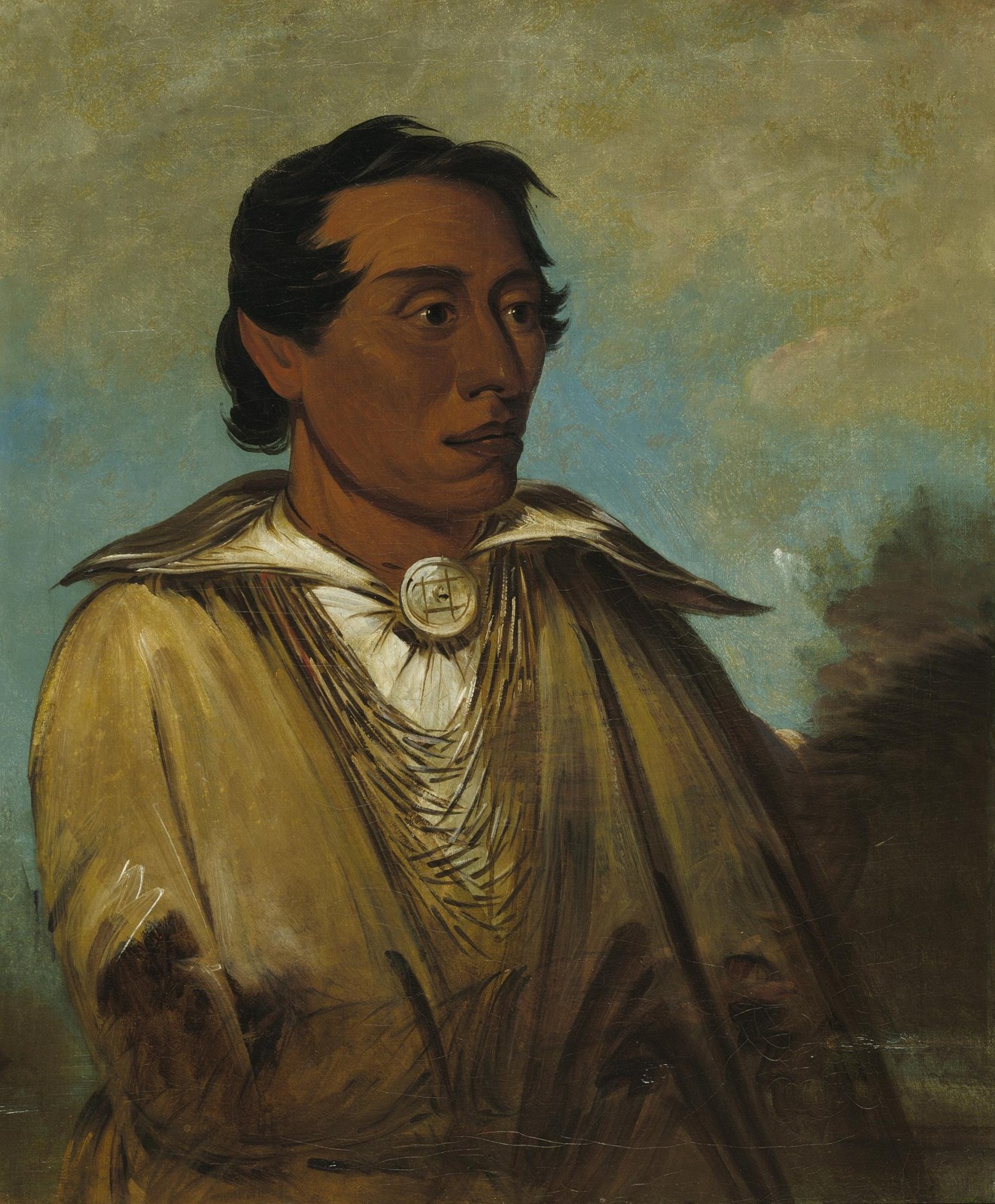
Kee-án-ne-kuk, Foremost Man, Chief of the Tribe (1830)George Catlin, 1830. Smithsonian American Art Museum, Gift of Mrs. Joseph Harrison, Jr., 1985.66.240. Public domain.
Kickapoo people continue in distinct communities and governments across the United States and Mexico. This Texas-focused reading path concerns the Kickapoo Traditional Tribe of Texas and selected cross-border, legal, language, education, family-policy, and planning sources; it does not represent every Kickapoo community. Several historical and ethnographic studies document particular periods and sites, while key parts of present-day community history still need direct, community-authored documentation.
See each region’s evidence for historical or present-day scope.
Homeland / region
Great Lakes / Kansas / Oklahoma / Texas / Mexico
Research depth
Cited overview
Source collection
21 annotated resources · 5 Indigenous-led
Inspected sources
15 substantive works · selected content reviewed
Initial adequacy
Still unfinished
Source review
October 26, 2026
Names & relationshipsKickapoo is a broad people-level directory entry spanning distinct communities and governments. This supplement focuses on the Kickapoo Traditional Tribe of Texas. It does not collapse the Texas, Oklahoma, Kansas, or Mexican communities into one government or imply that the Texas government represents all Kickapoo people.
A cited introduction, with more to explore.This overview draws together the linked sources below. It is an introduction, and does not replace community-authored histories or a full scholarly study.
Still unfinished
Fifteen substantive inspected works support this Texas-focused introduction. The newly inspected Tribe-linked departmental collection strengthens the direct community-published evidence on language teaching and early childhood education. Its program descriptions are not outcome evaluations, and the actual immersion resource book and classes were not reviewed. The wider historical and cross-community gaps, institution-centered older sources, shared authorship among several scholarly works and absence of community review still prevent an adequacy or completion claim.
Assessment recorded October 26, 2026. This is separate from research completion and community review.
The Tribe-linked education collection is now reviewed, including its public language and Head Start descriptions. Community-authored historical accounts, the underlying learning materials where publicly appropriate, and independent documentation of program outcomes still need review.
Review the full 2025 TAMIU thesis; only its abstract and repository record were inspected, and the automated download returned 403 without establishing a reader access requirement.
The constitution PDF is an image-based scan containing the 1989 constitution and later election/approval papers; amendment naming/numbering is inconsistent, and current consolidated status was not verified.
Add distinct community perspectives from Kickapoo communities in Oklahoma, Kansas, and Mexico; this supplement cannot stand for them.
The two Mager Hois works overlap in subject and author; repeated claims are not independent corroboration. Their interviews and observations cover earlier periods, so current cross-border conditions remain unestablished.
No community review or endorsement is recorded.
The 1875 diplomatic file and attached Coahuila reports are translated government documents produced during removal negotiations; their claims, figures, language, and accounts of agreement are not neutral or a complete record of community decisions.
Pool’s 1950 Dove Creek article was reviewed only on pages 367, 375, 379, and 385. Its military-history interpretation and OCR-derived excerpts require full-article and source-comparison review before broader claims are made.
Mager’s 2017 comparison was read only in selected sections. It shares an author with the 2010 and 2020 works, uses earlier interviews/documentary research, advances an interpretive thesis, and includes cultural descriptions outside the scope used here; its repeated claims are not independent evidence.
The 2025 transportation plan records dated planning priorities and proposals; implementation/outcomes were not checked, and the detailed crash-data appendices and web GIS remain unreviewed.
The publicly posted Chapter 20 child-welfare code was read only in selected sections; enactment/amendment history and current consolidated status were not verified.
Backdrop images & credits
These images have individual, documented connections to this entry. Their captions and source records define the people, place, object, and period shown; no one image represents every community within a broader label.
Kee-án-ne-kuk, Foremost Man, Chief of the Tribe (1830) George Catlin, 1830. Smithsonian American Art Museum, Gift of Mrs. Joseph Harrison, Jr., 1985.66.240. Public domain.
The museum identifies the sitter as Kickapoo. Its contextual note places the probable sitting at Fort Leavenworth, in present-day Kansas. Appropriate for the broad Kickapoo reading profile; it does not identify a present-day Texas government member or establish territorial boundaries. Read the primary item record, object metadata, museum contextual note, visible reuse label and item-specific HTML rights metadata. Visually inspected both the 793×960 preview and complete 2148×2600 source frame. The museum's historical note quotes Catlin; those attributed religious descriptions and trader anecdotes are not independently corroborated research in this review. The museum’s public-domain/Free to use designation is retained without inventing a CC0 license. Complete source frame proportionally resized and compressed for web copies; CSS crops/overlays apply to background/card copies, while the page banner retains the full frame. No generated or retouched image content. No community endorsement or documentary photograph claim.
Image, association, and reuse record reviewed 2026-10-26.
Full images are displayed proportionally above. A translucent background copy may be cropped by the viewport; it does not replace the complete image or its record.
The visual treatment does not change the research status, evidence, or remaining gaps recorded in this profile.
Start reading here
A broad people-level route with a Texas–Coahuila emphasis. Texas, Oklahoma, Kansas and Mexican communities are distinct; the Texas government is not a government for all Kickapoo people. The Spanish chapter is fully read in the prior review; No-ko-aht's account is mediated, and the statute is historical rather than current legal guidance.
Begin with the Texas Tribe's own account of language education and family supports; the described programs are aims and activities, not measured outcomes.
No-ko-aht's attributed journey account brings a historical Kickapoo voice to cross-border movement, with the federal recorder and later editor kept visible.
This Spanish-language chapter supplies wider Great Lakes–Coahuila–Texas context while explicitly exposing disputed dates and the scholar's perspective.
The complete 1983 statute lets readers distinguish the enacted border-passage and land provisions from later institutional history and present law.
These are selected starting points. The full annotated collection, source perspectives, inspection limits and remaining research questions follow below. A starting guide is not an exhaustive history or community endorsement.
01
Distinct communities and the Texas-focused scope
Kickapoo people are represented by distinct communities and governments in the United States and Mexico. The 1983 Texas Band of Kickapoo Act used a specific legal relationship to the Kickapoo Tribe of Oklahoma; the later Texas-hosted constitution packet’s preamble describes the Texas Tribe as organized separately and apart. The 2020 Interior Solicitor memorandum addresses a narrower federal-jurisdiction and fee-to-trust question. These records document legal wording and chronology, not every community’s own account of identity or the packet’s present consolidated legal status.
Two scholarly works by Elisabeth Mager Hois examine the Texas–Coahuila relationship through different publications and periods. Her 2010 chapter surveys migration and legal/economic history, drawing in part on published literature and interviews conducted in 1996–2002; the 2020 article focuses on border crossing and includes interviews from 1985–2005. Their claims are attributed to the author and periods, not counted as independent corroboration when repeated. A separate 2017 Texas intertribal public-safety report records the Texas Tribe’s participation in statewide planning; its schematic map serves the report’s planning purpose and does not define homelands. A 1867 account attributed to No-ko-aht, recorded by federal agent Franklin G. Adams and published in an edited 1932 article, offers a distinct contemporaneous perspective on a Kansas-to-Mexico journey, the Dove Creek attack, and treaty pressure. The mediation, editorial framing, and internal chronology/group-count discrepancies are explicit; this account is not treated as a verbatim or independently corroborated record. A 1875 translated diplomatic file gives the U.S. and Mexican governments’ competing positions and attached Coahuila reports during another removal effort. These are administrative perspectives, not neutral testimony; one Coahuila report states that some Kickapoo people remained at Nacimiento and other locations. The University of Texas at Austin finding aid identifies additional Latorre field notes, manuscripts, correspondence, and other collection materials relating primarily to El Nacimiento; the collection itself was not reviewed, and the archive states photography is prohibited and image publication/exhibition permission is not being granted. It is retained as a future research route, not counted as inspected primary evidence. A 2017 peer-reviewed comparison by Mager adds a Texas-focused account of land acquisition and the later economic history of the Texas Tribe, drawing on documentary research, participant observation, interviews reported from 1995–2015, and a cited 1981–1984 Land Acquisition Committee report. This is the same researcher represented by the 2010 and 2020 works; the article’s analytical thesis and interview-based claims are attributed and not treated as independent confirmation. Only the Kickapoo-focused historical passages were used; sensitive cultural descriptions were excluded.
What the 1983 statute and 2020 legal memorandum address
The 1983 federal act authorizes specified services, land-acquisition activity in Maverick County, and border-passage provisions. A Texas-hosted scan of the Tribe’s constitution and attached federal records documents approval of the constitution in 1989 and later amendment elections/approvals in 2017 and 2018. Its scan labels and amendment numbering are not fully consistent, and this review did not verify whether it is the current consolidated text. The 2020 Interior memorandum addresses a narrower question about federal jurisdiction in 1934 and a particular fee-to-trust application. These are dated legal records, not legal advice or proof of current implementation. The 1875 diplomatic record shows an earlier U.S.–Mexico effort to arrange removal to U.S. reservations; it records official claims and proposals, not a complete account of individual or community decisions.
The Texas Tribe’s education department publicly lists a Kickapoo language program alongside other services; some initiatives on the page are explicitly labeled under development. A 2011 INALI publication provides a much deeper, dated study of the Kickapoo variety in Coahuila: phonological analysis, an ethnographic overview based on fieldwork reported for 1980–1983 and later visits, and a practical writing-system chapter that describes consultation with speakers. The book documents a specific research and orthography project; it is not a current census of language use or a description of all Kickapoo communities. The Tribe-linked Education Department publication now provides a fuller first-party account. Its Language Department says it has developed and taught curriculum since 2017, creates learning materials, and incorporates language into Head Start, tutorial and summer programs. The Head Start page lists a Kickapoo immersion-language resource book, family-engagement activities and several learning platforms. These descriptions document the department’s published approach; they do not show measured language fluency, school outcomes or current class participation. The listed immersion book and software were not inspected. The public pages also describe family, disability and other supports, without supplying the evidence needed to evaluate their delivery.
Publicly posted policy on family, culture, and community planning
A public copy of the Tribe’s Chapter 20 Indian Child Welfare Code frames child-welfare policy around protecting family and Tribal connections and preserving children’s opportunity to learn about culture and heritage. Only selected pages were reviewed; the code’s enactment date and current consolidated status remain unverified, so it is presented as a published primary policy text rather than current legal advice or evidence of outcomes. The Tribe’s June 2025 transportation safety plan records a planning process that brought together several Tribal departments and external safety partners, using TxDOT and Tribal Police data while noting limits in the latter. Among its proposed strategies are community and school outreach, including media messages that use or honor Tribal/local language, symbols, or culture. These are dated plans and proposals, not proof of implementation or a general description of Kickapoo culture. The plan’s crash data, precise locations, appendices, and web GIS were not reviewed or reproduced.
A dated housing and community-development case study
A short HUD case feature describes housing and community-development projects involving the Texas Tribe, including FEMA mobile homes during 2009–2013 and a wellness-center project. The page’s publication date is unstated, so it is useful for a limited historical case study rather than present-day program or demographic information.
A historical synthesis and its unresolved chronology
A 2010 UNAM chapter and the 2011 INALI study trace Kickapoo histories through Great Lakes, Midwestern, Texas, and Coahuila settings, while focusing on different communities and drawing on different evidence. The chapter describes multiple migrations and the establishment of El Nacimiento; its own notes show disagreements among cited authors about the timing and victims of the 1873 El Remolino attack and about land-area figures. The 2011 study records its author’s fieldwork and ethnographic observations for specified periods. These works add valuable historical and language context but should be read alongside the relevant treaties, statutes, and distinct community sources rather than combined into a seamless migration story. The edited 1932 publication of No-ko-aht’s 1867 account also gives his perspective on the journey south and Dove Creek conflict. Its dates and numbers differ from the editor’s prefatory narrative, so the page preserves the discrepancy and does not use the account alone to settle the event chronology. A separate 1875 U.S.–Mexico diplomatic file preserves competing government arguments over attempts to move Kickapoo people from Mexico to U.S. reservations, alongside Coahuila reports that some remained at Nacimiento and other places. Because these are translated diplomatic and administrative documents written within removal negotiations, their language, numbers, and claims are attributed to the officials rather than treated as neutral or complete community testimony. Pool’s later study of Dove Creek adds a selected-page military-history reconstruction of the 1865 attack; only pages 367, 375, 379, and 385 were inspected, and its interpretation is not a community account. Mager’s 2017 comparative study adds another dated account of Texas land acquisition and economic change, based partly on interviews and a committee report, but shares an author with the 2010 and 2020 studies and does not provide independent corroboration of their repeated claims.
The 1867 No-ko-aht account was recorded in shorthand by federal agent Franklin G. Adams and edited by George A. Root in 1932. The editorial narrative and attributed account differ on dates and group counts; neither is treated as independently conclusive.
The Tribe-linked education collection is now reviewed, including its public language and Head Start descriptions. Community-authored historical accounts, the underlying learning materials where publicly appropriate, and independent documentation of program outcomes still need review.
Review the full 2025 TAMIU thesis; only its abstract and repository record were inspected, and the automated download returned 403 without establishing a reader access requirement.
The constitution PDF is an image-based scan containing the 1989 constitution and later election/approval papers; amendment naming/numbering is inconsistent, and current consolidated status was not verified.
Add distinct community perspectives from Kickapoo communities in Oklahoma, Kansas, and Mexico; this supplement cannot stand for them.
The two Mager Hois works overlap in subject and author; repeated claims are not independent corroboration. Their interviews and observations cover earlier periods, so current cross-border conditions remain unestablished.
No community review or endorsement is recorded.
The 1875 diplomatic file and attached Coahuila reports are translated government documents produced during removal negotiations; their claims, figures, language, and accounts of agreement are not neutral or a complete record of community decisions.
Pool’s 1950 Dove Creek article was reviewed only on pages 367, 375, 379, and 385. Its military-history interpretation and OCR-derived excerpts require full-article and source-comparison review before broader claims are made.
The UT Austin Latorre finding aid points to potentially relevant archival materials about El Nacimiento, but the collection itself was not inspected; its stated photography and image-publication restrictions must be respected.
Mager’s 2017 comparison was read only in selected sections. It shares an author with the 2010 and 2020 works, uses earlier interviews/documentary research, advances an interpretive thesis, and includes cultural descriptions outside the scope used here; its repeated claims are not independent evidence.
The 2025 transportation plan’s appendices, detailed crash data and web GIS remain unreviewed; proposed safety strategies are not treated as completed actions.
The public Chapter 20 code copy has an unverified enactment/amendment history and current status; further legal-history work is needed before describing it as current law.
Texas-focused supplement reviewed 2026-10-23. Five sources count toward the substantive target; the two existing homepages, brief Tribal education page, and unread-full-text TAMIU thesis are excluded. Legal sources are limited to their stated questions and dates. The 2017 report’s map is not reproduced or used as territorial evidence. No historical-map association was added in this source-focused batch. 2026-10-23 follow-up: reviewed a Tribe-hosted image-based constitution packet (selected scan pages 1–3 and 14–20), Mager Hois’s full 2010 UNAM chapter (printed pp.101–113), and selected substantial sections of Moctezuma Zamarrón and Nava López’s 2011 INALI publication (PDF/printed pages recorded in the cards). Added an INALI language-atlas lead as supporting only. Eight works now count toward the substantive target; five supporting cards remain excluded. Initial adequacy remains Still unfinished. No map association added. 2026-10-23 follow-up: read the full Kansas Historical Society transcription of No-ko-aht’s 1867 account (published in an edited 1932 article, pp.153–159). Added it as a substantive historical primary account with explicit mediation, editorial-bias, chronology, and group-count limits. Nine substantive works now count toward the target; five supporting cards remain excluded. Initial adequacy remains Still unfinished. No map association added. 2026-10-23 follow-up: read the full indexed 1875 FRUS document 444, including translated U.S.–Mexico correspondence and attached Coahuila reports, and inspected selected pages 367, 375, 379, and 385 of William C. Pool’s 1950 Dove Creek article through UNT Portal. The government records’ removal framing and counts are attributed and unresolved; Pool’s full article remains unread and OCR limits are disclosed. Eleven substantive works now count toward the target; five supporting cards remain excluded. Initial adequacy remains Still unfinished. No map association added. 2026-10-23 source-search note: read the UT Austin Benson Latin American Collection finding aid for the Latorre Collection. Added it as a supporting access reference only; underlying field notes, manuscripts, photographs, and correspondence were not inspected. The archive’s current restrictions are reproduced in the source annotation. Kickapoo remains at 11 substantive inspected works; no map association added. 2026-10-23 follow-up: inspected the eScholarship record and read Mager’s 2017 peer-reviewed comparative article in the methodological framing (printed pp.47–48), Kickapoo/Texas land and economic-history passages (pp.61–63), and related notes (p.71). It is the same author as the 2010 and 2020 works; argument, interview dates, perspective, and selected-page scope are explicit. Sensitive cultural descriptions were excluded. Twelve substantive works now count; six supporting references remain excluded. Initial adequacy remains Still unfinished. No map association added. 2026-10-23 follow-up: inspected selected pages of the Tribe-hosted 2025 Strategic Tribal Transportation Safety Plan (printed pp. 1–4 and 34–41) and selected provisions of its public Chapter 20 Indian Child Welfare Code (pp. 1–2, 5–6, 10–12). Both are counted as substantive primary government works for their bounded topics. Safety-plan strategies are proposals, not outcomes; appendices, crash data and GIS were not inspected. The code copy’s enactment/current status was not verified. Fourteen substantive works now count; six supporting references remain excluded. Initial adequacy remains Still unfinished. No map added. 2026-10-26: inspected the Tribe-linked Education Department Home/Language/Head Start pages in the browser as one substantive continuing work; fifteen substantive works now count. Program aims and descriptions are attributed, not adopted as demonstrated outcomes. Initial adequacy remains Still unfinished. Added a separately identified Texas-government queued route and a museum-cleared historical Kansas portrait only to this broad Kickapoo profile; no portrait assigned to the present Texas government.
Follow the reading path
Sources & further reading
Open any title to read the original source. Annotations explain what each link can help you explore.
No Indigenous-led source is identified in this entry yet. This is a gap in this collection, and does not imply an absence of community knowledge or organization.
The Oklahoma Tribe’s official homepage is retained as a community access point. It was not substantively reviewed for this Texas-focused supplement and does not count toward its source target.
Inspection: Content review not recorded
Access recorded: October 19, 2026
Counting note: Homepage/access point only; excluded from the substantive inspected-work count.
The Texas Tribe’s official homepage was checked for the site’s own identification and current contact/navigation context. This brief landing page does not count as a substantive historical or educational work.
Inspection: Supporting or limited review; see scope
Scope: Homepage identification statement and navigation rechecked; directly linked Tribal Education Canva publication establishes its departmental connection. Undated enrollment total and linked member services not used.
Review recorded: October 26, 2026
Counting note: Homepage/access point only; excluded from the substantive inspected-work count.
The 1983 statute names the Texas Band as a subgroup of the Kickapoo Tribe of Oklahoma, authorizes federal services and land acquisition in Maverick County, and addresses passage across the international border. It records the law as enacted then; it is not a complete account of later legal status or present implementation.
Inspection: Content reviewed for the stated scope
Scope: Entire three-page enacted statute read; land authority, services and border-passage provisions inspected.
Review recorded: October 23, 2026
Access note: Publicly readable during this review.
This 2020 solicitor memorandum addresses a specific federal-jurisdiction question and a pending fee-to-trust application. It distinguishes the 1934 Indian Reorganization Act analysis from the later 1983 statute. Its conclusion is limited to that legal issue and should not be read as a complete or current legal account, or as legal advice.
Inspection: Content reviewed for the stated scope
Scope: PDF pages 1–7 and 23–24 inspected, including background and conclusion; the other pages and current implementation were not reviewed.
Review recorded: October 23, 2026
Access note: Publicly readable during this review.
A 2017 public-safety broadband report includes a Kickapoo Traditional Tribe of Texas profile and documents the Tribe’s participation in a statewide intertribal planning effort. The migration map is schematic and designed for this report’s purpose; it is not reproduced or treated as a homeland boundary. Dated population and service figures are excluded.
Inspection: Content reviewed for the stated scope
Scope: Inspected PDF pages 4–5, 12–13 and 19–21, including participant list, map context and Kickapoo profile; references screened. Other profiles and dated population/service figures not used.
Review recorded: October 23, 2026
Access note: Publicly readable during this review.
This Spanish-language scholarly article analyzes how the U.S.–Mexico border affected Kickapoo communities in Texas and Coahuila. It combines earlier published literature with interviews conducted between 1985 and 2005. Interpretations and interview accounts are attributed to the author and their stated period; disagreements and broad claims are not presented as settled facts.
Inspection: Content reviewed for the stated scope
Scope: Full article body, from abstract and introduction through relevant historical sections, conclusion and references, read. Restricted cultural descriptions were deliberately excluded from the synthesis.
Review recorded: October 23, 2026
Access note: Publicly readable during this review.
A short federal case feature describes a dated sequence of housing and community-development work, including FEMA mobile homes from 2009 to 2013 and a wellness-center project. It offers a narrow program history; undated publication details and old demographic or funding figures do not establish current conditions.
Inspection: Content reviewed for the stated scope
Scope: Entire three-page case feature read. Publication date is not stated; time-specific project descriptions were retained while dated figures were excluded.
Review recorded: October 23, 2026
Access note: Publicly readable during this review.
The Tribe’s education department describes its mission and lists education and language-related programs. Some initiatives are explicitly labeled as under development on the page; the listing is not evidence of current operation or outcomes. Useful community context, but brief and excluded from the substantive-work count.
Inspection: Supporting or limited review; see scope
Scope: Actual page body inspected: department mission, program list, and the status labels identifying initiatives under development; linked materials not reviewed.
Review recorded: October 23, 2026
Access note: Public page; no linked program materials inspected.
Counting note: Useful supporting context, but not a substantive work for the profile target.
The repository record supplies a 2025 thesis abstract relevant to Texas Kickapoo economic history. The full thesis was not read, and no access restriction was verified; retain it as a lead rather than count it as inspected evidence.
Inspection: Supporting or limited review; see scope
Scope: Repository metadata and abstract inspected. Full-text download request failed in the search tool; this does not establish a reader paywall.
Review recorded: October 23, 2026
Access note: Full text unread; access requirement not verified.
Counting note: Useful supporting context, but not a substantive work for the profile target.
Publication: 1989 constitution; amendment/election papers 2017 and 2018
The Tribe-hosted 20-page scan includes the constitution and BIA election/approval papers from 1989, 2017, and 2018. The preamble describes organization as a Tribe separate and apart from the Kickapoo Tribe of Oklahoma; the 1989 approval certificate states that its approval does not authorize action contrary to federal law. Later papers document amendments to constitutional provisions. The scan’s cover wording and included amendment-number labels are not fully consistent, and it is not independently verified here as the currently operative consolidated constitution. It is a primary historical/governance record, not legal advice or a source for private enrollment details.
Inspection: Content reviewed for the stated scope
Scope: Scanned PDF pages 1–3 and 14–20 visually inspected: preamble, jurisdiction/governance passages, 1989 approval certificate, amendment text, and BIA election/approval records. Individual names/rolls and membership criteria were not transcribed.
Review recorded: October 23, 2026
Access note: Publicly downloadable scan on the Tribe’s official website; image-based PDF rather than searchable text.
This 2010 Spanish-language book chapter surveys Kickapoo histories from the Great Lakes to Coahuila and Texas and discusses the formation of the Texas community, cross-border relations, land, federal recognition, and the Lucky Eagle casino context. It is a scholarly synthesis by one author drawing on earlier publications and field interviews with Kickapoo and Múzquiz residents (1996–2002); its interpretations are not a community-authored consensus. The chapter itself notes contradictory dates and figures in cited works, including the 1873 El Remolino attack and land-area totals. Read those passages as attributed historical claims rather than settled facts. The repository lists open access and CC BY-NC-ND 4.0; only a link is reproduced here.
Inspection: Content reviewed for the stated scope
Scope: Full 13-page chapter read (printed pages 101–113), including historical narrative, El Nacimiento and Texas sections, source notes, and references.
Review recorded: October 23, 2026
Access note: Open-access PDF through UNAM repository; Spanish language; repository metadata lists CC BY-NC-ND 4.0.
A substantial Spanish-language study combines a short ethnographic overview of the El Nacimiento community with two phonological analyses of the Coahuila variety and a chapter on a practical writing system. The author reports six months of fieldwork in 1980–1983 and later visits in 1988 and 2010; a later chapter describes consultation and community decision-making in developing a practical alphabet. These are dated, author-attributed observations, not a measure of present language use or a universal account of every Kickapoo community. Restricted cultural descriptions were excluded from the atlas synthesis.
Inspection: Content reviewed for the stated scope
Scope: Selected sections in the 146-page PDF: printed pages 13–23 (method, community geography/history and economic context), 30–45 (social organization, language-use description), and 109–120 (practical alphabet). Other chapters and restricted cultural descriptions were not used.
Review recorded: October 23, 2026
Access note: Public PDF hosted by INALI; all-rights-reserved notice appears in the publication. Link only; no text or figures reproduced.
Publication: Copyright 2016; census figures cited are from 2000 and 2010
This Mexican government language-atlas page identifies the Kickapoo language in Múzquiz, Coahuila, links to the INALI phonology study, and summarizes historical/language material. Its high-risk classification and speaker figures rely on 2000 and 2010 census-era data; those figures are dated and are not presented here as current. The page also includes interpretive claims about cultural change that are not treated as established fact. Retained as a dated guide to the language-resource trail, not as a substantive source for the profile target.
Inspection: Supporting or limited review; see scope
Scope: Page sections on history, neighboring languages, revitalization, risk methodology, migration, and bibliography links read. Underlying 2000/2010 census data not independently recalculated.
Review recorded: October 23, 2026
Access note: Public INALI atlas page; Spanish language; underlying linked study reviewed separately as p165-s12.
Counting note: Useful dated government language-reference page, but its data are old and it partly points to the substantive INALI study already counted.
Publication: Interview recorded May 31, 1867; edited/published February 1932, Kansas Historical Quarterly 1(2), pp. 153–159
The article prints a May 31, 1867 account attributed to Kickapoo leader No-ko-aht and recorded in shorthand by federal agent Franklin G. Adams. No-ko-aht describes travel between Kansas and Mexico, the 1865 Dove Creek conflict, life in Coahuila, and his objections to treaty pressure and settler encroachment. This is a historically valuable but mediated account: the recorder was a federal agent, George A. Root edited and published it in 1932, and the surrounding editorial narrative uses period terminology and makes claims that should not be adopted as neutral fact. The printed account and editorial summary also differ in chronology and group counts; the discrepancy is retained rather than reconciled here.
Inspection: Content reviewed for the stated scope
Scope: Full transcribed article and footnotes read, pp.153–159. Inspected the editor’s account and the attributed No-ko-aht statement; no independent corroboration of every event, date, casualty number, or quotation was established.
Review recorded: October 23, 2026
Access note: Public transcription hosted by Kansas Historical Society; source page states digitized with permission. Historical spellings, editorial framing, and one illegible passage are retained as source limitations.
A translated diplomatic exchange and attached Coahuila state reports concerning U.S. efforts to move Kickapoo and other Indigenous people from Mexico to U.S. reservations. It records competing U.S. and Mexican government positions, and a Coahuila commissioner’s reports of negotiations, departures, and people still at Nacimiento and elsewhere. Those documents use coercive period language and reflect government interests; their stated counts and characterizations are not treated as neutral community testimony or a complete account of consent, movement, or later residence.
Inspection: Content reviewed for the stated scope
Scope: Full indexed document 444 read, including the U.S. minister’s dispatch, translated Mexican foreign-ministry reply, two attached Coahuila reports, and follow-up U.S. reply. The figures and claims are attributed to the specific officials; no independent corroboration of the reported counts or agreement was established.
Review recorded: October 23, 2026
Access note: Full transcription publicly readable through the U.S. Department of State Office of the Historian.
Scholarly historical articleWilliam C. Pool; Southwestern Historical Quarterly / Texas State Historical Association; The Portal to Texas History, University of North Texas LibrariesSource 16
Pool’s 19-page article reconstructs the January 8, 1865 Dove Creek battle using military correspondence and other records. This review inspected selected pages 367, 375, 379, and 385 only; the rest of the article was not read. The excerpt documents the attackers’ uncertain identification of the camp and the author’s reliance on conflicting reports. Its mid-20th-century military-history framing is attributed to Pool, and the article is not treated as a Kickapoo community account or as independent confirmation of every casualty or movement claim.
Inspection: Content reviewed for the stated scope
Scope: Selected OCR-extracted article pages 367, 375, 379, and 385 were read via the UNT Portal; page images and article title/issue metadata were inspected. This is a limited excerpt review, not a full-article reading. OCR errors are possible.
Review recorded: October 23, 2026
Access note: Selected page transcriptions and images publicly readable through UNT Portal; automatic OCR may contain errors.
Archive finding aidNettie Lee Benson Latin American Collection, University of Texas Libraries, The University of Texas at AustinSource 17Supporting reference · outside substantive inspected count
This detailed finding aid describes a collection of field notes, manuscripts, photographs, correspondence, and research materials, primarily concerning Kickapoo life in El Nacimiento and collected mainly during 1960–1975. It helps readers locate future primary-source research but is not a substitute for examining the materials themselves. The archive states that cell-phone photography is not permitted and that it is not granting permission to publish or exhibit collection images until further notice; standard copyright restrictions also apply. No collection images or restricted records are reproduced here.
Inspection: Supporting or limited review; see scope
Scope: Full public finding aid sections on scope and contents, dates, language, access/use restrictions, collector background, collection organization, and repository details read. Collection materials themselves were not inspected.
Review recorded: October 23, 2026
Access note: Public finding aid; underlying collection is subject to stated in-person access and image-use restrictions. These restrictions concern archive use, not a verified reader paywall.
Counting note: Archive finding aid and access description; underlying primary materials have not been inspected, so this reference does not count toward substantive works.
Peer-reviewed scholarly articleElisabeth A. Mager; translation by Heather Dashner Monk; American Indian Culture and Research Journal / eScholarship, University of CaliforniaSource 18
This peer-reviewed comparative study includes a dedicated section on the Kickapoo Traditional Tribe of Texas and El Nacimiento. Mager identifies documentary research, participant observation, and interviews as methods and cites interviews conducted from 1995 to 2015, along with the Texas Tribe’s 1981–1984 Land Acquisition Committee report. Selected passages discuss land acquisition and economic history; the author’s theory of “ethnic consciousness,” causal claims, and generalizations remain her interpretation, not a community consensus. This is the same researcher represented by sources 6 and 11, so repeated claims are not independent corroboration. Cultural descriptions outside the selected historical scope were not used.
Inspection: Content reviewed for the stated scope
Scope: Read article metadata and research-method statement (printed pp.47–48), Kickapoo-focused land and Texas economic-history passages (printed pp.61–63), and the corresponding cited notes on printed p.71. The comparative sections about Morongo and detailed ceremonial/cultural descriptions were not used. Claims are attributed to the author and the dates/interview sources stated in her notes.
Review recorded: October 23, 2026
Access note: Full article publicly available from eScholarship; its record lists a Creative Commons Attribution-NonCommercial license. The atlas links to the article and does not reproduce its text or images.
A public planning document prepared for the Kickapoo Traditional Tribe of Texas with consultant Red Plains Professional. It records a 2024 safety-planning grant, coordination among Tribal departments and outside safety partners, and proposed outreach and transportation-safety strategies. The text calls for some media to use or honor Tribal/local language, symbols, or culture. It is evidence of a dated planning process and stated strategies, not proof that proposed actions were completed or a general account of Kickapoo culture. The 127-page PDF includes digital appendices and an earlier plan; this guide does not reproduce crash data, locations, or appendices.
Inspection: Content reviewed for the stated scope
Scope: Read the 2025 plan’s title, contents, vision/introduction, plan-development and safety-partner sections (printed pp. 1–4), and selected education, outreach, data-management, and implementation sections (printed pp. 34–41). The appendices, underlying crash records, exact location data, web GIS application, and 2015 plan were not inspected.
Review recorded: October 23, 2026
Access note: Public PDF hosted on the Tribe’s official website. No reuse license was identified; the atlas links to the document and does not reproduce its maps or data.
This public copy of Chapter 20 states the Kickapoo Traditional Tribe of Texas’s child-welfare policy goals, including protecting family and Tribal connections and preserving children’s opportunity to learn about culture and heritage. It is a primary policy text, not evidence of program outcomes or a complete account of Kickapoo child-rearing traditions. The URL indicates a 2017 upload path, but the text’s enactment date and whether this is the current consolidated code were not verified; do not use it as current legal advice.
Inspection: Content reviewed for the stated scope
Scope: Inspected selected pages of the public 49-page PDF: opening policy and definitions (printed pp. 1–2), jurisdiction and confidentiality provisions (pp. 5–6), and the second policy section (pp. 10–12). The remaining code was not read, and the code’s enactment/amendment history and current status were not verified. No case details or confidential information were used.
Review recorded: October 23, 2026
Access note: Public PDF hosted on the Tribe’s official website. No reuse license was identified; the atlas links to the text without reproducing it.
Publication: Undated public pages; reviewed 2026-10-26
The Tribe-linked departmental publication supplies a direct account of its language curriculum, learning materials, Head Start resources and family supports. The Language page dates its curriculum work to 2017 and describes classes and integration with other education programs; Head Start lists a Kickapoo immersion-language resource book and family-engagement resources. These are the department’s descriptions and aims, not independently evaluated participation, fluency or learning outcomes. The three selected public pages are one continuing collection, not three separate works.
Inspection: Content reviewed for the stated scope
Scope: Read actual rendered public Home Page mission and program navigation, the complete Language Department body, and Head Start program/resources, curriculum platforms, family services, health/disability and food-service descriptions. The official kickapootexas.org homepage links directly to this Canva-hosted department site. Text was read in the normal browser because automated extraction returned no body. Personal staff/contact details, schedules, numerical health deadlines and promotional quality claims were not used in synthesis. No member-only material, classes, lesson books, student records or software were accessed; no photographs reproduced.
Review recorded: October 26, 2026
Access note: Publicly readable in the browser without an account. Automated web extraction returned an empty body; this is not evidence of a reader paywall.
Language Department ↗ — Complete public body, including curriculum work dated to 2017, program integration and stated learning routes; no classes or teaching materials inspected.
Head Start ↗ — Complete public program description and listed resources/supports; no underlying immersion book, software, child records or outcomes reviewed.
Related entries may represent alternate names, constituent communities, wider groupings, or historical connections. Read the naming notes before treating entries as equivalent.
Robey’s Atlas of Indigenous North America · Compiled October 19, 2026 · Kickapoo