Historical peoples / living descendant communities
Karankawa
Karankawa is a historical collective name associated with several Gulf Coast peoples, and it is also used in present-day descendant-community organizing. Historical labels, modern organizations and family histories are not interchangeable; the evidence and perspectives below are dated and attributed.
See each region’s evidence for historical or present-day scope.
Homeland / region
Texas Gulf Coast
Research depth
Source guide
Source collection
18 annotated resources · 2 Indigenous-led
Inspected sources
12 substantive works · selected content reviewed
Initial adequacy
Not assessed
Source review
October 22, 2026
A source guide for a deeper dive.This entry provides a brief orientation and an organized reading path. A comprehensive deep dive has not yet been completed. Follow the annotated sources and distinguish primary community accounts from outside reference material.
Not assessed
Twelve substantive works have actual-content inspection records, including community statements, first-person testimony, long-form reporting, scholarly and archaeological syntheses, and a selected government meeting record. This is a substantial initial reading path, but the distinct contemporary community names, dated marker discrepancy, uneven primary-source access and incomplete descendant-perspective coverage make an adequacy judgment premature.
Assessment recorded October 22, 2026. This is separate from research completion and community review.
The complete text of the replacement marker announced in July 2026 was not verified in an updated official Texas Historical Commission record.
The 2023 Karankawa Kadla and 2026 Karankawa Tribe of Texas publications use different names; their precise organizational relationship and the breadth of each community’s representation were not independently established.
The selected 2022 commission packet pages contain proposed motions and submitted material; the final action on that agenda item was not established from minutes.
Primary Spanish, Mexican and Republic-era records and archaeological publications require further source-by-source inspection; TSHA and Texas Beyond History bibliographies remain leads.
The full 2019 honors thesis was not read cover to cover; the full text of the 2021 peer-reviewed war article remains unread and excluded.
Further descendant-led publications and perspectives should be reviewed without assuming one organization speaks for all Karankawa descendants.
No current population estimate, exhaustive list of contemporary organizations, or legal-recognition status claim is made; no community endorsement or review is recorded.
No new historical-map association was added: this source batch did not inspect a specific archival map and its relevance to an individual community.
Backdrop photographs & credits
These photographs have individual, documented connections to this entry. Their captions and source records define the people, place, object, and period shown; no one photograph represents every community within a broader label.
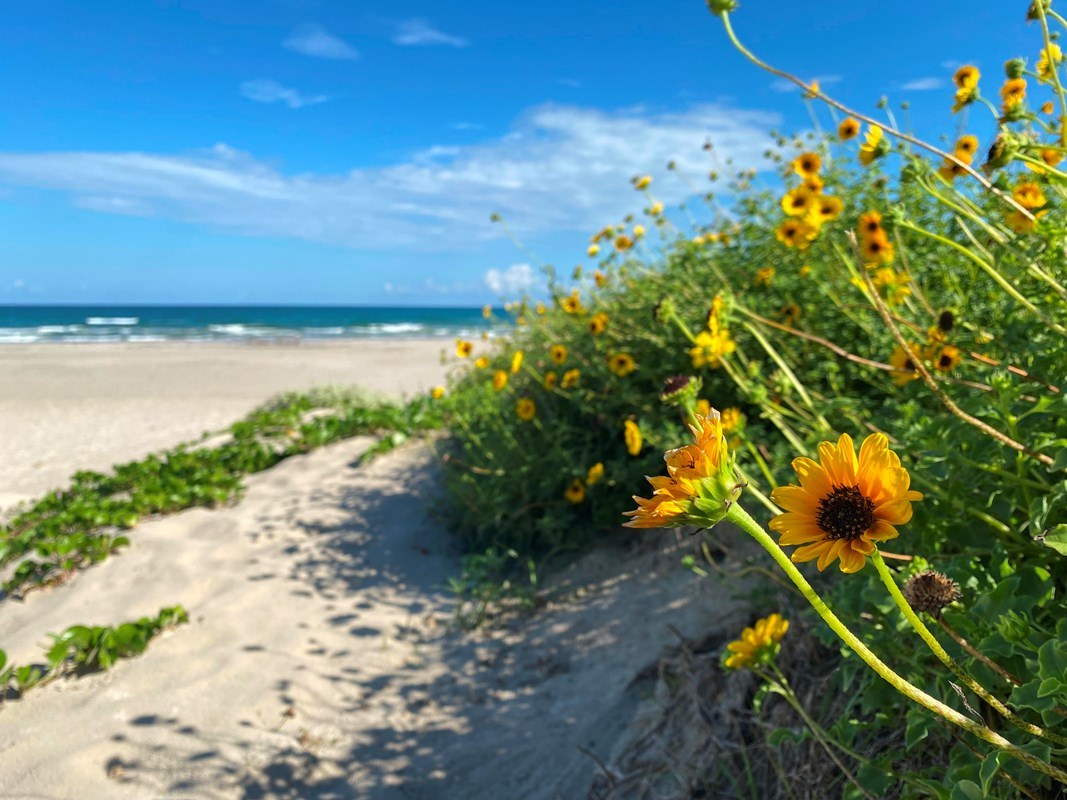
Flowering dunes along Malaquite Beach, Padre Island NPS Photo / Thomas DiGiovannangelo, Padre Island National Seashore · U.S. government work
A modern northern Padre Island landscape. The NPS history page explicitly records a historical Karankawa association with the island's northern end. It is regional environmental context, not a photograph of Karankawa people, a community endorsement, a historical reconstruction or a territorial boundary. Read the actual NPS homepage image caption and photographer credit, inspected the linked ownership policy and the history page's specific northern-island geography passage. Visually inspected the complete 1067×800 NPS-delivered frame. Exact image URL came from the displayed image link, confirmed in HTML; no filename was guessed. This is the openly delivered resized frame, not a claim to the photographer's highest-resolution original. No further image changes were performed. The complete available frame was proportionally resized/compressed for web copies without upscaling or retouching. Card/backdrop CSS crops and overlays apply; the page banner preserves the complete frame.
Image, association, and reuse record reviewed 2026-10-26.
Full photographs are displayed proportionally above. A translucent background copy may be cropped by the viewport; it does not replace the complete image or its record.
The visual treatment does not change the research status, evidence, or remaining gaps recorded in this profile.
Start reading here
Karankawa is a historical collective label and a living descendant-community name; old group lists, clans, family histories and current organizations are different categories. Beaumont’s account and the council’s statement are particular perspectives, and the speech’s orally restricted portion stays excluded.
The 2021 reported feature introduces named descendants’ public cultural work and a particular coastal preservation effort.
These are selected starting points. The full annotated collection, source perspectives, inspection limits and remaining research questions follow below. A starting guide is not an exhaustive history or community endorsement.
01
A name used for several coastal peoples
Historical references use Karankawa as a collective label for several coastal groups, with spellings and lists that vary across sources. TSHA and Texas Beyond History name groups including Cocos, Cujanes, Coapites or Guapites, Carancahuas, Copanes or Capoques. A 2024 speech by Chiara Beaumont describes “seven or so” clans, a different category and count. The profile preserves that variation rather than claiming one settled list or equating the historical groupings with a single present-day government.
Coastal place, seasonal movement and material life
Scholarly and archaeological education sources place the historical communities along the central Texas coast and describe seasonal movement between mainland, bays and barrier islands as people used coastal and inland resources. Those accounts support a broad historical association, not a precise border or evidence that every community occupied each place in the same period. The 2026 Karankawa Tribe of Texas announcement also rejects the older “nomadic” label in favor of “semi-nomadic”; this is that group’s stated correction, while more detailed source comparison remains open.
The Rosario and Refugio entries describe shifting relationships with Spanish mission institutions, including seasonal attendance, departure, negotiation, food shortages and mission movement. Balthazar’s biography follows one Copano leader’s diplomacy and should not be generalized to all coastal groups. These accounts rely on Spanish church and government records, whose labels and judgments—including descriptions of people as difficult to control—reflect colonial observers rather than neutral community testimony.
The Texas Beyond History exhibit links coastal archaeology and material culture to early written records, while later reporting documents the destruction and rediscovery of settlement places. Many commonly repeated descriptions passed through colonial, state or scholarly sources. The 2019 honors thesis examines the history of cannibalism claims; it is a student thesis whose argument should be read with its methods and source limits visible. No allegation from hostile or sensational historical sources is repeated here as established fact.
Living descendants and distinct dated community accounts
Karankawa descendants are publicly organizing today. A 2023 statement from the Karankawa Kadla Five Rivers Council describes some relatives’ family histories and its own reconnection guidance; Beaumont’s 2023 speech gives her family and Karankawa Kadla experience. A 2026 announcement on the same public site uses the name Karankawa Tribe of Texas and also refers to the Five Rivers Council. These dated sources document particular voices and public names; the precise organizational relationship across the different labels and the full range of descendant perspectives remain unverified here. Older “extinction” language and missing archival records do not establish that the people disappeared.
Historical markers, current records and next questions
The 2022 Texas Historical Commission packet records a request to revise an older marker and competing procedural recommendations. A community announcement and 2026 reporting say a replacement marker was unveiled in July 2026. However, the official marker record checked for this review still displays the 1976 inscription; the new full text was not verified against an updated official record. The 2021 report’s recognition statements are dated, not current status findings. Further work should compare the new marker text, commission records, archival sources and additional community publications without treating recognition rules as the definition of peoplehood.
The complete text of the replacement marker announced in July 2026 was not verified in an updated official Texas Historical Commission record.
The 2023 Karankawa Kadla and 2026 Karankawa Tribe of Texas publications use different names; their precise organizational relationship and the breadth of each community’s representation were not independently established.
The selected 2022 commission packet pages contain proposed motions and submitted material; the final action on that agenda item was not established from minutes.
Primary Spanish, Mexican and Republic-era records and archaeological publications require further source-by-source inspection; TSHA and Texas Beyond History bibliographies remain leads.
The full 2019 honors thesis was not read cover to cover; the full text of the 2021 peer-reviewed war article remains unread and excluded.
Further descendant-led publications and perspectives should be reviewed without assuming one organization speaks for all Karankawa descendants.
No current population estimate, exhaustive list of contemporary organizations, or legal-recognition status claim is made; no community endorsement or review is recorded.
No new historical-map association was added: this source batch did not inspect a specific archival map and its relevance to an individual community.
This dated Texas-focused review has twelve substantive inspected works and six supporting or further-reading cards excluded from the count. The count is not a claim of completeness or endorsement. Historical sources differ in lists, spellings and grouping categories. Beaumont’s 2023 speech uses a “seven or so” clan count, while TSHA and Texas Beyond History enumerate historical named groups differently; these categories were not collapsed into one definitive total. Community sources are dated and attributed: a 2023 Karankawa Kadla Five Rivers Council statement, a 2023 speech by Chiara Beaumont, and a July 2026 Karankawa Tribe of Texas marker announcement. The public name shifts and organizational relationships need more careful source review; no group is declared the sole representative. The THC’s 2022 meeting packet and a November 2025 packet document earlier marker processes. A 2026 community announcement and reporting describe a replacement unveiled July 25, 2026, while the official Atlas page checked still returns the 1976 inscription. The new text and final official record remain unverified. The 2019 thesis is an honors thesis, and only selected sections were reviewed. A journal article on the 1778–1789 war, the full thesis, linked primary documents, cited books and archival registers remain unread leads; none are described as inspected. The reviewed sources support broad historical coastal connections and mention specific archaeological places. No precise boundary, sensitive site coordinate or new map-to-profile association was created.
Follow the reading path
Sources & further reading
Open any title to read the original source. Annotations explain what each link can help you explore.
No Indigenous-led source is identified in this entry yet. This is a gap in this collection, and does not imply an absence of community knowledge or organization.
Academic / referenceTexas State Historical AssociationSource 1
A substantial scholarly state-history synthesis about the coastal peoples grouped under the Karankawa name. The article is useful for chronology, named historical groups, subsistence, mobility, missions and bibliography, but carries older extinction-era framing; read it beside dated descendant accounts and do not treat its cultural-group label as a present-day government.
Inspection: Content reviewed for the stated scope
Scope: The full visible article body and bibliography were read. Its broad description, period terminology and claims are attributed to the TSHA entry; cited books and archival collections were not independently inspected.
A later Texas Historical Commission quarterly packet contains a proposed Karankawa marker text, but it largely repeats one institutional narrative and predates a reported 2026 marker replacement. Kept as a dated comparison, not current marker text or an independent substantive history.
Inspection: Supporting or limited review; see scope
Scope: Selected Karankawa marker-text pages in the November 2025 packet were inspected. The complete report was not read, and no final/current marker status is inferred from this source.
Seiter’s honors thesis examines how claims of cannibalism entered colonial and later writing about the Gulf Coast peoples called Karankawa. It is a substantial student thesis, not a peer-reviewed monograph; its argument and source readings should be judged in that context and compared with the older accounts it discusses.
Inspection: Content reviewed for the stated scope
Scope: The thesis abstract, introduction, contents and selected chapters/conclusion were inspected. The full 207-page work was not read cover to cover; the thesis’s interpretation is attributed to Seiter, and no sensationalized allegation is repeated as fact.
A council statement describes the ways some Karankawa Kadla relatives came to know family histories and outlines the council’s own reconnection process. It is direct evidence about this council’s guidance and experience, not a universal membership rule or a complete account of all people who identify Karankawa.
Inspection: Content reviewed for the stated scope
Scope: The full one-page statement was read. Its genealogy and DNA comments are represented as the council’s own guidance; the Atlas does not treat genetic testing as a test of Indigenous identity or citizenship.
Publication: Speech delivered November 2023; transcript posted August 27, 2024
A 2023 speech by Chiara Beaumont, a Karankawa speaker, describes her family’s reconnection and her experience with Karankawa Kadla. The page identifies the transcription and light editorial work by the host; it should be read as Beaumont’s situated account, not as a single voice for all Karankawa people.
Inspection: Content reviewed for the stated scope
Scope: The speech transcript was read. The page explicitly withholds a portion shared for oral listening only; that material is not reproduced or summarized. The speaker’s references to clans and family geography are attributed rather than converted into universal facts or mapped boundaries.
This focused biographical entry reconstructs Copano leader Balthazar through Spanish mission and military records. Its evidence concerns one documented leader and the Copano people; it cannot stand for all Karankawa groups or present-day communities.
Inspection: Content reviewed for the stated scope
Scope: The full visible article and bibliography were read, including the entry’s treatment of a 1789 peace meeting and a 1790 census. The underlying Bexar archival documents cited by the article were not separately inspected.
A detailed mission-history entry discusses Cujanes, Copanes, Guapites and other Karankawa people in relation to Rosario. Its narrative depends heavily on colonial church and government records; period labels such as “indolence” are quoted colonial judgments, not neutral descriptions.
Inspection: Content reviewed for the stated scope
Scope: The visible article body and bibliography were read. It is used for the mission chronology and named groups, not as a complete account of Karankawa perspectives or present community histories.
This entry draws on mission and baptismal records to describe changing population and movement at Refugio and Rosario. Its numbers are colonial administrative categories and should not be taken as a complete count of Karankawa people or as proof that those who left ceased to exist.
Inspection: Content reviewed for the stated scope
Scope: The full visible article body and bibliography were read, including selected 1795–1830 mission records summarized by the author. The original registers were not inspected.
An archaeologist-authored public teaching exhibit places Karankawa communities within a wider Texas coastal region and links settlement, material evidence and seasonal mobility. It was published in 2009 and uses a period “gone forever” framing in its regional introduction; that framing does not establish the absence of living descendants and is balanced with later community sources.
Inspection: Content reviewed for the stated scope
Scope: The complete Native Peoples overview, Karankawa section, credits and bibliography were read. Linked site reports and cited books were not independently inspected; the page’s regional map is an explanatory scholarly illustration, not a present-day territorial boundary.
This reported feature documents Karankawa Kadla people’s public activity in 2021, including family oral-history accounts and an effort to protect a coastal archaeological place. It identifies several named participants and institutions; the article’s 2021 statements about recognition and community size are date-specific, not current legal or population data.
Inspection: Content reviewed for the stated scope
Scope: The complete article body and its sections on family history, archaeological records, community activity and agency responses were read. Interview testimony is attributed to the named speaker; archaeological interpretations and litigation statements remain attributed to the article and its sources.
A collaborative report describes the 2025 rediscovery and preservation campaign around a Corpus Christi Bay settlement site, with testimony from Love Sanchez and named archaeologists and other Indigenous leaders. It concerns a particular site and contemporary campaign; it does not establish a single Karankawa organization’s authority over all sites or people.
Inspection: Content reviewed for the stated scope
Scope: The complete article body was read, including the rediscovery narrative, quoted community and scholarly perspectives, archaeological access limits and permitting context. Sensitive site coordinates and restricted archaeological records are not reproduced; the article’s reported statements remain attributed.
Selected pages preserve a dated public review of a request to revise a Karankawa historical marker, including community-submitted material and competing procedural recommendations. A committee packet is not a complete meeting transcript or a current statement of marker wording.
Inspection: Content reviewed for the stated scope
Scope: Only PDF pages 43–47 concerning the Karankawa Campsite marker item were inspected. The packet contains submitted assertions and proposed motions; no final vote or current marker status is inferred from these selected pages.
A dated community announcement reports the July 2026 unveiling of a revised Karankawa marker and lists corrections sought by women it identifies with the Hawk Clan. It is evidence of that publication’s position and account of its participation, not a substitute for the marker text or a statement by every Karankawa-descendant community.
Inspection: Content reviewed for the stated scope
Scope: The full visible announcement was read. Its six requested corrections and reported collaboration are attributed to the publisher; the marker’s complete new text and the organization’s relationship to earlier Karankawa Kadla naming were not independently verified.
A peer-reviewed journal article identified by the author and journal as a study of the 1778–1789 war. Its full text is a useful route for interpreting colonial power and diplomacy, but it remains a scholarly argument based on archival sources and should be compared with community histories.
Inspection: Supporting or limited review; see scope
Scope: The journal record, abstract and bibliographic metadata were inspected; the full article was not accessible in this pass. It is therefore retained as a supporting unread lead and does not count toward the substantive inspected-work target.
A brief NPS summary supplies a visitor-oriented overview of Rosario and its Spanish context. It overlaps the longer TSHA mission histories and is retained as a convenient supporting introduction rather than an independent substantive work.
Inspection: Supporting or limited review; see scope
Scope: The complete visible page was read. No underlying Spanish records were inspected through it.
A library guide offers discovery paths to repositories and literature. It is a finding aid rather than a substantive history or inspected archival collection.
Inspection: Supporting or limited review; see scope
Scope: The full visible guide was read. The guide itself notes that the underlying primary sources are not held by the library; no linked archival item was inspected through it.
Archives and library research guideGalveston & Texas History Center, Rosenberg LibrarySource 17Supporting reference · outside substantive inspected count
This guide lists manuscripts, scrapbooks, vertical files, books and external research portals. It is useful for future archival work but is not itself a studied historical narrative.
Inspection: Supporting or limited review; see scope
Scope: The full visible guide was read, including its archival catalog descriptions and bibliography. No listed physical collection, catalog object or cited book was inspected through this guide.
A wider survey briefly situates Rosario among Texas missions. Its Karankawa-specific coverage is brief and overlaps dedicated Rosario and Refugio entries, so it remains a supporting orientation.
Inspection: Supporting or limited review; see scope
Scope: The complete visible article and its Rosario passage were read. The underlying source bibliography was not checked in this pass.