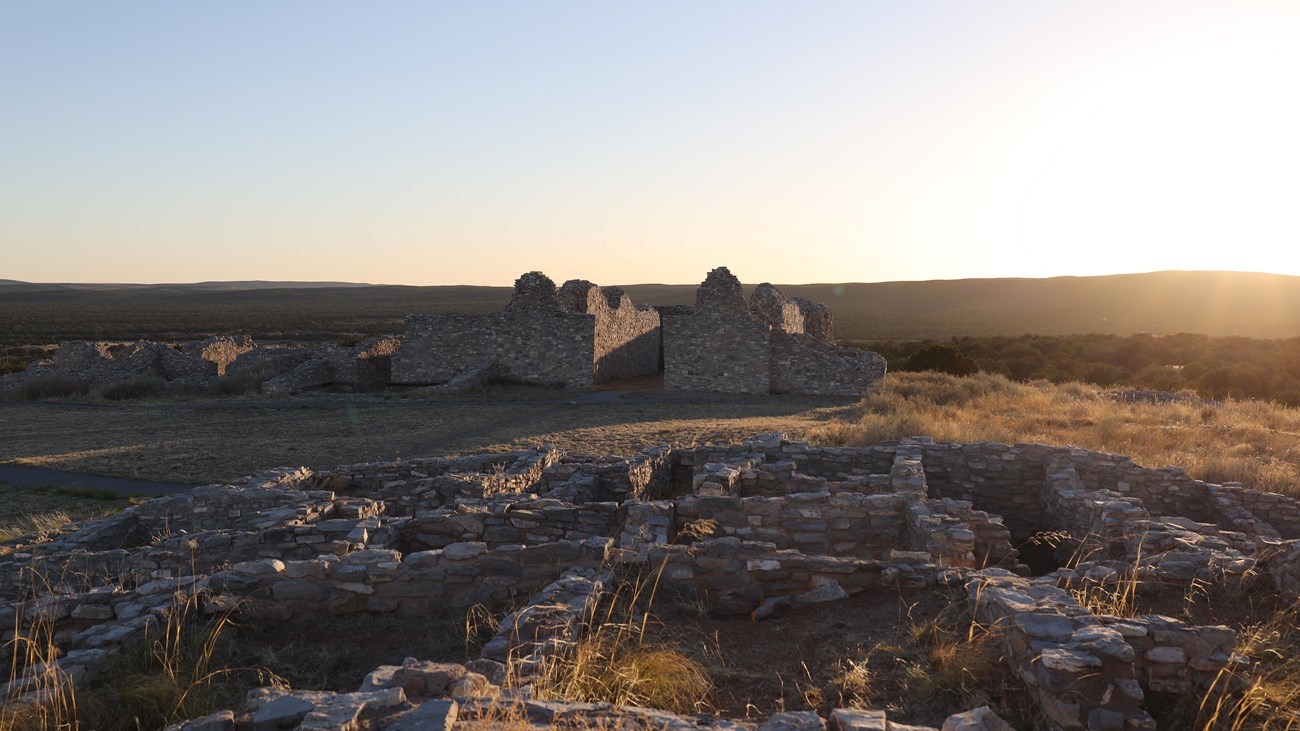
Gran Quivira, New Mexico — historical-label contextNPS Photo / Park Guide Alex Arnold, Salinas Pueblo Missions National Monument · U.S. government work
Spanish and later sources used “Jumano” for peoples across Texas, New Mexico, and adjacent northern Mexico. Scholars disagree whether it named one distinct people, several groups, or a broader label; contemporary Jumano community accounts describe living descendants. This profile keeps historical classifications and present-day community identity separate.
See each region’s evidence for historical or present-day scope.
Homeland / region
Texas / New Mexico / northern Mexico
Research depth
Cited overview
Source collection
26 annotated resources · 1 Indigenous-led
Inspected sources
13 substantive works · selected content reviewed
Initial adequacy
Still unfinished
Source review
October 26, 2026
Names & relationshipsThe historical label Jumano appears in sources for different peoples and settings. This entry also links to contemporary Jumano community accounts and a separate Indigenous-led La Junta organization that names Jumano among several descendant communities. These relationships are presented with their own source scope; they do not establish that every historical use names one polity, or that one modern organization represents everyone connected to the name.
A cited introduction, with more to explore.This overview draws together the linked sources below. It is an introduction, and does not replace community-authored histories or a full scholarly study.
Still unfinished
Thirteen substantive works after this addition provide a stronger source-critical guide, but no new community-authored coverage or direct manuscript inspection. The existing initial-coverage gaps remain open; quantity alone does not establish adequacy.
Assessment recorded October 26, 2026. This is separate from research completion and community review.
No community review or endorsement is recorded. Jumano Nation of Texas and People of La Junta for Preservation are distinct organizations and are not treated as interchangeable or representative of every person connected to historic Jumano labels.
The collection has twelve substantive works, but many analyze the same uneven Spanish documentary record; source quantity does not resolve the historical identity debate.
The 1986 Kelley monograph and 1988 Hickerson linguistic article remain partially inspected or abstract-only; the full texts were not reviewed.
Spanish and Mexican archival manuscripts discussed in the secondary literature, including the 1683–84 Domínguez de Mendoza diary, were not independently read.
The range of contemporary Jumano community publications, family histories, language evidence, and cultural transmission remains limited and needs further review.
The relationships among historical Jumano labels, Taovayas/Wichita, Tompiro Pueblo communities, and La Junta peoples remain contested; no exhaustive descent, identity, population, or federal recognition claim is made.
Historical maps described or reproduced in secondary pages were not independently inspected for this batch; no map-to-profile connection was added.
The new article's manuscript comparisons and historical conclusions were read as published scholarship; no underlying archival text was independently checked.
Backdrop photographs & credits
These photographs have individual, documented connections to this entry. Their captions and source records define the people, place, object, and period shown; no one photograph represents every community within a broader label.
Gran Quivira, New Mexico — historical-label context NPS Photo / Park Guide Alex Arnold, Salinas Pueblo Missions National Monument · U.S. government work
Gran Quivira in New Mexico, a place already linked as supporting context in the Jumano profile. NPS uses a combined eastern Tompiro/Jumano label for its historical population; that compressed terminology is not independent proof that Tompiro and all Jumano communities were interchangeable. The image is a modern view of this named public archaeological setting, not a Texas location, present Jumano-government representation, historical reconstruction or surveyed homeland. Read the complete primary visitor page and its image identification/creator credit; checked current profile source p151-s25 and its stated limits. Visually inspected the complete 1300×731 frame delivered by NPS. Actual source uses an agency cropped-image endpoint, which is disclosed; this review does not claim the uncropped camera original was inspected. No further image crop, generated content or retouching was applied. Agency-supplied cropped source view; camera-original frame not inspected. Preserve the complete downloaded source view and disclose this copying limit. Web copies were proportionally compressed without upscaling, retouching or invented content. CSS crops/overlays apply to card/background displays; the opened-page banner preserves the complete delivered source view.
Image, association, and reuse record reviewed 2026-10-26.
Full photographs are displayed proportionally above. A translucent background copy may be cropped by the viewport; it does not replace the complete image or its record.
The visual treatment does not change the research status, evidence, or remaining gaps recorded in this profile.
Start reading here
Historical Jumano labels and living descendant identities are related questions with different evidence. Jumano Nation of Texas and People of La Junta are distinct organizations; neither one modern organization nor the Gran Quivira Tompiro/Jumano label resolves every historical use.
This textual study explains how copies and translations of the Mendoza records can produce different historical narratives.
These are selected starting points. The full annotated collection, source perspectives, inspection limits and remaining research questions follow below. A starting guide is not an exhaustive history or community endorsement.
01
A historical name with contested scope
Historical materials used “Jumano” across more than one region and context. Nancy P. Hickerson’s distinct-trading-people interpretation appears in both her Handbook of Texas article and later scholarship, while older and other scholarly models proposed a broad Spanish label or linguistic connections to different peoples. Studies also disagree about whether particular Jumano groups were distinct from, related to, or interdependent with settled Patarabueye communities at La Junta. The Texas Beyond History exhibit and Bradley Folsom’s regional summary describe trade and mutual dependence while retaining cultural distinctions; these interpretations draw on inconsistent colonial names and should not be collapsed into one settled identity for every group. A National Park Service visitor page describes Gran Quivira at its peak as home to “eastern Tompiro/Jumano people” and as a Plains–Pueblo crossroads. Because this short public-history page gives no underlying citations and uses a combined label, it is useful evidence of a modern institutional summary, not proof that Tompiro and Jumano were interchangeable.
Historical syntheses describe Jumano travel and trade linking the South Plains, lower Pecos, Rio Grande, New Mexico, and communities farther east. They report exchanges with Pueblo, La Junta, and Caddo communities and diplomacy associated with Juan Sabeata. Robert Weddle’s biography of Juan Domínguez de Mendoza describes Sabeata’s appeal and the 1683–84 expedition; route reconstructions and the proposed location of San Clemente remain disputed. The accounts were produced in colonial settings, and their place names, population figures, and ethnic labels require attribution rather than treatment as settled facts.
La Junta de los Ríos, near the Río Conchos–Río Grande confluence, was a region of settled villages and movement among different communities. The Texas Beyond History exhibit distinguishes villagers described by Spanish sources as Conchos, Patarabueyes, or Amotomancos from Jumano traders and visitors, and explains how translation and later illustrations have sometimes blurred those categories. Bradley Folsom’s regional article presents a later interpretation of Jumano and Patarabueye communities as mutually dependent while culturally distinct. These are interpretations of incomplete written records and archaeological evidence; the confluence should not be assigned to a single people.
Most historical works in this collection rely on Spanish colonial documents, translated accounts, or later scholarly syntheses. Such sources describe encounters, trade, missions, and conflict, but they were written by outsiders and use names inconsistently. Two Arizona Historical Indexes records dated August and October 1683 identify correspondence involving Jumanes, Shulimes, and Sabeata and point to archival volumes and translation files. The catalogue summaries are not the letters: the original documents and translations remain unread, so no claims in those summaries are treated as independently verified here. The 1683–84 Mendoza diary is likewise represented by scholarly summaries and a catalogue record, not a direct reading of the manuscript.
A 2021 local newspaper report records Jumano Nation of Texas historian Felix Bonilla Salmeron describing the nation’s effort to connect with descendants and rejecting the claim that Jumano people disappeared. This is a dated, attributed community perspective reported by a journalist, not a census or an independently verified genealogy. Separately, the Indigenous-led People of La Junta for Preservation describes its descendant communities as including Jumano, Julime, Chisos, Concho, Lipan Apache, and others, and explains its stewardship work at La Junta. That organization’s broader community scope is not interchangeable with the Jumano Nation of Texas.
Reading claims about disappearance and recognition
Some scholarly summaries say the colonial record stopped identifying Jumano as a distinct people or that their trade networks and political position changed by the eighteenth century. That describes an interpretation of surviving documents, not proof that descendants or living communities disappeared. Contemporary accounts from Jumano Nation of Texas and the separate Indigenous-led People of La Junta for Preservation have their own stated scope and are not interchangeable. Texas House Resolution 1565 is a state expression honoring the Jumano Indian Nation of Texas; its historical assertions and population claim are not independently verified here and it is not a federal recognition decision.
Brian Imhoff’s comparison of copies and translations of the 1683–84 Mendoza expedition diary argues that some familiar English narratives omit conflict within the expedition. His reading includes testimony that Jumano participants defended a threatened soldier. This is an interpretation of colonial records reproduced in a modern study, not an Atlas inspection of the originals or an unmediated Jumano account. It strengthens caution about translations without resolving the historical identity debate.
No community review or endorsement is recorded. Jumano Nation of Texas and People of La Junta for Preservation are distinct organizations and are not treated as interchangeable or representative of every person connected to historic Jumano labels.
The collection has twelve substantive works, but many analyze the same uneven Spanish documentary record; source quantity does not resolve the historical identity debate.
The 1986 Kelley monograph and 1988 Hickerson linguistic article remain partially inspected or abstract-only; the full texts were not reviewed.
Spanish and Mexican archival manuscripts discussed in the secondary literature, including the 1683–84 Domínguez de Mendoza diary, were not independently read.
The range of contemporary Jumano community publications, family histories, language evidence, and cultural transmission remains limited and needs further review.
The relationships among historical Jumano labels, Taovayas/Wichita, Tompiro Pueblo communities, and La Junta peoples remain contested; no exhaustive descent, identity, population, or federal recognition claim is made.
Historical maps described or reproduced in secondary pages were not independently inspected for this batch; no map-to-profile connection was added.
The August and October 1683 Arizona Historical Indexes records are metadata-only leads; read the cited archival documents and translations before using their catalogue summaries as evidence.
Follow the reading path
Sources & further reading
Open any title to read the original source. Annotations explain what each link can help you explore.
No Indigenous-led source is identified in this entry yet. This is a gap in this collection, and does not imply an absence of community knowledge or organization.
The enrolled Texas House resolution documents a state legislative expression honoring the Jumano Indian Nation of Texas. Its historical narrative and population claim are not independent verification and it is not a federal recognition decision.
Inspection: Supporting or limited review; see scope
Scope: The enrolled resolution text was read. It is counted as a supporting primary civic record, not as a substantive historical study.
A National Archives finding aid that points researchers toward catalog records. Its brief Jumano note is not a substantive history or current legal-status determination.
Inspection: Supporting or limited review; see scope
Scope: The guide introduction and its Jumano catalog-note row were inspected. Linked catalog records and archival files were not opened.
Publication: Article date not stated on the accessed page
A substantial scholarly state-history synthesis with a bibliography. It describes several different historical groupings associated with Jumano and reviews documentary geography, trade, and migration. Its conclusion that Jumano ceased to exist as an identifiable distinct people is an interpretation of the surviving colonial record; it does not establish that descendants disappeared.
Inspection: Content reviewed for the stated scope
Scope: The full visible article and bibliography were read, including sections on La Junta, Tompiro communities, trade, and the article’s conclusion. The works in its bibliography and original Spanish records were not independently inspected.
Publication: Undated web exhibit; credits cite adaptation from Kenmotsu’s 1994 dissertation and 2001 article
An educational exhibit that synthesizes Spanish accounts of trade, diplomacy, missions, and conflict. Its author explicitly adopts the interpretation that Jumano was a distinct nation. The later statement that Jumano culture was gone and the treatment of biological ‘blood’ are dated outsider interpretations that conflict with contemporary community accounts and should not be presented as established fact.
Inspection: Content reviewed for the stated scope
Scope: Both substantive Jumano modules and the credits page were read. The exhibit’s embedded translations and secondary figures were inspected as presented; cited books, dissertation, article, archives, and maps were not independently reviewed.
Historical scholarshipQuarterly of the Texas State Historical Association 15, pp. 66–84; scan hosted by Wikimedia Commons from an Internet Archive digitizationSource 5
A full, early scholarly article arguing that Jumano groups remained in southern Texas into the eighteenth century and that the name was also applied to Taovayas/Wichita people. Read as a dated intervention in an identity debate, not current consensus. The article contains OCR errors and relies on colonial documents; cited manuscript originals were not inspected.
Inspection: Content reviewed for the stated scope
Scope: The complete 26-page scan was inspected across the introduction, Nueces geography, 1683–1716 records, Apache alliances, and the 1771 Taovayas discussion. Original manuscript sources and other works Bolton cites were not inspected.
A specialist monograph compares Jumano and Patarabueye using documentary, linguistic, and archaeological evidence. Kelley’s distinctions and proposed correlations are scholarly interpretations, not settled ethnic identifications. Full institutional access is required; only the page metadata, chapter structure, and selected displayed excerpts were reviewed.
Inspection: Content reviewed for the stated scope
Scope: Displayed excerpts from the introduction and selected chapters on historical data, Jumano identity, archaeology, and summary were read. JSTOR reported that the signed-in account lacked institutional access. The complete 201-page book was not inspected.
A local report on a public talk by Jumano Nation of Texas members, including historian Felix Bonilla Salmeron. His statements about continuing Jumano identity and descendant-search efforts are attributed to him; the article is not an independent demographic or genealogical study.
Inspection: Content reviewed for the stated scope
Scope: The full visible article body was read, including its direct quotations and image credit. A sign-in interface appeared below the story; the body was accessible without bypassing it. No underlying talk recording or independent genealogical evidence was inspected.
Publication: Current site reviewed October 23, 2026; individual page date not stated
The organization describes its work and identifies Jumano among several descendant communities connected to La Junta. This is a first-party community self-description about its own broader community and stewardship; it does not establish that the organization is the Jumano Nation of Texas or speaks for all Jumano people.
Inspection: Content reviewed for the stated scope
Scope: The visible homepage was read, including its self-description as Indigenous-led, named descendant communities, and discussion of current stewardship. The other named communities and individual family histories were not independently assessed.
Publication: Undated web exhibit; page references Morgenthaler’s 2007 book
A separate educational synthesis about La Junta’s archaeology and changing interpretations. It explains why Jumano cannot simply stand for everyone who lived at or visited the confluence, and summarizes Kelley, Kenmotsu, and Morgenthaler models. Its statements about the disappearance of Native groups are attributed historical interpretations, not proof that descendant communities no longer exist.
Inspection: Content reviewed for the stated scope
Scope: The full visible La Junta Reconsidered page was read, including its treatment of competing models and research limits. Cited books, archival material, and underlying archaeological data were not independently inspected.
Publisher description and chapter list for Hickerson’s full-length scholarly study. The book itself was not read in this update; the publisher summary is not counted as a substantive inspection.
Inspection: Supporting or limited review; see scope
Scope: Read the publisher description, author information and chapter listing on the EPUB record and checked the supplied print ISBN page. These are product records for the same 1994 monograph; the book itself was not accessed or counted.
Scholarly article abstract / further readingJournal of Anthropological Research / University of Chicago PressSource 11Supporting reference · outside substantive inspected count
The abstract summarizes Hickerson’s argument for a Tanoan connection and records competing linguistic affiliations. The full article requires subscription, institutional access, or purchase and was not inspected; no linguistic conclusion is adopted from the abstract alone.
Inspection: Supporting or limited review; see scope
Scope: The abstract, publication metadata, and displayed access terms were read. The complete article was not accessed.
A public humanities event notice identifies Jumano Nation members and their roles in a 2021 community-history program. It corroborates the event and names, not the historical claims or legal status in its summary.
Inspection: Supporting or limited review; see scope
Scope: The full visible event notice, date, participant names and roles, program purpose, and photographer credit were read. No event recording or presentation materials were inspected.
Publication: Article date not stated on the accessed page
A scholarly biographical entry on Domínguez de Mendoza and the 1683–84 expedition. It describes Jumano leader Juan Sabeata’s appeal and the expedition toward La Junta, while noting disagreement over routes and the proposed San Clemente location. This is a secondary synthesis of colonial records, not the expedition diary itself.
Inspection: Content reviewed for the stated scope
Scope: The complete visible article and its bibliography were read. The cited expedition diary, archival manuscripts, and competing archaeological route studies were not independently inspected.
Publication: 1979; open-access digital edition published 2022
A regional historical study drawing on Spanish documentary material for Chihuahua and the southern borderlands. Its section on the Conchería gives useful context for named groups and La Junta, but is not a Jumano-specific account. Its period language about assimilation or disappearance is an author’s interpretation of colonial records, not evidence that descendants ceased to exist.
Inspection: Content reviewed for the stated scope
Scope: The full online section “Historical Sketch of the Conchería,” online pages 4–24, was read, including its discussion of named groups and cited archival passages. The rest of the book and the archival records cited within it were not independently inspected.
A detailed exhibit chapter that distinguishes settled La Junta communities from Jumano visitors and traders, and discusses translation problems, Spanish slave raids, diplomacy, and Juan Sabeata. Its statements are an educational synthesis of secondary literature and translated colonial accounts; the underlying manuscripts and archaeology are not independently verified here. The page itself cautions that historic group names and localities can be difficult to match.
Inspection: Content reviewed for the stated scope
Scope: The complete visible chapter, map and illustration captions, and author/credit material were read. Cited translations and archaeological studies were not independently inspected. Historic maps embedded in the exhibit were not inspected as map objects or reviewed for reuse; no map was added to the Atlas.
Publication: Original entry 1952; revision dated August 25, 2023
A regional history of the Río Conchos–Río Grande confluence. It summarizes scholarship that treats Jumano and Patarabueye communities as either related or distinct partners, and presents a mutualistic relationship as a later interpretation. The page is useful for orientation but compresses a complex debate; its claims should be read alongside the specialist work it cites.
Inspection: Content reviewed for the stated scope
Scope: The full visible entry and bibliography were read, including discussion of Cabeza de Vaca, later Spanish expeditions, missions, and debated Jumano–Patarabueye relations. The cited dissertations, books, and Spanish records were not independently inspected.
A concise scholarly overview presenting competing proposals about Jumano identity, language, and regional history. It offers a useful synthesis of an earlier scholarly debate but uses dated language about the people having vanished from the record. That wording describes the author’s reading of colonial documentation and cannot establish disappearance of descendants or present communities.
Inspection: Content reviewed for the stated scope
Scope: The complete visible encyclopedia entry and its bibliography were read. The cited monograph, articles, archival records, and linguistic evidence were not independently inspected.
Government / park historyNational Park Service, Salinas Pueblo Missions National MonumentSource 18Supporting reference · outside substantive inspected count
A park-history page recounting reports that María de Ágreda visited Jumano communities and encouraged mission requests. The page presents the “Lady in Blue” story as a historical narrative, while its own wording includes “is said” and “was reported”; it is useful as an example of how the story is explained at a mission site, not independent proof of the reported visits or a general Jumano history.
Inspection: Supporting or limited review; see scope
Scope: The full visible article and image captions/credits were read. The underlying Franciscan reports, mission records, and community perspectives on this narrative were not independently examined.
Publication: December 15, 1683–June 14, 1684 (catalogue dates for manuscript)
A catalogue record describing a 28-page Spanish expedition diary and summarizing mentions of Jumano leader Juan Labeata, other named communities, and Apache conflict. This is a locator and catalogue abstract, not the diary itself; the manuscript was not read and the record’s summary is not counted as independent primary-source evidence.
Inspection: Supporting or limited review; see scope
Scope: The full visible catalogue record, summary, listed people and places, language, and archival location were read. The original 28-page Spanish manuscript held at the Dolph Briscoe Center for American History was not accessed.
Book-review record / supporting referenceGreat Plains Research / University of Nebraska–Lincoln Digital CommonsSource 20Supporting reference · outside substantive inspected count
The repository record identifies a published review of Nancy Parrott Hickerson’s book and its abstract summarizes the reviewer’s account of Hickerson’s distinct-people thesis. Only the record and abstract were inspected; the review text was not read, so this is a further-reading lead rather than a substantive content check.
Inspection: Supporting or limited review; see scope
Scope: Repository metadata and the complete visible abstract were read. The linked review document was not opened or inspected.
Publication: Original letter dated August 11, 1683; catalogue record undated
The University of Arizona index identifies a Spanish-language letter about Jumanes and Shulimes, their relations with Spaniards and Apaches, and a request for Spanish assistance. The catalogue points to the archival volume and a separate handwritten English translation in another file. This is a metadata summary, not the letter or translation itself; the contents and the catalogue’s wording have not been checked against the original.
Inspection: Supporting or limited review; see scope
Scope: Read the complete visible catalogue record, including author, date, Spanish-language description, archive references and note about a separate translated correspondence file (lines 11–65). The manuscript, typescript and translation were not read.
Publication: Original declaration dated October 20, 1683; catalogue record undated
The catalogue identifies a Spanish colonial record describing Sabeata’s declaration and the archival location of a related English translation. Its summary includes statements about neighboring groups, religion and conflict, but these are not treated here as verified testimony: the underlying document and translation have not been read. The record is useful for locating a primary source and for seeing how an archive indexes it.
Inspection: Supporting or limited review; see scope
Scope: Read the complete visible catalogue metadata, including the record’s Spanish title, author, date, English-translation note, archive location and cataloguer summaries (lines 11–81). The underlying manuscript, transcription and translation were not inspected.
This Trans-Pecos exhibit discusses Patarabueye villages and named communities at La Junta, using Spanish records and archaeological context. It states that Jumano groups were friendly with La Junta peoples but less often found there. The page is useful for keeping neighboring and allied peoples distinct; it does not make the Patarabueyes and Jumano interchangeable or establish one identity for all La Junta villages. Its historical interpretations are the author’s synthesis of colonial records and cited scholarship.
Inspection: Supporting or limited review; see scope
Scope: Read the complete visible “Part-time Farmers: Patarabueyes of La Junta” page and its credits/source page (including named author and bibliography). The linked scholarship and archival documents were not independently reviewed; illustrations and photographs were not inspected as cultural evidence.
La Junta de los Ríos·Patarabueyes and village nations·Jumano relationships·colonial nomenclature
Archaeological exhibit / contextual referenceTexas Beyond History; Center for Big Bend Studies, Sul Ross State UniversitySource 24Supporting reference · outside substantive inspected count
This exhibit describes archaeological evidence for early La Junta villages, trade, subsistence and competing models of population continuity. The authors distinguish archaeological phases from the later Spanish-recorded communities and describe the identification of early villagers as unknown. It gives valuable context for the region, but does not identify an archaeological phase as Jumano. Interpretive disagreement is stated in the exhibit and should remain attributed.
Inspection: Supporting or limited review; see scope
Scope: Read the complete visible “First Villagers” article, its image captions/credits and the full exhibit credits/source page (lines 23–64). The cited archaeological reports and underlying collections were not independently read; no illustration is reproduced.
La Junta archaeology·prehistoric village chronology·archaeological identity limits
Government / public historyNational Park Service, Salinas Pueblo Missions National MonumentSource 25Supporting reference · outside substantive inspected count
A National Park Service visitor page describes Gran Quivira at its peak as home to “eastern Tompiro/Jumano people” and as a place of Plains–Pueblo interaction. This is a concise public-history summary, not a detailed identity study; the page gives no underlying citations for the combined label or population estimate. It is retained as supporting context, not as independent proof that Tompiro and Jumano are interchangeable.
Inspection: Supporting or limited review; see scope
Scope: The complete visible visitor page was read October 23, 2026. It presents a combined eastern Tompiro/Jumano label and broad Plains–Pueblo interaction statement; no supporting bibliography or underlying archaeological/archival source was provided on the page.
Gran Quivira·Tompiro·Jumano·Plains–Pueblo relations
Academic / colonial textual criticismRomanian Journal of English Studies; West University of Timișoara; primary record now at Reference GlobalSource 26
Imhoff, Brian. 2013. “(MIS)Translating U.S. Southwest History.” Romanian Journal of English Studies 10(1): 165–173. https://doi.org/10.2478/rjes-2013-0014.
Publication: 2013-02-22
A philological study comparing Mendoza expedition diary copies, translations and related testimony. It explains why transmitted texts can offer different narratives. Its conclusions are attributed scholarly interpretations; the Atlas has not independently inspected the manuscripts.
Inspection: Content reviewed for the stated scope
Scope: Read the actual extracted publisher-PDF text: abstract and sections 1–7, printed pp. 165–172 (PDF pages 1–8); references and author note, p. 173 (PDF page 9), inspected for citation only. Reproduced Spanish passages and translations were read as printed, not checked against manuscripts.
Review recorded: October 26, 2026
Access status: Publisher labels Open Access; extracted text inspected, later PDF recheck failed
Access note: The research tool returned the complete nine-page publisher PDF text at the Sciendo URL. The normal article route redirected to Reference Global and the primary record was read there. Separate PDF screenshot requests failed on that redirect; no visual inspection, successful local PDF download, manuscript access, or reproduction permission is claimed. The publisher record confirms English language, author, journal, volume/issue, page range and online/print dates. Its login invitation did not prevent access to the record or returned PDF text; no paywall inference is made. A subsequent review request encountered a non-retryable redirect failure at the publisher download. This does not establish a reader paywall or erase the earlier extracted-text inspection.
These collections preserve links from supplied studies and further research leads. The collection notes explain their provenance and review status. Links already used above point to their source cards. Supporting references and unread leads are excluded from the substantive inspected-source count.
Jumano history, culture, and timeline · 18 links
Public URLs extracted from the owner-supplied Jumano history, culture, and timeline study. The original document displayed URLs without bibliographic titles. These are suggested reading leads; verify each original publication before using claims. Existing source-card links retain their Atlas inspection scopes.